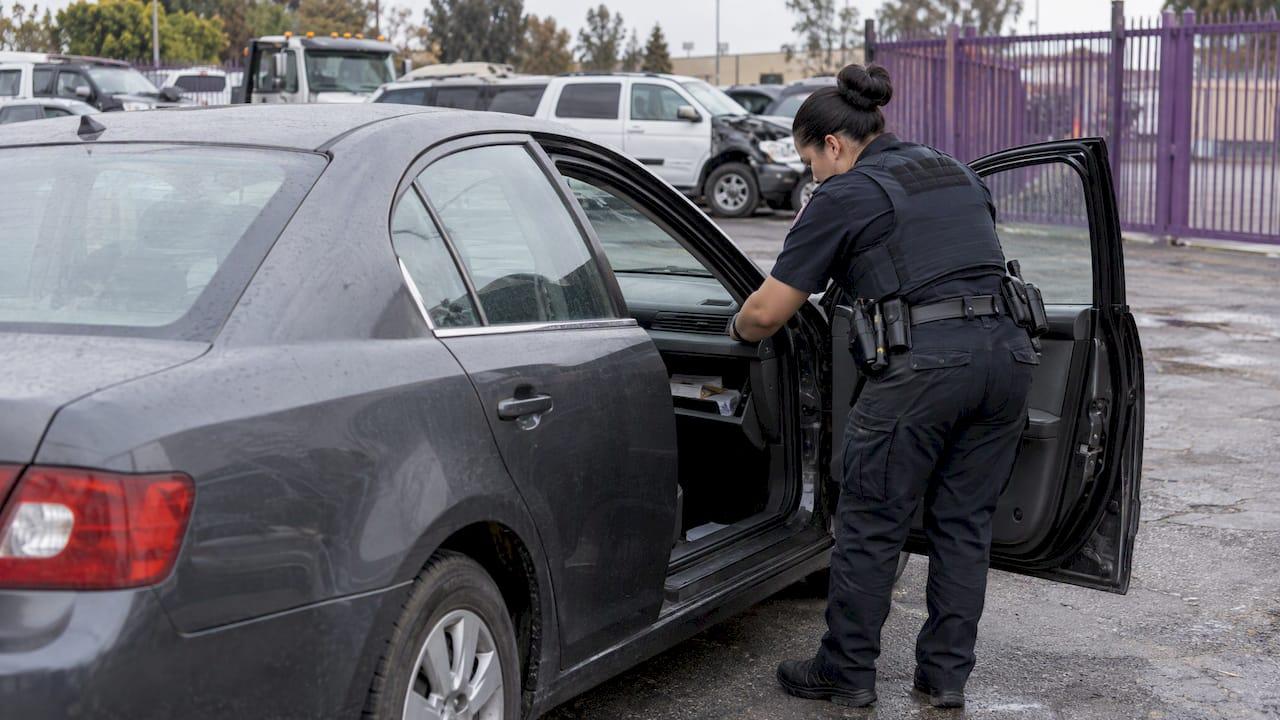
A California inventory search is a warrantless search of a vehicle that police have lawfully impounded. Officers say it exists to protect the car and its contents, not to find evidence. Because it needs no probable cause, the real fight is usually over two questions. Was the impound lawful? Did the officers follow a standard procedure? If either answer is no, the evidence found may be open to suppression.
This guide explains how inventory searches work, what limits apply, and what to do if drugs, a firearm or other evidence turned up in a search of your car after a tow.
TL;DR
- An inventory search is allowed when a car is in lawful police custody for a community caretaking reason, not because police suspect a crime.
- The impound itself must be justified. If it was a pretext to look for evidence, the inventory is unlawful.
- The search has to follow a standardized department procedure, and closed containers raise their own proof requirements.
- Evidence from an unlawful inventory can be challenged through a motion to suppress, and timing and wording matter.
- If you were charged after a tow and search, talk to a criminal defense attorney before you say anything more to police.
Table of Contents
- What an inventory search is
- When police can impound a car
- What officers may look at
- Lawful versus unlawful inventory: a quick comparison
- What if the search was unlawful?
- Where inventory searches show up in criminal cases
- Our perspective
- How Rubin Law can help
- FAQ
- Sources
What an inventory search is
When police take a car into custody, they list what is inside. California courts treat this as an established exception to the warrant requirement. In People v. Lee (2019), the court explained that when a vehicle is impounded or otherwise in lawful police custody, an officer may conduct a warrantless inventory aimed at securing or protecting the vehicle and its contents.
The reasoning is that the impound and the inventory rest on community caretaking rather than on criminal wrongdoing. That is why the search does not require probable cause. A more recent decision, People v. Hudson, repeats the point: courts describe the inventory as serving administrative caretaking functions, not investigatory ones.
In practice, this means an officer who could not have searched your car on the roadside may still end up with a full view of your glove box, backpack and console after a tow. That is where most disputes begin.
How it differs from a search for evidence
A search for evidence needs a warrant, consent, or a recognized exception such as probable cause. An inventory has none of those. It stands only on its caretaking purpose.
That purpose is also its weak point. Under Lee, a lawful inventory is not a ruse for general rummaging to discover incriminating evidence. If the impound was really a pretext for an investigatory search, the inventory is unlawful. The court discussed People v. Torres on this point: improper investigatory motivation can taint the impound and the inventory that follows, even though inventories are generally not based on probable cause.

When police can impound a car
The inventory is only as good as the impound behind it. Los Angeles County prosecutors summarized the rule in a 2026 One Minute Brief on inventory searches. A warrantless inventory is permitted when the vehicle is impounded or otherwise in lawful custody for a valid community caretaking function, not suspicion of criminal evidence. The brief gives examples of lawful impounds: the car is parked illegally, it blocks traffic or passage, or it is at risk of theft or vandalism.

The same brief notes that when a court evaluates an impound for inventory purposes, it looks at objective reasonableness and also at the officer's subjective intent. That second part matters for the defense. The officer's own words, report and body-camera footage can show whether the tow was about the car or about the search.
Common situations that lead to an inventory
- A traffic stop where the driver is arrested and no licensed driver can take the car.
- A DUI arrest, where the vehicle is towed from the roadside.
- A car left in a lane, a red zone or a private lot.
- A vehicle with an unlicensed or suspended driver.
- A car found after a collision where the driver is taken to a hospital.
Not every one of these produces a valid impound. Whether the tow was necessary, whether a passenger could have driven, and whether the car was truly in a hazardous spot are all fair questions for a defense lawyer to look at.
What officers may look at
A lawful inventory is not a free pass to open everything. It has to follow standardized departmental procedures or an established routine.
Standard procedure is required
The inventory has to be an administrative act, carried out the way the department does it every time. Lawful inventories are expected to serve administrative accounting and to protect against false claims and harm from dangerous items. As People v. Wallace frames it, when those justifications are absent or undocumented, courts view the inventory as vulnerable to suppression.
That is why reports matter. A thorough written inventory listing items and their location supports the caretaking story. A report that mentions only the one item that became the basis for charges invites questions.
Closed containers
Bags, boxes and backpacks are where the law gets specific. Under People v. Smith, which applies People v. Williams, the prosecution must prove a policy or practice governing the opening of closed containers. Showing a general inventory policy is not enough.
In other words, an officer saying "we always inventory" does not settle whether a zipped duffel could be opened. The prosecution needs the actual rule, and it needs to show it was followed.
What a real department policy looks like
The San Diego Police Department's vehicle towing, impound and release procedure is a representative example. It directs personnel ordering a tow to inventory all areas where valuables are likely to be stored, including containers within the vehicle. It also says that under normal circumstances locked compartments such as trunks do not need to be searched unless the officer has a key or there is an operable trunk release.
Policies differ by agency, so the rule that matters in your case is the one written by the agency that towed your car, whether that is the LAPD, the Sheriff's Department, the CHP or a city department. Getting that policy is part of building the challenge.
Lawful versus unlawful inventory: a quick comparison
| Question | Points toward a lawful inventory | Points toward an unlawful one |
|---|---|---|
| Why was the car towed? | Illegal parking, blocked traffic, theft risk | Tow appears aimed at searching |
| Who decided? | Officer applying a standard rule | Officer who had already suspected drugs or weapons |
| How was the search done? | Following the written policy, listing everything | Selective, focused on likely contraband |
| Closed containers | A policy on opening them, and it was followed | No proof of a policy for containers |
| Paperwork | Complete inventory list | Thin or missing report |
No single row decides a case. Courts look at the whole picture, which is why details from the stop, the report and the video are so valuable.
What if the search was unlawful?
If a court finds the impound or the inventory unlawful, the evidence found can be suppressed. Without that evidence, a possession, firearm or similar case may weaken a great deal, and in some cases it ends in dismissal or a reduced charge.
In California, this is usually raised by motion to suppress under Penal Code section 1538.5. Our guides explain the steps, including how to avoid waiving the issue and how to act quickly after an illegal search. For the bigger picture, see how evidence can be thrown out after an illegal search and seizure, and our overview of pre-trial motions in California.
What a defense attorney looks at
- The reason for the stop. If the stop itself was unlawful, everything after it may be affected.
- The reason for the impound. Was the tow necessary, or were there other options?
- The officer's statements. Reports, radio traffic and body-camera footage can show intent.
- The department policy. What did it require, and did the officers follow it?
- Closed containers. Did the prosecution have a policy for opening them?
- The inventory paperwork. Does it match what the officer says happened?
Steps to take right now
- Do not discuss the search or the contents of the car with police.
- Write down everything you remember: where you were stopped, why the car was towed, who was there, what was said.
- Note any cameras nearby, a passenger who can describe events, and the tow company used.
- Keep your citation, tow paperwork and booking documents.
- Avoid posting about the arrest online.
- Contact a criminal defense attorney promptly, since suppression motions have procedural rules and deadlines.
If evidence from a phone was involved, our phone search checklist covers a different set of rules, and our guide on preserving evidence after an unlawful search explains what to document.
Where inventory searches show up in criminal cases
Inventory searches tend to appear in a few kinds of cases:
- Drug charges. Narcotics found in a console or bag after a tow. See our guide to getting drug possession charges dropped in California.
- DUI and DUI of drugs. The arrest leads to a tow, and the tow leads to a search of the car.
- Firearm cases. A gun found during an inventory can lead to felon-in-possession or related charges.
- Warrant arrests. A person arrested on a warrant during a stop may have their car towed. Our page on bench and arrest warrant recall explains how to deal with an outstanding warrant.
- Federal investigations. Items found in a vehicle can feed into a federal case.
In each, the first question for a defense lawyer is whether the evidence can be kept out. If it can, the rest of the case changes.
Our perspective
Most people assume that once the car is towed, the search is simply routine. We do not accept that. An inventory search is an exception, and an exception only works when the police meet every part of it: a real reason to tow, a written policy, and a search that follows that policy.
At Rubin Law, we spend our time in Los Angeles County courtrooms, and we know how local judges and prosecutors present these cases. That helps us anticipate what the prosecution will say about why the car was impounded and how the inventory was done. We then test that story against the reports, the video and the department's own rules.
Our approach to search and seizure cases is constitutional challenge first. If the evidence can be suppressed, we say so in a motion and press it. Where a case calls for diversion or pre-file intervention, we pursue that too. Either way, you deal directly with your attorney and get a strategy built for your facts.
Jake
How Rubin Law can help
If police found something in your car after a tow, the way the search was done may decide your case. Rubin Law, P.C. defends clients in Los Angeles County facing drug crimes, DUI, violent crimes, federal charges and felon-in-possession cases, including constitutional search and seizure challenges and courtroom advocacy. We review the stop, the impound and the inventory, and then advise you on the options.
See our full list of criminal defense services or contact us through Rubin Law, P.C. to talk about your case. The sooner we see the paperwork, the more we can do.
FAQ
Do police need a warrant for an inventory search in California?
No. When a vehicle is lawfully impounded for a community caretaking reason, courts allow an inventory without a warrant or probable cause. The impound has to be valid, and the search has to follow standard procedure.
Can police open my bag or the trunk during an inventory?
It depends on the agency's policy and the proof. For closed containers, the prosecution must show a policy or practice covering their opening. One representative department policy says locked trunks generally need not be searched without a key or an operable release.
What if the tow was just an excuse to search my car?
Then the inventory may be unlawful. Courts look at whether the impound was a genuine caretaking act or a pretext to look for evidence. A defense attorney can examine the officer's reports and video to show which it was.
Can evidence from an unlawful inventory be thrown out?
Yes, it can be challenged by a motion to suppress. Where the justifications for an inventory are absent or undocumented, courts see the search as vulnerable. Whether it succeeds depends on your facts, so speak with a defense lawyer early.
Sources
- People v. Lee (2019), FindLaw
- People v. Hudson, F089136
- Los Angeles County District Attorney, One Minute Brief 2026-08 on inventory searches
- People v. Smith, 115 Cal. Rptr. 2d 483 (Cal. Ct. App. 2002)
- San Diego Police Department, Vehicle Towing/Impound and Release Procedures
- People v. Wallace, Alameda County District Attorney