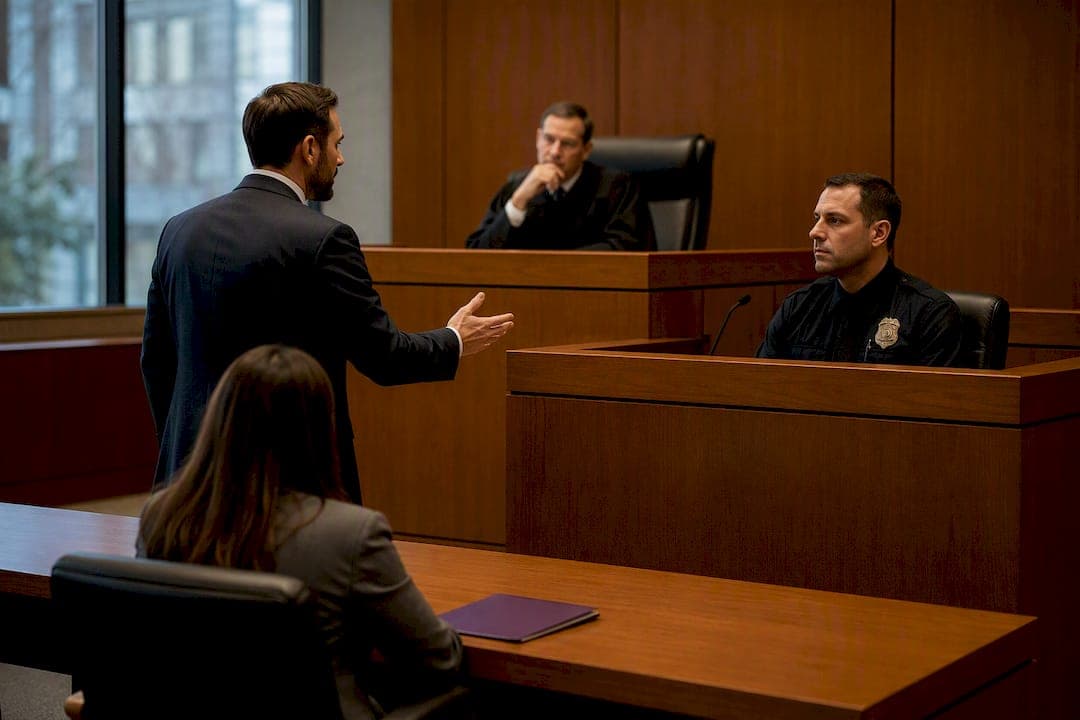
Under California Penal Code §1538.5, a defendant can ask a judge to suppress evidence obtained through an unlawful search or seizure. The hearing is decided by a judge alone, with deadlines that shift depending on whether the case is a misdemeanor or a felony. Win the motion, and prosecutors often lose their strongest evidence, which frequently forces a reduced charge or an outright dismissal.
TL;DR:
- Filing a suppression motion requires specific identification of the search or seizure, including detailed evidence and legal basis, to prevent procedural rejection.
- Warrantless searches are presumptively unreasonable unless justified by exceptions like consent, exigent circumstances, plain view, automobile exception, or search incident to arrest.
- Timing and procedural compliance are critical, with deadlines varying by case type and local court rules, as missing them results in waiver of suppression rights.
- Suppression hearings are judges-only proceedings that focus on officer testimony, records, and evidence, with the burden shifting depending on whether a warrant was involved.
- A strong factual record, including timestamps, footage, and inconsistencies, is essential to success, beyond just citing legal standards or exceptions.
Table of Contents
- What Does a Motion to Suppress California PC 1538.5 Actually Cover?
- What Legal Grounds Support Suppressing Evidence?
- When Do You Have to File the Motion to Suppress?
- What Happens at a California Suppression Hearing?
- What Must a §1538.5 Motion Include?
- How Do Prosecutors Fight a Suppression Motion?
- What Happens After the Judge Rules?
- Practical Drafting and Courtroom Tips from Rubin Law, P.C.
- Federal Court vs. California State Court: What Changes?
- How Does Suppression Affect Plea Negotiations?
- How Are California Suppression Rulings Evolving?
- Juvenile Suppression Motions: What's Different?
- What Actually Wins Suppression Motions
- How Rubin Law, P.C. Can Help With Your Suppression Motion
- Sources
What Does a Motion to Suppress California PC 1538.5 Actually Cover?
Penal Code §1538.5 does two things: it lets a defendant move to suppress evidence, and separately, it lets a defendant move for the return of property seized during a search. Both remedies flow from the same statute, and both require the same basic showing: the search or seizure violated the defendant's rights.
The statute reaches more than drugs found in a glove compartment or a gun found in a waistband. California Penal Code §1538.5 covers tangible evidence (physical objects, documents, cash) and intangible evidence (statements, observations, results of a blood draw). If police obtained it as a "result of a search or seizure," it is fair game for a suppression motion, provided a genuine constitutional problem exists.
Only the defendant, or someone with a recognized legal interest in the place or property searched, can file. That last part matters more than most people realize. A passenger in a car who owns nothing seized from the trunk may not have the legal standing to challenge that search, even if the search was clearly illegal. Standing is a separate question from legality, and prosecutors raise it constantly.
It helps to understand what §1538.5 is not. It doesn't create new constitutional protections. The Fourth Amendment already bars unreasonable searches and seizures; §1538.5 is the procedural vehicle California uses to enforce that protection in state court. Think of the Fourth Amendment as the right and §1538.5 as the specific California mechanism for exercising it. This distinction matters in practice, because courts will look first to whether a genuine constitutional violation occurred, then to whether §1538.5's procedural requirements were satisfied.
Two remedies also exist under the same statute. A motion "to suppress" asks the court to bar the prosecution from using the evidence at trial. A motion "for return of property" asks the court to physically give items back, which comes up often in drug cases where cash, phones, or vehicles were seized alongside contraband. You can request both in the same filing when it fits your facts, and many defense attorneys do exactly that when police held onto property well beyond what the investigation required.
None of this works as a generic objection. Courts expect the motion to identify precisely which search, which item, and which legal defect the defendant is challenging. A vague request rarely survives a hearing, no matter how obviously wrong the search felt to the person on the receiving end. That specificity requirement shapes almost everything that follows, from how the motion gets drafted to how the hearing gets argued.
Anyone facing a search that felt wrong from the start should read up on what actually counts as an illegal search in California before assuming the evidence is untouchable.
What Legal Grounds Support Suppressing Evidence?
Warrantless searches start out presumptively unreasonable. That single principle drives most of the litigation under §1538.5, because the burden of justifying the search generally falls on the prosecution once the defense shows there was no warrant. Prosecutors then have to fit the facts into one of several recognized exceptions, and defense attorneys spend most of their preparation time figuring out which exception the state will lean on and why it doesn't actually apply.
The recurring exceptions worth knowing:
- Consent — police claim the person voluntarily allowed the search, though consent obtained through intimidation, deception, or an authority figure's implicit pressure can be challenged as involuntary.
- Exigent circumstances — officers argue an emergency (fleeing suspect, destruction of evidence, safety threat) justified skipping the warrant.
- Plain view — an officer lawfully present in a location spots contraband without needing to search further.
- The automobile exception — vehicles get less Fourth Amendment protection than homes because of their mobility, letting officers search based on probable cause alone.
- Search incident to arrest — a lawful arrest permits a search of the person and the immediately surrounding area.
Warrant-based searches flip the burden. If police had a warrant, the defense generally has to show why the warrant itself was defective, whether that's a stale warrant based on outdated information, an overbroad description of the place to be searched, or an affidavit that didn't establish probable cause in the first place.
Sometimes the defect goes deeper than the document itself. A Franks challenge, named after Franks v. Delaware, lets a defendant attack the warrant affidavit directly by showing the officer who swore it out included false statements, or left out material facts, either knowingly or with reckless disregard for the truth. This is a higher bar than an ordinary suppression argument. Most §1538.5 motions never need to reach this level, since a Franks challenge requires a specific preliminary showing before the court will even hold a hearing on the affidavit's honesty, and practice guidance confirms that ordinary motions are procedurally simpler.
Standing questions run underneath all of this. Courts ask whether the person challenging the search had a reasonable expectation of privacy in the place or thing searched. Someone in their own bedroom clearly has that expectation. Someone standing near a stranger's car in a parking lot generally doesn't. This is why the same set of facts can produce a winning motion for one defendant and a losing one for a co-defendant charged in the same case.
Finally, there's the doctrine known informally as "fruit of the poisonous tree." If the initial search was illegal, evidence discovered because of that search, including confessions, additional physical evidence, or leads to witnesses, can also get excluded as derivative evidence. A single bad stop can end up costing the prosecution far more than the item found in that first search.
When Do You Have to File the Motion to Suppress?
Timing decisions in a §1538.5 motion carry real consequences, and missing a deadline can permanently forfeit the issue.
Felony defendants generally get two windows. The motion can be raised at the preliminary hearing, where the magistrate hears the suppression argument alongside the probable cause determination, or it can wait for a special hearing in superior court after the case is held to answer. Which path makes sense depends heavily on how strong your discovery is at each stage. Litigating early, at the preliminary hearing, forces the issue quickly but can lock you into an unfavorable record if you lose and haven't yet received full discovery. Waiting for a special hearing gives more time to gather body-camera footage, dispatch logs, and witness statements, though it means living with the evidence hanging over the case longer.
Misdemeanor cases don't get a preliminary hearing at all, so the suppression motion typically gets filed and litigated in the trial court itself, usually well before trial, under the same statute.
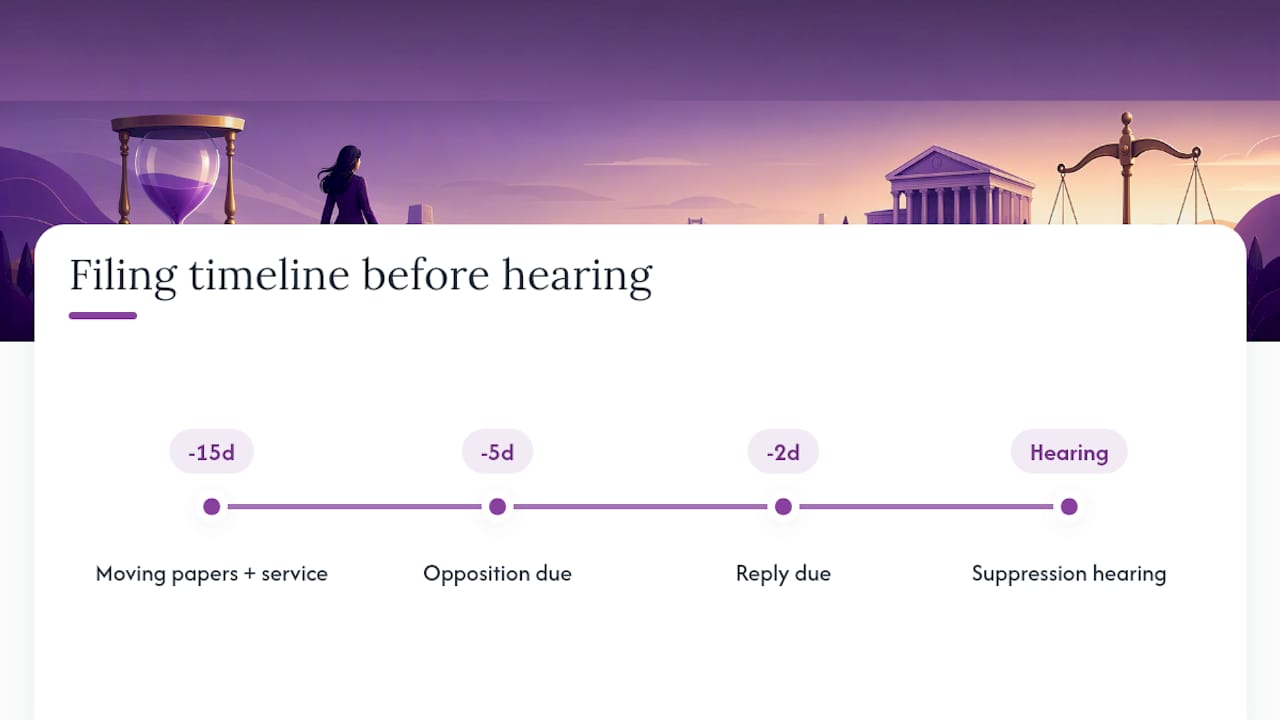
County local rules govern the actual paperwork deadlines, and they vary somewhat by court. A common pattern many counties follow, illustrated by San Diego Superior Court's local rules, sets moving papers at 15 court days before the hearing, opposition papers at five court days before, and any reply at two court days before. Proof of service has to be filed on time too, not just the motion itself. Miss the service deadline and a judge can refuse to hear the motion at all, regardless of how strong the underlying argument is.
Forfeiture is the real danger here. California courts treat the failure to raise a suppression issue at the proper stage as a waiver in most circumstances, with narrow exceptions for newly discovered evidence or a genuine change in the law. That means the tactical decision about when to file isn't just strategic. It can be the entire ballgame. Anyone facing custody decisions while these deadlines run should also understand how bail and release timing works in California, since custody status often affects how much time counsel actually has to prepare the motion. Reviewing how pretrial motions typically proceed in California cases gives useful context for planning around these windows.
What Happens at a California Suppression Hearing?
A suppression hearing has no jury. A judge alone decides whether the search or seizure passed constitutional muster, based on testimony, exhibits, and legal argument from both sides.
The prosecution typically calls the officers involved in the search, and this is where the case often turns. Officer testimony gets picked apart on cross-examination, particularly around the sequence of events: what the officer observed first, what justified the initial stop or entry, and whether the stated justification lines up with body-camera footage, dispatch recordings, or written reports. Inconsistencies between an officer's incident report and their live testimony can undercut the prosecution's entire theory of the search.
Who has to prove what depends on whether there was a warrant. In a warrantless search, the defense makes an initial showing that no warrant existed and that the search fell within the ambit of §1538.5, which then shifts the burden to the prosecution to prove the search fell within a recognized exception, according to analysis from LegalClarity's practice guide. In a warrant case, the burden generally sits with the defense to show the warrant itself was legally deficient, whether through a flawed affidavit, an overbroad scope, or a location mismatch between what was authorized and what officers actually searched.
Documentary evidence carries enormous weight in these hearings. Warrant affidavits get scrutinized line by line for the specific facts that supposedly established probable cause. Property inventory receipts can reveal whether officers seized items outside the warrant's scope. Body-camera footage, when it exists, is often the single most persuasive piece of evidence in the room, since it shows the actual encounter rather than a paraphrased police report written hours later.
Cross-examination strategy tends to focus on timeline gaps and unsupported conclusions. An officer who testifies that a driver's "furtive movement" justified extending a stop needs to explain, specifically, what that movement was and when they saw it. Vague, conclusory testimony is exactly what a well-prepared defense attorney is trained to expose, and it's often where these hearings are actually won or lost.
What Must a §1538.5 Motion Include?
A suppression motion that gets rejected on procedural grounds never even reaches the merits of the Fourth Amendment argument, which is why the drafting checklist matters as much as the legal theory itself.
- Notice of motion with specific items listed. Name each piece of evidence you want suppressed. Blanket language asking to suppress "all evidence obtained" invites a court to treat unlisted items as abandoned, a caution practitioners raise consistently in these filings.
- Memorandum of points and authorities. This is the actual legal argument. It should apply controlling Fourth Amendment case law and California precedent directly to your facts, not recite generic legal standards that could apply to any case. LegalClarity's guidance on sample motion language stresses this fact-specific approach as the difference between a persuasive brief and a forgettable one.
- Declarations and supporting attachments. Include the warrant, the supporting affidavit, property inventory sheets, and any other document that establishes the factual basis for your challenge.
- Proof of service. File it on time, separately from the motion. Courts treat a missing or late proof of service as a real procedural defect, not a technicality to wave away.
- Local rule compliance. Format, page limits, and filing deadlines vary by county. Check the specific superior court's local rules before filing, since a motion that would be timely in one county can be untimely in the next.
Attorneys who skip step one, and simply ask for broad suppression without naming items, often lose ground they didn't need to lose. Specificity forces the judge to rule on each item individually, which creates a clearer appellate record if the motion is denied and the case proceeds toward trial.
How Do Prosecutors Fight a Suppression Motion?
Prosecutors reach for a handful of doctrines almost every time a suppression motion lands on their desk.
The good-faith exception lets evidence stand if officers reasonably relied on a warrant later found defective, on the theory that punishing the prosecution for a judge's error in issuing the warrant doesn't serve the purpose of the exclusionary rule. Inevitable discovery argues the evidence would have been found through lawful means regardless of the illegal search, often raised when a routine inventory search or a parallel investigation was already underway. Independent source doctrine applies when police obtained the same evidence through a separate, lawful investigative path untainted by the initial illegality.
Beyond these three doctrines, prosecutors lean hard on the exceptions already covered, consent, plain view, and search incident to arrest, arguing the facts fit squarely within one of them. Expect the state to build its opposition around chain-of-custody documentation and corroborating witness testimony that backs up the officer's account of how the search unfolded. A well-prepared defense response anticipates exactly which of these doctrines the facts invite and gets ahead of it in the memorandum rather than waiting to respond at the hearing.
What Happens After the Judge Rules?
A granted motion excludes the evidence from trial, and depending on how central that evidence was to the case, it can lead directly to reduced charges, a dismissal, or significantly improved leverage in plea negotiations. In felony cases where a magistrate grants suppression at the preliminary hearing, the prosecution retains limited relitigation rights in superior court, a provision built directly into §1538.5's procedural framework.
A denied motion means the evidence stays in play, and the defense has to decide between litigating the case at trial with that evidence included or seeking appellate review. Because a mid-trial appeal usually isn't available, defendants in felony cases sometimes pursue a writ petition challenging the denial before trial begins, though appellate courts grant these sparingly and only where the ruling shows a clear legal error.
Preliminary hearing suppression rulings carry their own quirk. If a magistrate denies suppression at that stage, the defense generally isn't stuck with that ruling forever. Renewing the motion at a special hearing in superior court remains an option in many cases, which is part of why the timing decision discussed earlier carries so much strategic weight. Understanding how the preliminary hearing process fits into this sequence helps clarify why some defense teams deliberately hold their strongest suppression argument for the later stage.
Practical Drafting and Courtroom Tips from Rubin Law, P.C.
Boilerplate language is the fastest way to lose a suppression motion that should have won. Every search has its own timeline, its own officer statements, and its own gaps between what was claimed and what actually happened. A memorandum of points and authorities that walks through those specific facts, case by case, holds far more weight with a judge than one that recites the general legal standard and hopes the facts speak for themselves.
Discovery requests deserve real focus early. Body-camera footage, dispatch timestamps, and the warrant affidavit itself are usually the three items that make or break cross-examination. Timestamps in particular expose contradictions, an officer who claims a stop lasted "a few minutes" looks very different on the record when dispatch logs show twenty.
The choice between litigating at the preliminary hearing and pushing for a special hearing comes down to how strong your discovery already is. Strong body-camera footage and a clean witness list favor moving early. Thin discovery and an unresolved factual dispute favor waiting for the special hearing, where there's more time to build the record properly.
Pro Tip: List every suppressible item by name in your notice of motion, and file your proof of service the same day as the motion itself. Courts have rejected otherwise strong suppression arguments purely because service was late or the request was too broad, and that kind of procedural loss is entirely avoidable.
Federal Court vs. California State Court: What Changes?
Suppression practice in federal court runs on a different rulebook. Federal Rule of Criminal Procedure 41 and the accompanying case law govern warrant requirements and suppression motions, litigated under Federal Rule of Criminal Procedure 12, rather than California's §1538.5. The federal system generally requires suppression motions before trial with far less flexibility than California's preliminary hearing or special hearing structure allows.
One of the sharper differences involves the good-faith exception. Federal courts, following United States v. Leon, apply that exception fairly broadly. California courts also recognize it, but state judges applying §1538.5 sometimes scrutinize the underlying warrant affidavit more closely before letting good-faith reliance save an otherwise flawed search.
Timing flexibility is another real gap. California's two-track system, preliminary hearing versus special hearing, gives defendants a strategic choice that federal defendants simply don't have. Federal cases typically require the suppression motion to be filed by a single pretrial deadline set by the court, with far less room to hold the argument for a later stage if discovery is incomplete.
Federal judges also handle suppression hearings themselves, without the intermediate magistrate step that California felony cases go through at the preliminary hearing level. That structural difference changes how attorneys pace their strategy, particularly around when to reveal their strongest cross-examination material.
Anyone facing charges in both systems, which happens more often than people expect in drug and firearms cases, needs an attorney who understands both tracks rather than assuming state tactics transfer cleanly to federal court.
How Does Suppression Affect Plea Negotiations?
A pending suppression motion changes the leverage on both sides of the negotiating table before a judge ever rules on it. Prosecutors know a granted motion could gut their case, so a well-supported motion sometimes produces a better plea offer simply because the district attorney's office wants to avoid the risk of losing key evidence at the hearing.
Once the ruling comes down, the dynamic shifts fast. A grant of suppression often prompts an immediate reassessment from the prosecution, sometimes leading to a dismissal, sometimes to a dramatically reduced charge offered to avoid the embarrassment and expense of proceeding without their strongest evidence. A denial cuts the other way. Defendants who were holding out for trial sometimes reconsider a plea once the excluded evidence stays in the case, since the odds at trial just got noticeably worse.
Timing the motion relative to plea discussions is itself a strategic call. Some defense attorneys file and litigate the suppression motion early specifically to see how the prosecution reacts, using the ruling as a pressure point in negotiations. Others hold off if they believe going to trial with weakened evidence, after a partial suppression win, gives their client the best shot at an acquittal or a favorable jury outcome. Programs like drug diversion under Proposition 36 sometimes become realistic options specifically because a suppression motion weakened the prosecution's leverage enough to make diversion attractive to both sides.
How Are California Suppression Rulings Evolving?
California courts and the legislature continue refining how §1538.5 gets applied, particularly around digital evidence and vehicle searches, two areas where technology has outpaced older case law built around physical searches of homes and cars.
Cell phone search cases keep generating litigation because so much of modern investigative work runs through phone data, location history, and messaging records. Courts have increasingly required specific warrants for phone content rather than treating a phone like any other object found during an arrest, reflecting the reality that a phone holds far more private information than a wallet or a bag ever could.
Vehicle search litigation has also evolved as courts weigh the automobile exception against genuine privacy interests in locked containers or areas of a car not obviously connected to the reason for the stop. The automobile exception remains broad, but it isn't limitless, and recent rulings have pushed back on searches that stretched the exception past its original justification.
Legislative attention to police accountability, including body-camera mandates and disclosure requirements, has also changed what evidence is actually available for defense attorneys to use at a suppression hearing. Where footage exists, it often becomes the deciding factor in whether a motion succeeds, since it removes the guesswork from competing accounts of what happened during a stop. Defense attorneys who track these developments closely tend to build stronger motions than those relying on older case law that predates the current evidentiary landscape.
Juvenile Suppression Motions: What's Different?
Juvenile cases in California run through a separate delinquency system, but the underlying constitutional protections against unlawful searches still apply, and §1538.5 principles carry over in substance even though the procedural label sometimes differs in juvenile court filings.
The biggest practical difference is the setting. There's no preliminary hearing in juvenile delinquency proceedings, so suppression issues generally get litigated directly before the juvenile court judge handling the case, closer in structure to how misdemeanor suppression motions work in adult court.
Consent and voluntariness questions carry extra weight in juvenile cases. Courts weigh a minor's age, maturity, and the coercive dynamic of being questioned by an adult authority figure more heavily than they would for an adult in the same situation. A consent search that might hold up against an adult defendant can look very different when the person who "consented" was a fifteen-year-old alone with an officer.
School searches add another layer entirely. Searches conducted by school officials operate under a lower standard, reasonable suspicion rather than probable cause, following the U.S. Supreme Court's framework for school settings. That means evidence found by a school administrator sometimes survives a suppression challenge that would have succeeded against a police search under identical facts. Anyone handling a juvenile drug case in particular should look closely at how juvenile drug crime defense intersects with these search standards, since so many juvenile suppression issues arise from school-based searches rather than street encounters.
What Actually Wins Suppression Motions
Most articles on this topic treat §1538.5 like a form to fill out. It isn't. The statute gives you the procedural door, but what actually wins a hearing is the quality of the factual argument behind it, built from specific timestamps, specific footage, and specific inconsistencies in an officer's account.
The conventional advice, cite the right exception, file on time, tends to stop short of what separates a granted motion from a denied one. Judges see dozens of suppression motions built on the same generic legal standards. The ones that succeed are the ones where defense counsel found the actual gap between what an officer swore to and what the record shows.
If you're facing a search you believe was illegal, the priority isn't researching every exception in the abstract. It's getting discovery moving immediately, body-camera footage, dispatch logs, the warrant affidavit, before memories and video retention windows work against you. The legal theory matters, but it's only as strong as the facts you can actually put in front of the judge.
— Jake
How Rubin Law, P.C. Can Help With Your Suppression Motion
Filing a §1538.5 motion without knowing which local rules apply, or without a memorandum built around the specific facts of your search, is how strong cases get lost on procedure. Rubin Law, P.C. handles suppression motions from drafting through the hearing itself, including negotiating diversion or reduced charges when a motion creates real leverage against the prosecution.
Experienced attorneys spend regular time in Los Angeles County courtrooms, developing insight on how individual judges tend to rule on consent and search-incident-to-arrest arguments before hearings. That familiarity shapes how a motion gets written and how cross-examination gets planned. Whether your case involves a vehicle stop, a home search, or evidence tied to a drug possession charge, the same principle applies: the motion needs to be built around your specific facts, not a template.
Review the firm's criminal defense practice areas to see the full range of cases where suppression motions come into play, or reach out directly for a consultation if you're facing charges tied to a search you believe violated your rights. Time matters here, since filing deadlines start running quickly after arraignment.
This article is general information, not a substitute for advice from a qualified lawyer. Consult a qualified legal professional about your own circumstances before acting on anything here.
Sources
- California Penal Code §1538.5 (leginfo)
- California Penal Code 1538.5: Motion to Suppress - LegalClarity