
A California preliminary hearing is a probable-cause screening held exclusively for felony cases, where a judge decides whether enough evidence exists to send the case to trial. If the judge finds probable cause, you are "held to answer," the prosecution files a document called an Information, and the case moves to Superior Court for arraignment and trial preparation. If the judge finds no probable cause, the charges can be dismissed. This single hearing can reshape your entire case.
Here is what you need to know before you walk into that courtroom:
- Felony cases only. Preliminary hearings apply exclusively to felony cases in California; misdemeanors follow a different path entirely.
- The governing statute is Penal Code §859b, which requires the hearing within 10 court days of arraignment for in-custody defendants unless time is waived.
- Proposition 115 (Penal Code §872) allows qualified law enforcement officers to relay certain victim and witness statements at the hearing, which lowers the prosecution's immediate evidentiary burden.
- Two possible outcomes: held to answer (case continues) or dismissal (charges dropped, though the prosecution may refile).
Table of Contents
- What happens at a California preliminary hearing, step by step?
- What is the legal standard at a preliminary hearing?
- What are the timing rules and deadlines for a California preliminary hearing?
- What rights does a defendant have at the preliminary hearing?
- Should you waive the preliminary hearing?
- What are the possible outcomes at a preliminary hearing?
- How do defense attorneys prepare for a preliminary hearing?
- What happens after the preliminary hearing?
- Do misdemeanors have preliminary hearings in California?
- How does the preliminary hearing fit into the overall criminal timeline?
- What does the prosecution do at a preliminary hearing?
- What are your rights if you have a public defender or no attorney?
- Key Takeaways
- Why the preliminary hearing deserves more attention than most defendants give it
- Facing a felony charge in Los Angeles? Rubin Law, P.C. is ready to help
- Authoritative sources and further reading
What happens at a California preliminary hearing, step by step?
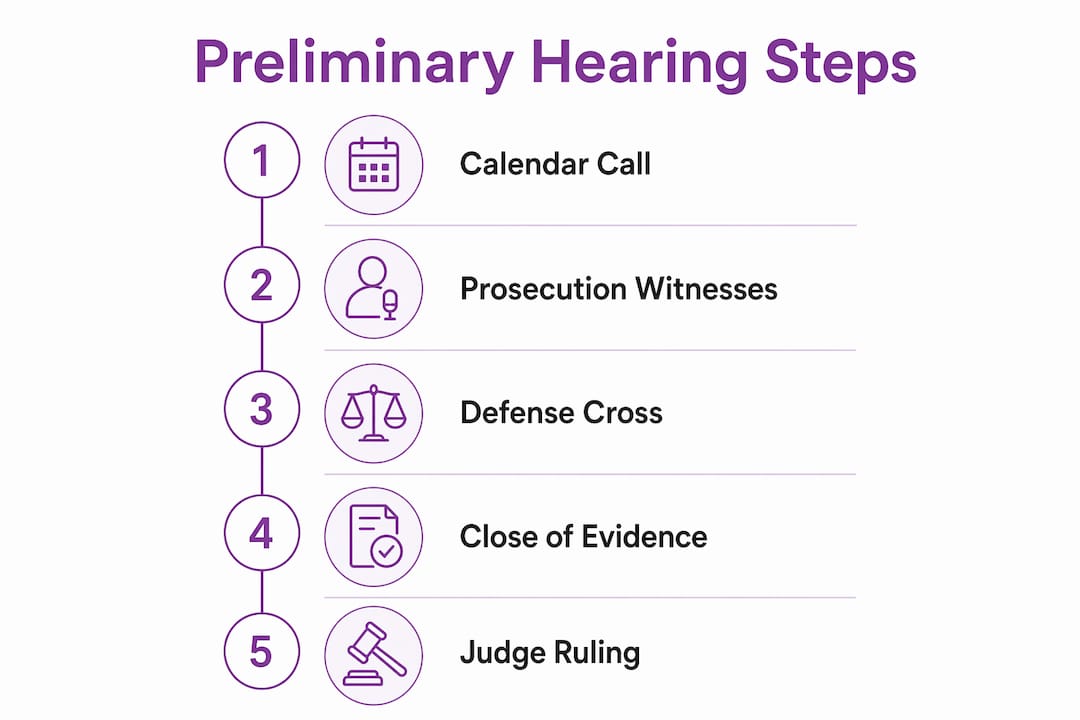
The hearing opens with a calendar call. The clerk calls the case, the attorneys identify themselves on the record, and the judge confirms whether the defendant is waiving or asserting time under Penal Code §859b. That procedural moment matters more than it sounds — a waiver of time changes your deadlines significantly.
Once the case is called, the prosecution goes first. The deputy district attorney calls witnesses, almost always a law enforcement officer, who walks through the facts of the arrest and the evidence. Under Proposition 115, that officer can relay out-of-court statements from victims or other witnesses, so the prosecution rarely needs to put the actual victim on the stand at this stage. That is a deliberate feature of California law, not a loophole.
After direct examination, the defense attorney cross-examines the prosecution's witnesses. This is the most strategically valuable part of the hearing for the defense. Defendants rarely call their own witnesses at a prelim, and most hearings run anywhere from 30 minutes to two hours depending on the complexity of the charges and how aggressively the defense cross-examines.

At the close of evidence, the judge rules. There is no jury. The judge either finds probable cause and holds the defendant to answer, or finds insufficient evidence and dismisses some or all charges. Whatever testimony was given is now on the record — and that transcript follows the case all the way to trial.
Pro Tip: The preliminary hearing transcript is a discovery tool. If a prosecution witness says something at the prelim that contradicts their trial testimony, your attorney can use that prior statement to impeach them in front of the jury. That alone is often reason enough not to waive the hearing.
What is the legal standard at a preliminary hearing?
The standard at a preliminary hearing is probable cause, which is a far lower bar than the "beyond a reasonable doubt" standard required for a conviction at trial. Under Penal Code §872, the judge must find only that there is a reasonable probability the defendant committed the charged offense. The prosecution does not need to prove guilt; it needs to show enough to justify putting the defendant through a trial.
The probable cause standard is intentionally low. The preliminary hearing is not designed to test whether the prosecution can win at trial — it is designed to screen out cases where the evidence is so thin that proceeding to trial would be unjust. A judge finding probable cause says nothing about guilt.
That low threshold explains why most preliminary hearings end with the defendant being held to answer. The prosecution must show probable cause, not proof beyond a reasonable doubt, so even a modestly supported case typically clears the bar. Dismissals happen, but they require either a genuinely weak factual record or a defense attorney who successfully impeaches the prosecution's key witness on cross-examination.
The practical consequence: do not assume a "held to answer" ruling means the case is over. It means the case moves forward. The real fight is at trial, and the preliminary hearing is where defense counsel begins building the ammunition for it.
What are the timing rules and deadlines for a California preliminary hearing?
Penal Code §859b sets the core rule: for an in-custody defendant, the preliminary hearing must be held within a short statutory period after arraignment unless the defendant waives time. If the court fails to meet that deadline without a valid waiver or continuance, the remedy for an in-custody defendant is release from custody.
| Event | Deadline | Notes |
|---|---|---|
| Arraignment | — | Clock starts here |
| Preliminary hearing (in custody) | Within 10 court days | Penal Code §859b; release remedy if violated |
| Preliminary hearing (out of custody) | Within 60 calendar days | Broader window; waiver mechanics still apply |
| Trial after Information filed | Within a statutorily defined period after Information; defendant may waive the deadline |
Courts do grant continuances. Common reasons include unavailability of a key witness, ongoing discovery, or negotiations between counsel. When the defense requests a continuance, it typically requires waiving time for the period of the extension. When the prosecution requests one, the rules are stricter, and an in-custody defendant who does not consent to a prosecution-requested continuance has stronger grounds to demand release if the deadline passes.
Here is what drives most continuance decisions in practice:
- Witness availability: If the arresting officer is on leave or unavailable, the prosecution will seek more time.
- Discovery disputes: Incomplete police reports, missing bodycam footage, or pending lab results often push the hearing date.
- Plea negotiations: Both sides sometimes agree to continue the prelim while working toward a resolution.
- Defense preparation: Newly retained private counsel frequently needs additional time to review the file.
Pro Tip: A limited time waiver — agreeing to continue the prelim to a specific date rather than waiving time indefinitely — protects your rights while giving counsel the preparation time they need. Never sign an open-ended time waiver without understanding exactly what you are giving up.
What rights does a defendant have at the preliminary hearing?
You have the right to be represented by an attorney at every stage of a California preliminary hearing. If you cannot afford private counsel, the court will appoint a public defender at or before the hearing. The right to counsel attaches early in the California criminal process, and no preliminary hearing should proceed without an attorney present for the defense.
Beyond counsel, your rights at the prelim include:
- Right to cross-examine prosecution witnesses. This is constitutionally guaranteed and strategically critical. Cross-examination lets the defense test witness credibility, expose inconsistencies, and lock in testimony before trial.
- Right to present your own witnesses and evidence, though in practice the defense rarely does so at this stage.
- Right to remain silent. You are not required to testify at the preliminary hearing, and in most cases your attorney will advise against it. Anything you say becomes part of the record and can be used against you at trial.
- Right to be present throughout the hearing.
Pro Tip: Cross-examination at the prelim is not just about winning the hearing. A skilled attorney uses it to pin down the prosecution's witnesses on the details of their story, creating a record that can be used for impeachment at trial if their account shifts. Preliminary testimony is part of the record for future credibility challenges.
Should you waive the preliminary hearing?
Waiving the preliminary hearing means giving up the probable-cause screening entirely. The case moves forward by information or indictment without the judge ever testing the prosecution's evidence at that stage. It is a significant decision, and the right answer depends entirely on the facts of your case.
Reasons defendants sometimes waive:
- The evidence against them is strong and the prelim is unlikely to produce a dismissal.
- They are in custody and want to move toward a plea resolution faster.
- The defense does not want to give the prosecution a preview of its cross-examination strategy.
- A plea deal is already on the table and the prelim would only delay resolution.
Reasons to think carefully before waiving:
- You lose the chance to test the prosecution's witnesses before trial.
- You lose the discovery value of locked-in testimony.
- You lose any chance of an early dismissal for insufficient evidence.
- Weak witnesses who might have crumbled under cross-examination never get tested.
The decision checklist defense counsel works through: How strong is the physical evidence? Are the prosecution's witnesses credible and consistent? Is a plea deal realistic, and on what terms? Is the defendant in custody, and does the timing of the hearing affect bail? The answers to those questions, not a general rule, drive the waiver decision.
Pro Tip: Waiving the prelim as part of a plea negotiation can make sense. Waiving it simply to speed things up, without a concrete benefit in return, rarely does. Make sure there is a specific, tangible reason before you sign.
What are the possible outcomes at a preliminary hearing?
The judge has several options at the close of a California preliminary hearing, and each one sets a different path for the case.
- Held to answer. The judge finds probable cause on all charges. The prosecution files an Information in Superior Court, and the defendant is arraigned again on those charges. This is the most common outcome given the low probable-cause threshold.
- Partial dismissal. The judge finds probable cause on some charges but not others. The Information can only include the charges the judge approved. This can meaningfully narrow the case before trial.
- Full dismissal. The judge finds no probable cause on any charge. The case is dismissed at that stage. The prosecution is not necessarily finished, however — they can refile charges if new evidence emerges, or take the case to a grand jury for an indictment.
- Negotiated plea. Prelims frequently produce plea deals. A weak or impeached witness can shift the prosecution's assessment of the case and lead to a better offer, even if the judge ultimately finds probable cause.
Custody and bail status can also shift after the hearing. A judge who finds the evidence thin may be receptive to a bail reduction motion. A defendant who was held on high bail may have new grounds to argue for release or modified conditions after the hearing record is established.
How do defense attorneys prepare for a preliminary hearing?
Preparation for a prelim starts the moment the defense attorney receives the police reports and initial discovery. The goal is to know the prosecution's case at least as well as the prosecutor does before anyone walks into the courtroom.
| Preparation Task | Purpose |
|---|---|
| Review police reports and arrest records | Identify factual inconsistencies and gaps |
| Obtain and review bodycam and dashcam footage | Catch officer conduct issues and contradictions |
| — | Compare caller statements to officer testimony |
| Research officer's prior testimony and complaints | Build impeachment material for cross-examination |
| Identify defense witnesses (if any) | Determine whether presenting defense evidence helps or hurts |
| Draft cross-examination outlines | Prepare targeted, controlled questions for each prosecution witness |
| Evaluate plea posture | Assess whether the prelim should proceed or be waived |
For clients, preparation means gathering anything that supports your account: alibi information, names and contact details of potential witnesses, any communications relevant to the incident, and documentation of your whereabouts. Bring everything to your attorney before the hearing, not after.
Pro Tip: Bodycam footage is often the most valuable piece of evidence at a preliminary hearing. Request it early through discovery. Officers sometimes testify to a version of events that the footage contradicts, and catching that contradiction at the prelim locks it in for trial.
What happens after the preliminary hearing?
If you are held to answer, the prosecution files an Information in Superior Court within a short window. You are then arraigned on the Information, at which point you enter a formal plea. From there, the case enters the pretrial phase: motions, continued discovery, and plea negotiations. Under Penal Code §1382, trial must generally begin within 60 days of the Information being filed, though defendants can and often do waive that deadline.
If the charges are dismissed, the case does not necessarily end. The prosecution can refile if new evidence surfaces, or present the case to a grand jury for an indictment. Your attorney will monitor for any refiling activity and advise on next steps.
Bail and custody status are worth addressing immediately after the hearing. A partial dismissal or a hearing that exposed weaknesses in the prosecution's case can support a motion to reduce bail or modify release conditions. Do not leave the courthouse without asking your attorney whether the hearing outcome changes your custody situation.
Do misdemeanors have preliminary hearings in California?
No. Preliminary hearings in California are a felony-only procedure. If you are charged with a misdemeanor, your case proceeds through arraignment, pretrial conferences, and potentially trial, but there is no probable-cause screening hearing in between.
The distinction matters practically. Felony defendants get the preliminary hearing as a constitutional and statutory checkpoint — a moment where a neutral judge reviews the prosecution's evidence before the case can proceed to trial. Misdemeanor defendants do not have that procedural protection. If you are unsure whether your charges are felonies or misdemeanors, the difference between felony and misdemeanor charges in California has direct consequences for your rights and the process you will face.
Wobblers — charges that can be filed as either a felony or a misdemeanor depending on the facts and the prosecutor's discretion — are an important exception to keep in mind. If the prosecution files a wobbler as a felony, you get a preliminary hearing. If they file it as a misdemeanor, you do not.
How does the preliminary hearing fit into the overall criminal timeline?
The preliminary hearing is not the end of anything. It is a checkpoint roughly in the middle of the California felony process, and understanding where it sits helps you plan.
Before the prelim: arrest, booking, arraignment in the lower court, bail determination, and initial discovery exchange. The 10-court-day clock under Penal Code §859b starts at arraignment for in-custody defendants.
After the prelim (if held to answer): Information filed in Superior Court, Superior Court arraignment, pretrial motions (including suppression motions under Penal Code §1538.5), continued plea negotiations, and eventually trial. The 60-day trial clock under Penal Code §1382 starts running from the Information. Defendants frequently waive that deadline to allow more time for preparation or negotiations, but waiving it is a strategic choice that should be made deliberately with counsel.
The preliminary hearing also affects plea leverage throughout the timeline. A strong cross-examination that exposes a shaky witness can push the prosecution toward a better offer even months later, because both sides now know what that witness looks like under pressure. The hearing's value extends well beyond the day it happens.
What does the prosecution do at a preliminary hearing?
The prosecutor's job at the preliminary hearing is to present enough evidence to satisfy the probable-cause standard, nothing more. They are not trying to win a conviction; they are trying to clear a threshold. That distinction shapes how they approach the hearing.
In practice, the prosecution typically calls one or two law enforcement officers and walks them through the facts of the case. Under Proposition 115, those officers can relay victim and witness statements without those individuals appearing in court, which means the prosecution can often build a sufficient probable-cause record without exposing its most important witnesses to cross-examination.
The prosecution also has disclosure obligations at this stage. They must provide the defense with the police reports, witness lists, and any exculpatory evidence they possess. Failure to disclose exculpatory material at or before the prelim can have consequences for the case later. If the prosecution seeks a continuance, they must show good cause, and an in-custody defendant who objects has procedural leverage.
What are your rights if you have a public defender or no attorney?
If you cannot afford a private attorney, the court will appoint a public defender. That appointment happens at or before your arraignment, and the public defender has the same rights and obligations as any other defense attorney at the preliminary hearing. You are entitled to meaningful representation, not just a warm body at the counsel table.
If you appear at a preliminary hearing without any attorney, the judge will typically pause the proceedings and either appoint a public defender or give you time to retain private counsel. Courts are reluctant to proceed with a felony preliminary hearing against an unrepresented defendant because the constitutional right to counsel is well established at this stage.
A few practical points if you are working with a public defender:
- Request a meeting before the hearing date to go over the police reports and discuss strategy.
- Ask specifically whether the attorney plans to cross-examine the prosecution's witnesses and on what points.
- Ask whether the attorney recommends waiving or asserting time, and why.
- If you believe your public defender is not adequately prepared, you can ask the court for a Marsden hearing to request substitute counsel.
Key Takeaways
A California preliminary hearing is a felony-only probable-cause screening that can narrow, redirect, or end a case before trial, and the 10-court-day deadline under Penal Code §859b makes timing one of the most consequential early decisions in any felony case.
| Point | Details |
|---|---|
| Felony-only procedure | Preliminary hearings do not apply to misdemeanors; only felony charges trigger this screening. |
| 10-court-day rule | In-custody defendants must have their hearing within 10 court days of arraignment under Penal Code §859b, or release may be required. |
| Proposition 115 hearsay | Officers can relay victim and witness statements at the prelim, so cross-examination of the officer is often the defense's primary tool. |
| Waiver is a strategic choice | Waiving the prelim speeds the process but eliminates early discovery value and the chance to test prosecution witnesses before trial. |
| Rubinlawpc | Rubin Law, P.C. handles preliminary hearing preparation and representation for felony defendants in Los Angeles, including discovery review, cross-examination strategy, and motion practice. |
Why the preliminary hearing deserves more attention than most defendants give it
Most people facing felony charges treat the preliminary hearing as a formality — something to get through on the way to the "real" fight. That framing costs defendants more than they realize.
The preliminary hearing is the only moment in the California criminal process where you get to see the prosecution's witnesses perform under oath before trial. The probable-cause standard is low, yes, and most defendants are held to answer. But "held to answer" is not the same as "nothing useful happened." A cross-examination that catches an officer contradicting their own report, or a victim whose timeline does not hold up under questioning, does two things simultaneously: it creates impeachment material for trial, and it changes the prosecution's internal calculation about how strong their case actually is.
Prosecutors know what their witnesses look like on the stand. If a key witness folds under cross-examination at the prelim, the offer that follows is often better than anything on the table before the hearing. That leverage is only available if you go forward with the hearing rather than waiving it.
The other underappreciated piece is Proposition 115. Because officers can relay hearsay at prelims, defense attorneys sometimes assume there is nothing to cross-examine. That is wrong. The officer's account of what the victim or witness said is still subject to scrutiny — on the details, the sequence, the officer's own conduct, and the consistency between the report and the testimony. Those details matter at trial even when they do not produce a dismissal at the prelim.
The preliminary hearing is not a formality. It is the first real look at the prosecution's case, and experienced defense counsel treats it that way.
Facing a felony charge in Los Angeles? Rubin Law, P.C. is ready to help
When a preliminary hearing is coming up, the preparation window is short and the stakes are real. Rubin Law, P.C. represents felony defendants in Los Angeles at every stage of the California criminal process, from the first arraignment through the preliminary hearing, pretrial motions, and trial. The firm's approach to prelims is built around thorough discovery review, targeted cross-examination of prosecution witnesses, and a clear-eyed assessment of whether to proceed or negotiate.
Whether you are facing drug charges, domestic violence allegations, weapons offenses, or violent crime charges, the preliminary hearing is where defense strategy takes shape. Rubin Law, P.C. reviews police reports, bodycam footage, and witness statements before the hearing date, and prepares cross-examination outlines designed to expose weaknesses the prosecution would rather keep hidden. For clients in custody, the firm also addresses bail and the 10-court-day deadline immediately.
To speak with a criminal defense attorney in Los Angeles about your preliminary hearing, contact Rubin Law, P.C. for a consultation. Bring whatever documents you have, including any paperwork from your arraignment, and be ready to walk through the facts of your case.
This article is general legal information, not legal advice for your specific situation. Consult a qualified California criminal defense attorney to understand how these rules apply to your case.
Authoritative sources and further reading
The following primary sources and practitioner references were used to build this article. They are the best places to verify the rules described here.
Statutes:
- California Penal Code §859b — the 10-court-day rule for in-custody defendants and waiver mechanics
- California Penal Code §872 — probable-cause standard and Proposition 115 hearsay rules at preliminary hearings
Court self-help resources:
- California Courts Self-Help Guide: Pretrial Activities — plain-language overview of the preliminary hearing process, the Information, and Superior Court arraignment
Practitioner references:
- California Judges Benchguide 92: Preliminary Hearings — the procedural checklist judges use for prehearing conferences, continuances, and waivers; the authoritative source for courtroom mechanics
- FindLaw: Preliminary Hearing — practitioner-level explanation of the held-to-answer process, discovery value, and downstream procedural steps
- Nolo: Preliminary Hearing vs. Trial — accessible explanation of the probable-cause standard and the strategic value of cross-examination
- California Penal Codes reference — statutory index for related California criminal laws