
California Penal Code 273.5 makes it a crime to willfully inflict corporal injury on a spouse, cohabitant, fiancé, or the parent of your child, resulting in a traumatic condition. This is not a charge reserved for severe beatings. A bruise, a scratch, or any visible physical injury can satisfy the statutory threshold. The law is a wobbler offense, meaning the prosecutor decides whether to file it as a misdemeanor or a felony based on the facts. Here is what the statute actually covers:
- Who it applies to: Current or former spouses, cohabitants, fiancés, and anyone who shares a child with the defendant
- What must be proven: Willful act, corporal injury, and a resulting traumatic condition, all three beyond a reasonable doubt
- Wobbler status: Filed as a misdemeanor or felony at prosecutorial discretion
- Base penalties: Up to one year in county jail (misdemeanor) or 2, 3, or 4 years in state prison (felony)
- Repeat offender exposure: Prior convictions within seven years push the felony range to 2, 4, or 5 years and fines up to $10,000
- Societal weight: California treats this charge seriously, with mandatory arrest policies, protective orders, and batterer intervention programs built into the system
What does PC 273.5 California actually say?
The statute text controls everything. Prosecutors, defense attorneys, and judges all work from the same language, so reading it directly removes ambiguity.
| Subdivision | Key Language |
|---|---|
| (a) | Any person who willfully inflicts corporal injury resulting in a traumatic condition upon a victim described in subdivision (b) is guilty of a felony |
| (b) | Qualifying victims: spouse, former spouse, cohabitant, former cohabitant, fiancé, former fiancé, or parent of defendant's child |
| (c) | Traumatic condition defined as a wound or external or internal injury, including, but not limited to, injury as a result of strangulation or suffocation, whether of a minor or serious nature, caused by a physical force |
| (d) | Strangulation or suffocation defined as impeding normal breathing or circulation of blood by applying pressure on the throat or neck, or by blocking the nose or mouth |
| (e) | Cohabitants defined as two unrelated persons living together for a substantial period of time, considering frequency of contact, sharing of duties, intermingling of finances, and length of relationship |
| (f) | Misdemeanor option: up to one year county jail and/or fine up to $6,000 |
| (g) | Felony sentencing: 2, 3, or 4 years state prison |
| (h) | Enhanced penalties for prior convictions within seven years under PC 273.5, PC 243(e)(1), or comparable statutes |
| (i) | Probation conditions including batterer intervention, restitution, protective orders, and minimum 36-month supervision |
| (j) | Mandatory minimum jail time of 15 days for one prior conviction, 60 days for two or more prior convictions |
| (k) | Court may issue criminal protective order upon conviction |
How the law defines "traumatic condition" and qualifying relationships
Traumatic condition is broader than most people expect. The statute covers any wound or external or internal injury caused by physical force, including minor injuries like bruises or scratches. Critically, victim pain alone without a visible or documented injury does not satisfy this element, as established in People v. Abrego. That distinction has real consequences at trial.
Willfully does not mean the defendant intended to injure the victim. PC 273.5 is a general intent crime, so the prosecution only needs to prove the defendant intended the act that caused the injury, not that they meant to cause harm.
Qualifying relationships under the statute include:
- Current or former spouses
- Current or former cohabitants (people who lived together as a couple for a substantial period)
- Current or former fiancés or fiancées
- Any person with whom the defendant has a child
Cohabitant gets its own definition in the statute. Courts look at how frequently the parties had contact, whether they shared household duties, whether finances were intermingled, and how long the relationship lasted. A roommate arrangement without a romantic or domestic partnership component typically does not qualify.
Pro Tip: If you are facing a PC 273.5 charge and the alleged injury was never photographed, documented by medical personnel, or observed by law enforcement, the traumatic condition element may be challengeable. Document everything about the incident from your own perspective immediately.

What are the penalties under PC 273.5?
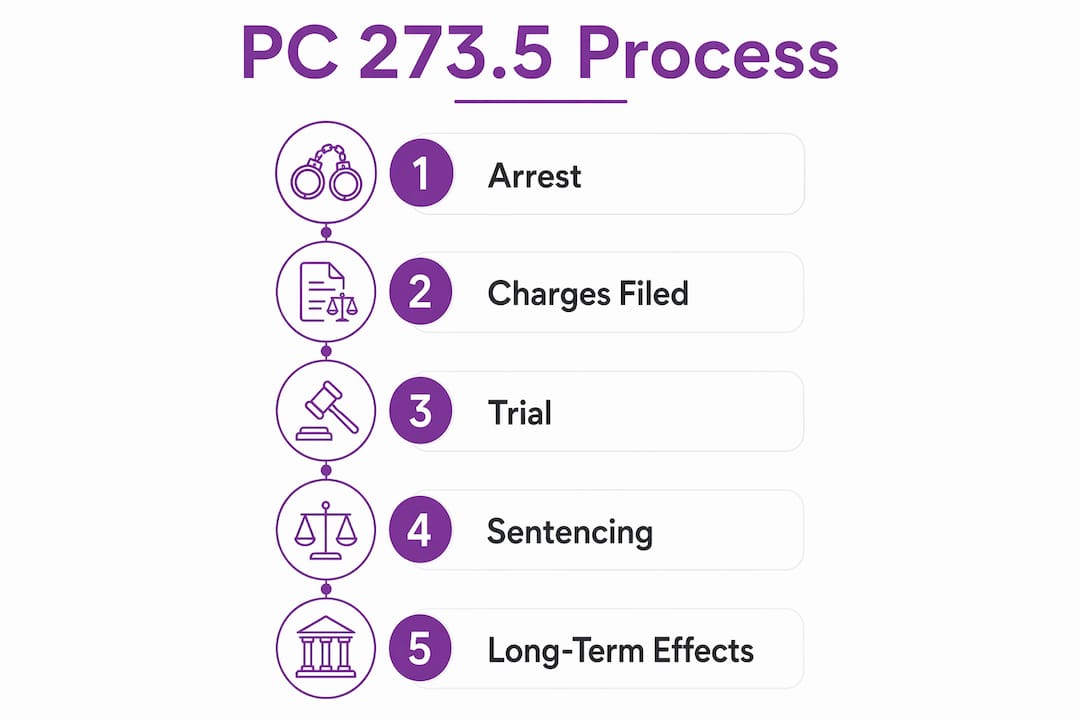
Sentencing under this statute depends heavily on prior history and how the prosecutor charges the case.
Misdemeanor conviction:
- Up to one year in county jail
- Fine up to $6,000
- Summary probation possible
Felony conviction (no prior qualifying convictions):
- 2, 3, or 4 years in state prison
- Fine up to $6,000
- Formal probation with mandatory conditions
Felony conviction with prior qualifying conviction within seven years:
- 2, 4, or 5 years in state prison, or up to one year in county jail
- Fine up to $10,000
- Mandatory minimum jail time: 15 days for one prior, 60 days for two or more priors
Prosecutors weigh injury severity, weapon use, prior domestic violence history, and whether children were present when deciding felony vs. misdemeanor filing. A first-time offense with a minor injury and no weapon is far more likely to land as a misdemeanor than a case involving strangulation or a prior conviction.
Probation conditions following conviction include a minimum 36-month supervision period, completion of a batterer intervention program, a minimum $500 fine, victim restitution, community service, and a criminal protective order prohibiting contact with the victim.
Key figure: Fines reach $10,000 for repeat offenders, and mandatory jail minimums apply even when probation is granted.
Long-term consequences of a PC 273.5 conviction
A conviction does not end when the sentence does. The collateral consequences follow defendants for years.
Child custody and family law: California family courts apply a "best interests of the child" standard. A PC 273.5 conviction weighs heavily against the convicted parent in custody proceedings. Judges can restrict visitation, require supervised contact, or deny custody outright based on the conviction record.
Professional licensing: Many California licensing boards, including those governing healthcare, law, real estate, and education, treat domestic violence convictions as grounds for denial, suspension, or revocation of a professional license. The impact varies by board and offense severity.
Federal firearms prohibition: A felony conviction under PC 273.5 triggers a lifetime federal firearms ban under 18 U.S.C. § 922(g). Even a misdemeanor conviction can trigger the federal prohibition under the Lautenberg Amendment if the offense qualifies as a "misdemeanor crime of domestic violence."
Immigration consequences: Non-citizens face serious risk. Domestic violence convictions are classified as crimes involving moral turpitude and can trigger deportation, inadmissibility, or denial of naturalization under federal immigration law.
Pro Tip: If you hold a professional license or are not a U.S. citizen, tell your domestic violence defense attorney about those facts immediately. The defense strategy for someone with immigration exposure differs significantly from a standard criminal defense approach.
How arrest and prosecution work under PC 273.5
California law requires law enforcement officers to make a mandatory arrest when they have probable cause to believe a domestic violence offense occurred, even if the alleged victim does not want to press charges. The officer's observation of injury, the victim's statement, and witness accounts all feed into that probable cause determination.
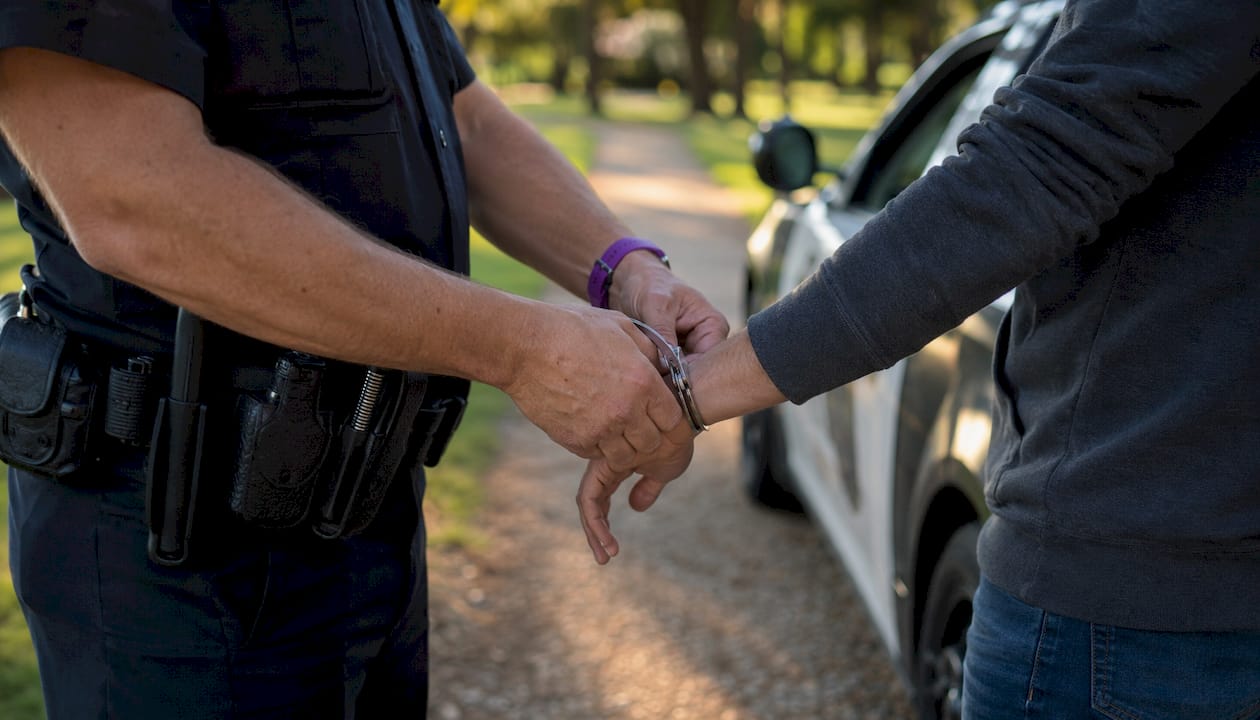
Once arrested, the defendant is booked and typically held until arraignment. The district attorney's office, not the victim, decides whether to file charges. Victims who later recant or refuse to cooperate do not automatically end the case. Prosecutors frequently proceed using physical evidence, 911 recordings, officer testimony, and medical records.
At trial, the prosecution must prove all three elements beyond a reasonable doubt: the willful act, the qualifying relationship, and the traumatic condition. Defense attorneys at Rubinlawpc regularly challenge the traumatic condition element, the credibility of witness accounts, and the sufficiency of physical evidence. When no traumatic condition can be proven, the charge can be reduced to domestic battery under PC 243(e)(1), which eliminates felony exposure entirely.
How common are PC 273.5 cases in California?
Domestic violence is one of the most frequently prosecuted categories of crime in California. The California Department of Justice tracks domestic violence incidents statewide, and law enforcement agencies across the state respond to a substantial volume of calls annually that result in PC 273.5 arrests. Los Angeles County, given its population size, accounts for a large share of those filings.
The charge appears across all demographics and income levels. Because mandatory arrest policies remove officer discretion, arrests happen even in cases where both parties dispute that any crime occurred. That dynamic produces a meaningful number of cases where the underlying facts are genuinely contested, which is why experienced legal representation matters from the moment of arrest.
Why mandatory arrest policies shape every PC 273.5 case
California's mandatory arrest policy under Penal Code § 836 removes the responding officer's discretion when probable cause exists for a domestic violence offense. The officer does not need the victim's cooperation or consent to make the arrest. This policy was designed to protect victims who might feel pressured to decline police intervention, but it also means defendants get arrested in ambiguous situations where the facts are far from clear.
The practical effect is that the criminal process starts immediately, regardless of what either party wants afterward. Protective orders issue quickly, often at arraignment, restricting where the defendant can go and who they can contact. Violating a protective order is a separate criminal offense. By the time a defendant fully understands the scope of what they are facing, the case has already moved through several procedural stages.
Understanding PC 273.5 charges early gives defendants the best chance to challenge the evidence before it hardens into a conviction.
Facing a PC 273.5 charge in Los Angeles? Rubinlawpc defends clients against domestic violence charges with courtroom experience, constitutional challenges, and a track record of reduced and dismissed cases. 
Contact Rubinlawpc for a direct consultation with an attorney who knows the local courts, the prosecutors, and the defenses that actually work.
Key Takeaways
PC 273.5 California is a wobbler offense that can result in felony state prison time, lifetime firearms restrictions, and lasting consequences for custody and professional licensing.
| Point | Details |
|---|---|
| Wobbler charge | Prosecutors file PC 273.5 as a misdemeanor or felony based on injury severity, weapon use, and prior history. |
| Traumatic condition threshold | Any physical injury qualifies, including bruises; pain alone without visible injury is legally insufficient. |
| Felony sentencing range | Base felony carries 2, 3, or 4 years in state prison; repeat offenders face up to 5 years and $10,000 in fines. |
| Mandatory probation terms | Conviction triggers a minimum 36-month probation with batterer intervention, restitution, and a protective order. |
| Collateral consequences | A conviction affects child custody, professional licenses, federal firearm rights, and immigration status. |