
A Pitchess motion is one of the most powerful discovery tools available in California criminal cases, and most defendants never hear about it until it is too late to use it effectively. At its core, it is a formal court procedure that lets defendants, and in some cases civil litigants, request access to confidential law enforcement personnel records under judicial supervision. The governing statute is California Evidence Code §§1043–1047, which sets out exactly what you must show, how to show it, and what the court can release.
Here is what the motion covers at a glance:
- Who can file: Defendants in criminal proceedings and parties in civil litigation where police conduct is at issue
- What it targets: Confidential personnel records of specific law enforcement officers, including complaints, internal investigations, and disciplinary findings
- Why it matters: Prior misconduct by an arresting or testifying officer can directly undermine the prosecution's case or support a self-defense theory
- Legal threshold: You must demonstrate "good cause" through a sworn affidavit connecting the requested records to a material issue in your case
- Statutory framework: Evidence Code §§1043 et seq. governs the entire process, from the initial motion through in camera review and disclosure
The motion traces its name to a 1974 California Supreme Court decision, and the procedure it created has shaped criminal defense strategy in this state for over five decades.
Table of Contents
- The legal foundation behind Pitchess motions in California
- How to file a Pitchess motion in California, step by step
- What records can you actually access, and what stays protected?
- What happens after you file: outcomes, partial disclosures, and appeals
- Recent law changes and practical tips for getting the most out of this tool
- Facing charges in Los Angeles? Rubinlawpc knows how to use this tool
- Key Takeaways
The legal foundation behind Pitchess motions in California
The landmark case is Pitchess v. Superior Court, 11 Cal.3d 531 (1974). Caesar Echeveria was charged with battery against four Los Angeles County deputy sheriffs and intended to argue self-defense, claiming the deputies had used excessive force. To support that defense, he sought records of prior citizen complaints against those same deputies. The California Supreme Court held that the trial court had not abused its discretion in ordering discovery, establishing that defendants have a right to access relevant officer personnel records when they can show sufficient cause.
The Legislature codified and refined that ruling through Evidence Code §§1043–1047. Section 1043 requires the moving party to file a written motion identifying the agency, describing the records sought with reasonable specificity, and attaching a supporting affidavit establishing good cause. Section 1045 governs what the court may actually disclose after reviewing the records privately, and Section 1047 limits disclosure to records relevant to the subject matter of the pending litigation.
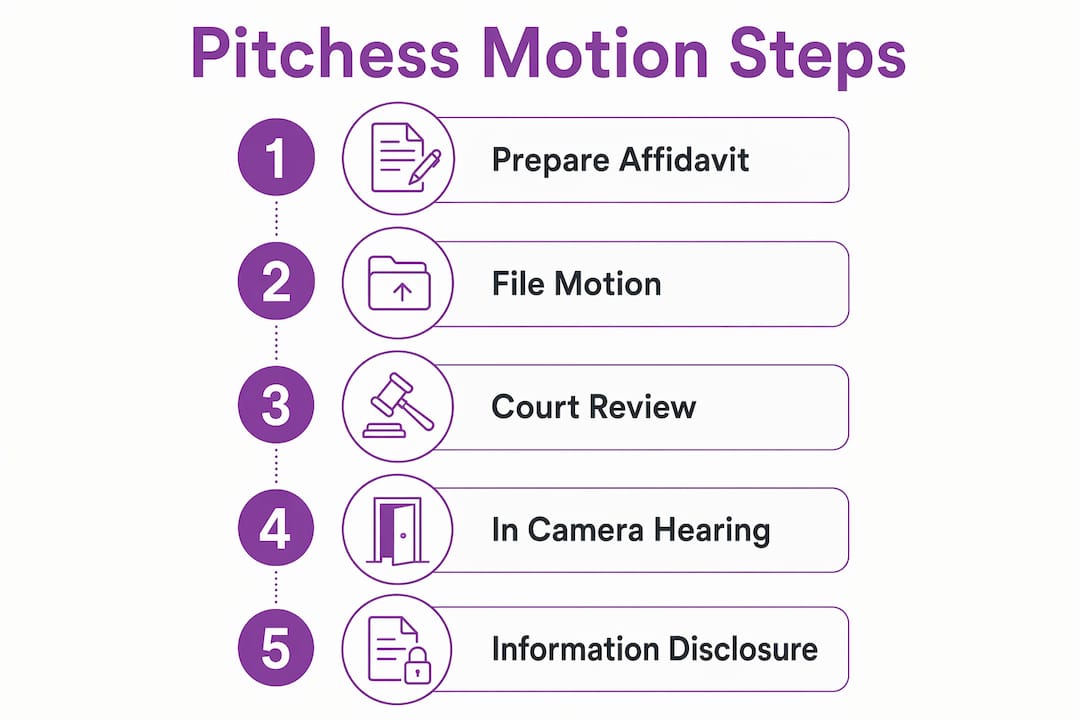
Judicial discretion runs through every stage of the process. The trial court first decides whether the motion clears the good cause threshold. If it does, the court conducts a private in camera review of the personnel file, examining records without the parties present, and releases only what it finds relevant. Courts conduct in camera review to balance the defendant's discovery rights against the officer's privacy interests and the agency's confidentiality concerns. The statute also protects the identities of complainants and witnesses unless the defense can show it cannot locate them through other means.
One important privacy guardrail: the motion applies only to records of the specific officer(s) named in the motion, for conduct relevant to the pending case. Courts will not permit broad fishing expeditions through an entire department's files.
How to file a Pitchess motion in California, step by step
Getting this right procedurally matters as much as the substance of your argument. A technically defective motion will be denied before the court ever reaches the merits.
Preparation steps:
- Identify the specific officer(s) whose records you are seeking, the employing agency, and the custodian of records
- Define the categories of records you want: prior complaints of excessive force, dishonesty, fabrication of evidence, or whatever conduct is directly relevant to your defense theory
- Draft a detailed affidavit or declaration establishing good cause, connecting the requested records to a specific, plausible factual scenario in your case
- Prepare a proposed order listing the exact categories of records you are requesting, which helps the judge grant the motion efficiently and limit unnecessary disclosures
Filing and service:
- File the motion and supporting affidavit with the court
- Serve the motion on the prosecuting agency, the law enforcement agency, and the custodian of records per Code of Civil Procedure §1005, which generally requires at least 16 court days' notice before the hearing
- Attach a proposed order to the motion
The hearing and in camera review:
At the initial hearing, the court determines whether you have shown good cause. The good cause threshold is relatively low: your affidavit can rely on hearsay and needs only to present a plausible factual scenario of officer misconduct connected to your defense. You do not need to prove the misconduct occurred. If the court finds good cause, it orders the agency to produce the records for in camera review. Only the judge and court staff attend that review. No attorneys, no parties.

After reviewing the records privately, the court discloses whatever it finds relevant. The agency and the prosecution can object at the initial hearing, typically arguing that the affidavit is too vague, the records are not relevant, or the motion is procedurally defective. Those objections are common, which is why specificity in your affidavit is the single most important factor in getting the motion granted.
Pro Tip: File the motion early. The Pitchess process takes significantly longer than standard civil discovery, which typically runs on 30-day response windows. Waiting until the eve of trial leaves no time to use what you obtain.
What records can you actually access, and what stays protected?
Not everything in an officer's personnel file is on the table. California law draws clear lines between what a Pitchess motion can reach and what remains off-limits.
Records typically accessible through a successful motion:
- Prior citizen complaints of excessive force, false arrest, or fabrication of evidence
- Internal affairs investigation findings related to the type of misconduct alleged in your case
- Disciplinary records directly relevant to the subject matter of the litigation
- Names and contact information of prior complainants and witnesses (subject to conditions)
What the court protects:
- Complaints or investigations unrelated to the conduct at issue in your case
- Personal information about officers unrelated to their professional conduct
- Victim information and records protected by separate privacy statutes
- Union grievance records and unrelated employment matters
Courts typically do not release full, unredacted personnel files. What you usually get is a list of complainant and witness names and contact information, along with redacted summaries of relevant incidents. Access to full investigative reports is contingent on the defense demonstrating it cannot locate those witnesses or obtain their cooperation through other means.
The legislative landscape shifted significantly starting in 2018. SB 1421 made several categories of misconduct records public under the California Public Records Act without requiring a Pitchess motion at all. Those categories include officer-involved shootings, serious uses of force, sustained findings of dishonesty, and sexual assault by an officer. A 2021 follow-up bill expanded that list to include discriminatory conduct, excessive force, and wrongful arrests or searches. Some police misconduct records are now publicly searchable through databases compiled by news organizations and transparency coalitions, covering many cases from various California agencies.
The practical implication: before filing a Pitchess motion, check whether the records you need are already publicly available. If SB 1421 covers the conduct at issue, you may be able to obtain those records directly under the California Public Records Act, saving time and litigation costs. The Pitchess process remains necessary for records that fall outside those public categories, which still covers a wide range of officer conduct.
What happens after you file: outcomes, partial disclosures, and appeals
The range of outcomes after a Pitchess motion is narrower than most defendants expect. Courts rarely hand over everything requested, and a complete denial is also less common than a partial result somewhere in the middle.
Possible outcomes:
- Full good cause finding with disclosure: The court finds good cause, reviews the records in camera, and discloses relevant materials. This is the best-case result, though "relevant materials" is defined narrowly.
- Partial disclosure: The most common outcome. The court releases some records, typically complainant contact information and redacted summaries, while withholding unrelated or private materials.
- Denial for lack of good cause: The court finds the affidavit too vague or the connection to the defense theory too speculative. The motion fails at the threshold, and no in camera review occurs.
- Denial after in camera review: The court reviews the records privately and finds nothing relevant to disclose. The defendant learns nothing about the contents.
When a court denies a Pitchess motion without conducting an in camera review at all, that may constitute an abuse of discretion. Appellate courts routinely examine sealed records to verify that the trial judge applied the correct relevance standards. If you believe the trial court improperly denied your motion or failed to conduct the required in camera review, you can seek appellate relief, and the reviewing court will examine the sealed file itself to check the trial court's work.
A denied motion can sometimes be refiled with a more detailed affidavit if new facts emerge or if the original declaration was simply too thin. The key is understanding why the court denied it. A procedural defect is easier to fix than a substantive finding that the records are not relevant to your defense theory.
Recent law changes and practical tips for getting the most out of this tool
The combination of SB 1421 and SB 16 has genuinely changed how defense attorneys approach California police records requests. The Pitchess motion no longer needs to do all the heavy lifting. Its role has shifted toward more targeted requests for records that fall outside the public disclosure categories, which makes precision in drafting even more critical than it was before.
What experienced practitioners recommend:
- Check public databases and submit California Public Records Act requests before filing a Pitchess motion. If the records you need are already public, use them directly.
- File the Pitchess motion early in the case, ideally at the first opportunity after arraignment. The process takes months, and you need time to actually use what you obtain.
- Draft the affidavit with a specific, named factual scenario. "Officer X has a history of excessive force" is not enough. Describe what happened in your case, why it suggests prior similar conduct, and why that prior conduct is material to your defense.
- Attach a detailed proposed order listing the exact categories of records you want. A well-drafted proposed order helps the judge grant the motion cleanly and reduces the chance of a vague ruling that produces nothing useful.
- Document everything at the hearing. If the court makes oral rulings about what it reviewed or why it declined to disclose certain records, get that on the record for any potential appeal.
- Accept that full unredacted files are rare. Build your strategy around what you are likely to receive: names and contacts of prior complainants who may be willing to testify or provide declarations supporting your defense theory.
Pro Tip: The affidavit supporting your motion may be filed under seal to protect your defense strategy from disclosure to the prosecution. Use that option when your theory of the case is sensitive.
The Pitchess motion process also applies in civil litigation involving police conduct, not just criminal defense. If you are pursuing a civil rights claim against an officer, the same statutory framework governs your access to that officer's personnel records. The good cause standard and in camera review procedure apply equally in that context.
Facing charges in Los Angeles? Rubinlawpc knows how to use this tool
A Pitchess motion is only as effective as the attorney who drafts and argues it. The affidavit has to connect the right facts to the right legal theory, the motion has to be filed at the right time, and the attorney has to know what to do with the disclosed records once they arrive. That is where courtroom experience makes the difference between a motion that produces useful evidence and one that produces nothing.
Rubinlawpc is a Los Angeles criminal defense firm that handles serious charges including drug crimes, DUI, domestic violence, sex offenses, and violent crimes across Los Angeles County. The firm's approach is built on frequent courtroom appearances and a detailed understanding of local judges and prosecutorial strategies. When officer credibility or conduct is central to a case, Rubinlawpc knows how to build the discovery strategy around it, including filing and litigating Pitchess motions where they can shift the outcome. Explore the firm's full range of California criminal defense practice areas, or review the California criminal laws relevant to your charges. Contact Rubinlawpc directly to discuss your case and what discovery options may be available to you.
Key Takeaways
A Pitchess motion in California requires a sworn good cause affidavit connecting specific officer misconduct records to a material defense theory, with disclosure limited to what the court finds relevant after private in camera review.
| Point | Details |
|---|---|
| Statutory basis | Evidence Code §§1043–1047 governs all Pitchess motions, from filing through disclosure. |
| Good cause threshold | The affidavit must present a plausible factual scenario of misconduct; hearsay is permitted and the bar is relatively low. |
| Typical disclosure scope | Courts usually release complainant contact information and redacted summaries, not full unredacted personnel files. |
| Legislative shift | SB 1421 and SB 16 made officer-involved shootings, dishonesty, and certain other misconduct records publicly available without a Pitchess motion. |
| Rubinlawpc | The firm handles Pitchess motions as part of criminal defense representation in Los Angeles, filing early and building case strategy around disclosed records. |