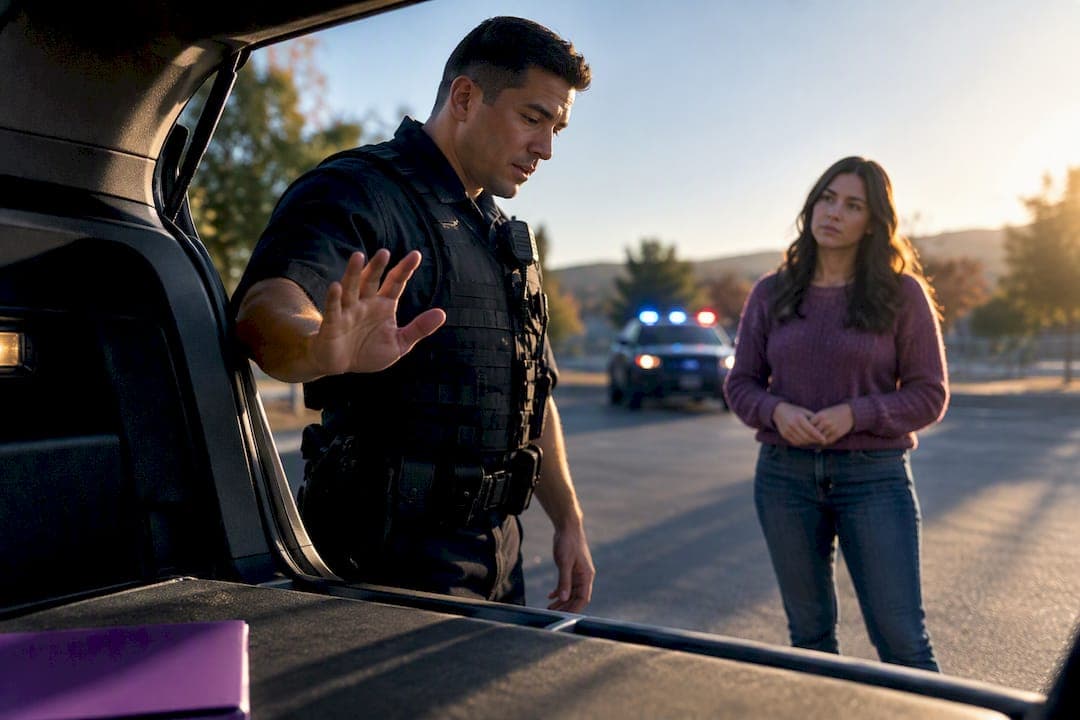
Consent searches are legal in California when a person voluntarily agrees to let police search without a warrant, but the prosecution must prove that consent was freely given under the totality of the circumstances. If an officer asks to search you, your car, or your home, you can say, "I do not consent to a search," and that refusal is your right. If you believe consent was coerced or misread, Rubin Law, P.C. can review the stop and pursue suppression under Penal Code section 1538.5.
TL;DR:
- Consent searches are valid only if the prosecution proves that the individual voluntarily agreed without coercion, deception, or false authority under totality of circumstances.
- Factors like commands versus requests, promises or threats, and length of detention heavily influence whether consent was truly voluntary in court.
- Third-party consent is valid when shared authority exists, but objecting occupants' refusals block searches unless they are lawfully removed.
- Clearly stating "I do not consent" and avoiding resistance can help preserve your rights during police searches.
- A motion to suppress evidence can exclude illegally obtained consent or coerced searches, but proper evidence preservation and quick legal action are essential.
Table of Contents
- What the law says about consent searches and the Fourth Amendment
- How courts decide if consent was truly voluntary
- Who can say yes: third-party and roommate consent rules
- What to say and do if an officer asks to search you
- If your consent was coerced: how a suppression motion works
- How LAPD, CHP, and other agencies document consent
- What AB 93 would change about consent searches in California
- How defense attorneys evaluate a coerced-consent claim
- When to call a lawyer after a search you did not agree to
- How Rubin Law, P.C. can help if your rights were violated
- Primary sources for California consent search law
- Sources
- FAQ
What the law says about consent searches and the Fourth Amendment
The Fourth Amendment protects against unreasonable searches, and a warrant is generally required before police can search a person, home, car, or belongings. Consent is one of the recognized exceptions to that warrant requirement, but it only works when the person giving it does so freely. Under federal guidance on voluntariness, a consent search is valid only if the prosecution proves, based on the totality of the circumstances, that consent was voluntary rather than the product of pressure, deception, or a claimed legal authority the officer did not actually have.
That burden matters because it flips the presumption in the citizen's favor. Police cannot simply assert that someone agreed; if the matter is challenged in court, prosecutors have to reconstruct the entire interaction and show a judge that the person's will was not overborne.
A handful of Supreme Court cases shape how California courts apply this rule:
- Schneckloth v. Bustamonte (1973) established that officers are not constitutionally required to tell someone they have the right to refuse a search, and that voluntariness is judged by the totality of the circumstances rather than a single warning.
- United States v. Matlock (1974) allowed a co-occupant with common authority over a space to consent to a search on behalf of others who share that space.
- Illinois v. Rodriguez (1990) extended that rule to situations where police reasonably, even if mistakenly, believed someone had authority to consent.
- Georgia v. Randolph (2006) held that when a co-occupant is physically present and objects, that objection controls and blocks the search, even if another occupant consents.
- Fernandez v. California, 571 U.S. 292 (2014), clarified that once an objecting occupant is lawfully removed, such as through a lawful arrest, police may return and obtain valid consent from the remaining occupant.
The Northwestern University Law Journal's analysis of Schneckloth points out that this ruling leaves a real gap: officers can ask for consent without ever mentioning that refusal is an option, and most people do not know they can say no. Some California departments have tried to close that gap through their own policies, which we cover later, but no statewide law currently requires an advisal before every consent request.
For California defendants, this body of case law is the backbone of every consent-search argument. When a criminal defense firm evaluates a stop, the first question is always whether the government can actually meet its burden under these precedents, not whether a client signed something or nodded along.
How courts decide if consent was truly voluntary
Judges do not look at a single moment when they evaluate consent. They look at everything that happened before, during, and after the request, a standard known as the totality of the circumstances. The Office of Justice Programs' review of consent-search voluntariness identifies the recurring factors that push a case toward involuntary consent.
- Command versus request. "I need to search your car" reads very differently in court than "Would you mind if I looked in your car?"
- False claims of authority. An officer who implies they already have a warrant, or that refusal is pointless, undercuts voluntariness.
- Promises or threats. Suggestions that cooperation will avoid a ticket, an arrest, or a tow, or that refusal will bring a worse outcome, weigh heavily against the state.
- Length and nature of the detention. A consent request minutes into a routine stop looks different from one after an hour of roadside questioning.
- Number of officers present. Multiple officers surrounding one person can create pressure that a single officer's request does not.
- Age, language ability, and vulnerability. Courts weigh whether the person could reasonably understand and refuse the request.
- Body-worn video or dashcam footage. Recorded exchanges make it far easier to test what was actually said, and their absence can cut against the officer's account.
A useful illustration comes from a California vehicle-stop case summarized in a Court of Appeal case summary, where an officer told a driver the car would be towed unless he agreed to a search. The court found that this false or misleading threat, rather than a fair choice, produced the consent, and it treated that fact as central to the voluntariness analysis. A promise to avoid a tow, a citation, or an arrest is exactly the kind of leverage that can invalidate consent later.
Consent is also not the same as silence. Standing quietly while an officer searches, or failing to object out loud, is not the same as saying yes. Courts generally require some affirmative act or statement, not the absence of a fight, before they will call a search consensual. If you freeze, say nothing, or simply do not resist, that alone should not count against you, though it is always safer to state a clear refusal out loud if you are able to.
Statistic: Under the federal standard, the prosecution carries the burden to prove by a preponderance of the evidence that consent was freely and voluntarily given, based on the totality-of-the-circumstances test. That burden sits with the government at every hearing, not with the person who was searched.
Who can say yes: third-party and roommate consent rules
Consent searches get more complicated once more than one person occupies a space, whether that is a shared apartment, a family car, or a hotel room. The Constitution Annotated summary of consent-search doctrine lays out the current rules for who can authorize a search on behalf of others.
- A person with common authority over a space, meaning joint access or control for most purposes, can consent to a search of shared areas under Matlock.
- Officers can also rely on a reasonable, good-faith belief that someone had authority to consent, even if that belief later turns out to be mistaken, under Rodriguez.
- If a co-occupant is physically present and objects, that refusal controls and blocks the search of shared spaces under Randolph, even when another resident says yes.
- If the objecting occupant is removed for an independent, lawful reason, such as an arrest, officers may return and lawfully obtain consent from whoever remains, under Fernandez v. California.
In practical terms, a roommate can generally consent to a search of common areas like a living room or kitchen, but not necessarily your locked bedroom or a container clearly marked as yours. A driver can typically consent to a search of a car they own or control, but a passenger's belongings raise separate questions about whose authority actually extends to them. Landlords generally cannot consent to a search of a tenant's private unit.
The Fernandez exception is worth understanding because it surprises a lot of people. If you object to a search and police then arrest you and remove you from the scene for unrelated, lawful reasons, they may come back and ask a co-occupant who did not object. That later consent can be valid, even though it would not have been valid while you were standing there objecting.
What to say and do if an officer asks to search you
The words you use in the moment matter, and simple, calm language works best. You do not need legal training to protect yourself, you need a clear, repeatable phrase and the composure to use it.
- Say plainly, "I do not consent to a search." You can add "but I am not resisting" if you want to make clear you are complying with orders, not fighting the process.
- If officers search anyway, state again, "I am not consenting to this search," so the objection is on the record, ideally near any body-worn camera.
- If you already said yes and want to change your mind, you can withdraw consent at any point by saying, "I am withdrawing my consent to this search."
- If officers ask to search your phone, decline separately: "I do not consent to a search of my phone," and do not provide a passcode or fingerprint unlock. Phone data raises its own set of legal exceptions distinct from a car or backpack search.
- If an officer asks to search only part of your car or bag, you can limit scope out loud: "I consent to a search of the front seat only," rather than leaving the scope open-ended.
Safety matters just as much as wording. Keep your hands visible, avoid sudden movements, and never physically block or resist an officer, even one you believe is acting unlawfully. Note the officer's name and badge number if you can see it, and ask whether body-worn video is active. None of this guarantees a particular outcome, but it creates the record a defense attorney needs later.
Pro Tip: A calm, repeated verbal refusal, spoken clearly enough for a body camera or dashcam to pick up, is worth more in a suppression hearing than an angry argument at the scene.
If your consent was coerced: how a suppression motion works
When consent was the product of pressure, deception, or a misunderstanding of authority, California law gives defendants a specific tool to fight back: a motion to suppress evidence under Penal Code section 1538.5. This motion asks the court to exclude evidence obtained through an unlawful search, including a search based on invalid consent, so the prosecution cannot use it at trial.
- Preserve the record immediately. Write down the officer's exact words, the number of officers present, and anything said about tickets, towing, or arrest before or during the request.
- Identify and secure body-worn or dashcam video. Departments often overwrite footage after a set retention period, so early requests matter; a related guide on preserving evidence after a questionable search walks through what to gather first.
- Collect witness information. Passengers, bystanders, or anyone nearby who heard the exchange can corroborate what was said.
- Contact a defense attorney quickly. Evidence preservation windows are often short, and a fast 48-hour response after an illegal search meaningfully improves the odds of a successful suppression claim.
- Expect a discovery and subpoena phase. Your attorney will typically request police reports, dispatch logs, and any body-worn video, then file the motion detailing why consent was not voluntary under the totality of the circumstances.
- Prepare for the evidentiary hearing. The judge hears testimony, reviews video, and decides whether the prosecution met its burden of proving voluntary consent.
- Understand the possible outcomes. A successful motion can suppress the evidence entirely, which often leads to reduced charges or dismissal; a denied motion still preserves the issue for appeal.
Filing this motion correctly the first time matters, since a botched or late filing can waive the issue. A more detailed walkthrough of how to build a winning suppression motion covers common procedural mistakes that weaken otherwise strong cases.
How LAPD, CHP, and other agencies document consent
Individual department policy often does more to protect a person's rights during a stop than the bare constitutional minimum, because Schneckloth does not require any advisal at all. Several California agencies have adopted their own rules that go further.
- The LAPD Consent to Search Verbal Advisement directs officers to advise a person that they may refuse or withdraw consent, and to capture that advisal on body-worn or in-car video whenever possible.
- When recording is not available, LAPD officers are expected to use a written consent form instead, creating a paper record of what was asked and agreed to.
- The California Highway Patrol's search-and-seizure policy, CHP GO 100.91, requires troopers to complete a CHP 202D consent-search form, obtain a signature when practical, and record the exchange on body-worn video where available.
- Both policies exist on top of, not in place of, the constitutional voluntariness standard, so even a signed form can be challenged if the surrounding circumstances suggest coercion.
These records matter enormously once a case reaches a suppression hearing. A recorded advisal where an officer clearly explained the right to refuse, followed by an unambiguous "yes," is difficult for a defense attorney to overcome. The reverse is also true: missing video, no signed form, or a garbled or rushed advisal gives the defense real leverage to argue the government cannot meet its burden.
What AB 93 would change about consent searches in California
California lawmakers have repeatedly tried to narrow how police use consent searches, and Assembly Bill 93 is the clearest recent example. According to the bill text tracked on the California Legislative Information site, AB 93 would specify that consent alone is not lawful justification for a search and would bar officers from even asking for consent unless they already have reasonable suspicion of a crime.
- AB 93 targets the practice of asking for consent as a fishing expedition during routine stops with no underlying suspicion.
- It would not eliminate consent searches outright, but it would require an independent legal basis before an officer could request one.
- As of 2026, California has not enacted a statewide statutory prohibition along these lines, so the current constitutional and departmental rules described above remain the operative standard.
- Supporters point to data showing consent searches are used disproportionately during stops of Black and Hispanic or Latine drivers and rarely turn up contraband relative to how often they are requested, a pattern documented in the bill's legislative counsel digest.
If a version of AB 93 or a similar reform eventually passes, the practical effect on an ordinary traffic stop would be significant: an officer with no suspicion of a crime could no longer simply ask to look through your car "just to check." Until then, the existing case law and departmental policies discussed above remain the primary tools available to challenge a consent search.
How defense attorneys evaluate a coerced-consent claim
When a defense team reviews a consent search, the analysis rarely starts with what the client signed or said in the moment. It starts with the full record: body-worn video, dispatch logs, the officer's written report, and any witness statements, all compared against the legal standard for voluntariness.

Attorneys look for the same red flags courts do: commands dressed up as requests, promises of leniency, threats of towing or arrest, and long or crowded stops that suggest pressure rather than free choice. They also check whether the department's own consent-advisement policy, such as LAPD's verbal advisement or CHP's 202D form, was actually followed, since a documented failure to follow internal policy can support an argument that the process itself was flawed.
Once the facts are assembled, the strategic decision is whether a motion to suppress under Penal Code section 1538.5 is likely to succeed, or whether the stronger path is negotiating a reduced charge based on the weakness of the evidence. That decision depends heavily on timing: video retention windows close, officer memories fade, and witnesses become harder to locate the longer a case sits.
Experienced criminal defense attorneys approach these cases with frequent courtroom presence and apply familiarity with local judges and prosecutors to decide quickly whether a suppression fight, a negotiated resolution, or a diversion program serves a client best. Readers weighing their own situation can review the firm's guidance on pre-trial motions and suppression procedure for a closer look at how these hearings typically unfold.
When to call a lawyer after a search you did not agree to
If you think you were pressured into a search, or you are not sure whether what happened counts as consent at all, the honest answer is: call sooner than you think you need to. Body-worn video gets overwritten, memories fade fast, and witnesses move on. None of that works in your favor if you wait.
Early contact with a defense attorney is not about panic, it is about preservation. A quick call lets counsel send a preservation letter for video before it disappears, track down anyone who saw the stop, and start evaluating whether a motion to suppress is realistic before evidence goes stale. Cases built on coerced consent are often won or lost on details that exist for a matter of days or weeks, not months.
You do not need to have all the answers before reaching out. Bring what you remember, and let someone who does this daily sort out what matters.
— Jake
How Rubin Law, P.C. can help if your rights were violated
A consent search that did not follow the rules can be the weakest link in an entire criminal case, and that weakness is worth testing quickly. Some defense attorneys represent clients in cases where an invalid or coerced consent search led to drug, weapons, DUI, or other charges, using constitutional challenges and motions to suppress as a core part of the defense strategy.

- Filing suppression motions to challenge searches based on coerced, misunderstood, or legally invalid consent.
- Preserving evidence, including urgent requests for body-worn and dashcam video before retention windows close.
- Courtroom advocacy leveraging familiarity with local courts and legal procedures.
An initial contact usually starts with the basic facts: where and when the stop happened, what was said, whether video exists, and what charges followed. From there, the firm can move quickly on time-sensitive steps like preservation letters and discovery requests. If a consent search led to charges you are now facing, the criminal defense services page is the fastest way to get details on how Rubin Law, P.C. can review your case and outline next steps.
Primary sources for California consent search law
- Schneckloth v. Bustamonte analysis, on the voluntariness standard and lack of a refusal-advisal requirement.
- Constitution Annotated summary of Matlock, Rodriguez, Randolph, and Fernandez on third-party consent.
- AB 93 bill status on California Legislative Information.
- LAPD Consent to Search Verbal Advisement via the California Attorney General's archive.
- CHP GO 100.91 search-and-seizure policy.
- OJP review of voluntariness factors in consent searches.
This article is general information, not a substitute for advice from a qualified lawyer. Consult a qualified legal professional about your own circumstances before acting on anything here.
Sources
- Consent searches: factors courts consider in determining voluntariness — OJP NCJRS
- Schneckloth v. Bustamonte analysis — Northwestern Law Journal Commons
- AB 93 (2023–2024) bill status — California Legislative Information
- Consent searches — Constitution Annotated (Congress.gov)
- LAPD Consent to Search Verbal Advisement (2020) — California Attorney General archive
FAQ
What is the legal standard for a consent search?
Courts use a totality-of-the-circumstances test, meaning they weigh everything about the encounter, not just the words exchanged, to decide if consent was voluntary. The prosecution carries the burden of proving voluntariness by a preponderance of the evidence.
Can a 16 year old consent to a police search in California?
California law does not set a fixed age below which consent is automatically invalid, but a minor's age and understanding are factors courts weigh under the totality-of-the-circumstances test. A minor's youth, along with pressure from officers or a lack of understanding of the right to refuse, can support an argument that consent was not truly voluntary.
What happens if you do not consent to a search?
Refusing consent is your right, and officers cannot search based on refusal alone; they need another legal basis, such as a warrant, probable cause, or an applicable exception. You may still be briefly detained while officers determine whether another basis for a search exists, but a lawful refusal itself is not evidence of wrongdoing.
Can a police officer search your car without consent in California?
Yes, but only if another exception applies, such as probable cause to believe the car contains evidence of a crime, a search incident to a lawful arrest, or plain-view observation of contraband. Absent consent or one of these recognized exceptions, a warrantless car search can be challenged through a motion to suppress under PC §1538.5.