
Police generally cannot search the contents of your phone without a warrant. The U.S. Supreme Court settled this in Riley v. California, and the rule applies whether you're stopped on the 405 or arrested at home in Los Angeles. Consent and a handful of narrow exceptions can change that. If an officer asks to look through your phone, say no and ask for a lawyer before you say anything else.
TL;DR:
- Police cannot search the contents of your phone without a warrant, unless you voluntarily consent, face exigent circumstances, or fall under specific exceptions.
- During an arrest, officers can seize your phone but cannot browse data or open apps without a warrant or valid exception, and holding the device in the meantime is lawful.
- Declining a search request and explicitly requesting a lawyer are crucial steps to protect your rights during police encounters involving your phone.
- Challenging unlawful searches through a suppression motion can lead to evidence being excluded, potentially collapsing the case or reducing charges.
- In California, phones are treated as carrying sensitive privacy rights, and law enforcement must follow strict rules aligned with Riley v. California and state statutes to lawfully access digital evidence.
Table of Contents
- What Riley v. California means for phone search rules in California
- When can police search your phone without a warrant?
- What to do if police want to search your phone
- How lawyers challenge unlawful phone searches
- Is looking at your phone screen a 'search' under California law?
- Recent California developments affecting phone searches
- Traffic stops versus arrests: different rules for phone searches
- Rights for minors during phone searches in California
- How digital evidence from phone searches is stored and handled
- How a phone search can affect immigration status for non-citizens
- A defense attorney's view on phone search cases
- If police searched your phone, talk to a defense lawyer before you talk to anyone else
- Sources
What Riley v. California means for phone search rules in California
The Supreme Court decided this one unanimously, which almost never happens. In Riley v. California, 573 U.S. 373 (2014), all nine justices agreed that police need a warrant before digging through the data on a phone taken during an arrest. That 9 to 0 vote matters because it means the rule isn't a partisan legal theory that could get chipped away next term. It's settled law.
Before Riley, police relied on the "search incident to arrest" doctrine, a rule built for the physical world. Under older cases like Chimel v. California and United States v. Robinson, officers could search whatever was in an arrestee's pockets. Cigarette packs, wallets, address books. The theory was simple: officers need to check for weapons and stop evidence from disappearing.
Phones broke that logic. A cigarette pack holds a few cigarettes. A modern phone holds years of texts, banking apps, medical records, location history, and photos going back a decade. The Court's reasoning in Riley treated that difference as a matter of kind, not just degree, noting that phones carry what the justices called the "privacies of life." Comparing a phone search to checking someone's pockets, the Court found, badly understates what's actually happening.
Here's the practical result:
- Officers can seize your phone during a lawful arrest and hold onto it.
- They cannot browse texts, photos, or apps without a warrant, your consent, or a recognized exception.
- Getting a warrant takes time, but it's routine. Judges sign off on phone-search warrants constantly once probable cause is shown.
- Holding the phone while a warrant gets processed is lawful. Opening it up before that warrant arrives usually is not, according to legal guidance from ASH Legal.
Riley didn't make phones untouchable. It just moved the decision to a judge instead of leaving it to whichever officer happens to be standing there.
When can police search your phone without a warrant?
Warrants aren't the whole story. California police and federal agents both rely on exceptions that let them bypass the warrant requirement under specific conditions. Courts read these exceptions narrowly, but narrow doesn't mean rare, and knowing them changes how you should act in the moment.
- Consent. If you say yes, the warrant requirement disappears. Consent has to be voluntary, and it can be challenged later if it was coerced or given without a real understanding of what was being asked. Attorneys who handle these cases consistently point out that agreeing to a search is often the single biggest mistake people make, according to SuperLawyers, because it wipes out a suppression argument you might otherwise have had.
- Exigent circumstances. Police can act without a warrant if waiting would mean losing evidence or risking someone's safety, like an active kidnapping where texts might reveal a location. Courts apply this exception tightly. A hunch that evidence "might" get deleted doesn't clear the bar.
- Plain view. If a text or notification is visible on a locked screen when an officer glances at it, that's fair game. That doesn't extend to unlocking the phone and reading what's behind the screen.
- Probation or parole status. People on probation or parole in California often have reduced privacy protections, and search conditions attached to supervision can specifically authorize phone searches.
- Border searches. At international airports and land crossings, Customs and Border Protection has broader authority than domestic police anywhere else in the state, and can conduct basic device searches without a warrant.
Pro Tip: If an officer says "you don't mind if I take a look, right?" that's a request for consent dressed up as small talk. A simple "I don't consent to a search" is a complete sentence. You don't owe an explanation.
What to do if police want to search your phone
The words you use in the first sixty seconds of an encounter can shape the rest of your case. Clarity matters more than politeness here, though you can have both.
Say it plainly: "I do not consent to a search of my phone, and I want to speak to a lawyer." You don't need to argue, raise your voice, or explain your reasoning. State it once and stay calm.
- Refuse to unlock the phone, whether that means a passcode or your fingerprint or face.
- Whether police can force a passcode or biometric unlock is still legally unresolved. Recent legal guidance from Arnold & Porter recommends declining and asking for counsel rather than testing the question yourself in the field.
- If the phone is seized, note the time, location, and, if it's safe to do so, the officers' badge numbers.
- Never delete data, factory reset, or remotely wipe the device after the fact, and follow guidance on how to preserve missing person evidence at home to protect crucial digital details. That can turn into a separate charge for destroying evidence or obstruction, on top of whatever you were originally being investigated for.
- Call a criminal defense attorney as soon as you reasonably can, not after charges are filed.
More than a passcode debate, this is a Fifth Amendment question that federal courts haven't fully resolved. SCOTUSblog's coverage of Riley notes that compelled decryption remains one of the more unsettled corners of search and seizure law, with different circuits reaching different conclusions. That uncertainty is exactly why you let a lawyer navigate it instead of guessing in the moment.
How lawyers challenge unlawful phone searches
A phone that got searched illegally doesn't automatically mean the case falls apart. It means there's a mechanism to fight it, and that mechanism has a name: the motion to suppress.
In California, that motion is filed under Penal Code 1538.5. It asks the court to exclude evidence gathered through an unlawful search, and it's typically filed and heard before trial, so the outcome can reshape the entire case before a jury ever gets involved.
Judges evaluating these motions look at specifics: was consent actually voluntary, or did it follow pressure and confusion? Did the circumstances genuinely qualify as exigent, or did officers stretch the definition to justify what they'd already decided to do? Was the eventual warrant, if there was one, written broadly enough to cover what was actually searched?
Defense attorneys build these motions around several angles:
- Challenging whether consent was freely given or coerced by the situation.
- Arguing the exigent circumstances claim doesn't hold up against the actual timeline.
- Attacking warrant language that's vague or broader than what the facts support.
- Raising chain-of-custody problems in how forensic extraction was handled.
When a suppression motion succeeds, the evidence gets thrown out. Sometimes that means the whole case collapses. Other times it means the prosecution's leverage shrinks and a better plea deal becomes possible. Either way, timing matters. The sooner defense counsel gets access to discovery and forensic reports, the more that timeline can be scrutinized for holes.
Is looking at your phone screen a 'search' under California law?
California courts and federal courts don't always draw the same line around what counts as a search, and that gap catches people off guard.
Under federal precedent, a "search" happens whenever the government intrudes into an area where you have a reasonable expectation of privacy. Riley extended that concept directly to phone data. Once officers move past looking at what's plainly visible and start opening apps, reading messages, or extracting files, they've crossed into search territory that needs a warrant.
California courts generally follow that same framework, since the state constitution's search and seizure protections track closely with the Fourth Amendment. Where things get murkier is in gray areas: does asking someone to read a text message out loud count as a search? Does glancing at a lock screen notification, without touching the device, count? Courts tend to treat physical manipulation of the device, unlocking it, scrolling, opening files, as the clearest trigger for warrant requirements. Passive observation of what's already displayed usually gets treated differently, closer to the plain view exception.
The practical takeaway: the moment an officer physically handles your phone to look past the lock screen, you're in warrant territory, absent one of the recognized exceptions. If you're ever unsure whether something crossed that line in your own case, that's a question for an attorney reviewing the specific facts, not something to sort out on the sidewalk.
Recent California developments affecting phone searches
California has generally moved in the direction of more privacy protection, not less, since Riley came down in 2014. The state's own courts have applied Riley's logic consistently in the years since, treating digital data as categorically different from physical evidence in search-and-seizure analysis.
California's privacy statutes, including the California Electronic Communications Privacy Act, add another layer on top of the federal baseline. CalECPA generally requires a warrant for government access to electronic device information and communications held by service providers, going further in some respects than federal law requires. That statute reflects a broader pattern in Sacramento: lawmakers have repeatedly tightened rules around digital surveillance and data access rather than loosen them.
None of this changes the core Riley rule, but it does mean California defendants sometimes have additional statutory arguments available that a federal-only analysis would miss. An attorney reviewing a phone-search issue in a California case should be checking both the federal Fourth Amendment framework and the state's own electronic privacy statute, because the two can work together to strengthen a suppression argument. Firms that track California criminal law developments closely tend to build suppression motions around whichever framework gives the client the stronger claim.
Traffic stops versus arrests: different rules for phone searches
A traffic stop and an arrest aren't the same legal event, and the rules around your phone shift depending on which one you're in.
During a routine traffic stop, an officer generally has no automatic right to your phone at all. There's no arrest, so there's no search incident to arrest, and there's no seizure of the device unless something else is happening, like visible contraband or an independent basis for probable cause. An officer asking to see your phone during a stop is almost always asking for consent, full stop.
Once you're actually arrested, the calculus changes. Officers can search your person and immediate surroundings for weapons or evidence relevant to the arrest, but Riley specifically carved phones out of that authority. They can take the phone. They can hold it. They generally cannot open it without a warrant or an exception, even though the arrest itself is legally valid.
This distinction trips people up constantly. Being pulled over for a broken taillight doesn't give an officer any right to your texts. Getting arrested at that same stop, say because a warrant check turns up an outstanding matter, still doesn't open your phone up to a search without a warrant. The arrest changes what officers can do with your person and immediate area. It doesn't change the Riley rule for your phone's digital contents.
Rights for minors during phone searches in California
Minors don't lose their Fourth Amendment protections just because they're under 18, but the practical dynamics around phone searches get more complicated when a parent, school official, or juvenile probation officer is involved.
Riley's core holding applies to minors the same as adults when law enforcement is involved. Police need a warrant, consent, or an exception before searching a minor's phone, regardless of the person's age. Where things diverge is around who can give consent. A parent or legal guardian sometimes has authority to consent to a search of a device they own or that's used by their child, particularly if the parent is the account holder or the phone is registered in the parent's name. That's a different legal question than whether the minor personally consented.
Schools operate under a separate, looser standard entirely. Under the Supreme Court's New Jersey v. T.L.O. framework, school officials only need "reasonable suspicion," a lower bar than probable cause, to search a student's belongings, including a phone, on campus. That standard doesn't apply once law enforcement takes over the investigation, though the line between school discipline and a criminal referral can blur fast.
Minors facing a phone search connected to a juvenile matter should get legal advice immediately, and parents should be cautious about consenting to a search on their child's behalf without understanding what that consent might expose. Firms that regularly handle juvenile cases in California see this consent confusion come up often.
How digital evidence from phone searches is stored and handled
Once a phone gets legally searched, whatever comes off it turns into digital evidence that has to be handled according to strict forensic protocols, and this is where a lot of suppression arguments actually get won.
Law enforcement agencies in California typically use specialized forensic extraction tools to pull data off a seized device rather than manually scrolling through it. That process creates a digital copy, often called a forensic image, which becomes the working record instead of the original phone. Every step of that process, who extracted the data, when, using what tool, and how it was stored afterward, gets documented to preserve chain of custody.
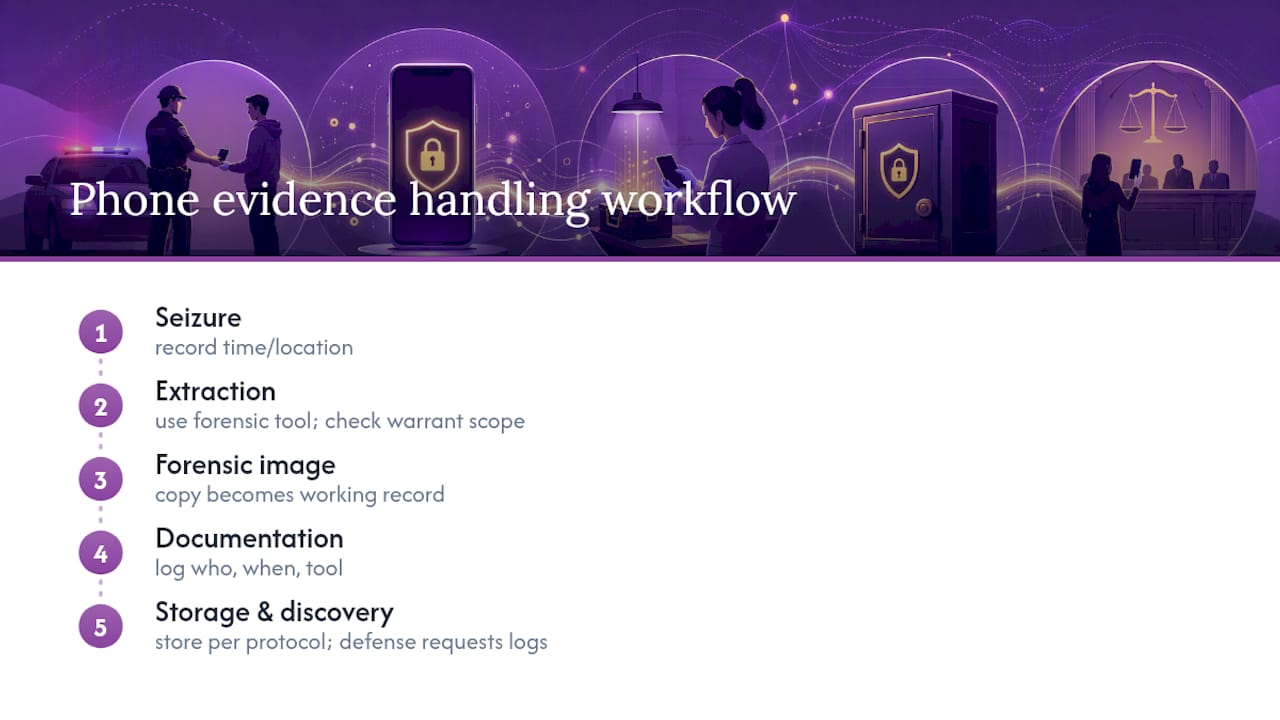
That documentation matters enormously to defense counsel. If there's a gap in the timeline, an unexplained delay between seizure and search, or evidence the extraction tool pulled data beyond what a warrant actually authorized, that's grounds to challenge the evidence's reliability or scope. A warrant that authorizes searching text messages doesn't automatically authorize extracting deleted photos or browser history, and prosecutors sometimes have to defend why an extraction went further than the warrant's language allowed.
Storage protocols also matter for how long evidence sits before trial and who has access to it. Defense attorneys requesting discovery should be asking specifically for forensic extraction logs and chain-of-custody records, not just a summary of what investigators found, since the summary alone won't reveal whether the process itself had legal problems.
How a phone search can affect immigration status for non-citizens
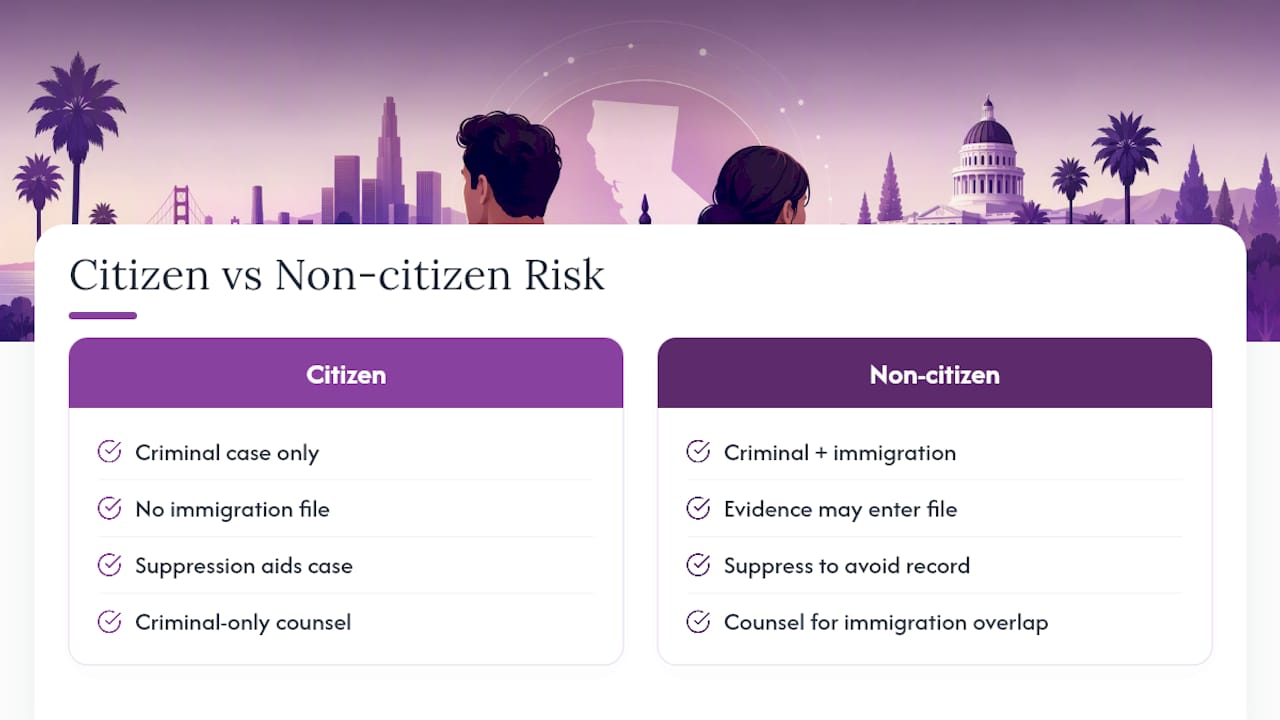
For non-citizens living in California, a phone search connected to a criminal investigation carries a second layer of risk that doesn't apply to citizens: immigration consequences that can follow even from a case that eventually gets resolved favorably in criminal court.
Federal immigration authorities can request information from local law enforcement, and evidence gathered from a phone, texts, photos, contacts, location data, can end up in a federal immigration file even if state charges are reduced or dropped. Certain criminal convictions trigger mandatory immigration consequences under federal law, including removal proceedings, regardless of how minor the underlying state sentence looks on paper.
This is one of the clearest reasons declining consent and demanding a warrant matters more, not less, for non-citizen defendants. Evidence collected without proper legal process can sometimes be suppressed in the criminal case, which in turn can prevent the underlying facts from ever becoming part of an immigration record in the first place. Once information exists in a case file, unwinding its downstream immigration effects is far harder than preventing its collection.
Non-citizens facing any phone-search issue connected to an arrest should treat the criminal case and its immigration exposure as intertwined from day one, not as separate problems to handle in sequence. An attorney experienced in this overlap can sometimes structure a plea or diversion outcome specifically to minimize immigration fallout, something a criminal-only strategy might miss entirely.
A defense attorney's view on phone search cases
Suppression fights over phone evidence rarely turn on the dramatic moment people picture, an officer scrolling through texts in front of a suspect. They turn on paperwork: the exact wording of a warrant, the gap between seizure and search, whether an extraction tool pulled more than a judge authorized. That's tedious work, and it's exactly where cases actually get won or lost.
The biggest mistake people make isn't refusing to talk to police. It's talking too much, or worse, unlocking the phone because an officer made refusal sound suspicious. Refusing consent isn't obstruction and it isn't evidence of guilt. Courts have said so repeatedly. Treat every request to "just take a quick look" as what it is: a request you're allowed to decline.
Rubin Law, P.C. builds suppression strategy around forensic timelines and warrant scope precisely because that's where prosecutors are least prepared for scrutiny. Frequent courtroom appearances mean recognizing which judges push back hard on overbroad warrants and which prosecutors fold quickly once a suppression motion is filed with real specificity behind it.
— Jake
If police searched your phone, talk to a defense lawyer before you talk to anyone else
Every day that passes after a phone search without legal advice is a day where suppression arguments can quietly weaken. Witnesses forget details, forensic reports get finalized, and the window to challenge a warrant's scope or a consent claim narrows the longer it sits unaddressed.
Rubin Law, P.C. is built around exactly this kind of fight. Frequent courtroom appearances across Los Angeles County mean the firm knows which judges scrutinize warrant language closely and which prosecutors will negotiate once a suppression motion gets filed with specifics attached. Whether the issue involves drug charges tied to phone evidence, a domestic violence allegation, or a broader constitutional challenge, the approach is the same: pull the forensic reports, map the timeline, and find where the search exceeded what the law allowed. The firm also structures diversion options where they're available, aiming to reduce or dismiss charges rather than just litigate them.
If your phone was searched or seized during an arrest or investigation anywhere in Los Angeles County, contact Rubin Law, P.C. for a consultation before you make any statements about what happened. The earlier a lawyer reviews the warrant, the consent claim, or the seizure timeline, the more options stay on the table.
This article is general information, not a substitute for advice from a qualified lawyer. Consult a qualified legal professional about your own circumstances before acting on anything here.
Sources
- Riley v. California, 573 U.S. 373 (2014)
- Riley v. California - Cornell Law School summary
- Can police search my phone in California? — ASH Legal