
California self-defense law permits you to use reasonable force to protect yourself or others from imminent harm, without any statutory duty to retreat. That single principle shapes every self-defense case in the state. California does not have a formal stand-your-ground statute, yet its common law tradition and jury instructions under CALCRIM No. 3470 and No. 505 produce nearly the same result for non-aggressors. The Castle Doctrine, codified in California Penal Code Section 198.5, adds a legal presumption of reasonable fear when you defend your home against an unlawful intruder. Understanding these rules is the difference between a valid legal defense and a criminal conviction.
What does self defense California law actually require?
Self-defense in California is legally justified when three conditions exist simultaneously: a reasonable belief of imminent threat, a genuine need to use force right then, and a proportional response to that threat. Miss any one of these, and the defense fails. California courts apply an objective standard, meaning a jury decides whether a reasonable person in your exact situation would have felt the same threat and responded the same way.
The legal requirements break down into four clear elements:
- Reasonable belief of threat. You must have genuinely believed you faced imminent unlawful force, and that belief must be one a reasonable person would share. A vague fear or past conflict does not satisfy this standard.
- Imminence. The threat must be happening now or about to happen. A threat made yesterday, or a promise of future harm, does not justify force today.
- Necessity. Force must be the only practical option available at that moment. If a safe, obvious alternative exists and a jury sees it, your claim weakens.
- Proportionality. Deadly force is justified only to prevent imminent death, great bodily injury, or a forcible felony. Excessive or disproportionate force forfeits the self-defense claim entirely.
These same rules apply when you defend another person. You step into that person's shoes legally, meaning you must reasonably believe they faced the same imminent threat you would have needed to face yourself.
Pro Tip: Document everything immediately after a self-defense incident. Write down what you saw, heard, and felt before the confrontation. Juries evaluate reasonableness based on the information you had at the moment, not what you learned afterward.

What is the "no duty to retreat" rule in California?
California's no-duty-to-retreat rule means you are not legally required to run before defending yourself. This rule comes from common law and jury instructions, not a written statute, which is a critical distinction. States with formal stand-your-ground laws often provide pre-trial immunity hearings. California does not. Your case goes to a jury, and that jury decides whether your actions were reasonable.
The rule traces back to People v. Estrada (1923) and is reflected today in CALCRIM No. 505 for homicide cases and CALCRIM No. 3470 for non-homicide cases. Both instructions tell jurors that a non-aggressor has no duty to retreat before using force.
A person who is not the initial aggressor and who is in a place they have a legal right to be may stand their ground and defend themselves without retreating, even if retreat might have been possible. However, the availability of a safe retreat is a factor jurors may consider when evaluating whether the use of force was reasonable.
That last sentence matters enormously. Safe retreat options can influence jury decisions even when no legal duty to retreat exists. A jury that sees an obvious exit you ignored may question whether force was truly necessary. The rule protects you legally, but it does not guarantee a favorable verdict.
Key limitations on the no-duty-to-retreat rule include:
- Initial aggressor status. If you started the fight, you cannot claim self-defense unless you clearly withdrew and communicated that withdrawal.
- Mutual combat. Agreeing to fight eliminates the self-defense claim unless the other party suddenly escalates to deadly force.
- Provocation. Deliberately provoking someone to create a pretext for using force disqualifies the defense.
- Location. The rule applies anywhere you have a legal right to be, including public spaces, not just your home.
California case law rejects a formal stand-your-ground statute, which means no pre-trial immunity hearing exists to dismiss charges before trial. Reasonableness is always a jury question.
What does the Castle Doctrine cover under California Penal Code Section 198.5?
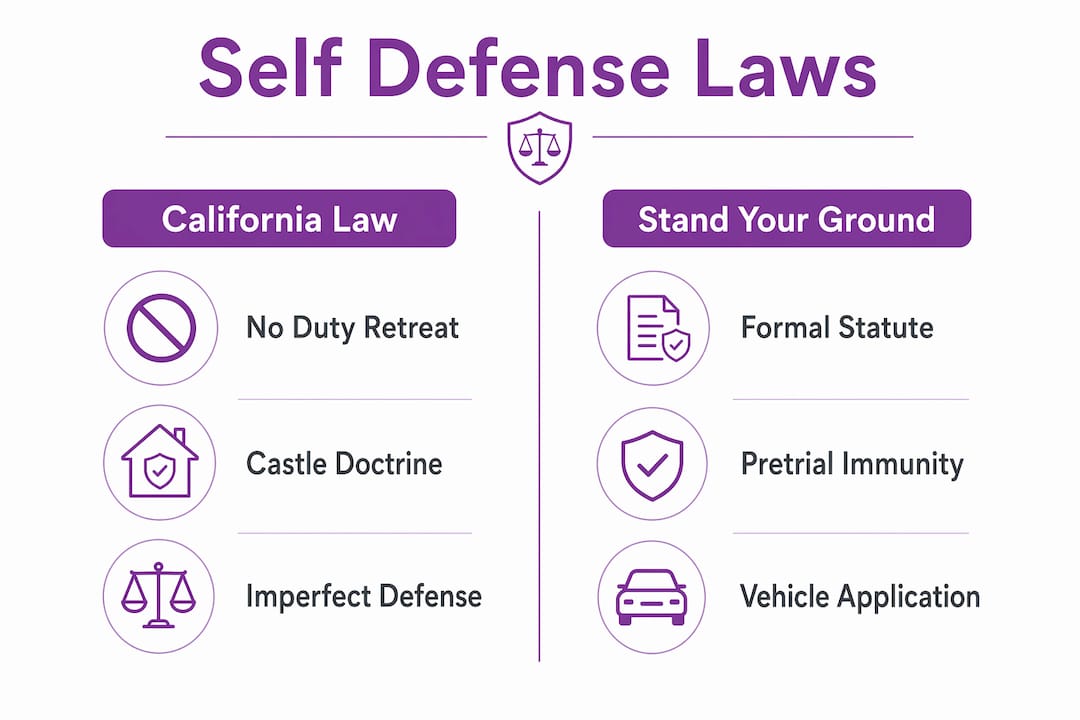
The Castle Doctrine is California's strongest self-defense protection. California Penal Code Section 198.5 creates a legal presumption that you had reasonable fear of imminent death or great bodily injury when you used deadly force against someone who unlawfully and forcibly entered your home. The prosecution must rebut that presumption to defeat your defense.
Three conditions must exist for the presumption to apply:
- The intruder entered your residence unlawfully and by force or threat of force.
- You knew or reasonably believed the entry was unlawful and forcible.
- You were a lawful resident of the home at the time.
When all three conditions are met, the law presumes your fear was reasonable. That shifts the burden to the prosecution, which is a significant legal advantage.
| Location | Castle Doctrine applies? | What you must prove |
|---|---|---|
| Your home (residence) | Yes | Unlawful, forcible entry by intruder |
| Your vehicle | No | Full self-defense elements required |
| Your workplace | No | Full self-defense elements required |
| A friend's home | No | Full self-defense elements required |
The Castle Doctrine presumption applies only to residences, not vehicles or workplaces. California has not extended the statutory presumption beyond the home. If you defend yourself in your car or at your office, you must prove every element of self-defense without any presumption in your favor.
Pro Tip: The Castle Doctrine does not give you unlimited authority to use deadly force at home. The threat must still be imminent. Shooting an intruder who is already fleeing your property likely falls outside the doctrine's protection.
What are the legal and practical limits of self-defense in California?
Self-defense rights in California have firm boundaries. Crossing them converts a legal act into a criminal one.
The most common ways people lose their self-defense claim include:
- Starting the confrontation. Initial aggressors lose self-defense rights unless they clearly and in good faith withdraw from the fight, or the other party suddenly escalates to deadly force. CALCRIM 3471 and People v. Quach (2004) both confirm this rule.
- Continuing force after the threat ends. Use of force must stop the moment the danger is no longer imminent. CALCRIM No. 3474 states directly that continuing to use force after the threat ends converts lawful self-defense into unlawful assault or homicide.
- Using deadly force to protect property alone. California law does not justify deadly force solely to protect property. If no person faces imminent great bodily injury or death, deadly force is not permitted.
- Disproportionate response. Responding to a shove with a firearm, for example, almost certainly exceeds proportional force.
The imperfect self-defense doctrine offers a partial escape from these limits. Imperfect self-defense can reduce murder charges to voluntary manslaughter when a defendant had an honest but unreasonable belief in the need for deadly force. The doctrine applies only to subjective belief, not objective reasonableness. It does not result in acquittal, but it does reduce the severity of the charge.
Civil liability is a separate and serious risk. California does not provide civil immunity for self-defense. A criminal acquittal does not protect you from a civil lawsuit. Civil cases carry a lower burden of proof, meaning someone you harmed in self-defense can still win a civil judgment against you even after you are cleared criminally.
Pro Tip: If you are acquitted on criminal charges after a self-defense incident, consult a civil litigation attorney immediately. The civil exposure does not disappear with the criminal case.
How should California residents apply self-defense rights safely?
Knowing your rights is only half the equation. Applying them without creating legal exposure requires deliberate choices before, during, and after any confrontation.
Follow these steps to protect yourself legally:
- Avoid escalation. Walk away from verbal confrontations whenever possible. The no-duty-to-retreat rule protects you legally, but avoiding the situation entirely eliminates legal risk entirely.
- Never brandish without justification. Displaying a firearm without a justified self-defense reason can lead to criminal charges in California, even if you never fire it.
- Call law enforcement immediately. After any self-defense incident, call 911. Being the first to report establishes your account early and demonstrates you were not the aggressor.
- Document the scene. Photograph injuries, property damage, and the location before anything changes. This evidence directly supports the reasonableness of your perception.
- Consult a criminal defense attorney before making detailed statements. Anything you say to police can be used against you. A brief, factual account is appropriate, but detailed statements should wait until you have legal counsel.
- Monitor legislative changes. In 2025, California briefly passed AB 1333, which would have imposed a duty to retreat outside the home. Public backlash led to its repeal. That episode shows how quickly California self-defense laws can shift, and residents need to stay current.
Pro Tip: Self-defense law in California operates primarily through jury instructions under CALCRIM, not written statutes. That means your fate rests on how a jury interprets your actions. An attorney who knows how local prosecutors and judges handle these cases gives you a measurable advantage.
Key Takeaways
California self-defense law permits reasonable, proportional force against imminent threats without a statutory duty to retreat, but juries, not statutes, determine whether your actions were justified.
| Point | Details |
|---|---|
| No duty to retreat | California common law allows you to stand your ground, but juries still weigh whether retreat was safely available. |
| Castle Doctrine protection | Penal Code Section 198.5 presumes reasonable fear at home; this presumption does not extend to vehicles or workplaces. |
| Proportionality is mandatory | Deadly force is only lawful against imminent death, great bodily injury, or a forcible felony. |
| Initial aggressors lose rights | Starting a fight forfeits your self-defense claim unless you clearly withdraw and the other party escalates. |
| Civil liability survives acquittal | A criminal acquittal does not block a civil lawsuit; California provides no civil immunity for self-defense. |
Why California self-defense law is more fragile than most residents think
Most people assume that if they were "in the right," the law will protect them. California self-defense law does not work that way. The entire system runs through jury instructions, not a written statute that grants immunity before trial. That means you can be factually justified and still face a full criminal trial.
What I find most underestimated is the civil exposure. Residents focus on the criminal side and forget that a civil suit operates on a preponderance of evidence standard, not proof beyond a reasonable doubt. You can win the criminal case and still lose your savings in a civil judgment.
The AB 1333 episode from 2025 is also worth taking seriously. The bill passed before public pressure forced a repeal. California's self-defense framework is not locked in place. Residents who assume the law will always look the way it does today are taking a real risk. Staying informed is not optional if you want to exercise these rights confidently.
The most responsible thing any California resident can do is understand the law before a crisis, not after.
— Jake
How Rubinlawpc helps when self-defense becomes a criminal charge
Self-defense incidents can turn into serious criminal cases fast, even when you acted within your rights. Rubinlawpc is a Los Angeles criminal defense firm with deep courtroom experience and a direct understanding of how local prosecutors approach use-of-force cases.

Rubinlawpc handles cases where the facts are on your side but the legal process is not. The firm's approach centers on constitutional challenges, early case evaluation, and anticipating prosecutorial strategy before it gains momentum. If you or someone you know is facing charges after a self-defense incident, getting qualified legal counsel early is the single most important step you can take. Visit Rubinlawpc to speak with a criminal defense attorney who knows California self-defense law from the inside out.
FAQ
What is the difference between stand your ground and California law?
California has no formal stand-your-ground statute and provides no pre-trial immunity hearing. The no-duty-to-retreat rule exists through common law and jury instructions, meaning a jury, not a judge, decides whether your use of force was reasonable.
Does the Castle Doctrine apply to my car in California?
No. California's Castle Doctrine applies only to your residence. Defending yourself in a vehicle requires proving all standard self-defense elements without any legal presumption in your favor.
Can I use deadly force to protect my property in California?
No. California law does not justify deadly force solely to protect property. Deadly force is only lawful when a person faces imminent death, great bodily injury, or a forcible felony.
What happens if I win my criminal case but get sued civilly?
A criminal acquittal does not protect you from a civil lawsuit. California provides no civil immunity for self-defense, and civil cases use a lower burden of proof than criminal cases.
What is imperfect self-defense in California?
Imperfect self-defense applies when a defendant had an honest but unreasonable belief that deadly force was necessary. It does not result in acquittal, but it can reduce a murder charge to voluntary manslaughter.