
Domestic violence charges in California are defined as criminal offenses committed against an intimate or familial partner under Penal Code 243(e)(1) or Penal Code 273.5. These two statutes cover the vast majority of domestic abuse cases filed in the state. The consequences reach far beyond jail time. A conviction can strip you of your right to own firearms, affect child custody, and trigger immigration consequences. If you are facing domestic violence charges California courts take seriously, understanding the law is the first step toward building a real defense.
What qualifying relationships and acts constitute domestic violence charges in California?
California domestic abuse laws protect a specific set of people, not just married couples. The protected categories under PC 243(e)(1) and PC 273.5 include:
- Current or former spouses
- Cohabitants or former cohabitants
- Dating or engagement partners, current or former
- Co-parents, meaning anyone who shares a child with the accused
- Fiancés or former fiancés
The definition of "cohabitant" is narrower than most people expect. Cohabitation requires more than sharing an address. Under People v. Holifield, courts look for evidence of a romantic or intimate relationship, not just a shared lease. Two roommates with no romantic history do not qualify, even if they live together full-time.
California defines domestic violence broadly to include physical violence, threats, stalking, and coercive control. Coercive control means a pattern of behavior designed to isolate, monitor, or dominate a partner without ever landing a punch. That matters because many defendants assume no physical injury means no charge. That assumption is wrong. A threat made over text, repeated monitoring of a partner's location, or cutting off access to finances can all support a domestic violence filing under California law.

Pro Tip: Save all communications, including texts and emails, from the period surrounding the alleged incident. These records can support a self-defense or false accusation claim and are often the most persuasive evidence in court.
How do misdemeanor and felony domestic violence charges differ in California?
The charge you face depends largely on whether visible injury occurred. The table below shows the key distinctions between the two primary statutes.
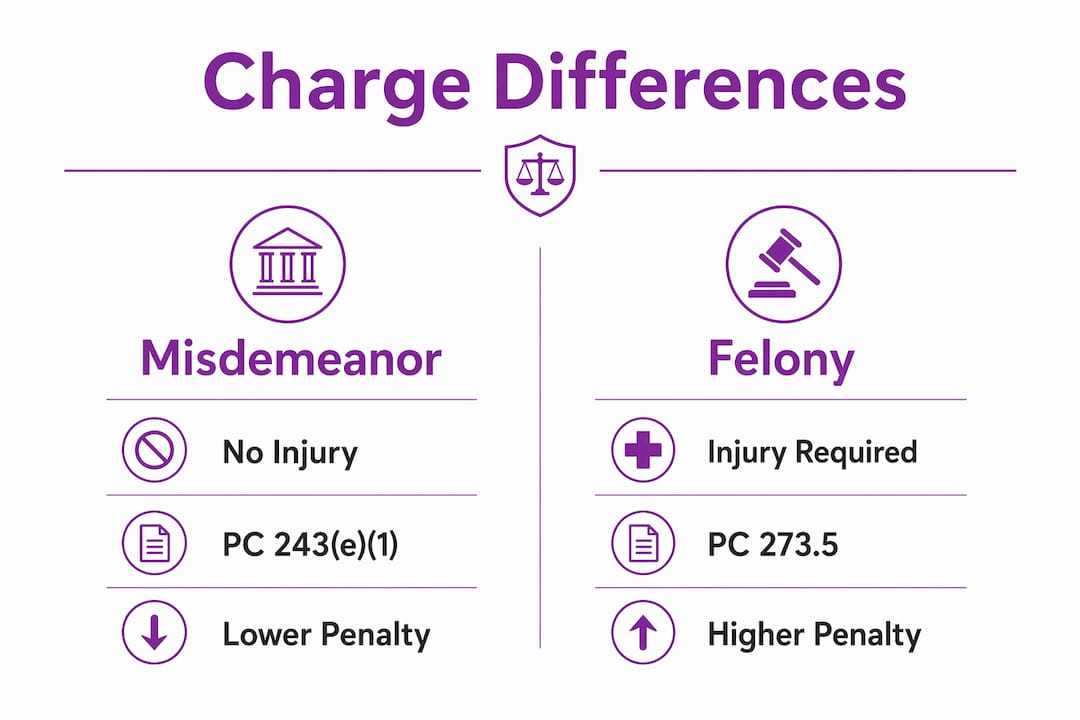
| Factor | PC 243(e)(1) Domestic Battery | PC 273.5 Corporal Injury |
|---|---|---|
| Injury required | No physical injury needed | Traumatic condition required |
| Charge classification | Straight misdemeanor | Wobbler (misdemeanor or felony) |
| Maximum jail/prison | Up to 1 year in county jail | Up to 4 years in state prison |
| Maximum fine | Up to $2,000 | Up to $6,000 |
| Qualifying relationship | Intimate partner or cohabitant | Spouse, cohabitant, or dating partner |
PC 243(e)(1) is a straight misdemeanor. The prosecution does not need to prove any injury occurred. Unwanted physical contact against a qualifying partner is enough. PC 273.5 requires proof of a "traumatic condition," which courts define as a wound or bodily injury caused by physical force.
The line between the two charges is often a bruise. Even minor bruises or scratches can escalate a misdemeanor filing to a felony wobbler under PC 273.5. That shift carries dramatically higher stakes, including potential state prison time and a permanent felony record.
Prosecutors weigh several factors when deciding whether to file a felony. Injury severity, weapon use, and prior convictions all push toward a felony charge. A first-time offense with no visible injury almost always lands as a misdemeanor. A second offense with any physical mark frequently becomes a felony.
Pro Tip: Do not make statements to police without an attorney present. Anything you say about the incident, including an explanation of how an injury happened, can be used to establish the "traumatic condition" element required for a felony charge.
What is the judicial process after a domestic violence arrest in California?
The process moves quickly after an arrest. Most defendants are arraigned within 48 hours, where the judge reads the charges and sets bail. A criminal protective order is almost always issued at arraignment, prohibiting contact with the alleged victim. Violating that order before your case resolves creates a separate criminal charge on top of the original filing.
Temporary Restraining Orders work on a parallel track. TROs are typically granted the same or next business day and remain in effect for about three weeks until a full evidentiary hearing. Within 48 hours of being served with a TRO, you must surrender all firearms to law enforcement or a licensed dealer. That requirement is not optional, and noncompliance is a separate crime.
If convicted, the sentencing structure under California domestic violence penalties follows a mandatory framework:
- Probation minimum. PC 1203.097 requires a minimum 36-month probation for any domestic violence conviction. This is not discretionary.
- Batterer intervention program. You must complete a state-certified one-year batterer intervention program as a condition of probation.
- Fines and restitution. Courts impose fines and may order restitution to the victim for medical costs or lost wages.
- Community service. Judges routinely add community service hours as part of the probation package.
- Protective orders. A criminal protective order typically runs for the full probation period and can extend up to 10 years for felony convictions.
- Mandatory jail minimums for repeat offenders. One prior conviction within 7 years triggers a 15-day minimum jail term. Two or more prior convictions require at least 60 days in county jail.
The probation conditions under PC 1203.097 reshape daily life in concrete ways. Missing a single batterer intervention session can trigger a bench warrant. Failing to pay fines can result in a probation violation hearing. The system is designed to monitor compliance closely.
What defenses are commonly used against domestic violence charges in California?
A charge is not a conviction. Several defenses apply directly to the elements prosecutors must prove under California domestic abuse laws.
- Self-defense or defense of others. California law permits the use of reasonable force to protect yourself or another person from imminent harm. The key word is "reasonable." The force used must match the threat faced.
- Accidental contact. PC 243(e)(1) requires willful touching. If the contact was accidental, the willfulness element fails. This defense works best when the physical evidence is ambiguous.
- No qualifying relationship. If the alleged victim does not meet the legal definition of an intimate partner or cohabitant, the domestic violence statutes do not apply. The charge may still proceed as simple battery, but the enhanced penalties disappear.
- Challenging the traumatic condition. For PC 273.5, courts have ruled that pain without physical evidence is insufficient to prove a felony. If no visible injury exists and no medical records document harm, the felony charge becomes harder to sustain.
- False accusation. Domestic disputes are emotionally charged. False reports do occur, particularly in the context of custody battles or divorce proceedings. Text messages, call logs, and witness statements can expose inconsistencies in the accuser's account.
One fact surprises many defendants: prosecutors control the case, not the alleged victim. Even if the victim wants to drop the charges, the state can proceed using photographs, 911 recordings, and witness statements. This means a defense attorney must address the evidence directly rather than relying on the victim's cooperation.
Pro Tip: If the alleged victim recants or refuses to cooperate, that does not end the case. Your attorney needs to challenge the physical evidence and any prior statements the victim made to police.
What are the risks of violating restraining orders and probation conditions?
Compliance failures are one of the most common ways defendants make their situation significantly worse. The rules are strict, and the consequences of breaking them are immediate.
- Firearm surrender. Failure to surrender firearms within 48 hours of a TRO or conviction triggers new criminal charges. This applies even if the firearm is registered legally and you have no prior record.
- Batterer intervention program. Failing to enroll in or complete the mandated program during probation results in bench warrants and potential additional penalties. Courts treat non-enrollment as a deliberate probation violation.
- Protective order contact. Any contact with the protected person, including a text message initiated by the victim, can be charged as a violation. The order protects the victim, not you. Their willingness to communicate does not give you legal permission to respond.
- Probation check-ins. Missing a scheduled meeting with your probation officer can result in a bench warrant and a probation revocation hearing.
Early legal counsel is the most effective way to manage these compliance requirements. An attorney can explain exactly what the protective order prohibits, set up a compliant firearm surrender process, and connect you with a state-certified batterer intervention program before the court requires proof of enrollment.
Key Takeaways
Domestic violence charges in California carry mandatory probation, firearm surrender, and batterer intervention requirements that begin the moment a restraining order is served or a conviction is entered.
| Point | Details |
|---|---|
| Two primary statutes | PC 243(e)(1) covers battery without injury; PC 273.5 covers corporal injury and can be filed as a felony. |
| Visible injury changes everything | Even a minor bruise can shift a misdemeanor charge to a felony wobbler under PC 273.5. |
| Prosecution proceeds independently | Victims cannot drop charges; the state files based on its own evidence, including photos and 911 calls. |
| Mandatory probation conditions | PC 1203.097 requires 36 months of probation and a one-year batterer intervention program for all convictions. |
| Compliance failures add charges | Missing firearm surrender deadlines or batterer program sessions creates new criminal exposure immediately. |
What I've learned defending domestic violence cases in Los Angeles
Most defendants I speak with share the same misconception: they believe the case ends if the alleged victim stops cooperating. That belief has cost people their freedom. California prosecutors are trained to build cases without victim testimony, and they are good at it. By the time a client comes to me after assuming the case would disappear, the prosecution has already locked in a 911 recording, officer body cam footage, and photographs of the scene.
The second pattern I see constantly is defendants who underestimate the probation conditions. A 36-month probation with a one-year intervention program sounds manageable until you realize that missing one session or one check-in can land you back in court facing a violation. The court's tolerance for non-compliance is essentially zero.
What actually works is early engagement. Clients who contact a domestic violence defense attorney before their arraignment have more options. Pre-filing intervention, diversion program eligibility, and evidence challenges all become harder to pursue once the case is already moving through the system. The window for the best outcomes is narrow, and it opens right after the arrest.
— Jake
How Rubinlawpc approaches domestic violence defense in California
Facing a domestic violence charge does not mean accepting the worst outcome. Rubinlawpc represents clients across Los Angeles County who are dealing with PC 243(e)(1) and PC 273.5 charges, from first-time misdemeanors to felony filings with prior conviction enhancements.

Rubinlawpc's attorneys appear in Los Angeles courtrooms regularly and know how local prosecutors build domestic violence cases. That courtroom familiarity translates into earlier identification of evidentiary weaknesses, faster access to diversion programs, and more targeted constitutional challenges. If you are facing criminal charges in Los Angeles, the time to act is before your arraignment, not after. Contact Rubinlawpc to discuss your case and your options.
FAQ
What is the difference between PC 243(e)(1) and PC 273.5?
PC 243(e)(1) is a misdemeanor requiring no physical injury, while PC 273.5 is a wobbler that requires proof of a traumatic condition and can be charged as a felony.
Can a domestic violence case proceed if the victim refuses to testify?
Yes. Prosecutors in California file and pursue domestic violence cases based on independent evidence, including 911 recordings, photographs, and officer statements, regardless of the victim's wishes.
How long does domestic violence probation last in California?
PC 1203.097 mandates a minimum 36-month probation period for all domestic violence convictions, along with a one-year batterer intervention program.
What happens if I do not surrender my firearms after a restraining order?
Failure to surrender firearms within 48 hours of a TRO or conviction is a separate criminal offense under California law and can result in new charges on top of the original case.
Can a first-time domestic violence charge be reduced or dismissed in California?
Yes. First-time offenders may qualify for diversion programs or plea agreements that result in reduced charges or dismissal, particularly when no visible injury occurred and the defendant has no prior record.