
Most California misdemeanors resolve relatively quickly, while felonies often take significantly longer, sometimes many months or years. The biggest swing factors are whether you're in custody, whether your case ends in a plea or goes to trial, and how crowded your courthouse's calendar is. Your first real checkpoint is arraignment, which for in-custody defendants must happen fast.
TL;DR:
- The timing of arraignment for in-custody defendants must occur within 48 business hours, while out-of-custody cases usually schedule arraignment within 10 days to a month.
- The statutory trial deadline for felonies is 60 days from arraignment, but delays often happen because of discovery disputes, pretrial motions, or court congestion.
- Pretrial negotiations and motions can resolve most cases before trial, making the case length more dependent on strategic choices than statutory limits.
- Case delays are common due to continuances for investigations, witness preparation, or scheduling conflicts, but courts require good cause for such extensions.
- Custody status influences case deadlines most significantly, with incarcerated defendants having stronger rights to expedite proceedings to secure favorable resolutions.
Table of Contents
- Understanding the Criminal Case Timeline in California, Stage by Stage
- What Are the Legal Deadlines That Control a California Criminal Case?
- Why Do Criminal Cases Get Delayed or Resolved Early?
- Your Practical Checklist: Dates and Questions That Matter Most
- Why Rubin Law, P.C.'s Courtroom Experience Matters Here
- Where to Verify These Deadlines Yourself
- What the Timeline Data Actually Tells You
- Sources
Understanding the Criminal Case Timeline in California, Stage by Stage
There's no single criminal case timeline California courts follow. What actually happens is a chain of hearings, each with its own purpose and its own clock. Some of those clocks are strict. Others bend depending on how the parties negotiate. Here's what the process actually looks like once you move past the headlines.
Arrest and booking
An arrest happens either by citation (you're released with a written promise to appear) or by full custodial booking (fingerprints, photos, holding cell). A citation release means your first court date could be weeks out. A booked arrest starts a much faster clock, because the Constitution and California law require prompt review of anyone held in jail.
Arraignment: your first real deadline
Arraignment is where the judge tells you the charges, you enter a plea (usually "not guilty" at this stage), and bail gets addressed. For defendants held in custody, arraignment generally has to happen within 48 business hours of arrest, excluding weekends and holidays. Out-of-custody defendants typically see their initial court date scheduled somewhere between 10 days and a month after charges are filed. Knowing what to expect at that first court date matters because decisions made here, like whether to waive time, ripple through everything that follows.
Pretrial: where most of the real work happens
This is the stage where cases actually get shaped. Prosecutors and defense attorneys exchange discovery (police reports, lab results, witness statements), file motions, and negotiate. California's own courts note that most criminal cases resolve before trial through a plea agreement or dismissal, which means the pretrial period, not the trial itself, is usually where a case's outcome and its length get decided. Plea bargaining can shorten a case dramatically, sometimes wrapping things up in a single hearing once terms are agreed.
Preliminary hearing (felonies only)
If you're charged with a felony, the case doesn't automatically go to trial. First, the prosecution has to show a judge there's enough evidence to proceed at a preliminary hearing, sometimes called a mini-trial. By statute, that hearing must occur within 10 court days of arraignment for defendants in custody, or 60 days for those out of custody. In practice, continuances push these dates back constantly, especially when defense counsel needs more time to review discovery or file a motion.
Trial: jury or bench, short or long
Before any trial starts, the court holds a readiness conference to confirm both sides are actually prepared. Jury selection alone can eat a day or several, depending on the charges. A straightforward misdemeanor bench trial might wrap in a day. A multi-defendant felony jury trial with expert witnesses can run weeks. Reviewing the full trial process ahead of time helps defendants understand what "trial ready" actually means on the court's calendar.
Sentencing and what comes after
If a case ends in conviction, sentencing typically happens weeks after the verdict or plea, giving probation officers time to prepare a report for the judge. From there, a defendant's options may include probation, appeal, or petitions to modify a sentence down the road.
Rough timeline snapshot:
- Booked arrest to arraignment: within 48 business hours (in custody)
- Citation arrest to arraignment: 10 days to a month
- Arraignment to preliminary hearing (felony): 10 court days in custody, up to 60 days out of custody
- Preliminary hearing to trial: weeks to several months, often longer with continuances
- Conviction to sentencing: typically several weeks
What Are the Legal Deadlines That Control a California Criminal Case?
The Sixth Amendment guarantees a right to a speedy trial, and California turned that constitutional promise into specific, enforceable numbers.
Key statutory deadline: Penal Code §1382 generally requires a felony trial to begin within 60 days of arraignment on the information, unless the defendant waives that time or a statutory exception applies.
These deadlines aren't just guidelines attorneys throw around loosely. They're hard defaults that courts have to work around:
- Misdemeanor trials generally must begin within 30 days of arraignment (in custody) or 45 days (out of custody), absent a waiver.
- Felony trials generally must begin within 60 days of arraignment on the information.
- Preliminary hearings must occur within 10 court days (in custody) or 60 calendar days (out of custody) of arraignment.
Custody status compresses all of this. A defendant sitting in jail has every incentive, and a statutory right, to push for the fastest possible resolution, so courts prioritize in-custody calendars over out-of-custody ones. That's also why defense counsel sometimes uses these deadlines as leverage. Coming close to a statutory trial date without the prosecution being ready can push toward dismissal or a more favorable plea, a dynamic that rewards attorneys who know how custody status shapes pretrial strategy.
Why Do Criminal Cases Get Delayed or Resolved Early?
Continuances are routine, but they're not automatic. Courts increasingly expect a real justification before pushing a trial date, and understanding why delays happen helps you tell the difference between normal case management and a red flag.
Common reasons a case slows down:
- Discovery disputes, where one side hasn't turned over evidence on schedule
- Expert witness preparation, particularly in DUI, forensic, or domestic violence cases
- Coordinating schedules across multiple co-defendants
- Pending pretrial motions, like a motion to suppress evidence
- Simple court congestion, especially in high-volume Los Angeles County courthouses
"Waiving time" means the defendant agrees to extend the statutory trial deadline. It sounds like giving something up, and in a sense it is, but it's often the smarter move. More time can mean a completed investigation, a stronger suppression motion, or room to negotiate a better plea. The tradeoff is real: waiving time also means staying in the legal system, and in custody, longer. Judges manage all of this under California Rules of Court Title 4, which requires continuance requests to show good cause rather than getting granted as a matter of course.
Pro Tip: Never agree to waive time just because it's presented as routine paperwork. Ask your attorney exactly what the extra time buys you, whether it's a pending lab result, a witness interview, or leverage in negotiations, before you sign off.
Your Practical Checklist: Dates and Questions That Matter Most
Whether you're the defendant or a family member trying to keep track, the same handful of dates and questions come up in nearly every case.
- Confirm custody status first. This determines every deadline that follows, including how fast arraignment happens.
- Write down the arraignment date the moment it's set, and confirm what plea was entered.
- Track the discovery deadline your attorney gives the prosecution, and follow up if it's missed.
- Note the preliminary hearing date for felony charges, along with any continuance and its new date.
- Mark the trial readiness conference and trial date, and ask directly whether time has been waived.
- Ask about diversion eligibility early. Programs can pause or resolve a case before trial ever becomes relevant.
Pro Tip: Keep a single physical or digital folder with every court document, date, and your attorney's contact notes. In a process with this many moving deadlines, the family member who can hand a paralegal an organized folder saves real time.
Why Rubin Law, P.C.'s Courtroom Experience Matters Here
Timelines on paper are one thing. What actually happens in a Los Angeles courtroom on a given Tuesday is another. Rubin Law, P.C. practices criminal defense across drug crimes, DUI, domestic violence, sex offenses, and violent and federal charges, and that work is built on frequent, direct courtroom appearances rather than occasional ones.
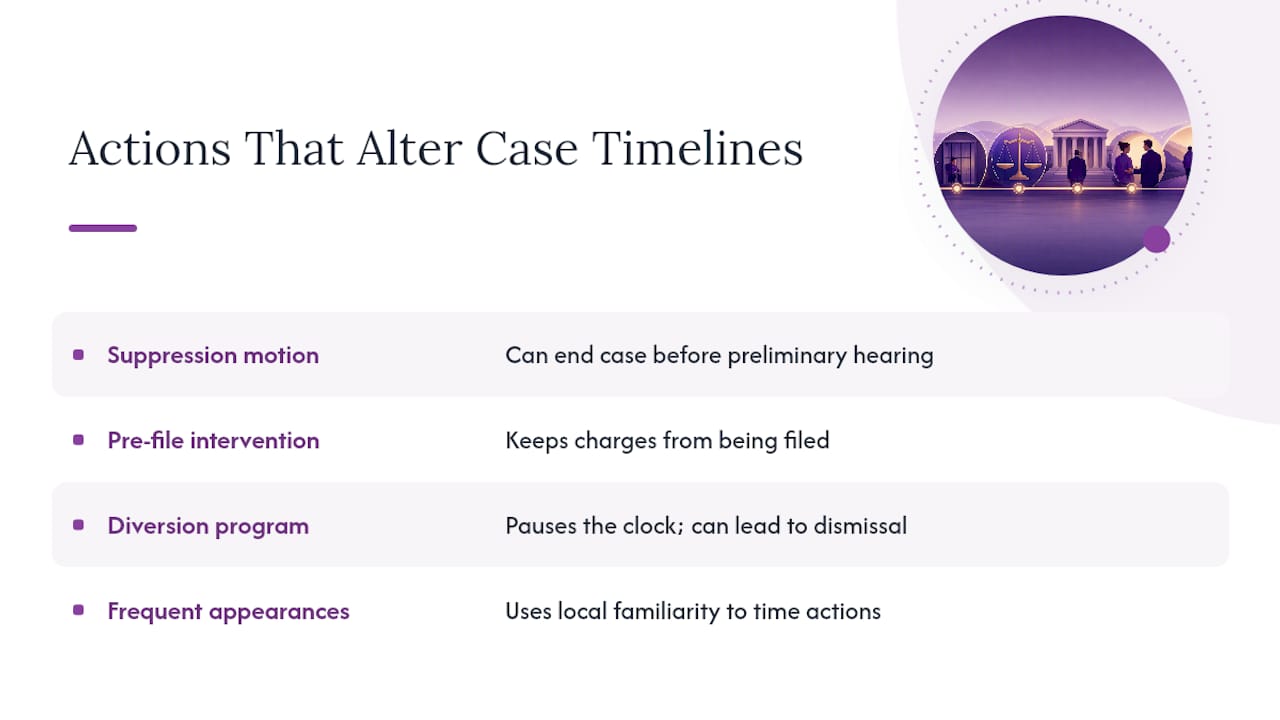
That local familiarity matters because timeline outcomes aren't fixed. A well-timed suppression motion can end a case before a preliminary hearing ever gets scheduled. A pre-file intervention can keep charges from being filed at all. A diversion program can pause the clock entirely while a client completes conditions that lead to dismissal. Rubin Law, P.C. uses constitutional challenges and diversion strategies specifically because they change how long a case runs and how it ends, not just when the next hearing lands on a calendar.
Where to Verify These Deadlines Yourself
Court rules change, and county practices vary, so always confirm current deadlines directly. Start with the California Courts Self-Help pretrial overview for plain-language explanations of each stage, and read Penal Code §1382 directly for the statutory trial deadline. For bail amounts and local filing procedures, check your county court's published bail schedule, since these figures differ by jurisdiction and get updated periodically.
What the Timeline Data Actually Tells You
The conventional advice out there treats a criminal case timeline like a fixed countdown clock. It isn't. The statutory deadlines, the 48 hours, the 10 or 60 days, the 60 day trial rule, are ceilings, not predictions. Most cases never come close to hitting them because pretrial negotiation resolves things first.
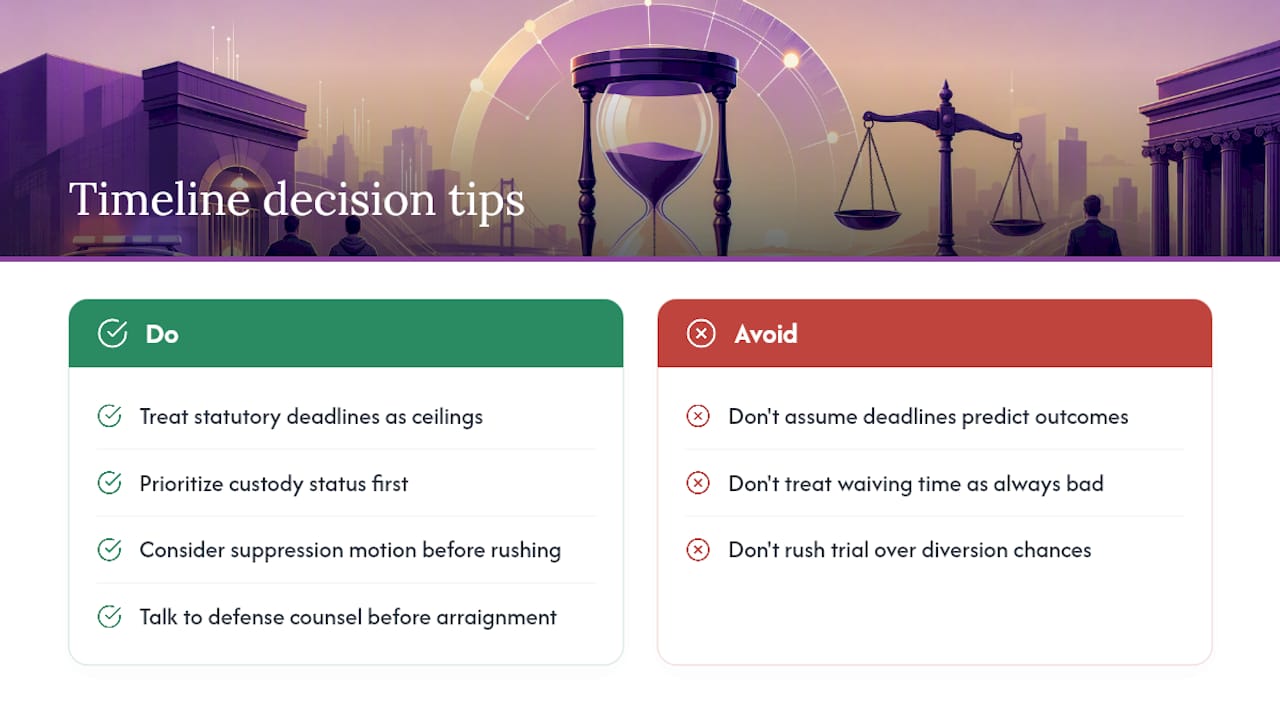
Where I think people get it wrong is treating "waiving time" as automatically bad and continuances as automatically suspicious. Sometimes the fastest path to a dismissal is the slower path through a well-built suppression motion. Sometimes rushing to trial on principle costs a client a diversion opportunity that would have cleared their record entirely.
If you take one thing from this, prioritize custody status first. It changes every deadline that follows and it's the one variable you can sometimes influence quickly through a bail motion, before the rest of the calendar even comes into play.
— Jake
If you or someone in your family is facing charges in Los Angeles, timing decisions made in the first days after arrest often shape everything that follows. Rubin Law, P.C. handles California criminal defense across drug, DUI, domestic violence, sex offense, and violent crime charges, with the courtroom frequency to know how local judges actually manage their calendars. Talk to a defense attorney before your arraignment, not after.
This article is general information, not a substitute for advice from a qualified lawyer. Consult a qualified legal professional about your own circumstances before acting on anything here.