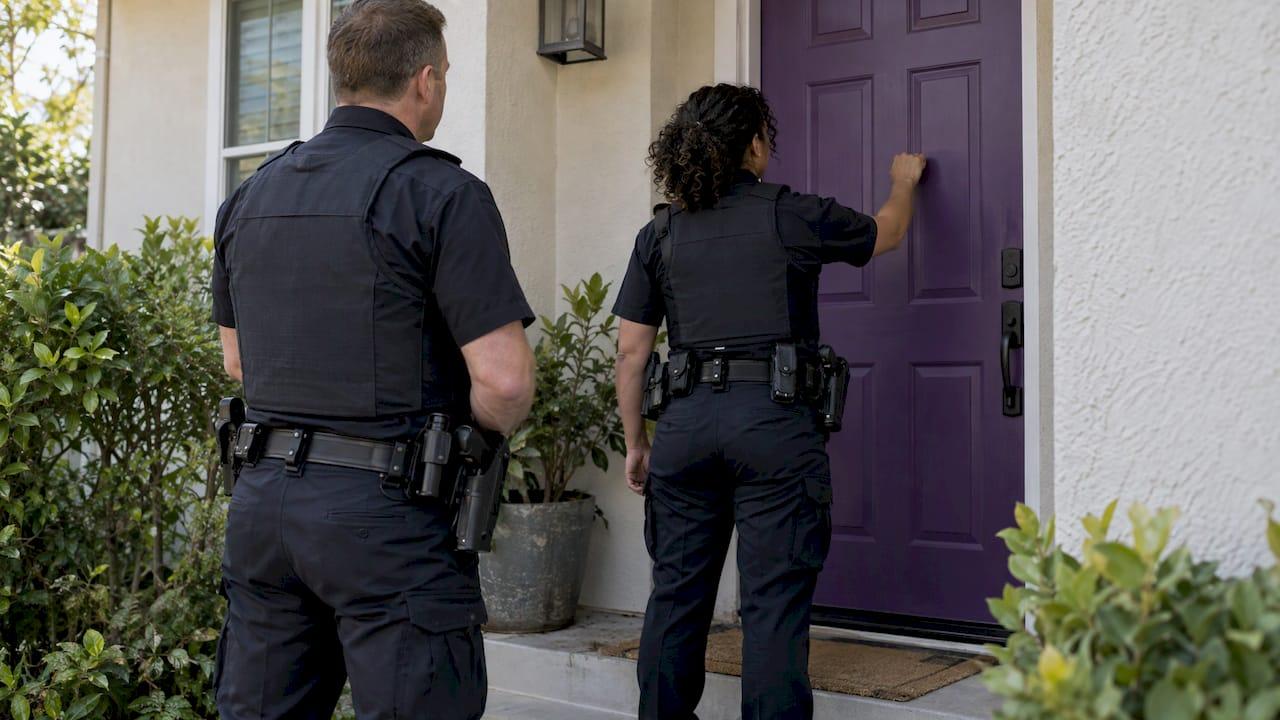
In California, officers who come to your home to make an arrest or serve a search warrant must first knock, identify themselves as police, state why they are there, and wait a reasonable time before forcing their way in. Courts excuse that duty only when specific facts known to the officers before entry show that compliance would be dangerous, futile, or allow evidence to be destroyed. If the police skipped the steps without a valid reason, the entry may be unlawful, and that can decide whether the evidence found inside is ever heard by a jury. If it just happened to you, a criminal defense attorney should review the warrant and the entry details quickly. At Rubin Law, P.C., challenging searches on constitutional grounds is part of what we do for clients in Los Angeles County.
TL;DR
- Under Penal Code sections 844 and 1531, officers must knock, announce they are police, state their purpose, and demand entry before breaking in.
- No statute sets a waiting time. Training materials point to roughly 30 seconds to a minute, and the answer depends on the facts of each case.
- Officers may skip the announcement only on specific, reliable facts showing danger, futility, or likely destruction of evidence. A general assumption about drug cases is not enough.
- An unexcused violation can lead to suppression of the evidence under California Supreme Court precedent.
- You do not have to consent to a search. Say so clearly, do not physically resist, and call a defense lawyer.
Table of Contents
- What the knock-and-announce rule requires
- How long officers have to wait
- Why the rule exists
- When officers can enter without knocking
- No-knock warrants in California
- What to do when police arrive with a warrant
- Can a knock-notice violation get evidence thrown out?
- How we approach a challenged entry at Rubin Law
- Our perspective
- FAQ
- Sources
What the knock-and-announce rule requires
California calls this rule "knock-notice." It comes from Penal Code sections 844 and 1531, which cover arrests and search warrants respectively. The federal counterpart for federal officers is 18 U.S.C. section 3109.
The California Court of Appeal in People v. Mays (1998) described the baseline. Before entering a residence, officers must knock or use other means reasonably calculated to give adequate notice of their presence, identify themselves as police officers, and explain the purpose of their demand for admittance.
The California Supreme Court said the same thing in People v. Murphy (2005): as a general rule, officers must identify themselves, explain their purpose, and demand admittance before entering a house to arrest or search.
Put together, a compliant entry has four parts:
- Knock or otherwise alert the occupants that someone is at the door.
- Announce authority: "Police, search warrant."
- Announce purpose: that they have a warrant, or are there to arrest.
- Wait long enough for the occupants to open the door peacefully.
The Sacramento Police Department's own training bulletin calls knock-notice an absolute requirement for arrests and search warrants, subject to the exceptions covered below. That is a useful fact: officers are trained on this rule, so a departure from it is something a defense lawyer can examine.
What counts as "breaking" in
People often assume the rule applies only when a door is battered down. It is broader. A California law enforcement publication explains that the rule applies whenever officers make a nonconsensual entry into a house to search or arrest, and that the word "break" has been read to mean any nonconsensual entry. Opening a closed but unlocked door can qualify.
Who must hear the announcement
The announcement does not need to reach every person in the home. In Mays, the court noted that identification and a statement of purpose need only be given to the person apparently in control of the premises. The same decision held that officers did not have to explain their purpose before the door was opened, only before they entered the residence.
Mays also addressed what happens once officers are inside. Because the officers had complied at the front door, they did not need to knock and announce again before entering a closed inner room.
How long officers have to wait
This is the question most people ask, and the honest answer is that no fixed number exists. The Sacramento bulletin states that the legislature and the courts have not mandated a precise waiting time, though case law typically points to 30 seconds to a minute, citing Hudson (2006) and Nealy (1991).
On the federal side, the Council on Criminal Justice notes that in U.S. v. Banks (2003) the Supreme Court ruled officers may enter after a 15 to 20 second notice of their intent to enter.

Those are guideposts, not a stopwatch rule. A court asks whether the wait was reasonable for the circumstances: the size of the home, the time of day, whether anyone could be heard moving, and whether officers had real reason to fear evidence would be flushed. For a defendant, the details matter. Body-worn camera footage, dispatch audio, the warrant return, and the officers' written reports often reveal how long the wait actually was.
Why the rule exists
In Murphy, the California Supreme Court identified four purposes of the rule, citing People v. King (1971):
- protecting the privacy of the householder;
- safeguarding innocent persons on the premises;
- preventing violent confrontations that follow unannounced entries;
- protecting the police from injuries caused by a surprised or fearful householder.
The Court of Appeal in People v. Miller (1999) explained the safety point in plain terms: a violent confrontation is more likely when occupants have no notice that the person bursting through their door is a police officer and not an intruder. That court also held that police must comply with knock-notice before entering a residence for investigative purposes, unless circumstances require instant entry or announcing would increase the danger of violence.
These purposes also explain how judges evaluate exceptions. A court will ask whether skipping the announcement was truly needed to protect people or evidence, or whether it was just faster.
When officers can enter without knocking
There are exceptions, and they are the center of most knock-notice disputes.
Exigent circumstances
Murphy quotes the long-standing standard from People v. Tribble (1971): strict compliance is excused if the specific facts known to the officer before entry support a good faith belief that compliance will increase his peril, frustrate the arrest, or permit the destruction of evidence.
The key words are "specific facts known before entry." A California law enforcement publication spells out the limit: exigency requires specific, apparently reliable information, not unsubstantiated street talk or unjustified but sincere fear. It adds that officers may not assume that certain kinds of suspects, most notably drug dealers, will always try to destroy evidence or arm themselves.
The California Supreme Court agrees that no blanket rule exempts all narcotics cases. A specific showing has to justify an unannounced entry. For anyone facing a drug charge after a raid, that principle is a starting point for a challenge.
What a justified unannounced entry looked like in Murphy
In Murphy, the court upheld a no-knock entry because several facts lined up: ongoing drug sales at the home, the officers' knowledge that the defendant was on probation for a drug offense and had consented to warrantless searches, an unplanned noisy confrontation with a suspect right outside the open doorway, and the officers' loud announcement of their presence and purpose to that suspect. It was the combination, not any one fact, that carried the day.
A Sacramento police spokesperson described the everyday version of exigency: situations where officers must prevent possible danger to someone, prevent destruction of evidence, or stop a suspect's escape.
Parole and probation searches
Probation or parole status does not erase the rule. The Sacramento bulletin says that for searches of a parolee's or probationer's residence, knock-notice requirements still apply, though they may be excused entirely or only substantially complied with depending on the circumstances.
No-knock warrants in California
People searching for "no knock warrant California" usually want to know whether a judge can authorize police to skip the announcement in advance. In practice, yes, under limits.
A California law enforcement publication says officers may ask the issuing judge for no-knock authorization if the affidavit shows reasonable suspicion that knock-notice would be futile, dangerous, or result in destruction of evidence. Even with authorization, officers must not make a no-knock entry if they learn that circumstances have changed and the need is gone.
That last point gives a defense lawyer room to work. A judge's approval reflects what officers knew when they wrote the affidavit. If the officers saw the situation change before they went in, the authorization may not protect the entry.
Nationally, the picture varies. As of 2020, the Council on Criminal Justice reports, most states allowed no-knock warrants in some form, while Oregon prohibited them entirely, Florida restricted them, and Utah banned those based solely on suspicion of drug possession. California is not on that list of outright bans. Individual police departments may also set stricter policies of their own.
The same publication gives context on how often forced entry happens. A records review of 818 SWAT deployments across 11 states between 2010 and 2013 found that 62% were for drug searches, and forced entry was used in 60% of those. Raids that begin with forced entry are common, which is why the rules around them matter.
What to do when police arrive with a warrant
The moment is stressful, and what you do in it can affect your case. These steps stay within your rights and keep you safe:
- Stay calm and keep your hands visible. Do not run, hide things, or physically resist, even if you believe the entry is unlawful. The legal fight happens afterward, in court.
- Ask to see the warrant. San Francisco's city guidance explains you can talk to officers through a window and ask them to slip the warrant under the door. A valid warrant is signed by a judge or magistrate, shows the address to be searched, and describes where police may look.
- Read what it covers. The American Bar Association notes that a warrant should include the judge's name, the address, the date, the place to be searched, a description of the items sought, and the name of the agency conducting the search. Police may only look at what the warrant lists.
- Do not consent to anything beyond the warrant. An officer may ask permission to look in your home or car. You do not have to allow it, and the ABA suggests clearly saying, "No, I don't consent to searches."
- You do not have to answer questions. Say that you want a lawyer, then stop talking.
- Write down what you observe. Note when they arrived, how long they knocked, what they said, and whether the door was opened by you or by force. Memory fades fast, and these details are the heart of a knock-notice claim.
- Call a criminal defense attorney right away. Early contact lets a lawyer preserve evidence such as camera footage before it is overwritten.
One thing to know: a consent search is a different problem from a warrant search, and your words at the door can turn a challengeable search into a lawful one. Our guide on calling a lawyer after a California consent search explains why timing matters.
Can a knock-notice violation get evidence thrown out?
Potentially, yes. In Duke v. Superior Court (1969), the California Supreme Court held that an unexcused failure to meet the knock-and-notice requirements of Penal Code section 844 nullifies the later search and requires exclusion of the evidence, because the search is unreasonable under the Fourth Amendment.
Whether that outcome applies in your case turns on the facts: what the officers said, how long they waited, what they knew beforehand, and whether an exception covers them. Suppression is also not automatic. The defense has to raise the issue in the proper motion and build a record for it.
That motion in California practice is typically brought under Penal Code section 1538.5. Our articles on how to stop an illegal search within 48 hours using PC 1538.5 and how to avoid waiver when filing a 1538.5 motion walk through the mechanics. If you are worried about what happens to items seized, see preserving evidence after an unlawful police search.
Facts that matter in a knock-notice challenge
- How the officers identified themselves, and whether anyone could realistically hear it.
- Exactly how long they waited before forcing entry.
- What the warrant said about no-knock authorization, and what the affidavit relied on.
- Whether officers had specific, reliable information of danger or evidence destruction, or only general assumptions.
- Whether anything changed on scene that made a no-knock entry unnecessary.
- Whether the person in control of the premises was the one who received notice.
- Whether the entry was in the daytime or at night, and whether the warrant authorized night service.
Because these questions come down to specifics, a reading of the police report alone is rarely enough. Video, radio traffic, and the officers' testimony at the hearing are where weaknesses surface.
How we approach a challenged entry at Rubin Law
If you were arrested after a raid, or are under investigation and expect one, our practice covers the charges that most often follow a home search: drug crimes, domestic violence, sex offenses, violent crimes, and federal cases. We handle constitutional search and seizure challenges, and we offer pre-file intervention for clients who learn they are under investigation before charges are filed. You can see the full range of what we defend on our criminal defense page.
Our approach is built on frequent courtroom appearances in Los Angeles County and direct attorney attention to each client's case. When the police entered your home, we look at how they did it first.

If officers have searched your home, or you have been told a warrant is coming, contact Rubin Law, P.C. through our website as soon as you can. The sooner we see the warrant and the entry details, the more we can preserve.
Our perspective
Most people think a search is judged by what the police found. We think it should be judged first by how they got in. A court looks at the door before it looks at the contraband.
Knock-notice is not a technicality. California's highest court has tied it to privacy, to the safety of innocent people in the home, and to the safety of the officers themselves. When an entry skips those protections without specific, reliable facts behind it, that is a constitutional issue, and we raise it.
Our practice is built around being in the courtroom often in Los Angeles County, which means we know how judges and prosecutors approach these motions. We use constitutional search and seizure challenges as a core tool, and we start working early, because the evidence that proves what happened at your door, such as video and logs, does not wait.
If you are facing charges after a warrant was served on your home, bring us the paperwork, tell us what you remember, and let us examine the entry before anyone decides what the case is worth.
Jake
FAQ
Are no-knock warrants legal in California?
California law does not bar them outright. A judge can authorize an unannounced entry when the affidavit shows reasonable suspicion that knocking would be futile, dangerous, or allow evidence to be destroyed. Officers still cannot use that authorization if circumstances change and the need disappears. Some local police departments have stricter policies of their own.
Can police enter my home without knocking in a drug case?
Not simply because the case involves drugs. The California Supreme Court has said there is no blanket exemption for narcotics investigations. Officers need specific facts, known before entry, showing that announcing themselves would create danger, frustrate the arrest, or lead to the destruction of evidence.
How long do police have to wait after knocking?
No statute sets an exact time. Police training materials cite case law pointing to roughly 30 seconds to a minute, and the U.S. Supreme Court has approved entry after a 15 to 20 second wait in one case. Courts judge the wait by the circumstances, so the facts of your case control.
Do I have to open the door if police knock?
If they have no warrant and no exigent circumstances, you generally do not have to let them in, and you can speak to them through the door or a window. A valid warrant, exigent circumstances, or parole or probation search conditions can change that. Do not resist physically in any case, and contact a criminal defense attorney afterward.
Will evidence be thrown out if police did not knock and announce?
It can be. California's Supreme Court has held that an unexcused knock-notice failure requires exclusion of the evidence obtained. Whether the failure was excused depends on the facts, and the defense must raise the issue by motion, so speak with a defense lawyer quickly.
Sources
- People v. Mays (1998), California Court of Appeal
- Roll Call Training Bulletin, Sacramento Police Department
- Knock-Notice, California law enforcement publication
- People v. Murphy (2005), California Supreme Court
- People v. Miller (1999), California Court of Appeal
- Duke v. Superior Court (1969), California Supreme Court
- No-Knock Warrants and Police Raids, Council on Criminal Justice
- When do I legally have to open my door to police in CA?, Sacramento Bee
- Know your rights around a police officer, SF.gov
- Know Your Rights, American Bar Association