
The strongest robbery defenses in California attack the elements the prosecution must prove under Penal Code §211: force or fear, a taking, and possession against the victim's will. Misidentification, insufficient force or fear, claim of right, and constitutional suppression of evidence are the arguments that most often move a case toward dismissal or reduction. Penalties hinge on degree and enhancements under §211 and §213, so the single most urgent move is to contact a defense attorney before answering any police questions.
TL;DR:
- The force or fear element must be proven at the moment of taking property, not before or after, and the victim's immediate presence is necessary for a robbery charge.
- Penalties vary by degree, with first-degree robbery carrying 3 to 9 years in prison plus potential sentencing enhancements and lasting collateral consequences.
- Defenses often focus on disproving elements like the actual taking, force or fear at the right time, or claiming a sincere belief of entitlement to the property.
- Suppression of illegal evidence, improper identification procedures, and weaknesses in surveillance footage or digital records are key strategies to challenge the case.
- Early legal intervention, including motions to suppress and prefile negotiations, can significantly impact whether charges are reduced or dismissed.
Table of Contents
- What Counts as Robbery Under California Law?
- What Are the Penalties for Robbery in California?
- Common Legal Defenses to Robbery Charges
- How Do You Attack the Evidence in a Robbery Case?
- What Should You Do Right After a Robbery Arrest?
- How Do Defense Attorneys Build a Robbery Case?
- When Can Robbery Charges Be Reduced or Dismissed?
- How Does Juvenile Status Change a Robbery Case?
- A Practitioner's Take on Fighting Robbery Charges
- Get Legal Help for a Robbery Charge in Los Angeles
- Sources
- FAQ
What Counts as Robbery Under California Law?
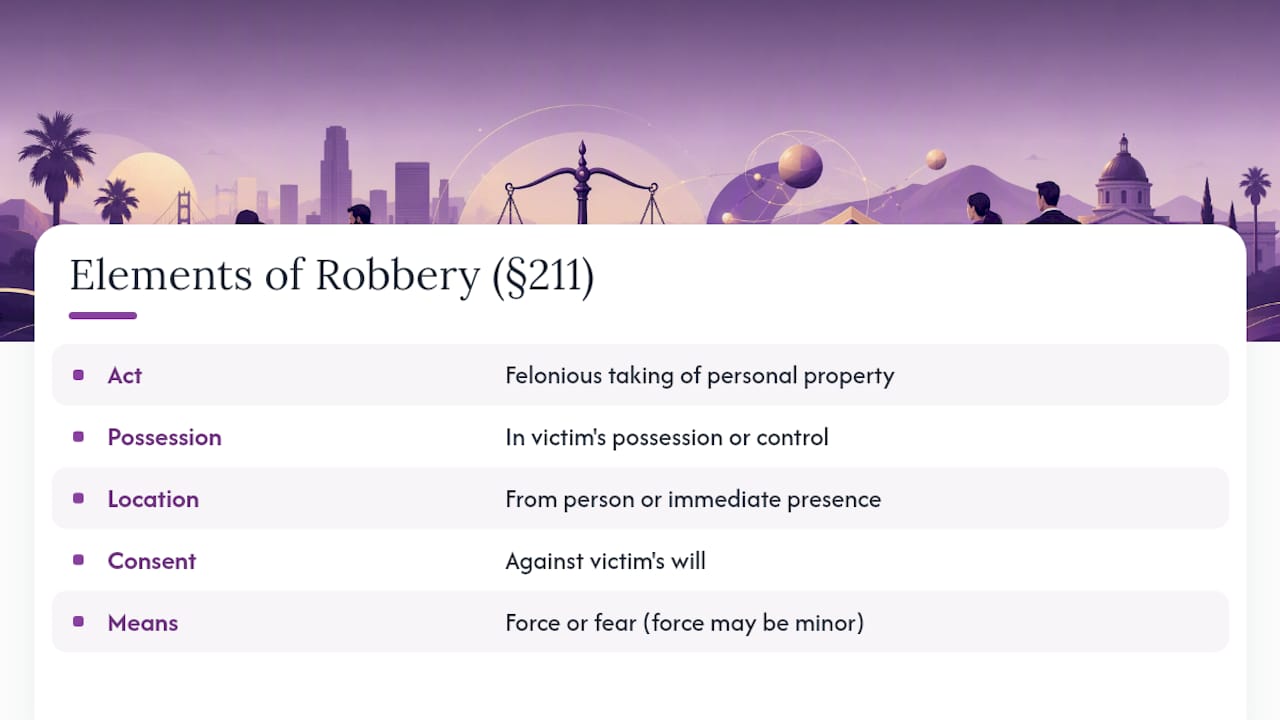
California defines robbery in blunt terms. Under Penal Code §211, robbery is "the felonious taking of personal property in the possession of another, from his person or immediate presence, and against his will, accomplished by means of force or fear." Every word in that sentence is a fact the prosecution has to prove beyond a reasonable doubt, and every word is a potential opening for the defense.
"Force" means physical compulsion, even minor. "Fear" covers threats to the victim, their family, or their property, and it doesn't require the victim to believe a weapon was real. The timing matters just as much as the definition: the force or fear has to exist at the moment of the taking, not before or after it. California courts have repeatedly stressed this timing requirement, and cases like People v. Hayes show how appellate courts scrutinize the sequence of events when a taking starts as simple theft and force only comes into play afterward.
Robbery also has to happen "from a person or immediate presence," meaning the property has to be close enough to the victim that they could have stopped the taking if not for the force or fear.
Degree matters for sentencing. Second-degree robbery is the default. First-degree robbery applies to carjackings, robberies inside an inhabited dwelling or structure, robberies of a person using or just having used an ATM, and robberies committed on certain transit vehicles or their passengers, all detailed in Chapter 4 of the Penal Code. These qualifiers under §212.5 aren't minor technicalities. They can add years to a sentence, which is why a detailed breakdown of robbery under §211 is worth reading closely if you're facing charges tied to any of these circumstances.
What Are the Penalties for Robbery in California?
Sentencing ranges are set out plainly in Penal Code §213. First-degree robbery carries 3, 4, or 6 years in state prison, or 3, 6, or 9 years when specific aggravating circumstances apply. Second-degree robbery carries 2, 3, or 5 years.
Those numbers are the floor of what's at stake, not the ceiling. Robbery is a "strike" offense under California's Three Strikes law, so a conviction can carry consequences that outlast the sentence itself, including doubled penalties for future felonies. Enhancements for firearm use, great bodily injury, or acting with an accomplice can stack additional years onto the base term. A prior record, even one unrelated to violent crime, often shapes how a prosecutor approaches plea negotiations and how a judge views sentencing discretion.
The collateral damage extends well beyond prison time. A robbery conviction is an automatic firearm prohibition. For non citizens, it can trigger deportation or bar future immigration relief. It shows up in background checks for years, closing doors to jobs, professional licenses, and housing long after any sentence ends.
Common Legal Defenses to Robbery Charges
Every robbery case turns on which element the prosecution can't prove cleanly. Defense strategy usually starts by identifying that weak link and building the entire case around it.
No taking or no possession. If the property never actually left the victim's possession, or if it was abandoned rather than seized, the taking element collapses. This comes up often in chaotic street encounters where property changes hands more than once, or where the alleged victim dropped an item before any contact occurred.
No force or no fear. The State has to prove force or fear existed at the moment of the taking, not as an afterthought. If a defendant grabbed an item and fled without threat or contact, that's theft, not robbery. Attorneys frequently focus here because the line between grand theft and robbery is often thinner than prosecutors present it.
Claim of right. California recognizes an honest belief defense: if a defendant genuinely believed they were entitled to the property, that belief can defeat the intent element robbery requires. But CalCRIM guidance on claim of right limits this defense sharply. It fails if the defendant tried to conceal the taking, based the claim on an illegal debt or offset, or engaged in conduct widely understood to be criminal. Claim of right works in narrow fact patterns, mostly disputes over specific property between people who know each other, not as a general escape hatch.
Mistaken identity and alibi. Robbery cases often hinge on split-second identifications made under stress, in poor lighting, or across racial lines where identification error rates climb. An alibi supported by phone records, receipts, or witnesses can dismantle a case built entirely on someone pointing a finger.
False accusation and witness motive. Some robbery allegations stem from disputes that get relabeled after the fact, a drug deal gone bad, a personal grudge, or an attempt to avoid other consequences. Inconsistent statements, a delayed report, or a witness with a documented motive to lie all matter here.
Constitutional and factual gaps. Cases built on rushed investigations sometimes miss basic questions of intent or opportunity, opening room to argue the evidence simply doesn't add up to robbery under §211.

Pro Tip: Don't assume claim of right will save a case just because you believed the property was yours. Courts look hard at whether you tried to hide the taking. If you announced it openly or left a note, that fact helps; if you snuck around, it usually hurts.
How Do You Attack the Evidence in a Robbery Case?
Robbery convictions live and die on evidence quality, and most of that evidence has a weak point somewhere.
Statements made to police are a common battleground. If officers failed to give Miranda warnings before a custodial interrogation, or if a "confession" came after hours of pressure without access to counsel, suppression motions can strip that statement from the case entirely.
Eyewitness identification is another frequent target. Suggestive lineup procedures, cross-racial identification errors, and stress-induced memory distortion are all documented weaknesses that defense attorneys raise in cross-examination and pretrial motions.
Surveillance footage feels ironclad to jurors, but it rarely is. Poor camera angles, missing timestamps, low resolution, and gaps in coverage all create room for reasonable doubt. The same goes for physical evidence: a broken chain of custody, whether an item was mishandled, mislabeled, or left unsecured, can get forensic evidence excluded outright.
Digital evidence carries its own vulnerabilities. Cell-site location data, transaction timestamps, and phone records require careful forensic review; sloppy authentication or misread metadata can undercut evidence prosecutors treat as decisive. Because surveillance footage, eyewitness testimony, physical evidence, and digital records form the backbone of most robbery prosecutions, an attorney who knows how to dismantle each type methodically often finds the case's real weakness within days of reviewing the file.
- Statements: check for Miranda violations and coerced or involuntary confessions.
- Eyewitness IDs: scrutinize lineup procedures and cross-racial identification reliability.
- Video: examine timestamps, angles, and resolution gaps.
- Chain of custody: trace every hand that touched physical evidence.
- Digital records: demand forensic authentication of cell-site and transaction data.
What Should You Do Right After a Robbery Arrest?
The first 48 hours after an arrest often decide how the rest of the case unfolds.
- Stay silent and request counsel. Anything said to police, even something that feels harmless, can become evidence. Politely decline to answer questions until an attorney is present.
- Don't consent to searches. Refusing consent doesn't stop police from getting a warrant if they have grounds, but it preserves your right to challenge an unlawful search later.
- Preserve everything. Photograph the scene if it's safe, save receipts, screenshots, and phone records, and write down anything you remember before memory fades.
- Get witness information. Names and phone numbers of anyone who saw what happened are often impossible to recover once the moment passes.
- Stay off social media. Posts get pulled into discovery constantly, and even innocent comments get twisted by prosecutors.
- Call a criminal defense attorney immediately. Early intervention opens doors, suppression motions, prefile negotiations, diversion eligibility, that close fast once charges are filed.
Pro Tip: Write down every detail you remember about the arrest itself: officer names, badge numbers, time of day, and exact wording used. Memory fades within days, and those details sometimes become the basis for a successful suppression motion months later.
How Do Defense Attorneys Build a Robbery Case?
Experienced defense work starts before trial, often before charges are even filed. Attorneys who appear in Los Angeles County courtrooms regularly develop a working knowledge of how specific judges and prosecutors handle robbery cases, which shapes everything from suppression strategy to plea timing.
Pretrial motions carry enormous weight. A motion to suppress an illegal search, an involuntary statement, or a tainted identification can gut a prosecution's case before a jury ever hears it. Discovery violations, evidence the State was required to turn over but didn't, can also force a case toward dismissal or a favorable plea.
Diversion programs and prefile intervention offer another path where eligibility allows it. Prefile intervention means reaching out to a prosecutor's office before charges are formally filed, presenting mitigating facts or evidence weaknesses, and sometimes persuading the office not to file at all. This only works with attorneys who understand how a specific office evaluates cases, which is why frequent courtroom presence matters as much as legal knowledge.
The decision between trial and plea comes down to a handful of factors: how strong the identification evidence is, whether DNA or video corroborates the accusation, how reliable the witnesses are under cross-examination, and what a prior record does to sentencing exposure. brand signal: courtroom frequency and local prosecutorial familiarity
When Can Robbery Charges Be Reduced or Dismissed?
Reductions happen more often than most defendants expect, especially when evidence has real cracks in it. A robbery charge frequently gets negotiated down to grand theft, attempted robbery, or simple assault when the force or fear element is shaky or when identification evidence is weak.
Dismissal becomes realistic when a suppression motion succeeds, a key witness becomes unavailable, or the State's evidence simply doesn't hold together under scrutiny. Prosecutors drop or reduce charges far more readily once they see a defense that's ready to litigate every weak point rather than accept the first offer on the table.
Accepting a plea trades certainty for finality: you know the outcome, but you carry a conviction and its consequences going forward. That trade-off deserves serious thought, not a rushed signature in a courthouse hallway.
Even after conviction, options remain. Expungement under §1203.4 can clear certain records once probation and sentencing terms are satisfied, and vacating a conviction for immigration purposes is possible in specific circumstances. Related charges like attempted robbery under §664 or carjacking under §215 sometimes become the actual charge a case resolves to, rather than robbery itself.
How Does Juvenile Status Change a Robbery Case?
Minors charged with robbery face a fundamentally different system, though not necessarily a lighter one. Juvenile court in California emphasizes rehabilitation over punishment for most offenses, but robbery is serious enough that prosecutors sometimes push for a minor to be tried in adult court, particularly for older teens or cases involving weapons.
Defense strategy for juveniles often layers in additional angles: peer pressure and group dynamics in cases involving multiple minors, incomplete brain development arguments relevant to intent and impulse control, and eligibility for juvenile diversion programs that don't exist in adult court. A juvenile adjudication for robbery can still count as a strike in specific circumstances, which makes it critical to challenge the case as aggressively as an adult matter rather than assuming the juvenile system guarantees leniency.
Parents and guardians play a bigger procedural role too, from custody hearings to consent for certain interviews. The stakes around a juvenile record are different but not smaller: a sustained robbery petition can affect school enrollment, sealing eligibility later, and how future adult charges get evaluated. Anyone facing a juvenile robbery matter should treat the first few days exactly the way an adult defendant would: silence, counsel, and a fast start on the defense before statements get locked in.
A Practitioner's Take on Fighting Robbery Charges
Frequent courtroom appearances teach you something textbooks don't: outcomes rarely turn on abstract legal theory. They turn on which specific fact a specific prosecutor or judge finds unconvincing, and catching that early changes everything. Case outcomes always depend on the actual facts and how fast the defense moves.
— Jake
Get Legal Help for a Robbery Charge in Los Angeles
This firm is an option built for cases that need aggressive early intervention, not a call center that hands you off to whoever picks up the phone. Robbery cases move fast in Los Angeles County courts, and an effective approach centers on frequent courtroom appearances and direct familiarity with how local prosecutors evaluate evidence, which shapes suppression strategy and prefile negotiation from day one.

Services relevant to a robbery charge include violent crimes defense, constitutional search and seizure challenges, prefile intervention, and diversion program guidance where eligibility allows it. A consultation is the place to lay out the specifics: bring the police report if you have one, any bail paperwork, witness contact information, and copies of anything the prosecution has already shared. Every one of those documents helps shape a faster, more specific strategy than a general conversation ever could.
Visit the criminal defense practice page to see the full range of services or to reach the firm directly and get a case evaluation started before your next court date.
Sources
Read the statutes directly rather than relying on secondhand summaries. Penal Code §211 defines robbery itself, §213 sets sentencing ranges by degree, and CalCRIM's claim-of-right guidance explains exactly where that defense applies and where it fails. For a broader look at how robbery compares to related charges, the burglary statute under §459 is worth reviewing side by side.
This article is general information, not a substitute for advice from a qualified lawyer. Consult a qualified legal professional about your own circumstances before acting on anything here.
- California Legislative Information — Chapter 4. Robbery 211 - 215
- CalCRIM / Justia — Claim of right defense guidance
FAQ
What is the minimum sentence for robbery in California?
Second-degree robbery carries a minimum of 2 years in state prison, while first-degree robbery carries a minimum of 3 years, both under Penal Code §213. Actual sentences can run higher depending on enhancements, prior convictions, and whether the case involves qualifying circumstances like carjacking or robbery inside a dwelling.
What is the new law for stealing in California?
California's theft laws have adjusted thresholds and penalties for certain theft offenses, but robbery itself remains governed by Penal Code §211 and carries felony-level consequences regardless of property value, since the force-or-fear element separates it from simple theft.
What is the difference between robbery and burglary in California?
Robbery requires taking property directly from a person through force or fear, while burglary involves entering a structure with intent to commit theft or another felony, even without any confrontation. The two can overlap when a burglary turns into a face-to-face confrontation, but they're charged and sentenced under different statutes.
How does a prior criminal record affect a robbery charge?
A prior conviction, especially for a violent felony, can trigger strike enhancements and push prosecutors toward harsher plea offers or longer requested sentences. It also affects a judge's sentencing discretion, which is why attorneys often address prior record strategy early in case planning.
Can a robbery charge be reduced to a lesser offense?
Yes, robbery charges are frequently negotiated down to grand theft, attempted robbery, or assault when identification evidence is weak or the force-or-fear element is difficult to prove. Firms like Rubin Law, P.C. build these negotiations around specific evidentiary weaknesses rather than generic plea requests.