
Yes, defenses such as self-defense, accident, or a false allegation can defeat a domestic battery charge in California, but none of them win automatically. Success depends entirely on the specific facts, the evidence you preserve in the first 48 hours, and how aggressively your attorney challenges the prosecution's case. Charges under California Penal Code §243(e)(1) are misdemeanors, and jurors evaluating a self-defense claim rely on CALCRIM No. 3470 to decide whether the prosecution has disproved it beyond a reasonable doubt.
Your first move is not to explain yourself to police. It is to stop talking and call a defense attorney, such as Rubin Law, P.C., before you say another word about the incident.
- Do not speak to law enforcement beyond identifying yourself.
- Preserve texts, photos, 911 audio, and witness contact information immediately.
- Call a criminal defense attorney before your arraignment, not after.
Quick fact: A conviction under PC §243(e)(1) can bring up to one year in county jail and fines up to $2,000, even when the alleged victim shows no visible injury.
Key Takeaways
Domestic battery charges under PC §243(e)(1) require proof of willful, harmful, or offensive touching of an intimate partner, and viable defenses like self-defense, accident, or false allegation depend entirely on evidence preserved early and legal counsel engaged immediately.
| Point | Details |
|---|---|
| No injury required | Prosecutors can charge PC §243(e)(1) without any visible injury, so credibility evidence matters most. |
| Willfulness is the key element | Proving contact was accidental or reflexive, not intentional, often defeats the charge outright. |
| Self-defense has a real standard | CALCRIM No. 3470 requires reasonable belief of imminent harm and proportional force, not a free pass. |
| Consequences extend past jail | A conviction can trigger firearm bans, the 52-week batterer intervention program, and immigration risk. |
| Get counsel immediately | Rubin Law, P.C. uses constitutional challenges and pre-file intervention to fight these charges before a plea locks anything in. |
Table of Contents
- What the Law Requires: The Elements of PC §243(e)(1)
- Common Defenses: Self-Defense, Accident, False Allegations, and More
- Evidence That Proves or Destroys a Defense
- Penalties and Collateral Consequences You Need to Understand
- What to Do Right Now: A Prioritized Checklist
- How a Defense Lawyer Actually Fights These Charges
- Statute of Limitations for Domestic Battery Charges
- Recent Changes to California Domestic Battery Laws
- Prior Convictions and How They Reshape Your Strategy
- How Restraining Orders Affect a Domestic Battery Case
- Misdemeanor vs. Felony Domestic Battery: Different Defense Playbooks
- Mandatory Arrest Policies and What They Mean for Your Defense
- A Straight Answer From Someone Who's Been in These Courtrooms
- Choosing Rubin Law, P.C. for Your Domestic Battery Defense
- Sources
What the Law Requires: The Elements of PC §243(e)(1)
Domestic battery under PC §243(e)(1) does not require a bruise, a scratch, or any injury at all. The law only requires willful and harmful or offensive touching of an intimate partner. That is a lower bar than most people assume, and it is exactly why so many charges get filed on thin evidence.
Three elements make up the offense:
- Willful: the touching was intentional, not accidental or reflexive.
- Harmful or offensive touching: any contact done in a rude, angry, or disrespectful manner counts, not just violence that leaves a mark.
- Intimate partner: a spouse, former spouse, cohabitant, co-parent, or someone in a current or former dating relationship.
"Willful" is the word that carries the whole case. A shove during an argument that was accidental, reflexive, or done in genuine self-protection is not willful battery, even if it looks bad on a body camera. Because no visible injury is required to sustain the charge, prosecutors often build cases on testimony alone, which means your defense strategy should focus squarely on undermining that one element: was the touching actually intentional, and did it actually happen the way it was described? Understanding the statute's exact language matters because every defense downstream depends on which element you're attacking.
Common Defenses: Self-Defense, Accident, False Allegations, and More
Not every defense fits every case, and picking the wrong one can hurt your credibility with a jury. Here's how the major defenses actually work in practice.
- Self-defense. Under CALCRIM No. 3470, you must show you reasonably believed you or someone else faced imminent bodily harm, that force was necessary to stop that threat, and that you used no more force than reasonably necessary. California courts have long held there's no duty to retreat for a non-aggressor, but proportionality is everything. Shoving back after being shoved can qualify; escalating to a punch when the threat has already ended usually does not.
- Lack of willfulness (accident). If the contact happened while separating a fight, during a struggle over an object, or as a reflex, willfulness is missing. Video, texts sent immediately afterward, and witness accounts of the physical layout of the room often prove this defense.
- False allegations. Custody disputes, immigration leverage, and messy breakups are common motives behind exaggerated or fabricated claims. Countering this requires phone records, alibi witnesses, inconsistent statements in the police report, and any texts showing the accuser's state of mind before or after the alleged incident.
- Consent. This applies narrowly, mostly in situations involving mutual physical contact where both parties understood and accepted the interaction, such as roughhousing that got misread by a third party.
- Defense of others. The same imminence and proportionality standard from CALCRIM No. 3470 applies when you intervened to protect a child or another adult from harm.
Prosecutors typically rebut these defenses by attacking the timeline, pointing to prior statements to police, or arguing the force used was excessive. A defense attorney counters by cross-examining on those exact inconsistencies and, once substantial evidence supports self-defense, the burden shifts to the prosecution to disprove it beyond a reasonable doubt.
Pro Tip: Write down everything you remember about the incident within 24 hours, including exact words spoken and the order of events. Memory fades fast, and a detailed contemporaneous account often becomes the backbone of a self-defense or accident claim months later.
Evidence That Proves or Destroys a Defense
Because injury isn't required to file the charge, these cases frequently come down to credibility rather than medical records. Whoever controls the evidence usually controls the outcome.
The evidence that moves these cases the most includes:
- 911 call recordings, which capture tone, background noise, and spontaneous statements before anyone had time to coordinate a story.
- Text messages and call logs from before and after the incident, showing intent, provocation, or reconciliation attempts.
- Surveillance or doorbell camera footage from the scene or nearby properties.
- Medical records, or the notable absence of any, since a claimed severe attack with zero documented injury undercuts the accusation.
- Witness statements from neighbors, family, or responding officers, especially regarding who called first and who appeared more agitated.
Statistic: Domestic violence probation in California routinely runs a minimum 36-month term, which is why building a strong evidentiary record early carries stakes well beyond the initial arrest.
Evidence preservation has to happen fast. Phone carriers purge data, businesses overwrite surveillance footage in days or weeks, and memories degrade. Ask any witnesses for a written statement while details are fresh, and request preservation of nearby camera footage in writing before it's automatically deleted.

Beyond building your own case, an attorney can attack the prosecution's evidence directly. Suppression motions targeting illegal searches or Miranda violations can knock out statements or physical evidence entirely, and credibility attacks on inconsistent police reports often do more damage to a weak case than any affirmative defense.
Penalties and Collateral Consequences You Need to Understand
A conviction under PC §243(e)(1) is a misdemeanor, but "misdemeanor" undersells how much it can change your life. The direct penalties are only the beginning.
- Jail and fines: up to one year in county jail and fines up to $2,000.
- Firearm restrictions: state and federal law can bar firearm ownership following a qualifying domestic violence conviction, sometimes permanently under federal law.
- Immigration, employment, and licensing: a conviction can jeopardize visa status, professional licenses, and background check outcomes for years.
| Consequence | Detail |
|---|---|
| Jail time | Up to 1 year in county jail |
| Fine | Up to $2,000 |
| Probation term | Often a minimum of 36 months |
| Batterer intervention program | 52 weekly sessions under PC §1203.097 |
| Domestic violence fund payment | $500 mandatory contribution |
County probation departments approve their own list of certified batterer intervention providers, and completion certificates are required to close out probation. Program cost and scheduling availability vary by county, which is a real factor when negotiating plea terms with a prosecutor who wants a guaranteed conviction resolved quickly.
What to Do Right Now: A Prioritized Checklist
The decisions you make in the first 24 to 72 hours after an arrest or accusation shape everything that follows. Work through these in order.
- Stay silent with police. Give your name and nothing else. Politely state you want an attorney present before answering any questions.
- Call a criminal defense lawyer immediately, ideally before your arraignment, so counsel can start requesting bail conditions and reviewing the police report.
- Preserve every piece of digital evidence, including screenshots of texts, call logs, and social media messages, and write down contact information for anyone who witnessed the incident.
- Document your physical condition, or lack of injury, with photos and, if relevant, a same-day medical exam. Save the clothing worn during the incident without washing it.
- Avoid all contact with the accuser, even a text meant to smooth things over, since it can be read as intimidation or evidence of guilt.
- Gather nearby surveillance sources by writing preservation requests to businesses or neighbors before footage is deleted.
Pro Tip: Bring the police report, your bail paperwork, any protective order documents, and a written timeline of events to your first consultation. Attorneys move faster on suppression motions and diversion requests when they have the raw documents on day one instead of a verbal summary.
How a Defense Lawyer Actually Fights These Charges
An experienced attorney doesn't wait for trial to start working the case. Most of the real leverage happens in the weeks between arraignment and any court date.
- Pretrial motions: suppression motions targeting unlawful searches or Miranda failures, and motions to dismiss when the police report doesn't establish probable cause for every element of the charge.
- Plea negotiation: pushing for a reduced charge, informal probation, or pre-file intervention before charges are even formally filed.
- Diversion and probation with BIP: negotiating a resolution that avoids a permanent conviction on your record in exchange for completing the batterer intervention program.
- Trial strategy: building the defense around jury instructions like CALCRIM No. 3470, attacking witness credibility, and hammering the reasonable doubt standard on the willfulness element specifically.
Local knowledge counts for more than most defendants realize. A lawyer who appears regularly in front of a specific judge, or who knows how a particular prosecutor's office typically handles first-time domestic battery filings, can often predict which arguments land and which plea offers are realistic before the first hearing even happens.
Statute of Limitations for Domestic Battery Charges
California prosecutors have one year from the date of the alleged incident to file a misdemeanor domestic battery charge under PC §243(e)(1), since misdemeanors generally carry a one-year limitations period under California law. If the year passes without charges being filed, the case is generally barred forever, with narrow exceptions for situations involving delayed discovery or the defendant fleeing the state.
That one-year window matters more than most people assume. It means an accusation made months after an alleged incident can still result in charges right up until the deadline, and it also means evidence you preserve now, texts, witness contact information, surveillance footage, may still matter if the prosecutor waits nine or ten months before filing. Delayed filings are common in domestic battery cases specifically because victims sometimes report incidents weeks or months later, once a relationship has fully ended or a custody dispute has begun.
If you're formally charged after being investigated for a stretch of months without formal charges, that gap is not necessarily good news. It often means the prosecutor spent time building a stronger case, interviewing additional witnesses, or gathering medical records. Ask your attorney to pull the exact filing date against the incident date early, since a charge filed even one day past the deadline is grounds for outright dismissal regardless of the underlying facts.
Recent Changes to California Domestic Battery Laws
California lawmakers have steadily expanded who qualifies as an "intimate partner" and tightened firearm restrictions tied to domestic violence convictions over the past several legislative sessions. These shifts don't change the core elements of PC §243(e)(1), but they do change how prosecutors charge cases and what a conviction costs you afterward.
The broadened definition of intimate partner relationships now sweeps in a wider range of dating and cohabitation arrangements than it did a decade ago, which means more disputes between people who might not consider themselves in a formal relationship can end up charged as domestic battery rather than simple battery. That distinction matters because domestic battery convictions carry the mandatory batterer intervention program and firearm consequences that simple battery does not.
Firearm restriction rules have also tightened at both the state and federal level, meaning even a misdemeanor conviction can trigger a longer or broader prohibition than defendants expect going in. If you're a gun owner, a hunter, or work in a field requiring a firearm, this is a conversation to have with your attorney before agreeing to any plea, not after.
For your defense strategy, these changes mostly raise the stakes of a conviction rather than closing off defenses. Self-defense under CALCRIM No. 3470, lack of willfulness, and false allegation defenses remain fully available regardless of these legislative updates. What has changed is the cost of losing, which is exactly why fighting the charge, rather than accepting a quick plea, has become more valuable for defendants with a genuine defense.
Prior Convictions and How They Reshape Your Strategy
A prior domestic violence conviction changes the calculus of your current case substantially, even when the new allegation is objectively minor. Prosecutors treat repeat domestic violence defendants more aggressively, and judges have less patience for plea deals that don't include real consequences.
The most immediate impact is charging exposure. What might have been filed as a straightforward misdemeanor for a first-time defendant can sometimes be filed differently, or prosecuted more aggressively for the maximum available penalty, when a prior conviction exists on your record. Sentencing enhancements and stricter probation terms also become more likely, and judges are far less receptive to diversion or informal probation for a defendant who has been through the system before.
Prior convictions can also come up at trial in specific circumstances, particularly if the prosecution argues a pattern of behavior relevant to intent or credibility. This is where a defense attorney's pretrial motion work becomes critical, since keeping prior conviction evidence out of the jury's hands, when legally permissible, can be the difference between a fair trial on the current facts and a jury swayed by past history.
If you have a prior conviction, the self-defense and lack-of-willfulness defenses covered earlier in this guide are still available to you. What changes is the urgency of building your evidentiary record early and the importance of an attorney who knows how to argue against propensity evidence before it ever reaches a jury.
How Restraining Orders Affect a Domestic Battery Case
A restraining order filed alongside or shortly after a domestic battery arrest adds an entirely separate legal track that runs parallel to your criminal case. Violating even a broadly worded protective order, intentionally or not, can result in new charges that stack on top of the original battery accusation.
Courts commonly issue an emergency protective order at the time of arrest, followed by a temporary restraining order and eventually a hearing on a longer-term order. These orders can restrict where you live, whether you can contact your children, and whether you can return to a shared residence, often before your criminal case has even had a preliminary hearing.
The civil restraining order proceeding and the criminal case use different standards of proof. A restraining order requires only a preponderance of the evidence, a far lower bar than the "beyond a reasonable doubt" standard required for a criminal conviction. That means a judge can grant a protective order even in a case where the criminal charges eventually get dismissed, which is exactly why fighting both proceedings matters, not just the criminal case.
Statements you make in a restraining order hearing can also be used against you in the criminal case. This is another reason early legal counsel matters: an attorney experienced in both tracks can coordinate your response so you don't inadvertently strengthen the prosecution's case while trying to get a restraining order narrowed or dismissed.
Misdemeanor vs. Felony Domestic Battery: Different Defense Playbooks
Most domestic battery cases filed under PC §243(e)(1) are misdemeanors, but prosecutors can file related charges as felonies when the facts involve serious injury, a weapon, or a pattern of prior convictions, typically under a different statute like PC §273.5 for corporal injury to a spouse or cohabitant.
The defense strategy shifts meaningfully once felony exposure enters the picture. Misdemeanor cases often resolve through informal probation, diversion, or a plea to a lesser charge with the batterer intervention program attached. Felony cases carry state prison exposure, strike consequences under California's sentencing laws, and far less prosecutorial appetite for an easy resolution, which means suppression motions and trial preparation take on much greater weight earlier in the process.
Self-defense, lack of willfulness, and false allegation defenses apply to both misdemeanor and felony charges, since the underlying question, did the touching happen the way the accuser describes, remains identical. What changes is the intensity of the investigation on both sides. Felony cases typically draw more detailed forensic review, more thorough witness interviews, and a prosecutor less willing to accept a defense argument without a fight.
If you've been arrested and you're not sure whether you're facing a misdemeanor or a felony charge, that distinction should be one of the first questions your attorney answers, since it determines everything from bail conditions to how quickly you need to prepare for trial.
Mandatory Arrest Policies and What They Mean for Your Defense
California law enforcement agencies operate under policies that push officers toward making an arrest at a domestic violence scene when there's probable cause to believe an offense occurred, even when the alleged victim doesn't want anyone arrested. This is one of the most misunderstood parts of these cases.
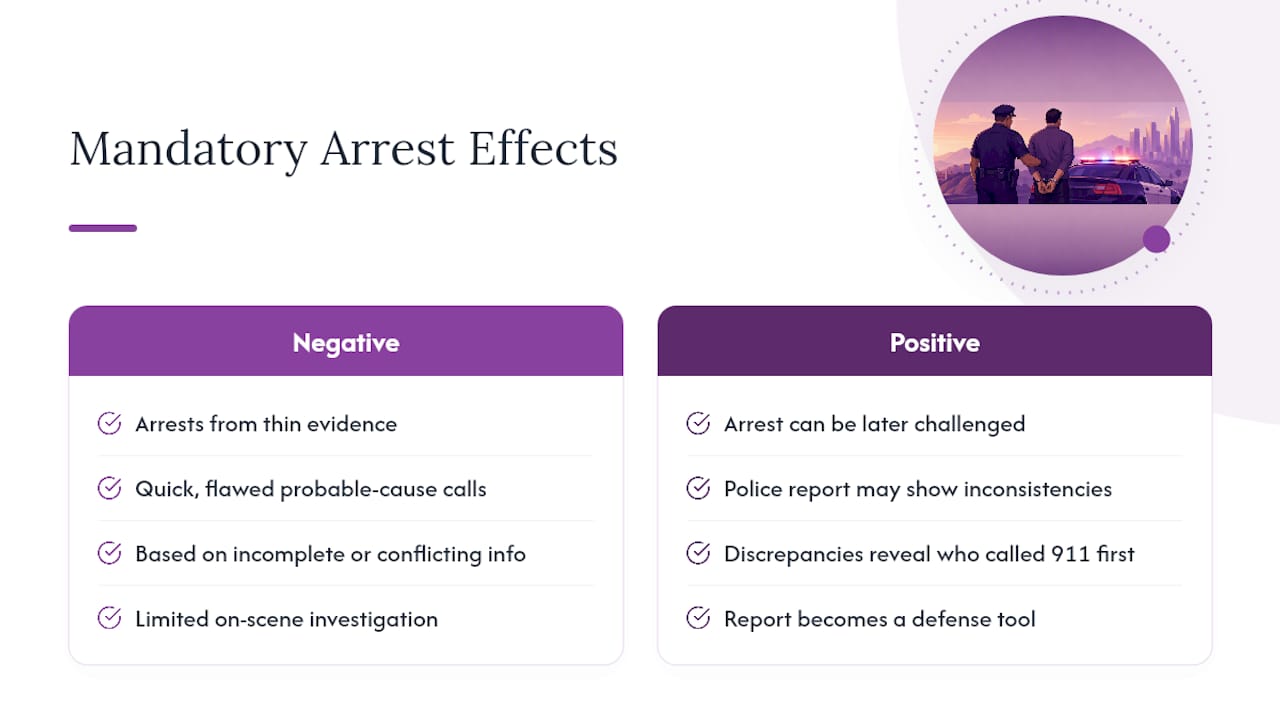
Mandatory arrest policies mean officers often make quick, sometimes flawed, probable cause determinations on the scene, based on incomplete information, conflicting statements, or visible agitation that has nothing to do with who was actually the aggressor. That speed cuts both ways for your defense. It can result in an arrest based on thin evidence, which later becomes easier to challenge, but it also means the police report written in the heat of the moment may contain the exact inconsistencies your attorney needs to build a defense.
Because officers frequently arrest based on limited on-scene information rather than a full investigation, the police report itself becomes one of your most useful defense tools rather than an obstacle. Discrepancies between what officers documented and what actually happened, who called 911 first, who had visible injuries, what witnesses said before they had time to coordinate a story, often surface directly in these hastily prepared reports.
This dynamic reinforces the same lesson that runs through this entire guide: the accusation and the evidence are not the same thing, and a rushed arrest doesn't mean a strong case. It just means your attorney has more work to do reviewing exactly how that arrest decision got made.
A Straight Answer From Someone Who's Been in These Courtrooms
Most defendants walk into a domestic battery case assuming the alleged victim's word is enough to convict them. It isn't, and it was never designed to be. The prosecution still has to prove willfulness beyond a reasonable doubt, and that single element is where most of these cases actually get won or lost.
Rubin Law, P.C. builds its approach around constitutional challenges and pre-file intervention because those tools work best when applied early, not after a plea has already been entered. Frequent courtroom appearances across Los Angeles County mean a real sense of how specific judges evaluate self-defense claims and how specific prosecutors value diversion versus trial. That local pattern recognition, built case by case, is what separates a lawyer reading the statute for the first time from one who knows exactly which motion a given courtroom respects.
Bring your police report, any protective order paperwork, and a written timeline to your first call. Reach Rubin Law, P.C. directly, and don't wait until your arraignment to make that call.
Choosing Rubin Law, P.C. for Your Domestic Battery Defense
Rubin Law, P.C. handles domestic battery defense the way this guide has laid it out: attack the willfulness element, preserve evidence fast, and use constitutional challenges before a plea locks in a permanent record. That's a different starting point than firms that push clients toward an early plea just to close the file quickly.

If you're facing a PC §243(e)(1) charge anywhere in Los Angeles County, the firm's domestic violence defense practice focuses on pre-file intervention, suppression motions, and diversion negotiations tailored to your specific court and prosecutor. For readers in the San Gabriel Valley or nearby areas, the firm also handles cases through its Arcadia service area. Call for a consultation before your arraignment date so an attorney can start reviewing your police report and evidence while there's still time to shape the outcome, not just react to it.
Sources
- CALCRIM No. 3470. Right to Self-Defense or Defense of Another (Non-Homicide)
- California Penal Code 243(e)(1): Domestic Battery - LegalClarity
- California Self Defense Laws - FindLaw
This article is general information, not a substitute for advice from a qualified lawyer. Consult a qualified legal professional about your own circumstances before acting on anything here.