
The most commonly viable assault defenses in California are self-defense (including defense of others), lack of intent or present ability, misidentification, consent, and procedural attacks on the prosecution's proof. Under California Penal Code §240, the prosecution must prove every element beyond a reasonable doubt, and a single gap in that proof can end the case.
The core defenses at a glance:
- Self-defense or defense of others: You reasonably believed force was necessary to prevent imminent harm, and your response was proportionate.
- Lack of intent: You did not willfully attempt to apply force, or the act was accidental.
- No present ability: You lacked the actual, immediate capacity to carry out the threatened force.
- Misidentification or false accusation: The wrong person was charged, or the complaining witness is not credible.
- Mutual combat or initial aggressor: The other party consented to the fight or provoked it. This defense carries strict limits under CALCRIM No. 3471.
- Insufficient evidence: The prosecution simply cannot meet its burden on one or more required elements.
Immediate action steps: Preserve any evidence (surveillance footage, texts, photos of injuries), say nothing substantive to police beyond your name, and contact a criminal defense attorney before your arraignment. Outcomes across these cases range from outright dismissal or charge reduction to diversion programs, negotiated pleas, or trial acquittal, depending on the strength of the evidence and the defense strategy.
Pro Tip: If surveillance cameras were near the incident, request preservation of that footage in writing within 24–48 hours. Most systems overwrite footage on a rolling cycle, and once it is gone, it cannot be recovered.
Key Takeaways
The strongest assault defenses in California attack the prosecution's required elements directly, and early attorney involvement preserves the most options.
| Point | Details |
|---|---|
| Preserve evidence immediately | Secure surveillance footage, texts, and photos within 48 hours before systems overwrite or memories fade. |
| Self-defense is fact-intensive | Document your injuries, the alleged victim's threats, and witness accounts to support proportionality and imminence. |
| Mutual combat limits self-defense | Under CALCRIM No. 3471, initial aggressors must show genuine, communicated withdrawal before claiming self-defense. |
| Accomplice liability requires intent | Mere presence at the scene is not enough; prosecutors must prove you knowingly facilitated the assault. |
| Rubin Law, P.C. | The firm handles assault and violent crime defense in Los Angeles County, including pretrial motions, diversion, and trial representation. |
Table of Contents
- What the prosecution must prove to convict you of assault in California
- Penalties for assault in California: what you are actually facing
- The most common defenses to assault charges in California
- How California's mutual combat rule limits your self-defense claim
- When others get charged: aiding and abetting and accomplice liability in California assault cases
- How a criminal defense attorney builds your assault defense
- What to do immediately if you are arrested for assault in California
- When to retain a criminal defense lawyer and what to expect
- Why local courtroom experience changes the outcome
- Rubin Law, P.C. defends assault charges in Los Angeles
- Sources
What the prosecution must prove to convict you of assault in California
California Penal Code §240 defines assault as an unlawful attempt, coupled with the present ability, to commit a violent injury on the person of another. No physical contact is required. The crime is complete the moment someone takes a direct, willful step toward applying force while having the immediate capacity to do so, and the target reasonably perceives the threat.
To secure a conviction, the prosecution must prove each of these elements beyond a reasonable doubt:
- You did an act that by its nature would directly and probably result in the application of force to a person.
- You did that act willfully.
- You were aware of facts that would lead a reasonable person to realize the act would directly and probably result in force being applied.
- You had the present ability to apply force to that person.
"Willfully" means on purpose, not accidentally. That distinction matters enormously for the defense, because an accidental shove or an unintended gesture that someone else misread as threatening does not satisfy element two.
Assault vs. battery. Assault (PC 240) is the attempt or threat; battery (PC 242) is the completed, unlawful touching. Many cases are charged as both. The distinction affects defenses: a battery charge requires proof of actual contact, while an assault charge does not. If the prosecution overcharges battery when no contact occurred, that creates a direct attack on the charging document.
Related statutes that raise the stakes. PC 241 and PC 245 layer on enhancements and separate offense categories. PC 241 covers assault on a peace officer, firefighter, or other protected class, which elevates the charge to a misdemeanor with higher penalties. PC 245 covers assault with a deadly weapon or by means of force likely to produce great bodily injury, a wobbler that can be charged as a misdemeanor or felony. Prosecutors typically upgrade to felony-level charges when a weapon is involved, when the alleged victim suffered serious injury, or when the defendant has prior convictions.
Key figure: California courts require the prosecution to prove present ability as a distinct element. If the defendant was physically incapable of carrying out the threatened force at the moment of the alleged act, the charge fails on that element alone.
Penalties for assault in California: what you are actually facing
The sentencing range for assault and battery in California spans from a small fine to years in state prison, depending on the specific charge, the alleged victim's status, and the defendant's prior record.
Misdemeanor assault (PC 240): Up to six months in county jail and a fine up to $1,000. Probation is common for first-time offenders with no aggravating factors.
Assault on a peace officer or protected class (PC 241): Up to one year in county jail and fines up to $2,000. The protected-class enhancement is what separates this from a standard PC 240 charge.
Assault with a deadly weapon (PC 245): As a misdemeanor, up to one year in county jail. As a felony, two, three, or four years in state prison. Firearm-related assault under PC 245(a)(2) carries higher ranges, and use of a semiautomatic firearm pushes the range to three, six, or nine years.
Common sentencing enhancements that can add years to any base term:
- Great bodily injury (GBI) enhancement (PC 12022.7): Adds three to six years consecutive.
- Personal use of a firearm (PC 12022.5): Adds three to ten years.
- Prior serious or violent felony (Three Strikes): Can double the base term or trigger a mandatory 25-to-life sentence on a third strike.
- Gang enhancement (PC 186.22): Adds two to fifteen years, or can convert a felony to a life term in serious cases.
Collateral consequences extend well beyond the sentence itself. A felony conviction triggers a lifetime ban on firearm possession under both California and federal law. Immigration consequences can be severe for non-citizens, potentially including deportation or inadmissibility, though the specific impact depends on the exact charge, the plea, and the individual's immigration status. Employment background checks will surface the conviction, and professional licenses in healthcare, law, education, and finance are often at risk.
Diversion and alternative sentencing. For first-time or low-level offenders, California offers several paths that can result in dismissal. Mental health diversion under PC 1001.36 is available when a qualifying mental health condition contributed to the offense. Deferred entry of judgment and informal diversion are sometimes available in misdemeanor cases. An attorney who knows the local courthouse can identify which programs the assigned judge and prosecutor are willing to consider.
The most common defenses to assault charges in California
Every viable defense attacks at least one element the prosecution must prove. Here is how each one works and what evidence supports it.
1. Self-defense and defense of others
California law permits the use of force when you reasonably believed you or someone else faced an imminent threat of unlawful force, and your response was no more force than reasonably necessary. The standard is objective: would a reasonable person in your position have believed the threat was real and immediate?
Evidence that supports this defense: prior threats from the alleged victim (texts, voicemails, police reports), witness accounts of who moved first, medical records showing your own injuries, and surveillance footage showing the other party's aggressive approach. See Rubin Law's detailed breakdown of California self-defense law for the full proportionality and imminence framework.

2. Defense of property
California allows reasonable force to protect property from imminent unlawful taking or damage, but the force must be proportionate. Deadly force is not justified to protect property alone. This defense works best in cases where the alleged assault occurred while the defendant was physically preventing a theft or trespass.
3. Lack of intent (the act was accidental)
PC 240 requires a willful act. If the contact or apparent threat arose from an accident, a reflexive reaction, or a misread gesture, the prosecution cannot satisfy the intent element. Medical evidence, witness accounts of the surrounding context, and the defendant's own conduct immediately before and after the incident all bear on this.
4. No present ability
If you could not actually have carried out the threatened force at the moment of the alleged act, the charge fails. Distance, physical barriers, or incapacitation can all negate present ability. This defense is particularly useful when the alleged assault involved a verbal threat without any physical capacity to follow through.
5. Consent
When both parties agreed to physical contact, such as in a sparring session, a sporting event, or a consensual physical altercation, consent can defeat the assault charge. The consent must be genuine and informed. Note that consent overlaps with the mutual combat doctrine, which carries its own complications under CALCRIM No. 3471 (addressed in the next section).
6. Misidentification or false accusation
Eyewitness misidentification is one of the leading causes of wrongful convictions. In assault cases, poor lighting, stress, brief contact, or a prior relationship between the witness and the actual perpetrator can all produce a mistaken ID. Defense strategies here include attacking the reliability of the identification procedure (lineup, photo array), presenting alibi evidence, and exposing inconsistencies in the witness's prior statements.
False accusations are common in domestic disputes, custody battles, and bar fights where the complaining witness has a motive to lie. Text messages, call logs, and social media posts from the alleged victim before and after the incident often reveal that motive.
7. Insufficient evidence or prosecution failure
The prosecution bears the burden of proof beyond a reasonable doubt on every element. If the only evidence is a single uncorroborated witness statement, or if the physical evidence contradicts the alleged victim's account, a motion for acquittal or a straightforward reasonable-doubt argument at trial may be the strongest play.
8. Mistake of fact
If you genuinely and reasonably believed facts that, if true, would have made your conduct lawful, mistake of fact can negate criminal intent. For example, if you reasonably believed someone was about to attack a third party and intervened, but that belief turned out to be wrong, the defense can argue the mistake was honest and reasonable.
9. Provocation and imperfect self-defense
Imperfect self-defense applies when a defendant genuinely but unreasonably believed force was necessary. It does not eliminate the charge, but it can reduce a felony assault to a lesser offense or mitigate sentencing. Provocation evidence, including the alleged victim's prior conduct and the circumstances leading up to the incident, supports this argument.
Pro Tip: Secure surveillance footage, location data from phones, and any timestamped digital evidence within the first 48 hours. Subpoena business surveillance systems immediately through your attorney, because most commercial systems overwrite footage within 30–72 hours. Once gone, that evidence cannot be recreated.
How California's mutual combat rule limits your self-defense claim
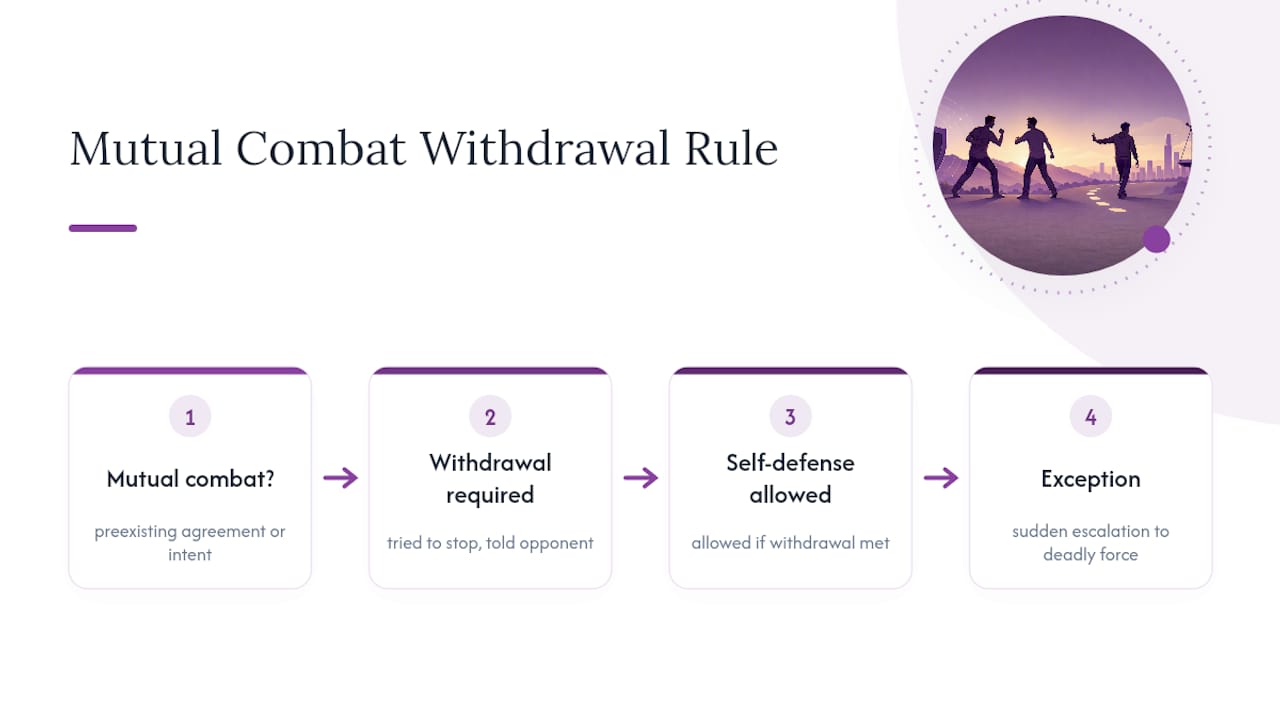
Under CALCRIM No. 3471, a person who engaged in mutual combat or who started a fight only has the right to self-defense if they actually and in good faith tried to stop fighting and clearly communicated that intent to the other party before claiming self-defense. This is one of the most misunderstood rules in California assault law, and it catches defendants off guard.
CALCRIM No. 3471 states: "A person who engages in mutual combat or who starts a fight has a right to self-defense only if: (1) He/she actually and in good faith tried to stop fighting; AND (2) He/she indicated, by word or by conduct, to his/her opponent, in a way that a reasonable person would understand, that he/she wanted to stop fighting and that he/she had stopped fighting."
The practical implication: if you threw the first punch, or if you and the other party agreed to fight, your self-defense claim is compromised unless you can show a genuine, communicated withdrawal before the situation escalated.
What counts as mutual combat? Not every exchange of blows qualifies. In People v. Ross (2007), the California Court of Appeal held that mutual combat requires a preexisting agreement or intent to fight. A spontaneous reaction to a sudden attack is not mutual combat, even if both parties end up trading blows. Courts look for evidence of planning, a prior agreement, or deliberate conduct designed to provoke a physical confrontation.
California regulatory guidance under 2 CCR 649.53 identifies specific factors that can indicate mutual combat: an implicit or explicit agreement to fight, deliberate threats, and conduct that reasonably provoked a physical altercation. Investigators and juries use these same factors.
The escalation exception. If you were engaged in non-deadly mutual combat and the other party suddenly escalated to deadly force, the withdrawal requirement may not apply. CALCRIM No. 3471 addresses this scenario: when the opponent suddenly uses deadly force, the original combatant may respond with deadly force in self-defense without first attempting to withdraw. The key word is "suddenly," meaning the escalation was not anticipated or invited.
People v. Gunning (2014) illustrates how appellate courts scrutinize whether CALCRIM No. 3471 was properly given to the jury. When the instruction is given without sufficient factual basis, it can constitute reversible error, which is a significant appellate argument if the instruction was improperly applied at trial.
When others get charged: aiding and abetting and accomplice liability in California assault cases
You do not have to throw a punch to face assault charges. California Penal Code §31 makes anyone who aids, abets, counsels, commands, or encourages another person in committing a crime equally liable as a principal. The prosecution does not need to prove you personally committed the assault, only that you intentionally helped someone else do it.
Elements prosecutors must prove for aiding and abetting:
- The perpetrator committed the assault.
- You knew the perpetrator intended to commit the assault.
- Before or during the commission of the assault, you intentionally aided, facilitated, promoted, or encouraged the perpetrator.
- Your words or conduct did in fact aid, facilitate, promote, or encourage the assault.
Mere presence at the scene is not enough. According to the Congressional Research Service's analysis of accomplice liability, aiding and abetting requires proof the defendant knowingly associated with and intended to further the underlying offense, and a completed offense is generally a prerequisite to accomplice liability. If the underlying assault was never completed, the aiding and abetting charge may fail.
Common defense strategies for accomplice liability:
- Attack knowledge and intent: Show the defendant did not know an assault was planned or occurring.
- Mere presence: Establish the defendant was physically present but took no action to facilitate the crime.
- Withdrawal: Demonstrate the defendant communicated withdrawal and took affirmative steps to prevent the crime before it occurred. As the DOJ Criminal Resource Manual notes, withdrawal defenses are rarely successful on their own and work best when combined with an attack on the prosecution's proof of intent or a completed offense.
- Coercion: Show the defendant participated only because of threats or duress.
Evidence that tends to prove or disprove accomplice liability includes communications before and during the incident (texts, calls, social media), physical presence and movement at the scene, any financial or logistical contribution to the confrontation, and witness accounts of what the defendant actually said or did. For a deeper look at how California courts apply PC 31, see Rubin Law's explanation of aiding and abetting under California law.
The distinction between aiding and abetting and conspiracy matters here. Conspiracy requires an agreement to commit a crime plus an overt act in furtherance of that agreement. Aiding and abetting does not require a prior agreement; it can arise spontaneously during the commission of the offense. Practically, conspiracy charges are harder to defend against because the agreement itself is the crime, while aiding and abetting requires proof of a completed underlying offense.
How a criminal defense attorney builds your assault defense
The defense plan starts before arraignment and runs through every stage of the case. The core priorities are securing exculpatory evidence before it disappears, disproving prosecution elements through investigation and expert analysis, and using procedural tools to weaken or eliminate the state's case.
Investigative checklist an attorney will work through:
- Collect and preserve all digital evidence: surveillance footage, phone records, location data, social media.
- Interview witnesses independently, before the prosecution shapes their accounts.
- Obtain and review all police reports, body camera footage, and dispatch records.
- Secure medical records for both parties, including emergency room reports and photographs of injuries.
- Evaluate the physical scene: lighting, distances, sight lines, and any physical evidence.
- Retain expert witnesses where needed: forensic analysts, medical experts, use-of-force specialists.
- Review the alleged victim's prior statements for inconsistencies.
- Investigate the alleged victim's background for prior false reports or relevant criminal history.
Common pretrial motions:
| Motion | Purpose |
|---|---|
| Motion to suppress | Exclude evidence obtained through an unlawful search or seizure |
| Brady/Giglio motion | Compel disclosure of exculpatory evidence the prosecution may be withholding |
| Motion in limine | Exclude prejudicial evidence before trial (prior bad acts, irrelevant character evidence) |
| Demurrer | Challenge the legal sufficiency of the charging document |
| Motion for discovery | Obtain all evidence the prosecution intends to use, including police reports and lab results |
Plea vs. trial strategy. Diversion or a negotiated plea makes sense when the evidence is strong against the defendant but the charge can be reduced to a lesser offense or dismissed after program completion. Trial is appropriate when the evidence is genuinely weak, when a key witness is unreliable, or when a suppression motion eliminates the prosecution's core evidence. An attorney who appears regularly in the assigned courthouse knows which prosecutors negotiate in good faith and which judges are receptive to suppression arguments, and that local knowledge shapes the strategy.
What to do immediately if you are arrested for assault in California
The decisions you make in the first hours after an arrest have a direct impact on your defense. Here is the sequence that protects your rights.
Invoke your rights immediately:
- State your name if asked. That is the extent of what you are required to provide.
- Say clearly: "I am invoking my right to remain silent and I want an attorney."
- Do not explain, justify, or narrate what happened. Anything you say will be used against you, and even a sympathetic-sounding account can create inconsistencies that prosecutors exploit at trial.
- Do not consent to a search of your phone, car, or home without a warrant. Politely decline and ask for your attorney.
What not to do:
- Do not post anything on social media about the incident, the alleged victim, or your whereabouts.
- Do not contact the alleged victim directly, even to apologize or explain.
- Do not discuss the case with cellmates, friends, or family on jail phone lines, which are recorded.
- Do not give a recorded statement to investigators without counsel present.
The typical timeline after arrest:
After booking, you will be arraigned, usually within 48 hours for a misdemeanor or 72 hours for a felony (excluding weekends and holidays). At arraignment, you enter a plea and bail is addressed. A preliminary hearing follows in felony cases, where the prosecution must show probable cause. Retaining counsel before arraignment gives your attorney the opportunity to appear at that first hearing, argue for lower bail, and begin the investigation while evidence is still fresh.
Evidence preservation steps to take now:
- Write down everything you remember about the incident, including the sequence of events, who was present, and what was said. Give this only to your attorney.
- Collect contact information for any witnesses who saw what happened.
- Preserve your own phone: do not delete texts, photos, or location data.
- If you have visible injuries, photograph them immediately and seek medical attention.
Pro Tip: If you know a business or residence near the incident had a security camera, contact your attorney immediately. Your attorney can send a preservation letter or subpoena before the footage is overwritten. Courts will not compel production of footage that no longer exists.
When to retain a criminal defense lawyer and what to expect
Retain counsel as early as possible, ideally before you speak to police or prosecutors. The window between arrest and arraignment is when the most critical evidence exists in its original, uncontested form. An attorney who gets involved on day one can send preservation demands, interview witnesses before the prosecution does, and potentially intervene before charges are even filed.
What a competent defense attorney does for you:
- Conducts an independent investigation and secures evidence.
- Appears at arraignment to argue for release on your own recognizance or reduced bail.
- Files pretrial motions to suppress unlawfully obtained evidence or compel disclosure of exculpatory material.
- Negotiates with the prosecutor for charge reductions, diversion, or dismissal.
- Prepares and tries the case if no acceptable resolution is reached.
- Advises on collateral consequences (immigration, firearms, professional licensing) before any plea is entered.
Fee structures. Criminal defense attorneys typically charge either a flat fee for early-stage representation (arraignment through preliminary hearing) or an hourly rate for complex litigation that extends through trial. Some firms offer a hybrid: a flat retainer for pretrial work with an additional fee if the case goes to trial. At the initial consultation, ask specifically what the retainer covers, what triggers additional fees, and what the attorney's experience is with the assigned courthouse and prosecutor's office.
What attorneys expect from clients. Full disclosure of the facts, even the unfavorable ones, is non-negotiable. An attorney cannot build a defense around a version of events that the prosecution's evidence will contradict. Clients who withhold information about prior incidents, prior convictions, or their own conduct during the incident put their own case at risk. Timely production of evidence (phone records, witness contacts, medical records) and responsiveness to attorney communications are equally important.
Why local courtroom experience changes the outcome
Most people charged with assault in California focus on the legal elements of their defense, and that is the right starting point. But the outcome of a criminal case is shaped as much by who is in the room as by what the law says on paper.
A defense attorney who appears regularly in the same courthouse knows how the assigned prosecutor evaluates self-defense claims, which judges are receptive to suppression motions, and how the local public defender's office typically handles similar cases. That knowledge is not available in a textbook. It comes from showing up, losing some motions, winning others, and building a read on how each courtroom actually operates.
The other thing that gets underestimated is the value of pre-file intervention. In many assault cases, especially those arising from domestic disputes or bar altercations, charges have not yet been formally filed when the client first contacts an attorney. An attorney who moves quickly, contacts the detective or prosecutor before filing, and presents exculpatory evidence or context at that stage can sometimes prevent charges from being filed at all. That outcome is not possible once the case is in the system.
This article provides general legal information about assault defenses in California and is not legal advice for any specific case. Laws change, and the facts of your situation determine which defenses apply. Contact a qualified California criminal defense attorney for guidance on your case.
Rubin Law, P.C. defends assault charges in Los Angeles
Facing an assault charge in Los Angeles County means navigating a courthouse system where the prosecutor's charging decisions, the judge's evidentiary rulings, and the availability of diversion programs all depend on local knowledge that only comes from regular courtroom presence.
Rubin Law, P.C. handles violent crime charges including assault, battery, domestic violence, and weapons offenses throughout Los Angeles County. The firm's approach combines early investigation, constitutional challenges to unlawfully obtained evidence, and aggressive pretrial motion practice. Where diversion or alternative sentencing is available, including mental health diversion under PC 1001.36 or prefile intervention in domestic violence-adjacent cases, the firm pursues those paths when they serve the client's interests. When they do not, the firm prepares for trial.
If you or someone you know is facing an assault charge or is under investigation in Los Angeles County, the time to act is now, before charges are filed or before arraignment. Contact Rubin Law, P.C. to schedule a consultation. Bring whatever documentation you have: police reports, texts, photos, and a written account of what happened. The earlier the firm gets involved, the more options remain on the table.
Sources
The following primary sources contain the statutory text and jury instructions cited throughout this article.
- CALCRIM No. 3471. Right to Self-Defense: Mutual Combat or Initial Aggressor
- California Penal Code §240 - Assault
- 2 CCR 649.53 — Factors for mutual combat consideration
- Congressional Research Service report R43770 (overview of aiding and abetting/accomplice liability)
- DOJ Criminal Resource Manual — Conspiracy, aid and abet
This article is general information, not a substitute for advice from a qualified lawyer. Consult a qualified legal professional about your own circumstances before acting on anything here.