California sets the commercial DUI threshold at 0.04% BAC under Vehicle Code §23152(d), half the 0.08% limit for regular drivers, and a conviction triggers at least a one-year CDL disqualification even for a first offense. The DMV handles the license consequence separately from the criminal case, and the clock starts immediately. If you've been arrested, you have 10 days to request a DMV hearing or you lose that right automatically, and you need an attorney reviewing both tracks before that window closes.
TL;DR:
- A commercial DUI in California triggers a BAC threshold of 0.04%, double the strict limit for drivers under 21 but half the regular 0.08% limit for adults.
- A first offense results in at least a one-year CDL disqualification, regardless of whether the DUI occurred during work or personal driving.
- The DMV has a strict 10-day window to request a hearing to contest automatic license suspension after arrest, and missing this can lead to immediate disqualification.
- Blood or breath tests within three hours create a rebuttable presumption of BAC, making rising blood alcohol defenses more difficult for CDL holders.
- A DUI conviction can cause severe criminal penalties, including jail time, fines, and extended or lifelong CDL disqualification, particularly in cases with prior convictions or accidents.
Table of Contents
- What VC §23152(d) Actually Says About Commercial DUI in California
- CDL Disqualification: How Long You're Off the Road
- Criminal Penalties for a Commercial DUI Conviction
- The DMV Hearing: Your 10-Day Window to Fight for Your License
- Defense Strategies That Actually Move the Needle in CDL Cases
- How a Commercial DUI Wrecks Your Job, Not Just Your License
- What to Do in the First 10 Days After a Commercial DUI Arrest
- How Rubin Law Approaches Commercial DUI Defense
- The Part of This Story Most Drivers Miss
- Get Legal Help for a Commercial DUI in California
- Sources
What VC §23152(d) Actually Says About Commercial DUI in California
California Vehicle Code §23152(d) makes it a crime to operate a commercial motor vehicle with a BAC of 0.04% or higher. That's not a guideline. It's a per-se violation, meaning the state doesn't have to prove you were impaired in any observable way. Hitting the number is the offense.
The statute also carries a rebuttable presumption: if a chemical test administered within three hours of driving shows a BAC of 0.04% or more, the law presumes that was your BAC while you were behind the wheel, according to the California Vehicle Code. The burden shifts to the defense to show otherwise, which is a much harder position than the state having to prove the number from scratch.
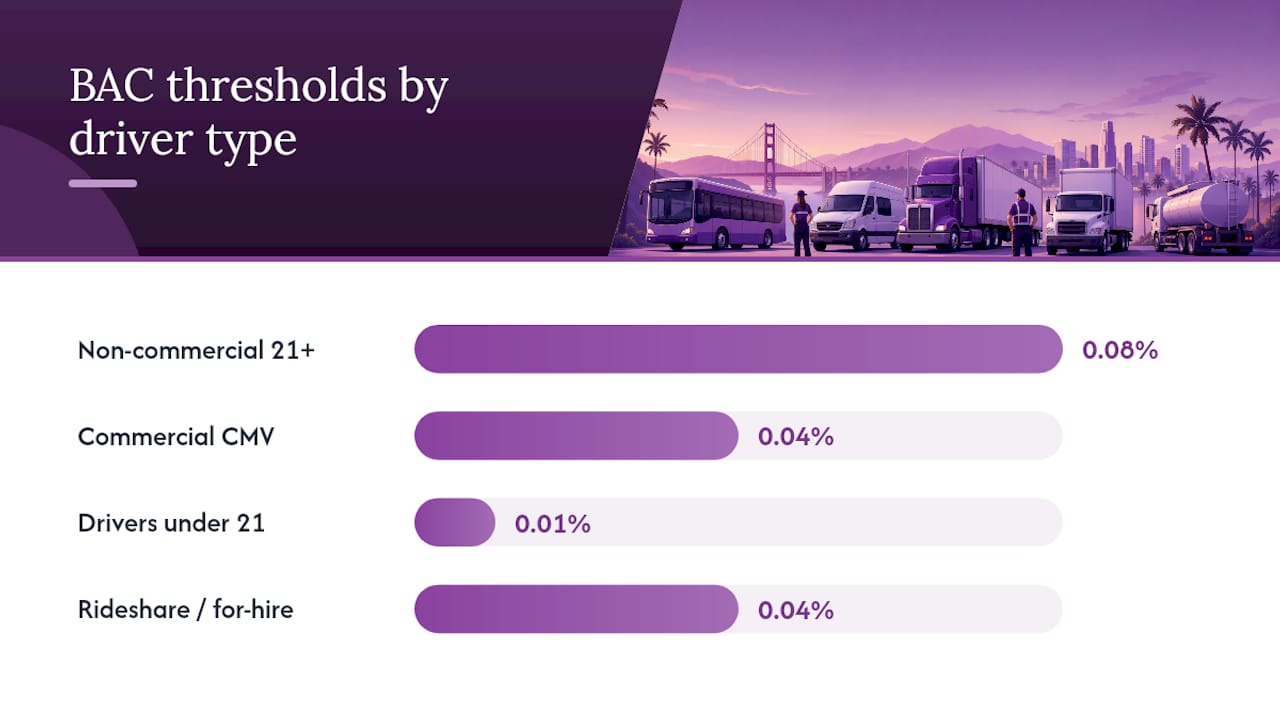
Here's how the thresholds actually compare:
- Non-commercial drivers 21 and over: 0.08% BAC
- Commercial drivers operating a CMV: 0.04% BAC
- Drivers under 21 (any vehicle): 0.01% BAC
- Rideshare and for-hire drivers while carrying passengers: 0.04% BAC
The lower commercial threshold applies regardless of what you're hauling or whether you're technically "on the clock." Weekend driving in your own truck doesn't get you a pass either, a point that trips up a lot of CDL holders who assume the stricter limit only applies during paid runs. The DMV's guidance on driving under the influence confirms the 0.04% standard applies specifically to commercial vehicle operation, and CDL holders face heightened scrutiny from officers who know the stakes are different for professional drivers.
CDL Disqualification: How Long You're Off the Road
A DUI conviction doesn't just cost you a fine. It costs you your ability to earn a living behind the wheel, and the disqualification periods are set by statute, not judicial discretion.
- First offense, standard commercial vehicle: One-year CDL disqualification. This applies whether the DUI happened in a commercial vehicle or your personal car, since a conviction attaches to your license, not the vehicle you were driving.
- First offense while transporting hazardous materials: Three-year disqualification. Hazmat endorsements carry extra weight in the eyes of both the DMV and federal regulators, and the penalty reflects that.
- Second DUI conviction (any combination of commercial or personal vehicle offenses): Lifetime CDL disqualification. Some drivers can apply for reinstatement after 10 years under narrow federal waiver provisions, but that path isn't guaranteed and isn't fast.
Federal rules under 49 CFR Part 383 largely drive these numbers, and California's own disqualification statutes, including VC §15302 provisions governing CDL holders, incorporate them directly. State and federal law work in tandem here rather than competing, so there's no state-level workaround.
The detail that catches drivers off guard: a DUI in your own pickup truck on a Saturday night triggers the identical CDL disqualification as one in an 18 wheeler on a delivery run. The DMV doesn't distinguish between "personal" and "professional" driving when it comes to disqualification, because the license itself is the commercial credential.
Criminal Penalties for a Commercial DUI Conviction
The criminal case runs on a separate track from the DMV disqualification, and it carries its own consequences. A first DUI conviction in California typically brings:
- Several years of informal probation
- Fines and penalty assessments that can be substantial once court fees and assessments are added to the base fine
- Up to several months in county jail, though first offenders frequently avoid custody time
- A mandatory DUI program of varying length, depending on the county and case facts, as required under the Vehicle Code's sentencing provisions
Prior convictions within 10 years change everything. A second DUI brings mandatory minimum jail time, longer probation, and a longer program requirement. A third conviction within that same 10-year window is often charged as a felony-adjacent offense with significantly harsher sentencing exposure, and courts treat repeat commercial drivers with particular skepticism given the public safety stakes.
Cases involving injury or death get charged far more seriously. A DUI causing injury can be filed as a felony under Vehicle Code §23153, and a DUI causing death with a prior DUI conviction on record can trigger Watson murder charges, one of the most severe outcomes in California DUI law.
The California DUI-MIS report tracks statewide sanction data and shows how frequently priors and aggravating facts push cases into harsher sentencing categories, underscoring why the first offense matters so much for anyone holding a CDL.
Pro Tip: A "wet reckless" plea, where a DUI is reduced to a reckless driving charge with an alcohol notation, can sometimes reduce criminal penalties, but it does not automatically protect a CDL. Confirm with counsel exactly how a proposed plea affects your license before agreeing to anything.
The DMV Hearing: Your 10-Day Window to Fight for Your License
The moment you're arrested for a commercial DUI, an Administrative Per Se (APS) suspension kicks in against your license, separate from whatever happens in criminal court. This is the DMV's own track, and it moves fast.
- You have 10 days from the arrest date to request a DMV hearing. Miss that window and the suspension becomes automatic, no exceptions for being busy, hospitalized, or unaware of the deadline.
- The hearing only decides narrow questions: whether the officer had reasonable cause to believe you were driving under the influence, whether you were lawfully arrested, and whether your BAC met or exceeded the legal threshold. It does not decide guilt or innocence on the criminal charge.
- If you lose the hearing (or don't request one), the suspension proceeds on its own timeline, which can run concurrent with or independent of any criminal court suspension, depending on the outcome there.
- SR-22 insurance and ignition interlock device (IID) requirements often follow, particularly for repeat offenders or high BAC cases. An SR-22 is a certificate your insurer files with the DMV proving you carry the state's minimum coverage, and it typically stays required for three years after reinstatement.
The DMV's official guidance lays out these procedural mechanics in detail, and the timelines are unforgiving by design.
Pro Tip: Call an attorney the same day as the arrest, not the day before your hearing. Preparing an APS challenge takes time to gather body camera footage, calibration records, and arrest reports, and a rushed request often means walking into that hearing with half the evidence you needed.
Defense Strategies That Actually Move the Needle in CDL Cases
Not every defense carries the same weight once VC §23152(d)'s lower threshold and rebuttable presumption come into play. Some strategies that work well in ordinary DUI cases lose power here, while others become more important.
- Challenging the stop itself. If the officer lacked reasonable suspicion to pull you over, everything that followed, including the chemical test, may be suppressible. This is often the single highest-value defense because it can eliminate the prosecution's core evidence before trial.
- Attacking chemical test accuracy. Breath machines require regular calibration and maintenance logs; gaps or errors in those records can undercut the reliability of a 0.04% reading. Blood tests carry their own vulnerabilities around chain-of-custody handling and lab error rates, and both deserve scrutiny detailed further in how DUI evidence gets challenged in California courts.
- Rising blood alcohol arguments face a tougher road for commercial drivers. The standard rising-BAC defense argues your alcohol level was still climbing at the time of driving and only hit the illegal threshold later, during testing. But VC §23152(d)'s rebuttable presumption for tests within three hours specifically counters this argument, shifting the burden onto the defense in a way that makes rising blood alcohol claims harder to win outright, though not impossible with the right expert testimony.
- Refusing the chemical test carries its own penalty structure, including an automatic one-year license suspension under implied consent rules, independent of the DUI charge itself. For CDL holders, a refusal can also trigger a separate one-year disqualification even without a DUI conviction, so refusal is rarely the strategic move it might seem to be in the moment.
How a Commercial DUI Wrecks Your Job, Not Just Your License
Most motor carriers don't wait for a conviction to act. Many suspend or terminate a driver immediately upon arrest, especially once the APS suspension hits, because insurance carriers and safety audits treat any DUI arrest as a red flag regardless of the eventual case outcome.
- Federal Motor Carrier Safety Administration (FMCSA) rules require carriers to report DUI-related disqualifications, and that record follows a driver through the Drug and Alcohol Clearinghouse, visible to future employers doing background checks.
- Insurance premiums for the carrier can spike after a driver's DUI, which is exactly why many companies have zero-tolerance policies baked into their employment contracts, a dynamic explored in this fleet operations guide on commercial vehicle risk.
- Documenting any treatment program enrollment early helps if you're negotiating a return to work or explaining a gap in driving history to a future employer.
- Requalification after disqualification requires completing the DMV's reinstatement process, including proof of program completion, reinstatement fees, and sometimes a new road test, before a CDL is reissued.
What to Do in the First 10 Days After a Commercial DUI Arrest
Every hour matters here, mostly because of that 10-day DMV clock.
- Request your DMV hearing immediately. Don't wait to "figure things out" first. This is a formal request, not a formality, and it's the only way to contest the administrative suspension before it becomes automatic.
- Get copies of everything: the arrest report, chemical test results, breath machine calibration records if available, and any notice your employer has already sent regarding your employment status.
- Contact an attorney with specific CDL DUI experience. General DUI defense knowledge helps, but the disqualification statutes and federal overlay require someone who handles commercial cases specifically.
- Start planning practically. That means figuring out SR-22 insurance requirements, whether an ignition interlock device applies to your case, and how you'll notify your employer if you haven't already.
Pro Tip: Keep a written timeline of the arrest, in your own words, while the details are fresh. Officers' memories fade too, and a clear personal account written within 24 hours can become useful if inconsistencies show up later in the police report.
How Rubin Law Approaches Commercial DUI Defense
Frequent courtroom appearances change how a case gets built. When you appear before the same judges and face the same prosecutors regularly, you learn which arguments actually land in a given courtroom and which ones waste a hearing date. The legal team brings that pattern recognition to commercial DUI cases specifically, prioritizing constitutional challenges to the stop and the arrest before anything else, because suppressing bad evidence early often reshapes the entire case.
Early priorities typically include securing the DMV hearing request before the 10-day window closes, scrutinizing breath and blood testing procedures for gaps, and evaluating whether diversion or reduced-charge negotiations are realistic given the facts.
For CDL holders, the calculation is different from an ordinary DUI defendant. A guilty plea that seems minor on paper can still end a career, so every strategic decision gets weighed against the license consequence, not just the criminal exposure.
The Part of This Story Most Drivers Miss
Everyone focuses on the criminal case because it feels like the scarier headline: jail time, a criminal record, a permanent mark. But for a CDL holder, the administrative side is where the real damage happens first, and it happens fast. By the time the criminal case resolves months later, the CDL disqualification has often already cost the driver their job.
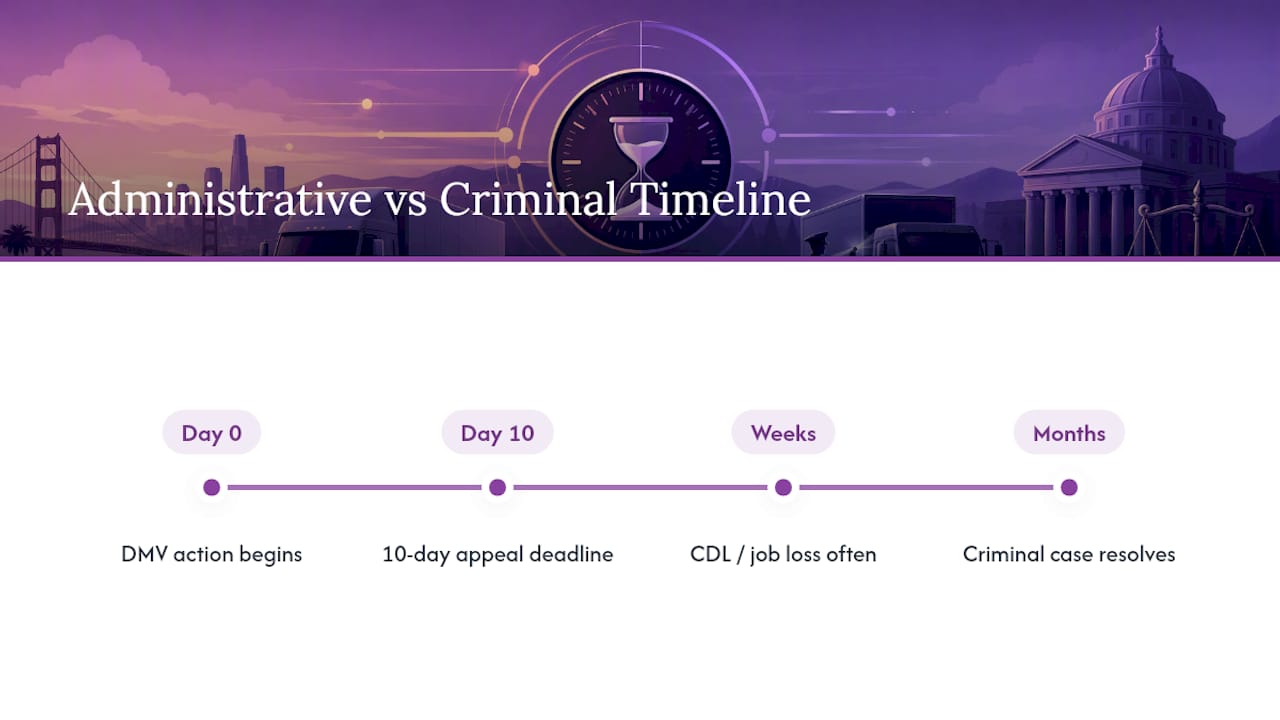
That's the gap conventional advice tends to miss. Most general DUI guidance treats the DMV hearing as a formality, something to check off before focusing on the "real" fight in criminal court. For a commercial driver, that's backwards. The DMV hearing is often the higher-leverage fight precisely because it happens first, moves faster, and can preserve driving privileges while the criminal case is still working through the system.
If there's one thing this article's research supports clearly, it's this: treat the 10-day window like a deadline that determines your income, not a bureaucratic formality. Drivers who call an attorney on day one, rather than day nine, consistently have more options on the table, from suppression motions to negotiated outcomes that protect the CDL. Waiting doesn't make the case easier. It just narrows what's left to work with.
— Jake
Get Legal Help for a Commercial DUI in California
Experienced legal counsel is crucial for CDL holders who need someone who understands both sides of a commercial DUI case, the criminal charge and the DMV disqualification, moving on the same tight timeline. Where a general practice attorney might treat these as sequential problems, skilled defense handles both tracks simultaneously from the first phone call, because a missed 10-day deadline can cost a driver their livelihood before the criminal case even gets a court date.
If you've been arrested, bring the arrest report, any chemical test paperwork, and your CDL information to your first consultation so counsel can assess the DMV hearing deadline immediately. A detailed page on California DUI laws and defense strategy outlines what to expect from the process, and reaching out promptly is the single most important step you can take to protect both your case and your career.
This article is general information, not a substitute for advice from a qualified lawyer. Consult a qualified legal professional about your own circumstances before acting on anything here.