
A rising blood alcohol defense argues that your BAC was still climbing after you stopped driving, meaning the chemical test result overstates how much alcohol was in your system at the actual moment you were behind the wheel. In the right circumstances, this defense can reduce or defeat a per-se DUI count. Whether it applies to your case depends on a specific set of facts: how recently you had your last drink, how long the officer waited before testing you, and how close your result was to the 0.08% legal threshold.
The defense is grounded in pharmacokinetics, the science of how substances move through the body. Alcohol absorbs gradually, not instantly, and Peak BAC often occurs between roughly 30 and 90 minutes after the last drink, but the range varies by individual and circumstances. A driver tested some time after their last drink may have a test result higher than the actual BAC while driving. That gap is the foundation of the defense.
Rubin Law, P.C. handles exactly these cases in Los Angeles, combining scientific expert analysis with constitutional and procedural challenges to build the strongest possible defense.
If you were recently charged, do this in the first 48–72 hours:
- Write out a detailed drinking timeline: what you drank, when, how much, and whether you ate
- Collect every receipt, credit card record, or phone timestamp that documents your evening
- Identify any witnesses who can confirm your drinking timeline
- Do not make recorded statements or informal comments to law enforcement about how much you drank
- Contact a DUI attorney before your arraignment and before any DMV deadline passes
One clear caution: this defense is fact-specific. A tested BAC well above the limit, or strong documented impairment, significantly reduces viability. Not every DUI case qualifies.
Table of Contents
- How does alcohol absorption cause BAC to keep rising after you stop driving?
- When is a rising BAC defense actually viable?
- What evidence does the defense need to prove the rising BAC timeline?
- How do prosecutors typically fight a rising BAC claim?
- How experienced attorneys build a layered rising BAC defense
- What outcomes can you realistically expect, and how does DMV differ from criminal court?
- What to do in the first 48–72 hours if rising BAC might apply to your case
- Key Takeaways
- What the rising BAC defense actually demands from your attorney
- Rubin Law, P.C. handles your DUI defense from arrest through DMV hearing
- Useful sources and further reading
How does alcohol absorption cause BAC to keep rising after you stop driving?
BAC rises after drinking because alcohol absorbs into the bloodstream over time, not all at once. When you drink, alcohol enters your stomach first, then passes into the small intestine, where the vast majority of absorption occurs. The small intestine has a much larger surface area than the stomach, so the rate of absorption accelerates once gastric emptying begins.
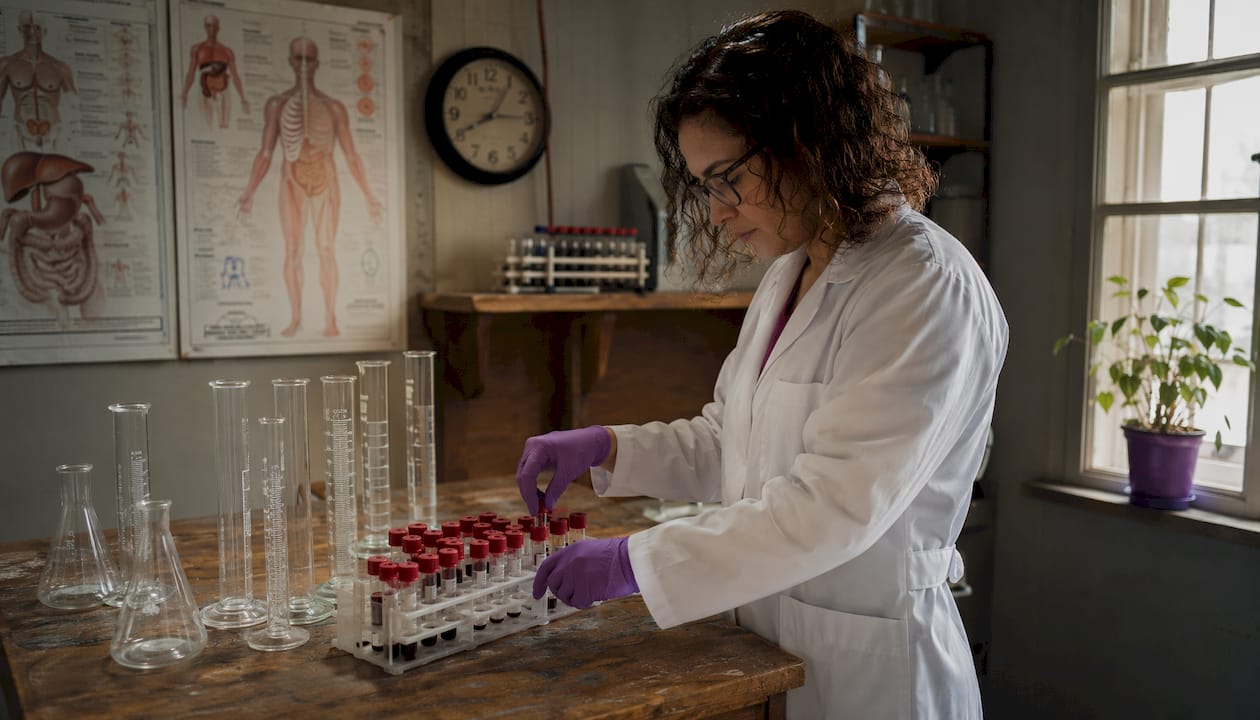
Several variables control how fast that process moves. Food in the stomach slows gastric emptying significantly, which delays peak BAC. Carbonated drinks and higher-proof alcohol tend to speed absorption. Body composition, gender, and certain medications all shift the curve. The result is that two people who drink the same amount at the same pace can reach peak BAC at very different times.
| Factor | Effect on Absorption | Typical Peak BAC Window |
|---|---|---|
| Empty stomach | Faster absorption | peak BAC occurs sooner after last drink |
| Food consumed | Slower absorption | peak BAC occurs later after last drink |
| Carbonated mixer | Faster absorption | peak BAC occurs sooner after last drink |
| High body weight | Slower rise, lower peak | peak BAC occurs later after last drink |
| Gender (female) | Faster rise, higher peak | peak BAC occurs sooner after last drink |
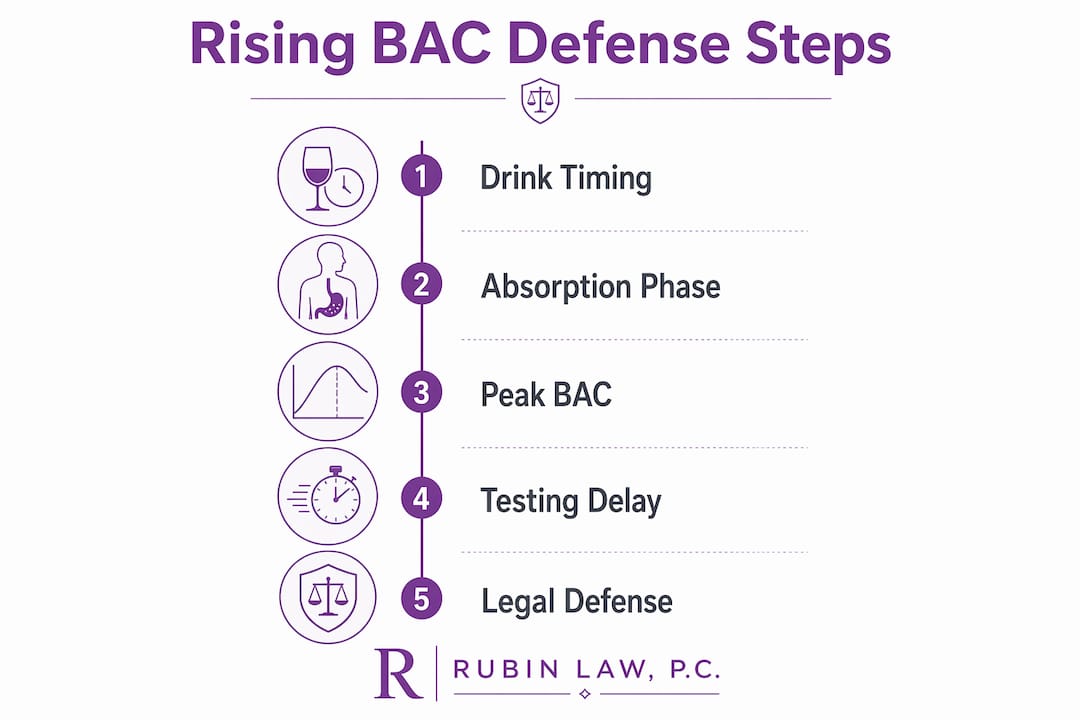
The practical implication: if you had your last drink 20 minutes before being pulled over, your body may still have been absorbing alcohol during the entire roadside investigation, the drive to the station, and the paperwork processing. A breath test administered 60–90 minutes after the stop can capture a peak that simply did not exist while you were driving.
Once absorption is complete, the body shifts into the elimination phase. The liver breaks down alcohol at a rate commonly estimated between 0.015 and 0.020 percent per hour for forensic purposes. Only during elimination does backward math from a test result produce reliable estimates of earlier BAC. If absorption was still underway at the time of testing, that backward calculation rests on a false assumption.
When is a rising BAC defense actually viable?
The defense works best when several conditions line up at once. A single favorable factor rarely carries the argument alone. The strongest cases combine a short drinking window before driving, a meaningful delay between the stop and the chemical test, and a result that landed close to the legal limit.
Timing and test result factors that favor the defense:
- Last drink consumed within about an hour before driving
- Chemical test administered after a significant delay following the traffic stop
- Tested BAC close enough to the legal limit that an absorption differential is pharmacologically plausible
- No documented evidence of continued drinking after the stop
- Field sobriety performance that does not clearly indicate impairment
Factors that undercut the defense:
- A tested BAC well above the legal limit makes the absorption differential required to bring driving-time BAC below legal limit pharmacologically implausible in most scenarios
- Officer notes documenting slurred speech, inability to follow instructions, or obvious impairment at the time of the stop
- Admission to the officer about when and how much you drank, especially if the timeline does not support rising BAC
Breath and blood testing also differ in ways that matter here. Breath tests require a 15-minute observation period before administration, but the actual test is typically given at the station well after the stop. Blood draws often involve additional delays for transport and processing. Both create windows where absorption could continue. However, blood testing also captures a sample that can be independently retested, which gives the defense an opportunity to challenge the result through a forensic chemist rather than relying solely on the absorption argument.
The prosecution carries the burden of proving the driver exceeded the legal limit while actually operating the vehicle. A later test is evidence of BAC at testing time, not automatic proof of BAC at driving time. The rising BAC argument targets exactly that gap.
What evidence does the defense need to prove the rising BAC timeline?
The defense builds a timeline: last drink, start of driving, traffic stop, field sobriety tests, transport, and chemical test. A forensic toxicologist then models an absorption curve consistent with that timeline and the driver's individual characteristics, showing that driving-time BAC was plausibly below 0.08%.
Documentary evidence to pursue immediately:
- Police report with precise timestamps for the stop, field tests, and chemical test
- Dash camera and body camera footage from the officer's vehicle
- Receipts and credit card records showing what you ordered and when
- Surveillance footage from the bar, restaurant, or venue
- Witness statements from anyone who observed your drinking and behavior
- Breath or blood instrument maintenance and calibration logs
Each item serves a specific purpose. Timestamps anchor the timeline. Surveillance footage can confirm when you left a venue. Calibration records let a forensic chemist examine whether the testing device was functioning properly and whether chain-of-custody procedures were followed.
Expert roles in the defense:
A forensic toxicologist models the absorption curve using your body weight, the timing and volume of drinks, meal timing, and the exact gap between driving and testing. Their report converts the pharmacokinetics into admissible testimony. A forensic chemist examines the breath or blood instrument's calibration records, maintenance logs, and chain-of-custody documentation to identify procedural failures that could independently challenge the test result. Courts apply Daubert or Frye standards to expert testimony, so the methodology must be reliable, documented, and defensible under cross-examination.
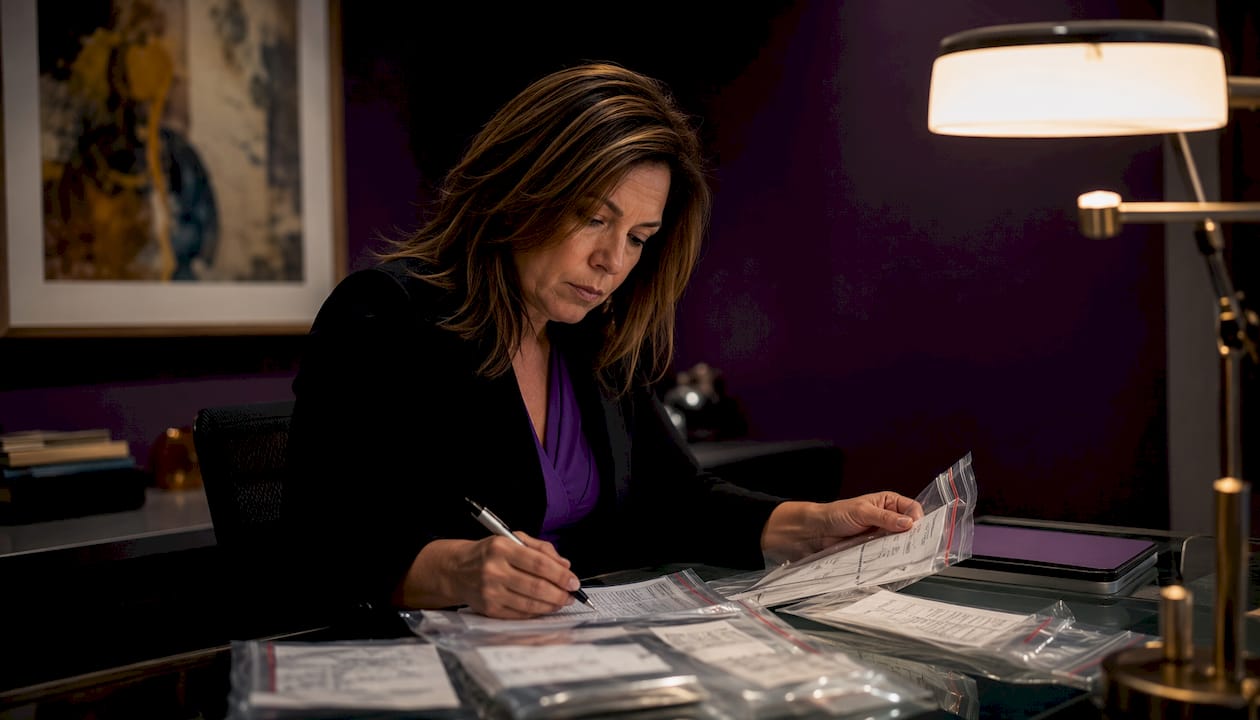
Pro Tip: Send a preservation letter to the arresting agency within 72 hours of your arrest demanding that all video footage, instrument logs, and officer notes be preserved. Agencies routinely overwrite dash cam footage on short cycles. A formal letter creates a legal obligation to retain the material; without it, critical evidence can disappear before your attorney ever files a discovery request.
How do prosecutors typically fight a rising BAC claim?
Prosecutors have heard this defense many times, and they come prepared. Understanding their standard rebuttals helps you and your attorney anticipate where the argument is most vulnerable.
Common prosecution arguments:
- Documented continuing drinking: if any evidence suggests you drank after the stop or during transport, the absorption argument collapses entirely
- Strong impairment observations: officer testimony about slurred speech, poor coordination, or failed field sobriety tests gives the prosecution an independent path to conviction that does not depend on the BAC number
- Very high tested BAC: a result of 0.15% or above makes the math implausible; the absorption differential needed to bring driving-time BAC below 0.08% simply does not fit standard pharmacokinetic models in most cases
- Statutory relation-back presumptions: many states have enacted statutes that treat a test administered within two or three hours of driving as presumptively reflecting the BAC at the time of driving, shifting the burden to the defense to affirmatively rebut that presumption with expert evidence
- Prosecution retrograde extrapolation: the state's expert may use backward calculation from the test result to argue the driver was at or above 0.08% while driving, though this method is unreliable across the absorption phase without complete drinking-history data
Consider a scenario where a driver tests at 0.18% and the officer's report documents that the driver stumbled during the walk-and-turn, smelled strongly of alcohol, and admitted to drinking "a lot." The rising BAC argument has almost no traction there. The tested BAC is too high for the absorption differential to matter, and the impairment evidence gives the prosecution a conviction path that bypasses the per-se count entirely. That is the scenario where the defense is unlikely to succeed, and experienced counsel will say so plainly rather than pursue a theory that wastes time and resources.
How experienced attorneys build a layered rising BAC defense
Relying on a single scientific theory is a losing strategy. The most effective defenses combine the rising BAC science with constitutional challenges and procedural attacks, so the scientific argument sits inside a broader reasonable-doubt framework. Rubin Law, P.C. approaches these cases with exactly that structure, integrating courtroom experience in Los Angeles courts with coordinated expert analysis.
The layered defense roadmap:
- Immediate intake and timeline capture. The attorney documents the full drinking timeline, driving route, stop circumstances, and test timing before memory fades. This is the raw material for everything that follows.
- Evidence preservation. Formal preservation letters go to the arresting agency within days. Discovery requests follow for police reports, video, instrument logs, and chain-of-custody records.
- Toxicologist retention. A forensic toxicologist is retained early to assess whether the absorption timeline is pharmacologically supportable before resources are committed to a full expert report.
- Instrument record analysis. A forensic chemist reviews calibration logs and maintenance records for the breath or blood testing device. Procedural failures here can independently suppress the test result.
- Pretrial motions. Depending on findings, the attorney files suppression motions (illegal stop or search), Daubert or Frye challenges to prosecution expert testimony, and chain-of-custody challenges. These motions create leverage even when they do not succeed outright.
- Expert report coordination. The toxicologist's absorption model and the chemist's instrument analysis are coordinated into a unified defense narrative. Cross-examination plans for prosecution experts are built from the same analysis.
- Negotiation and trial decision. Expert analysis often creates a basis for negotiating a reduced charge. The attorney evaluates whether early resolution or trial gives the client the better outcome, based on the strength of the evidence at each stage.
Pro Tip: Expert fees for a forensic toxicologist can be significant, and discovery timelines in California DUI cases often extend for several weeks to months from arraignment. Retaining counsel early gives the defense maximum time to build the scientific record before any pretrial deadlines close off options.
What outcomes can you realistically expect, and how does DMV differ from criminal court?
The rising BAC defense most commonly aims to reduce or dismiss the per-se count, the charge based purely on the BAC number. It rarely eliminates all possible charges if the officer documented clear impairment, because California and most states charge both per-se and impairment-based DUI counts under statutes like VC §23152.
The criminal case and the DMV administrative process run on separate tracks with different standards, different timelines, and different consequences.
| Dimension | Criminal Case | DMV Administrative Hearing |
|---|---|---|
| Burden of proof | Beyond a reasonable doubt | Preponderance of the evidence |
| Decision-maker | Judge or jury | DMV hearing officer |
| Primary remedy | Fines, probation, jail, DUI program | License suspension or revocation |
| Typical timeline | Months to over a year | Weeks to a few months |
| Key deadline | Arraignment date | Often 10 days from arrest to request a hearing |
| Rising BAC applicability | Directly challenges per-se count | Can be raised but faces a lower evidentiary bar |
The DMV hearing deadline is the one that catches people off guard. In California and many other states, you have 10 days from arrest to request an administrative hearing or your license is automatically suspended. Missing that window forfeits your right to contest the suspension, regardless of how the criminal case resolves.
State law varies significantly on relation-back presumptions and statutory testing windows. Consulting local DUI counsel for your specific jurisdiction is not optional advice; it is the only way to know which presumptions apply and what the defense must present to rebut them.
What to do in the first 48–72 hours if rising BAC might apply to your case
Speed matters. Evidence disappears, memories fade, and DMV deadlines do not move.
- Write your drinking timeline now. Record every drink: what it was, how strong, what time you started and finished it, and whether you ate. Include the time you got in the car and the time of the stop. This document becomes the foundation of any expert analysis.
- Collect every timestamp you have. Pull credit card receipts, digital payment records, text messages, and phone location data. Screenshot everything and save originals as PDFs.
- Identify witnesses. Write down the names and contact information of anyone who saw you drinking or can confirm your timeline. Do this before you lose touch with them.
- Preserve video evidence. If you were at a bar or restaurant, contact the venue immediately. Most surveillance systems overwrite footage within 24–72 hours.
- Do not make recorded statements. Do not call the arresting officer, do not post on social media, and do not discuss the case with anyone other than your attorney.
- Request your DMV hearing. In California, you have 10 days from arrest. Check your state's deadline and act immediately, even before you have retained counsel.
- Contact a DUI attorney. Bring your drinking timeline, all receipts and timestamps, the arresting officer's name and badge number, and your arrest paperwork to the consultation.
For documentation, a usable drinking timeline is a written narrative with specific times, not a rough estimate. "I had two glasses of wine between 7:00 PM and 8:30 PM, ate dinner at 7:15 PM, and left the restaurant at 8:45 PM" is useful. "I had a couple drinks" is not. The more precise the record, the more the toxicologist can do with it.
Key Takeaways
A rising blood alcohol defense succeeds when the timing gap between driving and testing, combined with a borderline BAC result, makes it pharmacologically plausible that the driver was below 0.08% at the wheel.
| Point | Details |
|---|---|
| Timing is everything | The defense requires a short drinking window before driving and a meaningful delay (often 45 minutes to 2 hours) before chemical testing. |
| Borderline BAC matters | Results near the legal limit are most viable; a tested BAC well above the limit makes the absorption differential implausible in most cases. |
| Expert testimony is required | A forensic toxicologist must model the absorption curve; courts apply Daubert or Frye standards to admit that testimony. |
| DMV deadline is separate | In many states, you have only 10 days from arrest to request a DMV hearing; missing it means automatic license suspension. |
| Rubin Law, P.C. | Handles both the criminal case and DMV hearing in Los Angeles, integrating scientific and constitutional challenges from day one. |
What the rising BAC defense actually demands from your attorney
The conventional wisdom treats rising BAC as a scientific curiosity, a clever argument that occasionally works. That framing undersells what the defense actually requires and oversells how often a bare absorption argument succeeds on its own.
What actually moves cases is the combination. A toxicologist's report that shows plausible absorption timing is useful. That same report, paired with a suppression motion challenging the legality of the stop, a chain-of-custody challenge to the breath instrument, and a cross-examination plan that dismantles the prosecution's retrograde extrapolation, is a different thing entirely. Prosecutors settle cases and juries acquit when the entire evidentiary picture becomes uncertain, not just one number.
The other thing most articles skip: the DMV hearing is not a formality. Winning the administrative hearing preserves your license while the criminal case proceeds, which matters enormously for anyone whose livelihood depends on driving. Losing it early, because no one requested the hearing in time or no one showed up prepared, is a concrete harm that happens before the criminal case even reaches a preliminary hearing.
The cases where rising BAC changes outcomes are the ones where counsel moved fast, built the record completely, and attacked the prosecution's evidence from multiple angles simultaneously. That is the standard worth holding your defense to.
Rubin Law, P.C. handles your DUI defense from arrest through DMV hearing
When a rising BAC argument applies to your case, the difference between a reduced charge and a conviction often comes down to how quickly the defense record was built and how many angles were attacked at once. Rubin Law, P.C. represents DUI clients in Los Angeles on both the criminal case and the DMV administrative hearing, retaining forensic toxicologists, challenging instrument calibration records, filing suppression motions, and negotiating with prosecutors who know the firm from regular courtroom appearances.
Bring your drinking timeline, your arrest paperwork, and any receipts or timestamps you have collected. The firm will assess whether the rising BAC theory fits your facts, identify every other challenge available, and act on the DMV deadline before it closes. Contact Rubin Law, P.C. to schedule a consultation with a Los Angeles DUI attorney who handles both tracks of your case from day one.
Useful sources and further reading
The sources below are authoritative starting points for defendants, their families, and counsel researching the rising BAC defense and related DUI law.
- National DUI Authority: Rising Blood Alcohol Defense — Overview of the defense's pharmacokinetic basis, viability factors, and expert requirements
- LegalClarity: Rising BAC Defense, Absorption Phase and DUI Challenges — Detailed explanation of absorption-phase science and how it applies to DUI outcomes
- Cleveland Clinic: Blood Alcohol Content (BAC) — Medical reference on BAC measurement and physiological factors affecting absorption
- Virginia ABC: Health Care Professionals Publication on Alcohol — Government-sourced reference on alcohol pharmacokinetics and BAC thresholds
- Pennsylvania DMV: DUI Legislation — Example of state-level statutory DUI framework, including testing windows and presumptions
- Rubin Law, P.C.: DUI Evidence in California — How breath, blood, and field sobriety evidence is challenged in California DUI cases
- Rubin Law, P.C.: DMV Hearing Guide — Deadlines and procedures for California DMV administrative hearings
State law advisory: statutory relation-back presumptions, testing windows, and burden-shifting rules vary significantly by jurisdiction. The sources above provide general frameworks. Counsel should review the specific statutes and case law for the defendant's state before relying on any presumption or deadline described here. This article is general legal information, not legal advice for your specific situation; confirm current rules with a qualified DUI attorney in your jurisdiction.