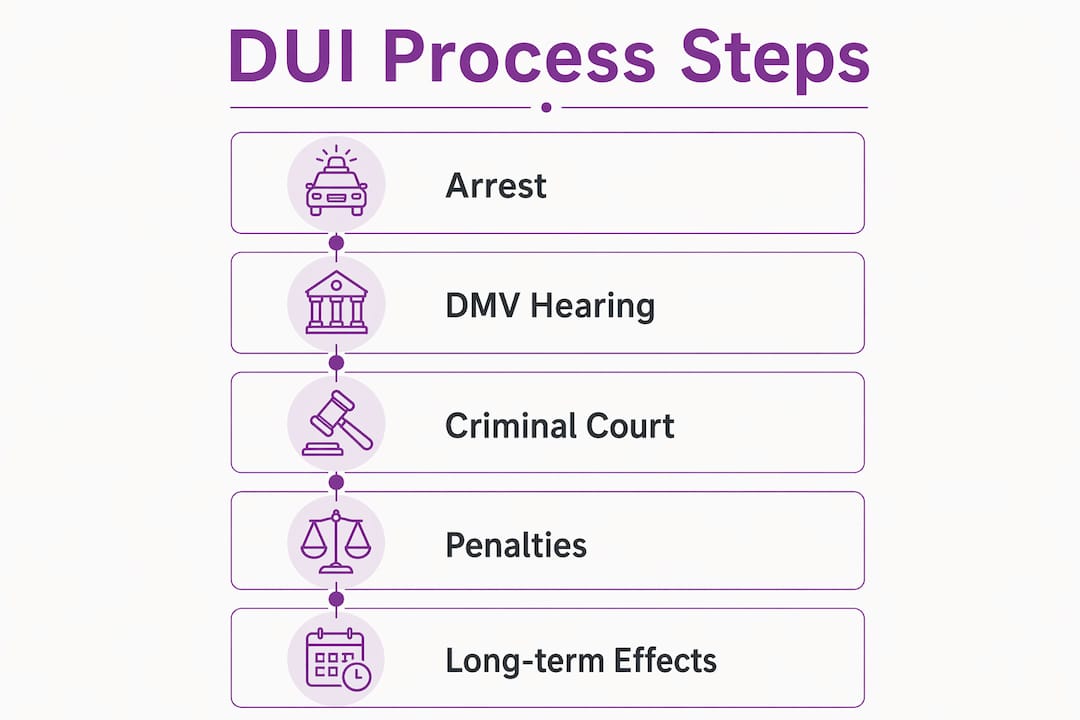
A DUI first offense in California is a misdemeanor under Vehicle Code sections 23152(a) and 23152(b), carrying penalties that include up to six months in jail, fines, and a mandatory license suspension. Most people arrested for a first time DUI in California are shocked to learn the case splits into two separate proceedings: one in criminal court and one before the California DMV. Both run simultaneously, and missing a deadline in either can make your situation significantly worse. Understanding what you face in the first 72 hours after arrest is the most important thing you can do.
What penalties apply to a DUI first offense in California?
A first DUI conviction in California carries a defined range of penalties, but the base fine tells only part of the story. Base fines range from $390 to $1,000, but California's penalty assessment system stacks surcharges on top of that figure. After assessments, your total court-imposed fine typically lands between $1,800 and $4,000.
The financial picture gets worse when you add everything else. Total costs over 3–5 years, including insurance increases, DUI education programs, and legal fees, can reach $16,000 to $20,000. That number surprises most people because they focus only on the court fine.
Here is a breakdown of what first offense DUI CA penalties typically include:
- Jail time: Up to 6 months, though jail is not automatic for a first offense. Judges weigh BAC level, driving behavior, and aggravating factors before imposing custody.
- Probation: Informal probation for 3–5 years, which usually includes conditions like no driving with any measurable alcohol in your system.
- DUI education program: A state-licensed program lasting 3 months for a standard first offense, or 9 months if your BAC was 0.15% or higher.
- Fines and assessments: Court fines plus penalty assessments, as described above.
- Towing and impound fees: Vehicle impound at arrest adds several hundred dollars in storage and release fees.
- Attorney fees: Attorney fees for a straightforward first DUI typically run $2,500 to $4,000. Complex cases that go to trial can exceed $10,000.
Pro Tip: Request an itemized breakdown of all court fees from your attorney before your first hearing. Many defendants are blindsided by penalty assessments that triple the base fine.
How does the California DMV suspension process work after a first DUI?
The DMV process runs completely separate from your criminal case, and it moves faster. When you are arrested for a DUI in California, the officer typically confiscates your license and issues a pink temporary driving permit. That permit is valid for 30 days, but your window to act is much shorter.

You have 10 days from the date of arrest to contact the DMV and request an Administrative Per Se (APS) hearing. Missing that deadline means the suspension proceeds automatically once your temporary permit expires. There is no appeal, no second chance, and no way to contest the suspension after the deadline passes.
The APS hearing is a distinct administrative proceeding with its own rules:
- Request the hearing immediately. Call the DMV Driver Safety Office within 10 days of arrest. Your attorney can do this on your behalf.
- Understand who decides. A DMV hearing officer, not a judge, presides. The rules of evidence differ from criminal court.
- Know what is at stake. The hearing focuses on three issues: whether the officer had lawful cause to stop you, whether you were lawfully arrested, and whether your BAC was 0.08% or higher.
- Explore restricted license options. Even if the suspension is upheld, you may qualify for a restricted license allowing travel to work and the DUI education program, often paired with an ignition interlock device (IID).
- Understand the overlap. A criminal court conviction triggers its own separate suspension. Both the DMV suspension and the court suspension can run concurrently or consecutively depending on the outcome.
Missing the DMV hearing deadline means automatic license suspension without any opportunity to contest the evidence. That is a significant loss of leverage, especially if the stop or the chemical test had procedural problems.
Pro Tip: Hiring an attorney before the 10-day DMV deadline is the single most time-sensitive decision you will make. An experienced DUI defense lawyer can request the hearing, preserve your driving privileges during the process, and begin building your defense simultaneously.
What legal defenses exist for a first DUI offense in California?
"First offense" does not mean automatic leniency. Prosecutors treat mandatory minimums seriously and evaluate aggravating factors carefully before deciding how hard to push a case. That said, first-time DUI cases offer more room for defense than most people realize.
Common defense strategies include:
- Challenging the traffic stop. If the officer lacked reasonable suspicion to pull you over, evidence gathered during the stop may be suppressed under the Fourth Amendment.
- Questioning field sobriety test administration. Standardized Field Sobriety Tests (SFSTs) must follow National Highway Traffic Safety Administration (NHTSA) protocols. Deviations can undermine their reliability.
- Attacking the chemical test. Breathalyzer calibration records, blood sample chain of custody, and testing procedures are all challengeable. A poorly maintained device or a broken chain of custody can invalidate BAC results.
- Medical or physiological factors. Conditions like acid reflux, diabetes, or a high-protein diet can produce falsely elevated breath test readings.
- Rising BAC defense. Alcohol absorbs into the bloodstream over time. If you were tested well after driving, your BAC at the time of the test may have been higher than when you were actually behind the wheel.
Prosecutors may also agree to reduce a first DUI charge to a "wet reckless" under Vehicle Code 23103/23103.5. A wet reckless is a negotiated outcome that acknowledges alcohol involvement but carries lighter penalties than a DUI conviction. It does not eliminate all consequences, but it avoids the full weight of a DUI on your record.
Aggravating factors such as a BAC of 0.15% or higher, a minor in the vehicle, an accident, or chemical test refusal significantly reduce a prosecutor's willingness to negotiate. Chemical test refusal is treated as an aggravating factor and triggers longer license suspensions on its own. The stronger your defense, the more leverage your attorney has at the negotiating table.
What are the long-term consequences of a first DUI conviction in California?
A first DUI conviction follows you for a decade. The offense stays on your driving record as a priorable offense for 10 years. Any subsequent DUI arrest within that window is treated as a second offense, with dramatically harsher mandatory penalties.
The insurance impact is where most people feel the long-term pain most acutely. SR-22 insurance is required for three years after a DUI conviction. SR-22 is not a type of insurance. It is a certificate your insurer files with the DMV confirming you carry the state minimum coverage. Many standard insurers drop clients who require SR-22 filings, forcing them into high-risk insurance pools at much higher rates.
| Long-term consequence | What it means in practice |
|---|---|
| 10-year priorable offense | A second DUI within 10 years triggers felony-level penalties |
| SR-22 requirement | Mandatory for 3 years; many insurers drop clients who need it |
| Insurance premium increases | Increases over 3–5 years can add $5,000 to $15,000 or more |
| Employment background checks | A DUI conviction appears on criminal background checks and can affect professional licensing |
| Expungement limitations | Penal Code 1203.4 allows expungement but does not remove the offense from DMV records |
Employment consequences are real but often overlooked. A DUI conviction appears on criminal background checks and can affect professional licenses in fields like healthcare, law, education, and transportation. Expungement under Penal Code 1203.4 clears the conviction for many civil purposes, but it does not erase the offense from your DMV record or remove its priorable status for future DUI charges.
Pro Tip: Defense attorneys caution that insurance premium increases are the largest long-term cost most clients fail to anticipate. Get an insurance quote before your sentencing date so you understand the full financial picture.
Key Takeaways
A first DUI conviction in California triggers both criminal penalties and a separate DMV suspension process, and acting within 10 days of arrest is the most critical step to protecting your driving privileges and defense options.
| Point | Details |
|---|---|
| Two parallel proceedings | Criminal court and DMV run simultaneously; both require immediate attention after arrest. |
| 10-day DMV deadline | Request an APS hearing within 10 days or face automatic license suspension with no right to contest. |
| True cost is $16,000–$20,000 | Base fines are small; insurance increases and program costs drive total expenses over 3–5 years. |
| Defense options exist | Challenging the stop, BAC testing, or negotiating a wet reckless can significantly reduce penalties. |
| 10-year priorable status | A first conviction stays on your record for a decade and triggers harsher penalties for any repeat offense. |
What most people get wrong about a first DUI in California
People consistently underestimate a first DUI. I have seen clients walk into the process assuming a clean record means a slap on the wrist. That assumption costs them.
The 10-day DMV deadline is the clearest example. Most people spend the first week after arrest in shock, talking to family, and trying to process what happened. By the time they think about calling a lawyer, the window to request the APS hearing has closed. That one missed deadline locks in a four-month suspension with no ability to fight it.
The other thing people miss is the insurance math. The court fine feels like the punishment. The SR-22 requirement and the premium increases that follow are the actual financial consequence. A $1,000 fine is manageable. An extra $3,000 per year in insurance premiums for three to five years is a different problem entirely.
What I find most encouraging is that first-time DUI cases in California are genuinely defensible. Breathalyzer calibration records, officer body camera footage, and NHTSA protocol compliance are all areas where experienced defense attorneys find real problems. The earlier you get a lawyer involved, the more of that evidence is preserved and available.
— Jake
How Rubinlawpc approaches first DUI defense in Los Angeles
Facing a first DUI charge in California means managing two legal tracks at once, and the clock starts the moment you are arrested.
Rubinlawpc handles both the criminal court defense and the DMV APS hearing process for clients across Los Angeles. The firm's approach is built on frequent courtroom appearances and a direct understanding of how local prosecutors and judges evaluate first-time DUI cases. That knowledge shapes every decision, from whether to challenge the traffic stop to whether a wet reckless negotiation makes sense for your specific facts. If you are looking for experienced DUI defense representation in Los Angeles, Rubinlawpc offers the kind of case-specific attention that first-time DUI charges require.
FAQ
What is the penalty for a first DUI offense in California?
A first DUI in California carries up to 6 months in jail, fines of $390 to $1,000 before penalty assessments, probation of 3–5 years, and a mandatory DUI education program. Total costs including insurance increases can reach $16,000 to $20,000 over several years.
How long does a first DUI stay on your record in California?
A first DUI conviction stays on your driving record as a priorable offense for 10 years. Any DUI arrest within that period is treated as a second offense with significantly harsher penalties.
Can a first DUI in California be reduced or dismissed?
Prosecutors may reduce a first DUI to a wet reckless under Vehicle Code 23103/23103.5 if evidence and circumstances support it. Charges can also be challenged and potentially dismissed if the traffic stop, arrest, or chemical testing had procedural violations.
What happens if I miss the 10-day DMV hearing deadline?
Missing the 10-day deadline results in automatic license suspension once your temporary permit expires. You lose the right to contest the suspension, and the DMV proceeds without any hearing.
Does a DUI expungement clear your record completely in California?
Expungement under Penal Code 1203.4 removes the conviction for many civil and employment purposes, but it does not erase the offense from your DMV record and does not remove its priorable status for future DUI charges.