
A DUI DMV hearing is a civil administrative proceeding that determines whether your driver's license will be suspended after a DUI arrest, and it operates entirely separate from your criminal case. Most drivers make the mistake of focusing only on criminal court while ignoring this parallel process. That is a costly error. The DMV hearing runs under a lower burden of proof than criminal court, which means the state can win your license suspension even if your criminal charges are later reduced or dismissed. You have 10 calendar days from your arrest to request this hearing. Miss that window, and your license is gone automatically.
What happens during a DUI DMV hearing?
The DMV APS hearing, formally called the Administrative Per Se hearing, evaluates three specific legal questions: whether the officer had reasonable cause to believe you were driving under the influence, whether your arrest was lawful, and whether your blood alcohol concentration (BAC) was at or above 0.08% or higher. The hearing does not decide your guilt or innocence. It decides only whether your license gets suspended.
The hearing officer plays a role unlike anything in criminal court. That officer acts as prosecutor, judge, and jury simultaneously. This structure creates an inherent challenge for anyone who walks in unprepared or unrepresented.

Evidence at the hearing comes primarily from police paperwork, not live testimony. The DS 367 form (the officer's sworn statement), breathalyzer printouts, and toxicology reports are all admitted under the Official Records Exception to the Hearsay Rule. That means the arresting officer does not need to appear in person for the DMV to use their report against you.
The standard of proof is preponderance of evidence, meaning the DMV only needs to show it is more likely than not that the three conditions above were met. That is a much lower bar than the "beyond a reasonable doubt" standard in criminal court. Hearings are typically conducted by phone or in person at a local DMV Driver Safety Office.
Effective defenses at this stage target procedural and technical errors rather than arguing whether you were actually impaired. Common defense points include:
- Lack of reasonable suspicion for the initial traffic stop
- Errors or inconsistencies in the DS 367 officer's sworn statement
- Breathalyzer calibration failures or improper administration of the chemical test
- Medical conditions that can affect BAC readings
- Officer training gaps or procedural violations during the arrest
Pro Tip: Request the DMV's evidence package before your hearing date. Reviewing the DS 367 form and test documentation early gives you time to spot errors that could set aside the suspension.
How to prepare effectively for your DMV hearing
Preparation for a DUI administrative hearing starts the moment you are released from custody. The 10-day deadline is not flexible. Missing this deadline results in automatic license suspension with no opportunity to contest it. The clock starts on the date of arrest, not the date you receive paperwork.
Follow these steps immediately after a DUI arrest:
- Request the DMV hearing within 10 calendar days. Call the DMV Driver Safety Office listed on your temporary license. Do not wait for a lawyer to do this for you. The deadline passes regardless of your circumstances.
- Explicitly demand a Stay of Suspension. This is the step most people miss. Without a Stay of Suspension request, your driving privileges end after 30 days even if your hearing is still pending. You must ask for it directly when you call.
- Request discovery from the DMV. Ask for all evidence the DMV plans to use, including the DS 367 form, chemical test results, and any calibration records. You have the right to review this material before the hearing.
- Hire a qualified DUI attorney as early as possible. An attorney familiar with DMV hearing procedures can identify technical errors in paperwork, challenge the validity of the stop or arrest, and handle all procedural filings on your behalf.
- Do not assume the hearing is automatic. The DMV does not schedule a hearing for you. You must affirmatively request one. Drivers who assume the process is automatic lose their license before they realize their mistake.
Pro Tip: When you call the DMV, write down the name of the representative you spoke with, the time of the call, and the confirmation number for your hearing request. This documentation protects you if a dispute arises about whether you met the deadline.
The DMV hearing and the criminal DUI case run on parallel tracks. Preparing for one does not prepare you for the other. An attorney who handles both simultaneously gives you the best position on both fronts.
What are the possible outcomes of a DUI DMV hearing?
The hearing officer issues one of two decisions: the suspension is set aside, or the suspension is upheld. Each outcome carries specific consequences for your driving privileges and your next legal steps.
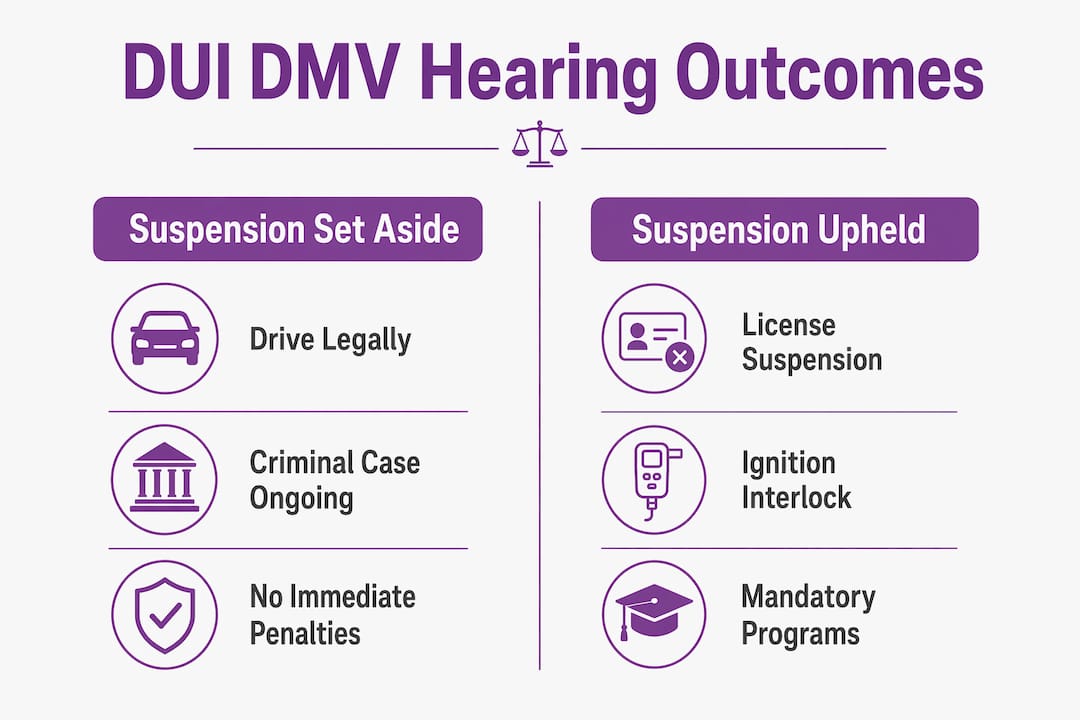
If the suspension is set aside, your driving privileges continue while your criminal case proceeds. Winning the DMV hearing does not resolve your criminal case. The two processes are legally independent, and a DMV victory does not prevent a criminal conviction from triggering a separate court-ordered suspension later.
If the suspension is upheld, it typically takes effect within days of the hearing decision. You will face mandatory requirements before your license can be reinstated.
| Outcome | What it means | Next steps |
|---|---|---|
| Suspension set aside | Driving privileges preserved pending criminal case | Monitor criminal case; no DMV action required |
| Suspension upheld | License suspended, often within days of decision | Fulfill reinstatement requirements |
| IID requirement | Ignition Interlock Device must be installed | Contact a licensed IID provider |
| DUI school | Mandatory education program enrollment | Enroll in a state-approved DUI program |
| Reinstatement fees | Fees paid to DMV before license restored | Pay fees and submit proof of completion |
When the suspension is upheld, additional penalties such as Ignition Interlock Device installation, DUI education programs, and reinstatement fees become mandatory conditions before you can drive again. These requirements add cost and time on top of the suspension itself.
Options after losing the hearing are limited. You can request an administrative review within the DMV system, or file a writ petition in superior court challenging the hearing officer's decision. Both paths are difficult and rarely succeed without strong procedural grounds. The better strategy is to build a solid defense before the hearing, not after.
Why legal representation matters at a DMV hearing
The DMV hearing officer's dual role as both adjudicator and advocate for the DMV's position creates a structural disadvantage for unrepresented drivers. Legal representation at the hearing can identify technical errors that are not apparent to drivers handling the process alone. Those errors are often the only path to a favorable outcome.
An experienced DUI attorney brings specific advantages to this process:
- Scrutinizes the DS 367 form and chemical test records for procedural errors or inconsistencies
- Challenges the validity of the traffic stop based on lack of reasonable suspicion
- Questions breathalyzer calibration records and the officer's certification to administer tests
- Ensures the Stay of Suspension is properly requested and documented
- Coordinates the DMV defense with the concurrent criminal DUI case strategy
The hearing officer reviews reasonable suspicion, lawful arrest, BAC level, and proper chemical test administration. Each of these elements has procedural requirements that, if violated, can undermine the suspension. Attorneys trained in DMV hearing procedures know exactly where to look.
Pro Tip: Ask any attorney you consult whether they personally appear at DMV hearings or delegate them to staff. Frequent, direct DMV hearing experience makes a measurable difference in outcome.
Rubinlawpc handles both the DMV administrative hearing and the criminal DUI case simultaneously. That coordination matters because evidence and arguments developed for one proceeding can inform strategy in the other.
The 10-day deadline is the most important fact in this article
Most drivers I speak with after a DUI arrest are focused entirely on the criminal case. That instinct is understandable. Criminal charges carry serious consequences. But the DMV hearing deadline arrives first, and it is absolute.
The lower burden of proof at the DMV hearing is what makes it more dangerous than most people expect. In criminal court, the prosecution must prove guilt beyond a reasonable doubt. At the DMV, the hearing officer only needs to find it more likely than not that the three conditions were met. That is a much easier standard to satisfy, and it means drivers who show up unprepared lose far more often than they should.
I have seen drivers walk into DMV hearings assuming the process is informal or that a good attitude will carry the day. It does not. The hearing officer follows a structured process, relies on documentary evidence, and applies a legal standard that favors the DMV when the paperwork is in order. The only effective counter is identifying where the paperwork is not in order.
The other misconception I encounter regularly is that winning the DMV hearing solves the problem. It does not. A DMV win preserves your driving privileges while the criminal case continues. It does not prevent a court-ordered suspension if you are convicted. Both proceedings require attention, and both require preparation.
Act on the 10-day deadline the same day you are released. Everything else can wait. That deadline cannot.
— Jake
How Rubinlawpc can protect your driving privileges
Facing a DUI charge means managing two separate legal processes at once, and the DMV deadline arrives before most people have had time to think clearly.
Rubinlawpc handles DUI cases and DMV hearings for clients across Los Angeles. The firm requests hearings and Stay of Suspension protections immediately, reviews all DMV evidence for procedural errors, and appears at hearings to challenge suspensions directly. That same legal work informs the parallel criminal defense strategy. If you need a Los Angeles DUI defense attorney who understands both the administrative and criminal sides of a DUI arrest, Rubinlawpc offers consultations to assess your case and your options before the 10-day window closes.
FAQ
What is a DUI DMV hearing?
A DUI DMV hearing is a civil administrative proceeding that determines whether your driver's license will be suspended after a DUI arrest. It is separate from your criminal case and focuses only on three issues: reasonable cause, lawful arrest, and BAC level.
How long do I have to request a DMV hearing after a DUI?
You have 10 calendar days from the date of your DUI arrest to request a DMV hearing. Missing this deadline results in automatic license suspension with no opportunity to contest it.
What is a Stay of Suspension and why does it matter?
A Stay of Suspension is a specific request that preserves your driving privileges while your DMV hearing is pending. Without it, your license is suspended after 30 days even if a hearing is scheduled.
Does winning the DMV hearing mean my DUI charges are dropped?
No. The DMV hearing and the criminal DUI case are legally independent. Winning the DMV hearing sets aside the license suspension but has no direct effect on criminal charges or their outcome.
What happens if I lose my DMV hearing?
If the hearing officer upholds the suspension, your license is suspended within days of the decision. You will also face mandatory requirements including Ignition Interlock Device installation, DUI education programs, and reinstatement fees before you can drive again.
Key takeaways
The most effective way to protect your driving privileges after a DUI arrest is to request a DMV hearing and a Stay of Suspension within 10 calendar days, then build a defense around procedural and technical errors in the evidence.
| Point | Details |
|---|---|
| 10-day deadline is absolute | Request your DMV hearing within 10 calendar days of arrest or lose the right to contest. |
| Stay of Suspension must be explicit | Ask for it directly when you call the DMV or your license lapses after 30 days. |
| Lower burden of proof favors the DMV | Preponderance of evidence is easier to meet than criminal court's reasonable doubt standard. |
| Defense targets procedural errors | Successful outcomes depend on identifying paperwork flaws, not arguing impairment. |
| DMV and criminal cases are independent | A DMV win preserves driving privileges but does not affect criminal charges or convictions. |