Yes, many California DUI arrests end in a dismissal or a reduced charge when the defense exposes procedural or scientific weaknesses in the case. The moment matters more than the fear does: request your DMV Administrative Per Se hearing within 10 calendar days of arrest, and get an experienced DUI attorney on the phone before you say another word to anyone about what happened.
TL;DR:
- Challenging the timing of blood alcohol testing and evidence collection is crucial because tests taken more than 40 minutes after driving may not reflect your BAC at the wheel.
- The first ten days after arrest are critical for filing a DMV hearing and gathering evidence, such as police reports and video footage, to protect your driving privileges and build a defense.
- Validity of field sobriety tests and breathalyzer results can be contested based on officer protocol deviations, calibration lapses, or medical conditions affecting breath chemistry.
- Suppression motions and early discovery requests targeting the arrest process and testing procedures are central to reducing or dismissing DUI charges.
- The outcome heavily depends on timely legal action, the strength of procedural defenses, and how evidence like video and calibration logs are managed within the crucial initial days.
Table of Contents
- How Can You Beat a DUI in California?
- What Should You Do in the First 72 Hours After Arrest?
- Common Defenses Your Lawyer Will Investigate
- DMV Hearing vs. Criminal Court: What's the Difference?
- How Lawyers Take Apart a DUI Case: Motions and Discovery
- Can Medical Conditions or Timing Beat a Breath Test Result?
- What Are the Plea Options if a Full Dismissal Isn't Realistic?
- What Happens If You're Convicted: Penalties and Collateral Damage
- Why Local Courtroom Experience Changes the Outcome
- An Editorial Take on What Actually Wins DUI Cases
- Talk to a DUI Defense Attorney Before Your Next Court Date
- Where to Verify These Facts Yourself
- Sources
How Can You Beat a DUI in California?
Prosecutors have to prove one of two things beyond a reasonable doubt: that you were actually impaired while driving under Vehicle Code §23152(a), or that your blood alcohol content was 0.08% or higher at the time you were driving under §23152(b). Both charges usually get filed together, but they only count as one conviction if you're found guilty of both.
That last phrase, "at the time of driving," is the hinge a lot of defenses swing on. A breath or blood test taken 40 minutes after a traffic stop doesn't measure what your BAC was at the wheel. It measures what it was in a police station or a hospital room later. California courts have made that timing gap a legitimate basis for challenge, and it's one of several reasons a 2022 DMV report found county conviction rates for DUI ranging from roughly 41% to 92%. That spread alone tells you outcomes depend heavily on how the case is handled, not just on what the officer wrote in the report.
Two things need to happen in the next ten days, and neither can wait for you to feel ready. First, you or your attorney must request a DMV hearing to contest the automatic suspension of your license. Second, you need a lawyer who can start pulling calibration logs, bodycam footage, and arrest reports before that evidence disappears or gets deprioritized by an overloaded department. Both actions protect your driving privileges and start building your case at the same time.
What Should You Do in the First 72 Hours After Arrest?
The three days after a DUI arrest decide more about your outcome than most people realize. Memories fade, footage gets overwritten on rolling storage cycles, and the DMV clock keeps ticking whether you're paying attention to it or not.
- Request your DMV hearing immediately. You have 10 calendar days from the arrest date, not 10 business days, to contest the automatic license suspension. Miss it, and the suspension takes effect automatically, no hearing, no argument, no second chance.
- Write down everything while it's fresh. Where were you coming from? What did you eat and drink, and when? What time was the stop, the arrest, the test? Small details like these often become the backbone of a rising-BAC defense later.
- Preserve physical evidence. Save receipts from the bar or restaurant, get contact information for anyone who was with you, and note any surveillance cameras nearby that might have caught the stop or your behavior beforehand.
- Request the police report and any video through your attorney as early as possible. Bodycam and dashcam footage on many department systems doesn't stay archived forever.
- Say less than you think you should. Anything you post online or say to friends about the arrest can surface later. Politely declining to discuss details with police beyond the legally required information is not obstruction. It's self-preservation.
- Consider a second blood draw if you're still within a testable window, performed by a neutral medical provider, not the arresting agency. Your attorney can advise on timing and whether it's worth pursuing.
- Gather everything for your first attorney meeting: the citation, any hospital paperwork, a rough timeline of your evening, and the names of anyone who witnessed the stop.
Pro Tip: Take a photo of the citation and any paperwork the moment you get home, before coffee, before sleep, before you talk yourself out of remembering details. Phones timestamp photos automatically, and that timestamp can become useful evidence for reconstructing your timeline later.
Common Defenses Your Lawyer Will Investigate
Every DUI case rests on a chain of evidence, and chains break at their weakest link. Defense attorneys work through the same sequence prosecutors use, checking each link for a crack.
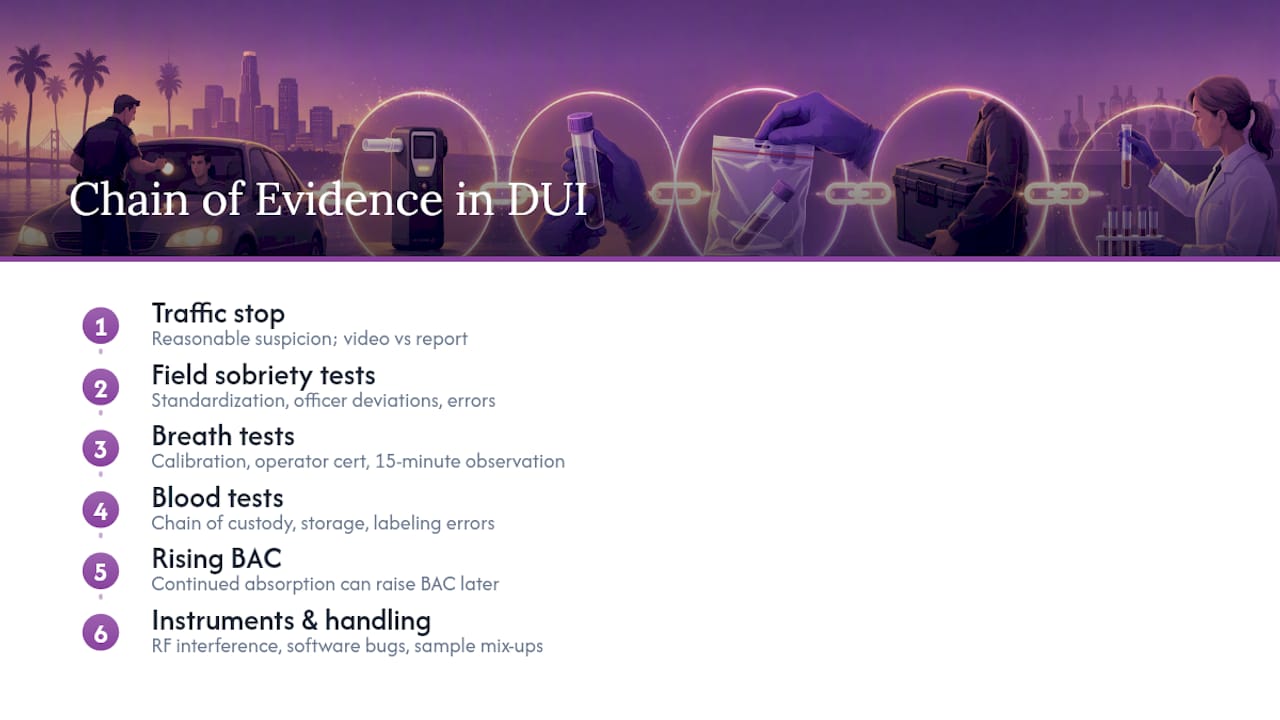
The traffic stop itself. Officers need reasonable suspicion to pull you over and probable cause to arrest you. Courts scrutinize whether the stated reason for the stop (a broken taillight, weaving within a lane, an expired tag) actually appears on video, and whether the officer's report matches what happened. A stop built on a vague or unsupported justification can lead to suppression of everything that followed it.
Field sobriety tests. The standardized tests (walk-and-turn, one-leg stand, horizontal gaze nystagmus) were validated under controlled conditions that rarely match a roadside stop at 1 a.m. on an uneven shoulder. NHTSA's own research on impaired-driving detection acknowledges these tests carry real error rates, and officers frequently skip steps in the standardized instructions or misjudge results in people with inner-ear issues, prior injuries, or ordinary nervousness. Our field sobriety test guide breaks down what "standardized" actually requires and where officers commonly deviate from it.
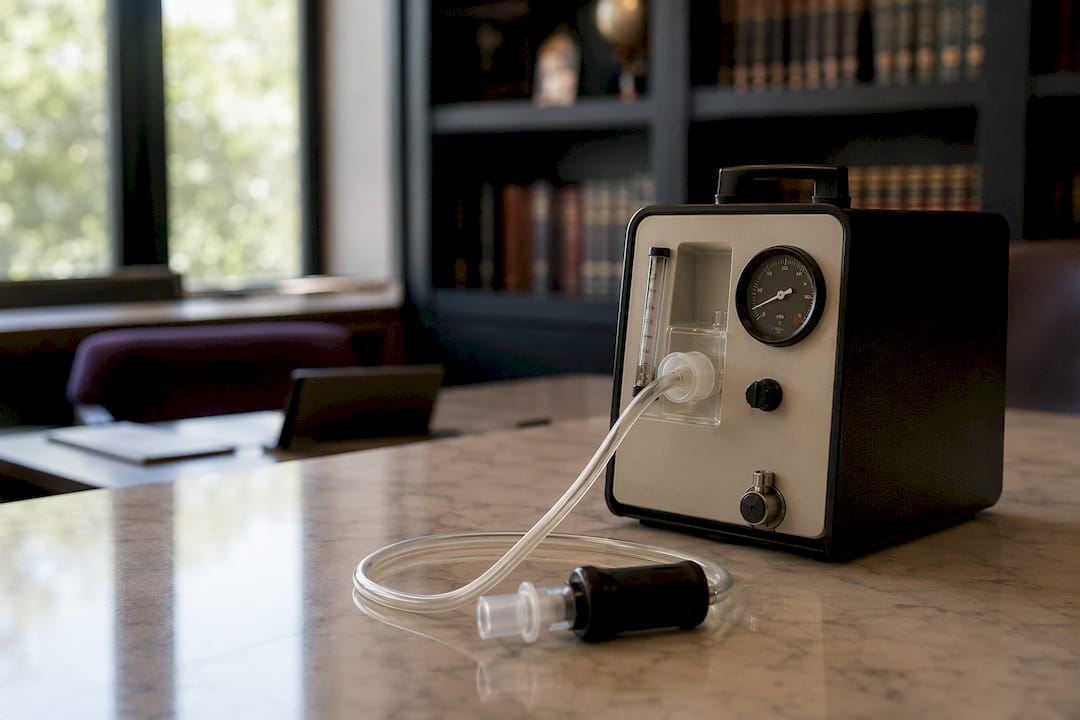
Breath tests. Title 17 of the California Code of Regulations sets strict rules for how breath machines must be calibrated, maintained, and operated, including a mandatory 15-minute observation period before testing to rule out residual mouth alcohol. Missing calibration entries, an operator without current certification, or a skipped observation window can all undercut a breath result's reliability in court.
Blood tests. Chain-of-custody failures happen more often than people expect. A sample sits too long before refrigeration, gets mislabeled, or passes through hands that never documented the handoff properly. Each gap is a place where the defense can raise doubt about whether the number on the lab report reflects what was actually in your blood.
Rising BAC. Alcohol keeps absorbing into your bloodstream for a while after you stop drinking, meaning your BAC can still be climbing when you're pulled over and peak sometime after. If your last drink was close to the time you started driving, the number on the test might be higher than what it actually was behind the wheel.
Medical and dietary factors. Acid reflux, certain diabetes-related conditions, and low-carb or ketogenic diets can all produce breath chemistry that reads inaccurately high on some machines, a point supported by clinical explanations of how these conditions affect breath and blood chemistry.
Instrument and handling errors. Less common, but real: radio frequency interference near breath machines, software glitches, or a sample that gets mixed up with someone else's in a busy lab. Our DUI evidence breakdown walks through how each type of test gets scrutinized in practice.
DMV Hearing vs. Criminal Court: What's the Difference?
These are two separate battles running on two separate clocks, and losing track of that distinction costs people their license every year.
- The DMV hearing decides only whether your license gets suspended. The standard of proof is "preponderance of the evidence," a much lower bar than the "beyond a reasonable doubt" standard criminal court requires. The DMV hearing officer looks at three things: did the officer have reasonable cause to believe you were driving under the influence, was the arrest lawful, and was your BAC at or above 0.08%.
- You have exactly 10 calendar days from arrest to request it. Ask, and you get a temporary license that keeps you legally driving while the hearing is pending. Miss the deadline, and the suspension kicks in automatically with no hearing at all.
- The DMV process often helps the criminal case even when you don't win it. Requesting the hearing forces early disclosure of the arresting officer's report, and sometimes calibration records and other documents your attorney can then use in criminal court, well before a normal discovery timeline would produce them.
- What to request for the hearing: the officer's sworn statement, breath or blood machine calibration and maintenance logs, and any video from the stop. These same documents typically end up central to a suppression motion down the line.
How Lawyers Take Apart a DUI Case: Motions and Discovery
Beating a DUI charge is rarely about one dramatic moment in court. It's about a series of technical filings that chip away at the prosecution's evidence long before a trial date ever gets set.
- Motions to suppress under Penal Code §1538.5 attack evidence obtained through an unlawful stop, arrest, or search. Win one, and the breath or blood test the whole case relies on can get thrown out entirely.
- Formal discovery requests demand the breath machine's calibration history, the operator's training and certification records, the full lab report on any blood sample, and bodycam or dashcam footage. Departments don't hand these over voluntarily; they respond to specific, timely requests.
- Title 17 audits go line by line through maintenance records looking for the gaps that matter most: a missed calibration date, an incomplete 15-minute observation log, or an expired operator certification. Any one of these can be enough to challenge admissibility.
- Expert witnesses, usually forensic toxicologists or FST specialists, review the raw data and produce reports modeling your absorption curve or critiquing how the field tests were administered. These reports carry real weight with judges because they come from people with no stake in the outcome.
- Timing drives everything. Evidence like video and physical samples degrades or gets deleted on a schedule. Filing motions and discovery requests early, sometimes within days of arraignment, is what keeps the strongest evidence available to challenge.
Pro Tip: Ask your attorney specifically whether they've filed a Title 17 discovery request in your case within the first two weeks. If the answer is vague, that's worth a follow-up question.
Can Medical Conditions or Timing Beat a Breath Test Result?
Rising BAC only works as a defense when the timeline actually supports it, and California courts have set a real legal standard for that. In People v. McNeal, the California Supreme Court held that prosecutors must prove your BAC at the time you were driving, not merely at the later moment someone tested you. A test taken 30 or 45 minutes after the stop doesn't automatically satisfy that requirement.
- Building the timeline requires receipts, witness statements about when drinking stopped, and phone or surveillance timestamps that pin down when the stop and the test actually happened.
- GERD, certain diabetic conditions, and ketogenic or low-carb diets can all skew breath chemistry, and medical records documenting these conditions become part of the defense file.
- Forensic toxicologists model absorption and elimination curves using your body weight, drink timing, and test results to show what your BAC likely was at the wheel, not an hour later. Our rising blood alcohol defense guide covers what that modeling process actually looks like in practice.
What Are the Plea Options if a Full Dismissal Isn't Realistic?
Not every case ends in outright dismissal, and a negotiated resolution is sometimes the smarter move, especially when the evidence is mixed rather than clearly flawed.
- Wet reckless (VC §23103.5) reduces the charge to reckless driving involving alcohol, which usually means less jail exposure, a shorter license impact, and lower insurance fallout than a full DUI conviction carries.
- Diversion and treatment programs under Penal Code §1000 or mental health diversion statutes can lead to dismissal after successful completion, though eligibility depends heavily on your record and the specific facts of the arrest.
- License-focused resolutions, like a restricted license tied to an ignition interlock device (IID), let you keep driving to work and required appointments while the broader case resolves.
- A negotiated reduction makes the most sense when the evidence is genuinely mixed: strong enough that trial carries real risk, weak enough that the prosecution has an incentive to settle for less than a full conviction.
What Happens If You're Convicted: Penalties and Collateral Damage
A first-offense DUI conviction typically brings fines, informal probation, mandatory DUI school, and the possibility of jail time, though actual sentences vary widely by county and by the specifics of the case. Second and subsequent offenses within ten years escalate sharply: longer license suspensions, mandatory ignition interlock devices, and increasingly serious jail exposure.
- The conviction itself is often the smaller problem. Insurance premiums can jump dramatically for years afterward, and many insurers require an SR-22 filing just to keep you on the road.
- Certain professions, particularly ones requiring state licensing, security clearances, or a clean driving record, treat a DUI conviction as a serious red flag, sometimes triggering separate disciplinary review.
- Non-citizens facing DUI charges should get specialized guidance immediately, since immigration consequences can extend well beyond what the criminal court itself imposes.
- Completing treatment programs, staying compliant with probation terms, and maintaining SR-22 coverage without lapse are the practical steps that limit how far these collateral effects spread over time. Given that county conviction rates for DUI vary from about 41% to 92%, where your case is filed and how it's handled both matter enormously to the eventual outcome.
Why Local Courtroom Experience Changes the Outcome
Rubin Law, P.C. builds its DUI defense work around constitutional challenges and diversion pathways, the two levers that most often move a case toward dismissal or reduction rather than a straight conviction. Frequent courtroom appearances across Los Angeles County mean familiarity with how individual judges and prosecutors tend to handle suppression motions and DMV-related evidence disputes.
In practice, that means filing the DMV hearing request the same week as arrest, sending formal discovery demands for calibration logs and bodycam footage before they age out of retention, and bringing in toxicology experts early enough that absorption modeling can actually be completed before trial dates get set.
An Editorial Take on What Actually Wins DUI Cases
Most people fixate on the breath test number, as if that single figure decides everything. It rarely does. The cases that fall apart in court usually fall apart over paperwork: a missing calibration entry, a skipped observation period, a stop report that doesn't match the video. Those details don't feel dramatic, but they're where real leverage lives.
The other thing people underestimate is speed. Waiting a week to "think it over" before calling a lawyer isn't caution, it's cost. Footage gets purged, memories blur, and the 10-day DMV window closes whether you were ready or not. The strongest defenses are built in the first 72 hours, not the week before trial.
If you've been arrested, the honest move is to treat the next three days as more urgent than the case itself. Document everything, request the DMV hearing, and get a lawyer reviewing the evidence while it still exists.
— Jake
Talk to a DUI Defense Attorney Before Your Next Court Date
Rubin Law, P.C. is the option for drivers who need someone who already knows the Los Angeles County courtrooms, not just the statute book. Rubin Law's approach centers on filing your DMV hearing request the moment you retain counsel, sending discovery demands for calibration logs and bodycam footage before departments have a chance to lose or overwrite them, and pushing constitutional challenges under §1538.5 wherever the stop or the testing procedure shows a crack.
An initial engagement typically starts with a case review covering your arrest report, any test results, and your timeline of the night in question, followed immediately by the DMV filing and the first round of evidence requests. That early work is often what separates a case that gets reduced from one that doesn't. If you were recently arrested, review the California DUI law page and reach out for a case evaluation before the 10-day DMV window closes.
Where to Verify These Facts Yourself
The California Driver Handbook covers DUI law and the APS hearing process directly from the DMV. Title 17 and related Penal Code provisions are published through California Legislative Information. NHTSA publishes national impaired-driving research, including data on field sobriety test reliability, that provides useful context for evaluating DUI evidence anywhere in the country.
This article is general information, not a substitute for advice from a qualified lawyer. Consult a qualified legal professional about your own circumstances before acting on anything here.