A California DUI arrest sets two separate legal processes in motion simultaneously. The criminal court case handles fines, jail, probation, and your driving record. The DMV's Administrative Per Se (APS) process handles your license — and it runs on its own clock, completely independent of what happens in court. Under VC §23152, a first-offense misdemeanor DUI carries statutory base fines starting at $390, up to six months in county jail, mandatory DUI school, an ignition interlock device (IID), and SR-22 insurance. Those numbers look manageable until you add penalty assessments and fees, which often substantially increase the real cost beyond the base fines.
Two things matter most in the first 24–48 hours:
- Request your APS/DMV hearing within 10 calendar days of arrest. Miss that window and the DMV automatically suspends your license 30 days after arrest. That deadline cannot be extended after it passes.
- Contact a qualified DUI attorney before your arraignment. Early counsel can challenge the suspension, review the police report and chemical test results, and identify weaknesses before you're pressured into a plea.
The 10-year DMV lookback means any prior DUI conviction within the past decade counts against you at sentencing — including a "wet reckless" plea under VC §23103.5. If injury was involved, VC §23153 applies and the exposure jumps sharply, potentially into state prison territory.
Table of Contents
- What legally counts as a DUI in California?
- DUI penalties in California by offense level
- When DUI causes injury or death: VC §23153
- DMV administrative suspensions, IID requirements, and how to request an APS hearing
- How fines, fees, and insurance costs add up after a DUI
- Jail exposure, probation conditions, and alternatives to custody
- Aggravating factors that trigger mandatory sentence enhancements
- What happens when you refuse a chemical test in California
- Criminal court vs. DMV administrative hearing: two separate tracks
- What to do in the first 10 days after a DUI arrest
- How long a DUI stays on your record and what expungement can do
- Key Takeaways
- A perspective on California DUI cases that most guides skip
- Facing DUI charges in Los Angeles? Rubinlawpc can help
- Useful sources and statutes for further research
What legally counts as a DUI in California?
California's DUI law covers more ground than most people expect. VC §23152 defines several distinct violations, and prosecutors can charge any one of them — or multiple at once.
The core offenses under VC §23152:
- §23152(a): Driving under the influence of alcohol. No BAC threshold required — impairment is the standard.
- §23152(b): Driving with a BAC of 0.08% or higher. This is a per se offense; impairment doesn't need to be proven separately.
- §23152(c): Driving while addicted to any drug (with a narrow exception for approved narcotic treatment programs).
- §23152(d): Driving a commercial motor vehicle with a BAC of 0.04% or higher.
- §23152(e): Driving for hire (rideshare, taxi) with a BAC of 0.04% or higher, effective July 1, 2018.
- §23152(f): Driving under the influence of any drug.
- §23152(g): Driving under the combined influence of alcohol and drugs.
Under-21 drivers face a stricter standard. California's zero-tolerance law applies a BAC threshold of 0.01% for drivers under 21 — effectively any detectable alcohol. A BAC of 0.05% or higher triggers additional presumptions under the Vehicle Code. These drivers face administrative consequences even when the BAC falls below the adult 0.08% threshold.
Related charges that affect future priors:
- Wet reckless (VC §23103.5): A reduced plea that carries lighter immediate penalties but still counts as a prior DUI conviction within the 10-year sentencing lookback.
- Dry reckless (VC §23103): A further reduction that does not count as a DUI prior — a meaningful distinction for future sentencing exposure.
Understanding which subsection applies to your case shapes everything from the plea negotiation to the DMV suspension length. For a deeper breakdown of California DUI charge types, the statutory distinctions matter more than most defendants realize at the outset.
DUI penalties in California by offense level
The table below reflects statutory ranges under California law, current through 2026. Actual sentences depend on the specific facts, the court, and whether aggravating factors apply.
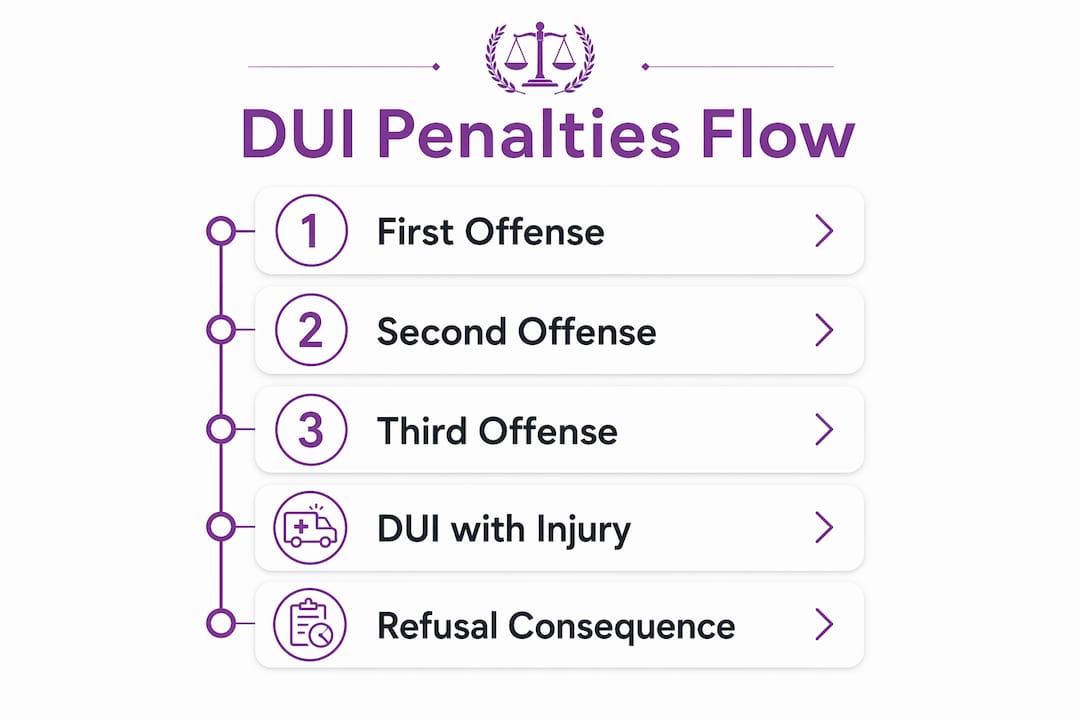
| Offense | Classification | Jail Exposure | Base Fine | DUI Program | IID Minimum | License Consequence |
|---|---|---|---|---|---|---|
| 1st offense | Misdemeanor | 48 hrs–6 months | $390–$1,000 | 3 months (AB-541) | 6 months | 6-month suspension |
| 2nd offense (within 10 yrs) | Misdemeanor | 96 hrs–1 year | $390–$1,000 | 18–30 months | 1 year | 2-year suspension |
| 3rd offense (within 10 yrs) | Misdemeanor | 120 days–1 year | $390–$1,000 | 30 months | 2 years | 3-year revocation |
| 4th+ offense (within 10 yrs) | Wobbler (felony) | 16 months–3 years (state prison) | $390–$1,000+ | 30 months | 3 years | 4-year revocation |
Note: While the table reflects the common practice of a 6-month license suspension for a first DUI criminal conviction, the DMV's separate APS administrative suspension for a first offense with BAC ≥ 0.08% is typically 4 months (see DMV section below). Criminal court suspensions and DMV APS suspensions may overlap but are distinct processes.
Key points on how these numbers work in practice:
- The base statutory fines of $390–$1,000 are the floor, not the ceiling. California's penalty assessment multipliers routinely push the actual court-ordered amount to several times the base figure before fees and programs are added.
- The 10-year lookback applies to all priors — including wet reckless pleas and, in many cases, out-of-state DUI convictions that are substantially similar to California offenses.
- DUI program lengths are mandatory conditions of probation: the 3-month AB-541 program applies to many first offenders; the 9-month AB-1353 program is required when BAC was 0.15% or higher or when the driver refused chemical testing; 18–30 month programs apply to multiple-prior and some felony cases.
- IID requirements are now mandatory statewide following a DUI conviction. The device must be installed on every vehicle the person operates, not just their primary car.
- Criminal sentence, DMV APS suspension, and IID periods often run concurrently rather than consecutively — but the IID period typically starts from the date of license reinstatement, not the date of conviction.
For a detailed breakdown of first-offense DUI penalties and the defense options available at that stage, the distinctions between probation-only and custody outcomes are worth understanding before arraignment.
When DUI causes injury or death: VC §23153
VC §23153 is the statute that transforms a DUI from a traffic offense into something with state-prison consequences. It applies when a driver under the influence causes bodily injury to another person — and it is a wobbler, meaning prosecutors can charge it as either a misdemeanor or a felony depending on the severity of the injuries and the defendant's history.
As a misdemeanor, VC §23153 carries up to one year in county jail and fines in the $390–$5,000 statutory range. The felony version carries state prison exposure and a mandatory four-year license revocation. Courts also order restitution to injured victims, which is separate from fines and not dischargeable.
Multiple victims compound the exposure significantly. Each additional person injured adds a mandatory consecutive one-year enhancement when charged and proven. Gross negligence — driving at extreme speeds, running red lights, or driving with a very high BAC — can push a case toward the upper end of the sentencing range and affect the prosecutor's willingness to negotiate.
A felony DUI conviction under VC §23153 also carries long-term collateral consequences: loss of firearm rights, potential federal implications for employment or immigration status, and a criminal record that PC §1203.4 expungement does not fully erase for all purposes.
DMV administrative suspensions, IID requirements, and how to request an APS hearing
The DMV process runs parallel to the criminal case and operates under different rules. You can win in criminal court and still lose your license through the APS process — or vice versa. Understanding both tracks is not optional.
The 10-day APS deadline
When you're arrested for DUI in California, the officer typically confiscates your physical license and issues a temporary driving permit valid for 30 days. The APS hearing request must be filed within 10 calendar days of arrest — not business days, calendar days. Miss that window and the DMV automatically suspends your license on day 31. That suspension cannot be reversed after the deadline passes.
Typical DMV suspension lengths
| Situation | Suspension/Revocation Length |
|---|---|
| 1st offense, APS (BAC ≥0.08%) | 4 months |
| 1st offense, test refusal | 1 year |
| 2nd offense within 10 years | 2 years |
| 3rd offense within 10 years | 3 years |
| 4th+ offense or felony DUI | 4 years |
Note: The DMV's administrative APS suspension for a first-offense DUI with BAC ≥ 0.08% is normally 4 months, while a criminal court conviction often triggers a 6-month suspension. These may run concurrently but are not identical; defendants should be aware of both processes.
How to request an APS hearing: step by step
- Locate the phone number on your temporary license. The arresting officer's paperwork includes the DMV Driver Safety Office number for your area.
- Call within 10 calendar days of arrest. Request a stay of the suspension and an APS hearing. Get a confirmation number.
- Follow up in writing. Send a written hearing request to the same Driver Safety Office by certified mail on the same day or the next business day.
- Note the hearing date and prepare. The DMV will schedule the hearing, typically 30–75 days out. Your attorney can appear on your behalf.
- Gather evidence before the hearing. Relevant materials include the police report, chemical test records, calibration logs for the breathalyzer, and any witness information.
Restricted licenses and reinstatement conditions
After a first-offense suspension, many drivers qualify for a restricted license that allows driving to work, school, and DUI program appointments. Conditions typically include enrollment in the required DUI program, an SR-22 filing with your insurer, and IID installation. The restricted license is not automatic — you must apply and meet all conditions before the DMV will issue it.
Pro Tip: Request the APS hearing the same day you retain counsel. Rubinlawpc routinely handles DMV hearings as part of DUI representation, and the APS hearing itself creates a discovery opportunity — the DMV must produce the officer's sworn statement and test records, which counsel can use in the criminal case.
How fines, fees, and insurance costs add up after a DUI
The statutory base fine is the number that appears in the Vehicle Code. It is not what you will actually pay.
Cost components for a typical California DUI:
- Base fine: $390–$1,000 (statutory range for a basic misdemeanor)
- Penalty assessments: California adds multiple state and county assessments on top of the base fine. These multipliers typically bring the court-ordered total to $1,800–$4,000 for a first offense before any other costs.
- DUI program tuition: The 3-month AB-541 program runs roughly $500–$700. The 9-month AB-1353 program costs $1,500–$2,000 or more depending on the provider.
- IID installation and monitoring: Installation typically costs $70–$150 per device. Monthly monitoring fees run $60–$80. Over a 6-month IID period, that adds $430–$630 per vehicle.
- License reinstatement fee: The DMV charges a reinstatement fee, typically around $125.
- SR-22 insurance surcharge: SR-22 is a certificate of financial responsibility your insurer files with the DMV. The filing itself is inexpensive, but the underlying insurance rate increase is not. Drivers with a DUI conviction commonly see annual premium increases of $1,000–$2,500 or more, sustained for three or more years.
All-in costs for a first-offense DUI frequently exceed $10,000 when insurance increases are factored over the SR-22 period. A case with aggravating factors — high BAC, test refusal, accident — pushes that figure higher still, and a felony DUI with restitution obligations can reach multiples of that amount.
The base fine figure that appears in most news articles and legal summaries is genuinely misleading as a planning tool. Budget for the total, not the statutory floor.
Jail exposure, probation conditions, and alternatives to custody
When judges impose actual jail time
First-offense misdemeanor DUIs carry up to six months in county jail, but actual custody is not the norm for unaggravated first offenses. Most resolve with probation, DUI program enrollment, IID, and fines. The statutory minimum for a first offense is 48 hours, which courts often satisfy with time served at booking.
Second and third offenses carry mandatory minimums of 96 hours and 120 days respectively, and judges have less discretion to waive custody entirely. Felony DUIs — fourth offense or VC §23153 felony — typically result in state prison or county jail sentences measured in months or years, not days.
Standard probation conditions for a DUI conviction:
- No driving with any measurable amount of alcohol in the blood (stricter than the 0.08% standard)
- Completion of the court-ordered DUI program
- IID installation and compliance
- Payment of all fines, fees, and restitution
- Community service (commonly 40–80 hours for a first offense)
- No new criminal violations during the probation period (typically 3–5 years of summary probation)
Alternatives to custody
California offers several paths that can reduce or eliminate jail time for eligible defendants:
- Diversion programs: Pretrial diversion is available in some counties for first-time offenders, particularly when substance use disorder is a factor. Successful completion results in dismissal of the charges.
- Mental health diversion (PC §1001.36): Available when a qualifying mental health condition contributed to the offense. Completion leads to dismissal and avoids a conviction entirely.
- Work release or electronic monitoring: Some courts allow jail sentences to be served through supervised work release or home detention with an ankle monitor.
- Wet reckless plea: Reduces the conviction to VC §23103.5, which carries lighter immediate penalties, shorter DUI program requirements, and no mandatory IID in some cases — though it still counts as a prior within the 10-year lookback.
Who qualifies for diversion depends heavily on the specific court, the prosecutor's office, and the facts of the case. Early counsel is the most reliable way to identify whether diversion is realistically available.
Aggravating factors that trigger mandatory sentence enhancements
California law builds mandatory enhancements on top of the base DUI penalties when specific aggravating facts are present. These are not discretionary — they add to the sentence independently of what the judge might otherwise impose.
Common enhancements and their effects:
- BAC ≥0.15% (high BAC): Triggers the 9-month AB-1353 DUI program instead of the standard 3-month program. Courts may also impose additional jail time and are less likely to grant diversion.
- Child passenger under 14: Adds a mandatory 48 hours to 90 days in jail for a DUI without injury, on top of the base sentence. With injury, the enhancement is more severe.
- Chemical test refusal: Adds 2 days to 18 days of mandatory jail time depending on the offense level, triggers a longer DMV suspension (1 year for a first refusal), and eliminates eligibility for the restricted license during the suspension period.
- Driving 30+ mph over the speed limit on a freeway (or 20+ mph on surface streets): Adds a mandatory 60-day jail enhancement.
- Multiple injured victims (VC §23153): Each additional victim adds a consecutive one-year enhancement when charged and proven at trial.
- Prior DUI within 10 years: Elevates the offense to a second or subsequent DUI with mandatory minimums and longer IID and program requirements.
Aggravating factors are independent of the base charge — a defense strategy that focuses only on the underlying DUI without addressing the enhancements misses half the problem. Counsel needs to evaluate both from the first meeting.
What happens when you refuse a chemical test in California
California's implied-consent law means that by driving on California roads, you have already agreed to submit to a chemical test (breath or blood) if lawfully arrested for DUI. Refusing that test after a lawful arrest is not a neutral choice — it carries its own set of consequences that stack on top of any DUI penalties.
The administrative consequences of refusal
- First refusal: One-year administrative license suspension, with no eligibility for a restricted license during that period.
- Second refusal (within 10 years): Two-year revocation.
- Third refusal (within 10 years): Three-year revocation.
The refusal suspension is separate from any criminal-court license consequence. Both can apply simultaneously.
How refusal affects the criminal case
Refusal can be introduced as evidence of consciousness of guilt at trial. Prosecutors routinely argue that a driver who refused testing did so because they knew they were impaired. That argument is not always persuasive, but it is available to the prosecution and juries do hear it.
On the other side, refusal means there is no BAC number in evidence. That removes the per se §23152(b) charge from the table and forces the prosecution to prove impairment under §23152(a) alone, which requires more circumstantial evidence. Whether that trade-off benefits the defense depends entirely on the specific facts.
Pro Tip: Refusal cases require a different defense approach than BAC cases. The absence of a chemical test result shifts the evidentiary focus to the officer's observations, field sobriety test performance, and the lawfulness of the stop and arrest. Rubinlawpc's approach to DUI evidence challenges — including breath and blood test procedures and FST validity — applies directly to refusal cases where the prosecution's case rests on officer testimony alone.
Criminal court vs. DMV administrative hearing: two separate tracks
Most people assume that winning in criminal court protects their license, or that losing at the DMV hearing hurts their criminal case. Neither is automatically true. The two processes operate under different legal standards, different evidence rules, and different timelines.
Key differences between the APS hearing and criminal court:
- Purpose: The APS hearing determines only whether your license should be suspended. The criminal case determines guilt, penalties, and probation.
- Legal standard: The DMV uses a preponderance of the evidence standard (more likely than not). Criminal court requires proof beyond a reasonable doubt.
- Evidence rules: DMV hearings are administrative proceedings — formal rules of evidence apply loosely. Criminal court has strict evidentiary rules that defense counsel can use to exclude improperly obtained evidence.
- Deadlines: APS hearing request must be filed within 10 calendar days of arrest. Criminal arraignment typically occurs within 48 hours for in-custody defendants or within a few weeks for those released.
- Outcomes: A DMV win preserves your license but does not affect the criminal charge. A criminal acquittal does not undo a missed APS deadline or reverse an APS suspension already in place.
- Who decides: A DMV hearing officer decides the APS case. A judge (and potentially a jury) decides the criminal case.
The APS hearing also serves a strategic function in the criminal case. The DMV must produce the arresting officer's sworn DS-367 statement and the chemical test records. Defense counsel can use that discovery to identify inconsistencies, calibration issues, or procedural defects before the criminal case reaches a critical stage.
Engaging counsel early allows both tracks to be managed simultaneously rather than reactively. Waiting until after arraignment to retain an attorney often means the APS window has already closed.
What to do in the first 10 days after a DUI arrest
The decisions made in the first 10 days after a DUI arrest have a disproportionate effect on the eventual outcome. Here is the tactical sequence that matters most.
- Request the APS hearing immediately. Call the DMV Driver Safety Office listed on your temporary license. Do this before you do anything else. The 10-day deadline is absolute.
- Retain a DUI attorney before arraignment. Early counsel reviews the police report, the chemical test records, and the officer's sworn statement before you're asked to enter a plea. Arraignment pressure is real — having counsel before that date changes the dynamic entirely.
- Do not discuss the case. Not with friends, not on social media, not with the arresting officer if contacted. Anything you say can be used in both the DMV hearing and the criminal case.
- Preserve all evidence you can access. Note the names and contact information of any witnesses. Document any medical conditions, prescription medications, or device issues (dentures, GERD, mouth alcohol) that could affect breath test results.
- Collect all paperwork from the arrest. The temporary license, the DS-367 form, any receipts from the booking process. Give everything to your attorney.
- Avoid entering a plea at arraignment without counsel. If you appear without an attorney, request a continuance. A plea entered under arraignment pressure is almost always worse than one negotiated after discovery review.
- Identify potential defense angles early. Common challenges include the lawfulness of the traffic stop (probable cause), the administration of field sobriety tests, the calibration and maintenance records of the breathalyzer, chain-of-custody issues with blood samples, and medical explanations for apparent impairment.
Pro Tip: Early intervention before arraignment consistently produces better outcomes because counsel can review discovery, identify weaknesses in the prosecution's case, and negotiate from a position of knowledge rather than reacting under pressure. Rubinlawpc prioritizes the APS hearing and pre-arraignment discovery review as the first two steps in every DUI case.
Consider a typical scenario: a client arrested for a first-offense DUI with a BAC of 0.09% retains counsel within 48 hours. Counsel requests the APS hearing, obtains the breathalyzer calibration records, and discovers a maintenance gap in the device's service log. The APS hearing is won on that basis, preserving the license. In the criminal case, the same calibration issue supports a motion to suppress the breath test result. The prosecution, without a reliable BAC number, offers a wet reckless plea. The client avoids a DUI conviction on their record, keeps their license, and completes a shorter DUI program. That sequence of outcomes is only possible when counsel is engaged before the APS window closes.
For a broader look at California DUI defense strategies, the interplay between the APS hearing and criminal discovery is where most of the leverage lives.
How long a DUI stays on your record and what expungement can do
The DMV's 10-year lookback
For sentencing purposes, the DMV and California courts use a 10-year lookback period. Any DUI conviction — including a wet reckless under VC §23103.5 — within the past 10 years counts as a prior and elevates the offense level. Once a conviction ages past 10 years, it no longer counts as a prior for sentencing, though it may still appear on your driving record.
The DMV driving record itself retains DUI entries for 10 years from the date of conviction. After that period, the entry drops off the DMV record.
The criminal record: indefinite unless expunged
A DUI conviction on your criminal record does not automatically disappear after 10 years. Criminal records are indefinite unless you take affirmative steps to seek relief.
Expungement under Penal Code §1203.4:
- Available after successful completion of probation (or early termination of probation granted by the court)
- Requires a petition to the court that sentenced you
- If granted, the conviction is dismissed and the plea is withdrawn — the case is treated as if you were acquitted
- Does not seal the record from all purposes: law enforcement can still see it, it can still be used as a prior in future DUI sentencing, and it does not restore firearm rights for felony convictions
- Background check effects vary: private employers generally cannot use an expunged conviction against you under California law, but certain licensed professions and government positions may still consider it
Practical timeline for record relief:
- Probation typically runs 3–5 years for a misdemeanor DUI
- Early termination of probation is possible after completing all conditions and serving at least half the probation term
- A §1203.4 petition can be filed immediately after probation ends or is terminated early
- For sentencing purposes, the 10-year lookback clock runs from the date of conviction, not the date of expungement
A wet reckless conviction follows the same expungement rules as a DUI — and still counts as a prior within the 10-year window even after expungement. That is the trade-off defense counsel must explain clearly before a client accepts that plea.
Key Takeaways
A California DUI triggers two simultaneous legal tracks — the DMV's APS process and the criminal case — and missing the 10-day APS hearing deadline is the single most consequential and irreversible mistake a defendant can make.
| Point | Details |
|---|---|
| The 10-day APS deadline | Request your DMV hearing within 10 calendar days of arrest or face automatic license suspension with no reversal. |
| Real cost vs. statutory fine | Base fines of $390–$1,000 balloon to $2,000–$10,000+ after assessments, DUI program, IID, and SR-22 insurance increases. |
| Two separate tracks | Winning the APS hearing preserves your license; a criminal acquittal does not undo a missed APS deadline. |
| The 10-year lookback | Prior DUIs and wet reckless pleas within 10 years elevate your offense level and mandatory minimums at sentencing. |
| Rubinlawpc's approach | Rubinlawpc handles both the APS hearing and criminal defense simultaneously, using DMV discovery to strengthen the criminal case from the outset. |
A perspective on California DUI cases that most guides skip
Most DUI articles focus on the penalty chart. That is useful, but it misses where cases are actually won and lost.
The APS hearing is treated as a formality by defendants who don't understand it, and as a tactical asset by experienced defense counsel. The DMV must produce the officer's sworn statement and the chemical test records at that hearing. Those documents arrive before the criminal case reaches the discovery phase in many courts. That timing advantage is real, and it is one of the main reasons early retention of counsel changes outcomes in ways that late retention simply cannot replicate.
The other thing most guides understate is how much the enhancement analysis matters. A defendant with a BAC of 0.16% and a child in the car is not facing a standard first-offense DUI — they are facing a case with two independent enhancements that add mandatory jail time regardless of how sympathetic the judge might otherwise be. Defense planning that ignores the enhancements and focuses only on the underlying charge is incomplete from day one.
The wet reckless plea is genuinely useful in the right case. But it is not a clean outcome. Clients who accept it without understanding that it counts as a prior within the 10-year window sometimes find themselves classified as second-time offenders years later, facing mandatory minimums they didn't expect. The short-term relief is real; so is the long-term exposure. That trade-off deserves a direct conversation, not a quick signature at arraignment.
What actually changes outcomes is the combination of early action on the APS deadline, thorough discovery review before any plea discussion, and a defense strategy that addresses both the base charge and every applicable enhancement from the first meeting. That sequence is not complicated, but it requires counsel who is engaged before the critical windows close — not after.
Facing DUI charges in Los Angeles? Rubinlawpc can help
When the 10-day APS clock is running and arraignment is approaching, the decisions you make in the next few days determine what options remain available. Rubinlawpc provides Los Angeles DUI defense that covers both tracks from day one: DMV APS hearing representation to preserve your driving privileges, and criminal-court defense focused on discovery, constitutional challenges, and plea negotiation.
The firm's approach starts with the APS hearing request and a full review of the police report, chemical test records, and field sobriety test administration before any plea discussion. For clients where the facts support it, Rubinlawpc pursues diversion, wet reckless pleas, or outright dismissal through suppression motions. For cases involving injury, high BAC, or prior convictions, the focus shifts to minimizing mandatory enhancements and negotiating the best available outcome given the specific facts.
If you were arrested for DUI in Los Angeles or the surrounding area, the most useful thing you can do right now is call Rubinlawpc before your arraignment date. Request a consultation, preserve the APS deadline, and get a realistic assessment of your case before you're asked to enter a plea. Reach the firm through rubinlawpc.com/criminal-defense or call directly to speak with a DUI defense attorney today.
Useful sources and statutes for further research
The following primary sources and statutory references were used throughout this article. Readers are encouraged to verify current procedural forms, fee schedules, and program requirements directly with the DMV and the California Legislature's official code portal, as administrative details can change.
Primary statutory references:
- Vehicle Code §23152 — Core DUI offense definitions (impairment, per se BAC, drug, commercial, and for-hire standards): leginfo.legislature.ca.gov
- Vehicle Code §23153 — DUI causing injury, wobbler treatment, and enhancement provisions: California Vehicle Code penalties sections
- Vehicle Code §23103 / §23103.5 — Dry reckless and wet reckless definitions and prior-count rules
- Penal Code §1203.4 — Expungement eligibility and process after probation completion
- Penal Code §1001.36 — Mental health diversion eligibility and procedure
- California Senate Public Safety Committee — DUI Overview (2026): spsf.senate.ca.gov — Statutory penalty tables, enhancement schedules, and program length requirements
- California DMV — Driving Under the Influence: dmv.ca.gov — APS hearing procedures, suspension lengths, IID program requirements, and restricted license eligibility
- Alameda Superior Court — Misdemeanor DUI Plea Attachment: alameda.courts.ca.gov — Example of court-level penalty disclosure used at plea
- DHCS Licensed DUI Provider Directory: gis.dhcs.ca.gov — Locate licensed AB-541, AB-1353, and SB-38 DUI program providers by county
For out-of-state perspective on DUI attorney intake and APS-preservation practices, mpclaw.legal/dui-attorney offers a useful comparison of how defense counsel in other jurisdictions approach the early-intervention window — though California's specific 10-day APS rule has no direct equivalent in most other states.