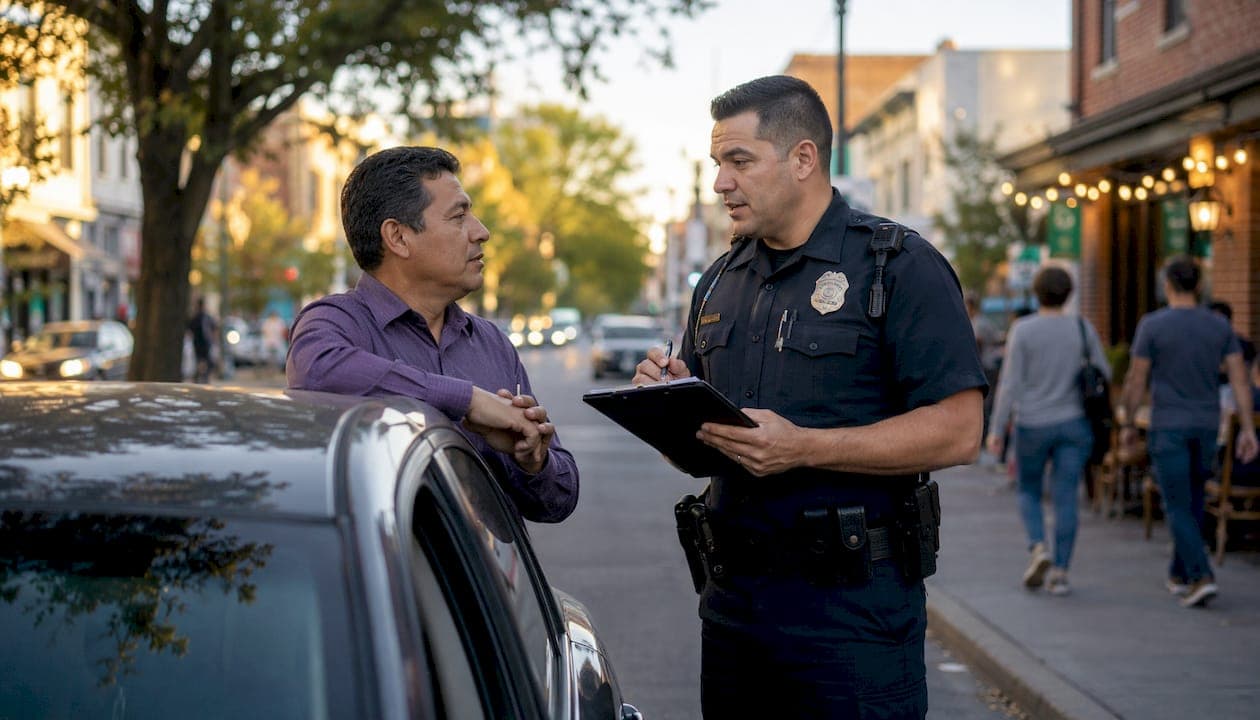
Are field sobriety tests mandatory in California?
Field sobriety tests in California are entirely voluntary. You can decline them without triggering a license suspension or any automatic legal penalty under California Vehicle Code. That's the short answer, and it's one most drivers don't know until it's too late.
Here is what the law actually says as of 2026:
- FSTs are voluntary under California state law; refusal carries no administrative consequences.
- Refusing an FST does not suspend your license. That penalty applies only to chemical tests after arrest.
- Officers are not required to tell you that FSTs are optional. Most won't.
- Chemical tests (breath, blood, or urine) after a lawful DUI arrest are a different matter entirely, governed by California's implied consent law.
- A Preliminary Alcohol Screening (PAS) breath test at the roadside is also voluntary for drivers over 21 who are not on DUI probation, per Cal. Veh. Code § 23612.
The critical distinction: pre-arrest tests (FSTs and PAS) are optional. Post-arrest chemical tests are not.
Pro Tip: If you choose to refuse, do it calmly and politely. Say something like, "I'd prefer not to take any field tests." Keep your tone neutral. Hostile or agitated behavior can be documented and used against you.
Types of field sobriety tests used by California law enforcement
California law enforcement relies on three tests developed and validated by the National Highway Traffic Safety Administration (NHTSA) in the 1970s. These are the only tests with any scientific backing, though officers sometimes use others.
The three standardized tests
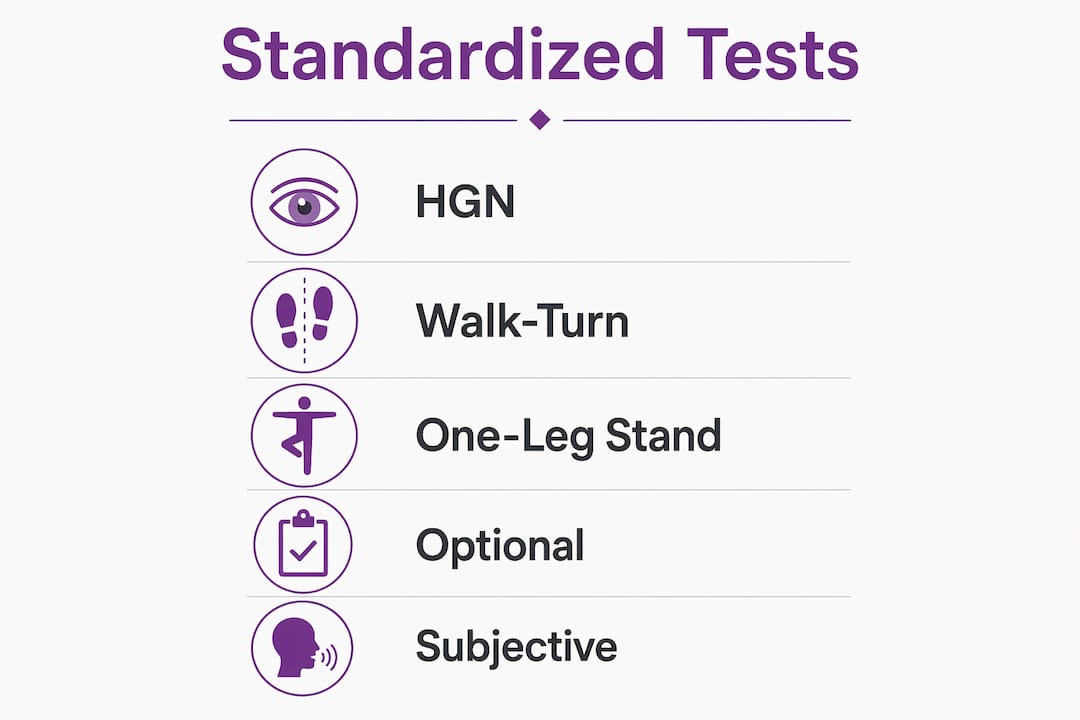
Horizontal Gaze Nystagmus (HGN) The officer moves a pen or light slowly across your field of vision and watches your eyes. They're looking for involuntary jerking of the eyeball, called nystagmus, which can intensify with alcohol consumption. There are six specific clues the officer scores: lack of smooth pursuit in each eye, distinct nystagmus at maximum deviation in each eye, and onset of nystagmus before 45 degrees in each eye. Four or more clues is considered a positive indicator.
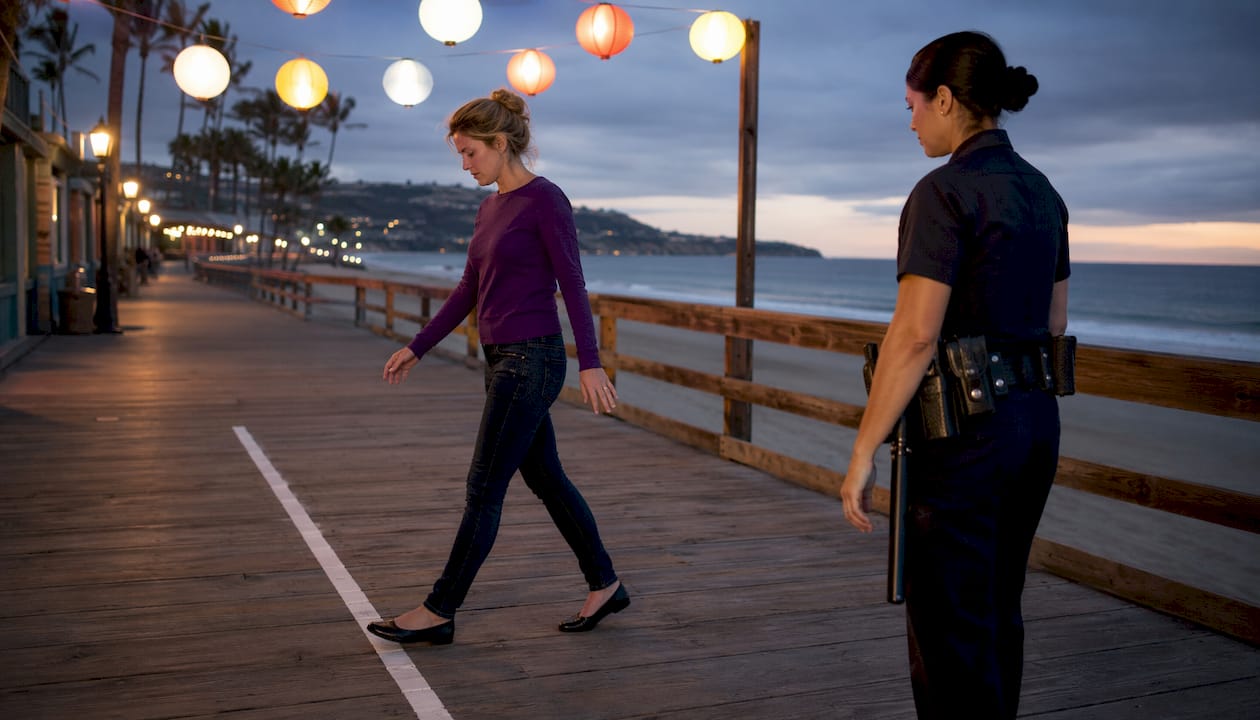
Walk-and-Turn (WAT) You take nine heel-to-toe steps along a line, turn on one foot, and walk back. Officers watch for eight clues: losing balance during instructions, starting too soon, stopping mid-walk, missing heel-to-toe contact, stepping off the line, using arms for balance, making an improper turn, or taking the wrong number of steps. Two or more clues typically signals impairment in the officer's assessment.
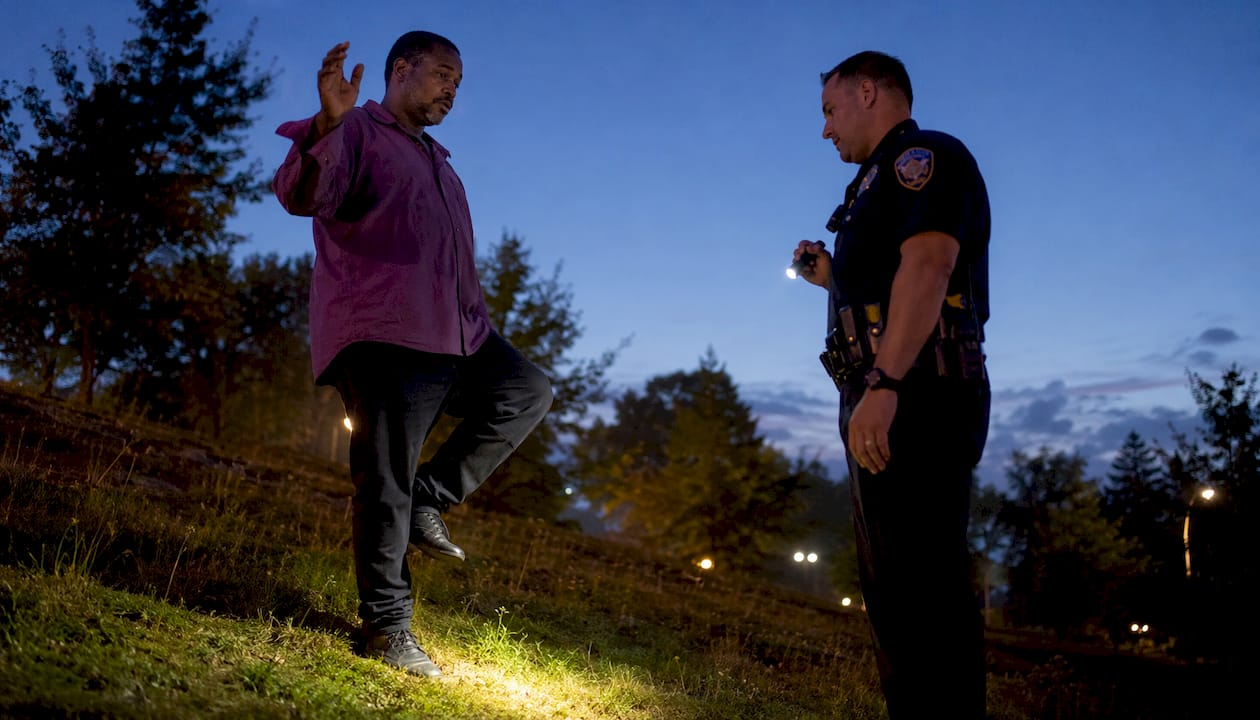
One-Leg Stand (OLS) You raise one foot about six inches off the ground and count aloud for 30 seconds. Officers look for four clues: swaying, using arms for balance, hopping, or putting the foot down. Two or more clues is treated as a positive result.
Non-standardized tests
Beyond the NHTSA battery, officers sometimes ask drivers to recite the alphabet, count backward, or perform a finger-to-nose test. None of these have been validated by controlled research, and their results carry less weight in court. Still, they get used.
"FSTs remain largely observational and hinge on officer interpretation, even when officers aim to simulate scientific objectivity with the NHTSA standardized tests." — Nolo Legal Encyclopedia
The subjectivity problem runs through all of these tests. Nervousness, uneven pavement, poor lighting, age, inner ear conditions, and even the type of shoes you're wearing can all affect your performance. Experts note that FSTs measure compliance with instructions and perceived balance, not definitive impairment levels.
How California's implied consent law applies after a DUI arrest
Once you're under arrest for DUI, the rules change completely. California's implied consent law kicks in, and refusing a chemical test at that point carries real, automatic consequences.
- License suspension: A first refusal results in a one-year suspension under Cal. Veh. Code § 13353. Subsequent refusals carry longer suspensions.
- Court use: Refusal can be introduced as evidence of consciousness of guilt at trial.
- No choice of test: You must submit to a breath or blood test. Urine is available in limited circumstances.
- No penalty for FST refusal: The suspension and penalties above apply only to chemical test refusal, not to declining an FST or PAS before arrest.
The implied consent law applies to chemical testing after a lawful DUI arrest, not to roadside sobriety exercises. That distinction is the foundation of your rights during a DUI stop.
At California DUI checkpoints, enforcement goes beyond alcohol. Drug Recognition Evaluators (DREs) are trained officers who assess impairment from prescription drugs, marijuana, and other substances when standard FSTs don't tell the full story. If a DRE is called in, the encounter can escalate quickly, which is another reason to understand your rights before you're in that situation.
What you are never required to do before arrest:
- Perform any FST
- Blow into a roadside PAS device (if you're over 21 and not on DUI probation)
- Answer questions about how much you've had to drink
What to expect during a California DUI stop
Knowing the sequence of a DUI stop helps you respond clearly instead of reacting in the moment.
-
The initial stop. An officer pulls you over for a traffic violation or flags you at a checkpoint. They approach, ask for your license and registration, and begin observing. Slurred speech, the smell of alcohol, or bloodshot eyes may prompt them to investigate further.
-
Questions about drinking. The officer will likely ask whether you've been drinking. You are not required to answer. Politely declining to answer is legal and often advisable.
-
The FST request. If the officer suspects impairment, they'll ask you to step out and perform field sobriety tests. At this point, you can decline. Say clearly and calmly that you'd prefer not to participate in field testing.
-
The PAS offer. The officer may also offer a roadside breath test. For drivers over 21 not on DUI probation, this is voluntary. Officers are legally required to inform you of that right under Cal. Veh. Code § 23612(h)–(i).
-
Arrest decision. Refusing FSTs does not prevent an arrest. If the officer has enough other evidence, such as odor, driving behavior, or your statements, they can still arrest you. Refusal simply removes one category of evidence from the equation.
-
Post-arrest chemical test. Once arrested, you must submit to a breath or blood test. This is where implied consent applies. Refusing at this stage triggers the automatic one-year suspension discussed above.
-
Booking and charges. After the chemical test, you'll be processed. The DUI evidence collected during the stop, including any FST observations, officer notes, and chemical test results, becomes the foundation of the prosecution's case.
Pro Tip: Stay calm throughout. Keep your hands visible, answer basic identification questions, and decline everything else politely. Being argumentative or hostile gives officers more to document and more for a prosecutor to use.
How reliable are field sobriety tests, and can you challenge the results?
The short answer: FSTs are far from foolproof, and their results can be challenged on multiple grounds.
"Errors in test administration, environmental conditions, and officer training deviations provide grounds to challenge FST results in court. Officers must strictly follow NHTSA standardized procedures; non-compliance can lead to suppression of evidence." — FindLaw
The accuracy numbers tell a sobering story. Standardized FST accuracy rates hover between 65% and 88%, with the One-Leg Stand ranging from 65% to 83% in controlled studies. That means a significant percentage of sober drivers fail one or more of these tests under controlled conditions, let alone on the side of a freeway at night.
Where defense challenges typically land
Officer training and certification. NHTSA requires officers to complete specific training before administering standardized FSTs. If the administering officer didn't complete that training or administered the tests out of sequence, the results may be challengeable. Challenging NHTSA procedure compliance is one of the most effective defense strategies available.
Environmental conditions. Uneven pavement, poor lighting, traffic noise, and inclement weather all affect test performance. A defense attorney can argue that conditions made the test inherently unreliable.
Medical and physical factors. Inner ear disorders, knee or ankle injuries, neurological conditions, and even certain medications can cause the same "clues" officers look for. These factors don't disappear just because an officer didn't ask about them.
Refusal as evidence. Declining an FST can be introduced in court as consciousness of guilt, as clarified in People v. Jackson. But it is not a legal penalty, and a skilled defense attorney can contextualize refusal as a reasonable exercise of legal rights rather than an admission of impairment.
Pro Tip: If you did take FSTs and believe the conditions or administration were flawed, write down everything you remember as soon as possible: the road surface, lighting, what the officer said, and any physical conditions you have. That detail matters later.
Many defense attorneys advise declining FSTs even when sober, precisely because the tests are subjective enough that a nervous but completely sober driver can fail. Preserving the chemical test as the primary evidence gives a defense team more to work with, since breath and blood results are subject to their own set of constitutional and procedural challenges.
The subjectivity of field sobriety tests is well-documented, and courts have increasingly scrutinized how officers score and report clues. An experienced DUI defense attorney will examine the officer's body camera footage, training records, and written report to find inconsistencies between what was observed and what was documented.
Facing a DUI charge? Rubinlawpc can help.
If you've been stopped at a California DUI checkpoint or arrested after a sobriety test, the decisions you make in the next few days matter enormously. Rubinlawpc is a Los Angeles criminal defense firm with deep courtroom experience and a direct understanding of how local prosecutors build DUI cases.
Whether the issue is a flawed FST, a disputed chemical test, or a stop that may not have been legally justified, Rubinlawpc's attorneys know where the evidence breaks down and how to use that in your defense. Contact a Los Angeles DUI attorney at Rubinlawpc for a consultation before your case moves forward.
Key Takeaways
Field sobriety tests in California are voluntary, carry no automatic penalties for refusal, and are far less reliable than most drivers assume.
| Point | Details |
|---|---|
| FSTs are voluntary | California law does not require you to perform field sobriety tests; refusal triggers no license suspension. |
| Chemical tests are mandatory post-arrest | Refusing a breath or blood test after arrest results in a one-year license suspension under Cal. Veh. Code § 13353. |
| Accuracy has real limits | Standardized FST accuracy rates hover between 65% and 88%, with the One-Leg Stand ranging from 65% to 83% in controlled studies. This margin of error means sober drivers can and do fail these tests. |
| NHTSA compliance matters | Officers must follow exact NHTSA procedures; deviations can be grounds to challenge or suppress FST evidence. |
| Refusal is admissible but not punishable | A court can hear that you refused an FST, but that refusal carries no administrative penalty under California law. |