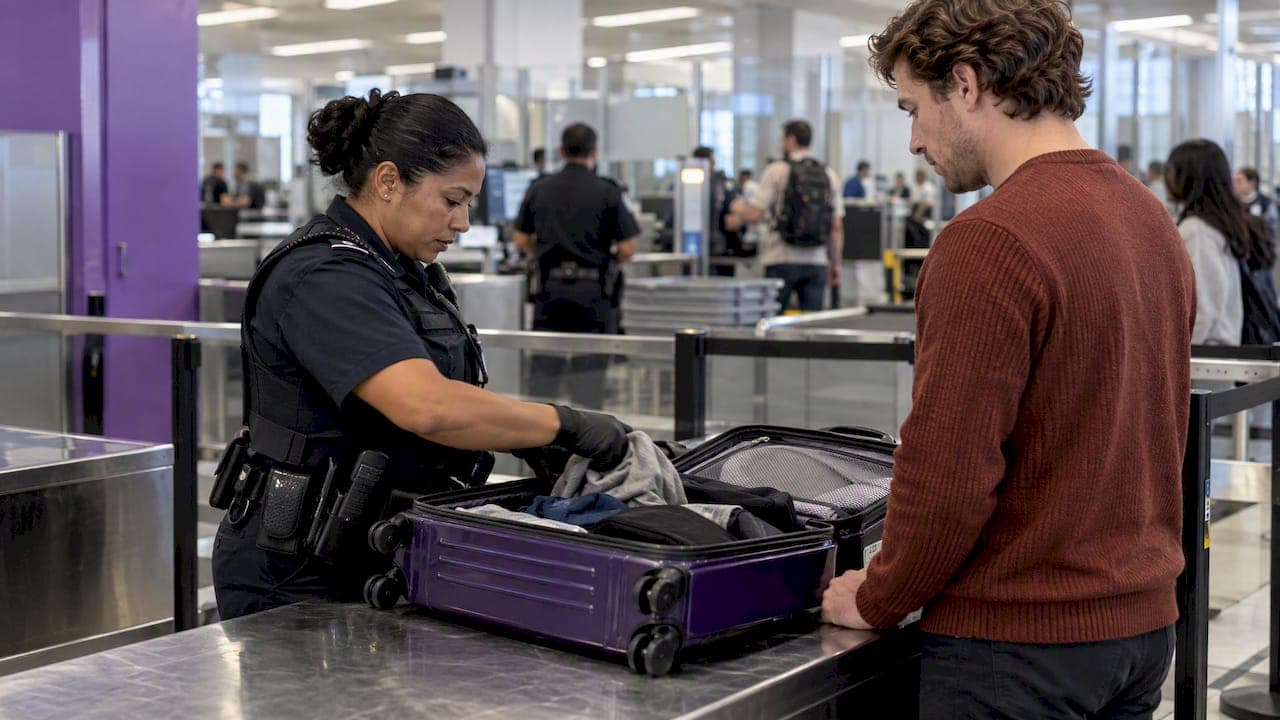
The border search exception is a rule that lets federal officers search people and property entering the United States without a warrant, probable cause or even suspicion. It applies at the physical border and at its "functional equivalents," such as international airports. It does not give officers unlimited power. Intrusive searches face a higher bar, phones and laptops are the most contested area, and evidence from a search that went too far can sometimes be challenged in court.
This guide explains where the exception applies, what it allows, where the limits sit and what to do if a border search led to criminal charges.
TL;DR
- Routine border searches of your person, bags and vehicle need no warrant, probable cause or reasonable suspicion.
- The exception covers the border itself and its functional equivalents, including international airports and post offices that receive international airmail.
- Basic manual searches of a phone need no suspicion under CBP policy. Advanced searches, which copy or analyze data with external equipment, require reasonable suspicion or a national security concern.
- Highly intrusive searches, such as strip searches, may require reasonable suspicion. Courts have never drawn a precise line between routine and non-routine.
- Evidence from a border search can be challenged. The arguments usually turn on the type of search and where it happened.
Table of Contents
- What the border search exception is
- Where the exception applies
- Routine versus non-routine searches
- Phones, laptops and other devices
- How border search evidence gets challenged
- Our perspective
- When to call a criminal defense lawyer
- How Rubin Law can help
- FAQ
- Sources
What the border search exception is
The Fourth Amendment protects against unreasonable searches and seizures, and the usual rule is that police need a warrant based on probable cause. The border search exception is one of the recognized exceptions to that rule. Under it, routine searches of people and property crossing into the country are reasonable simply because they happen at the border or its functional equivalent.
The reasoning is about sovereignty and expectations of privacy. The government has the authority to protect its territorial integrity, and travelers have a lower expectation of privacy when they cross. CBP's own directive says the Fourth Amendment balance at the border is struck in favor of the government. It also cites the Supreme Court's holding in United States v. Flores-Montano (2004) that the government's interest in keeping out unwanted people and goods is at its zenith at the international border.
In practice, this means a CBP officer can open your suitcase, inspect your car, look through your wallet and ask you to unlock your devices, with no warrant and no explanation.

Where the exception applies
The border and its functional equivalents
The exception is not limited to a land crossing line. It covers the physical border and its functional equivalents, including U.S. international airports and post offices that receive international airmail. If you land at LAX on a flight from abroad, you are at a border for Fourth Amendment purposes, even though you are hundreds of miles from Mexico or Canada.
For an interior location to count as a functional equivalent, the Congressional Research Service describes factors such as the relative permanence of the checkpoint, minimal impact on domestic traffic, and the ability to monitor international traffic that would otherwise go uncontrolled.
Extended border searches
Some searches happen away from the border or its functional equivalent, after someone has crossed. These are called extended border searches, and they get more protection. They require both reasonable certainty of a recent border crossing and reasonable suspicion of unlawful activity. If officers cannot show both, the exception does not justify the search.
The 100-mile zone
This is the part people most often misunderstand. Federal law lets designated immigration officers board and search conveyances for aliens within 100 air miles of a U.S. external boundary. That is not a blanket border search power. According to the CRS:
| Situation in the 100-mile zone | What Border Patrol needs |
|---|---|
| Roving stop of a vehicle | Reasonable suspicion |
| Search of a vehicle at a roving stop | Probable cause |
| Stop at a fixed checkpoint | No individualized suspicion |
| Search of a vehicle at a fixed checkpoint | Probable cause |
These rules come from the CRS analysis of border searches. Because Los Angeles County sits near the coast, much of Southern California falls within the 100-mile band, so it matters here. Being in the zone does not strip away your rights. It changes which standard applies.
Routine versus non-routine searches
The exception works on a sliding scale. Routine searches need nothing. Non-routine, highly intrusive searches, such as strip searches, may require reasonable suspicion. The Library of Congress describes these as searches that infringe on personal dignity or destroy property.
The catch is that courts have not precisely defined where routine ends and non-routine begins. The same Library of Congress analysis notes the boundary is unsettled, which has produced judicial debate, especially over forensic searches of electronic devices. That uncertainty is useful in a criminal case. If the government justified a search as routine, the question of whether it really was routine can be the heart of a motion.
Phones, laptops and other devices
Devices are where the exception is most disputed, because a phone holds far more personal information than a suitcase ever could. The rules that govern what CBP does in practice are in CBP Directive 3340-049B, effective January 2026, which applies to both inbound and outbound travelers.
According to CBP's published guidance on device searches:
- Basic searches. An officer may manually review a device without suspicion.
- Advanced searches. Connecting external equipment to a device to review, copy or analyze its contents requires reasonable suspicion of a violation of law that CBP administers, or a national security concern. A manager at Grade 14 or higher must approve it.
- Passwords. Bypassing a password just to enable inspection does not trigger the advanced search standard.
The directive itself says CBP imposes policy requirements above and beyond constitutional minimums. That matters because a policy is not the Constitution. An agency can follow its own policy and still conduct a search a court finds unreasonable, and an agency can break its policy without that alone making the search unconstitutional. ICE has its own separate policy, Directive 7-6.1, issued in 2009, on border search authority for electronic devices.
If your concern is a phone search by local police rather than at a port of entry, a different set of rules applies. Our rights-first checklist on phone searches in California covers those.
How border search evidence gets challenged
If a border search turns up contraband, or data on a device leads to charges, the case often depends on a motion to suppress. The CRS identifies two main lines of attack:
- The search was non-routine and lacked the required suspicion. For example, a prolonged or invasive search, or an advanced device search, carried out without reasonable suspicion.
- The location did not qualify. The search took place somewhere that is not the border or a true functional equivalent, or an extended border search lacked reasonable certainty of a recent crossing.
Both arguments turn on whether the search was reasonable under the specific circumstances. Facts decide these motions: how long you were held, what officers did with your device, who approved it, and what they said at the time. Your own account helps, but written records, timestamps and what officers actually did matter more.
What helps most in the first days:
- Write down everything you remember: times, locations, names or badge numbers, what you were asked and what was taken.
- Keep any receipt or form you were given for seized property or devices.
- Do not discuss the facts with investigators, and do not describe your travel or your devices to anyone but your lawyer.
- Do not delete anything, anywhere. Deleting data after a search can create a separate problem.
For the general framework of suppression, see our explainer on whether evidence can be thrown out after an illegal search. If federal agents also executed a warrant, time matters, as we explain in challenging a federal search warrant.
Our perspective
Most people who call us after a border search are not thinking about constitutional doctrine. They are scared, and they have usually been told by someone that the government can do whatever it wants at the border. That is overstated. The exception is broad, but it is a rule with edges, and the edges are where cases are won or lost.
We approach these cases the way we approach any search and seizure case. We look at what exactly the officers did, in what order, on whose authority and under which standard, then test each step. Our work in Los Angeles courtrooms has taught us that judges respond to precise factual records, not general indignation. A device search that went past a basic manual look, a detention that stretched on, an interior stop that was labeled a border search: each of these is a specific argument.
There is also a second front. Border encounters often start federal investigations involving drugs, fraud, firearms or digital material. Early action, before statements are made and before devices are handed over in ways that cannot be undone, shapes what is possible later. If you are contacted by agents after a crossing, speak to counsel first.
— Jake
When to call a criminal defense lawyer
Call a lawyer if any of these apply:
- You were arrested or charged after a search at an airport, port or crossing.
- Agents seized your phone, laptop or other devices and have not returned them.
- You were told you are under investigation, or a federal agent asked to interview you.
- You received a subpoena, search warrant or target letter after traveling.
If the charges involve digital material, speak to counsel before anything else. Our guides on federal child pornography charges and digital evidence defenses in California cases explain why.
How Rubin Law can help
Rubin Law, P.C. is a Los Angeles criminal defense firm. Our services include constitutional search and seizure challenges, federal crimes defense, drug crimes defense and pre-file intervention for clients who know they are under investigation but have not yet been charged. You deal directly with an attorney who knows the local courts and how local prosecutors approach cases.
If a search at the border or an airport led to an investigation or charges, we can review what happened and tell you whether there is a basis to challenge the evidence. See our criminal defense practice areas or contact the firm.
FAQ
Can border officers search my phone without a warrant?
Under CBP policy, officers can do a basic manual search of a phone without any suspicion. An advanced search, which uses external equipment to copy or analyze data, requires reasonable suspicion of a violation of law CBP administers or a national security concern, plus manager approval. Courts have debated how much protection the Constitution adds beyond that policy.
Does the border search exception apply at airports far from the border?
Yes, if it is an international airport receiving international flights. U.S. international airports are treated as functional equivalents of the border. That includes passengers arriving on international flights, wherever the airport is.
Can Border Patrol search my car 50 miles from the border?
Not without justification. Within the 100-mile zone, a roving stop requires reasonable suspicion and a vehicle search requires probable cause. At a fixed checkpoint, the stop needs no individualized suspicion, but searching the vehicle still requires probable cause.
Does a border search ever require reasonable suspicion?
Yes, for non-routine and highly intrusive searches, such as strip searches, and for advanced electronic device searches under CBP policy. Courts have not precisely defined the line between routine and non-routine, so the answer depends on the facts.
Can evidence from a border search be thrown out?
Sometimes. The usual arguments are that the search was non-routine and lacked the required suspicion, or that it happened at a place that was not the border or its functional equivalent. A lawyer needs to look at the specific facts, so contact one before you make any statement.
Sources
- Searches at International Borders, Constitution Annotated (Cornell LII)
- CBP Directive 3340-049B (January 2026)
- Searches and Seizures at the Border and the Fourth Amendment, Congressional Research Service
- U.S. Customs and Border Protection's Powers and Authorities, Library of Congress
- Border Search of Electronic Devices at Ports of Entry, CBP
- ICE Directive 7-6.1, Border Searches of Electronic Devices