Federal charges apply the moment internet use, a cloud account, or a mailed device crosses state lines, and that covers nearly every case investigators bring today. The controlling statutes are 18 U.S.C. §§ 2251, 2252, and 2252A, with definitions set out in §2256. Production carries far higher mandatory minimums than possession, receipt, or distribution. Whatever the allegation, the first move is the same: stop touching devices or accounts, and call a federal defense attorney before saying anything to investigators.
TL;DR:
- Federal child pornography charges are triggered once digital files or devices cross state lines or are transmitted across interstate commerce, making nearly every online activity relevant.
- The severity of penalties depends on the specific charge, with production carrying a mandatory minimum of 15 years and up to life in prison, while possession can lead to up to 10 years depending on the age depicted.
- Defense strategies focus on challenging the government's proof of knowledge, intent, and interstate jurisdiction, and constitutional issues related to warrant execution often yield suppression motions.
- Immediate actions after contact from investigators include preserving all evidence, requesting warrants, and consulting a federal defense attorney before answering questions or deleting files.
- Early involvement of a specialized federal defense lawyer allows for comprehensive warrant review, forensic examination, and forceful motions that can significantly influence case outcomes.
Table of Contents
- What Counts as Child Pornography Defense Federal Charges?
- How Do Cases Become Federal, and Who Investigates?
- What Penalties and Sentencing Guidelines Apply?
- What Defense Strategies Actually Work in These Cases?
- What Should You Do Immediately After Contact From Investigators?
- How Rubin Law, P.C. Approaches Federal CSAM Defense
- Facing Federal Charges? Here's Your Next Step
- Sources
- FAQ
What Counts as Child Pornography Defense Federal Charges?
Federal law defines child pornography under 18 U.S.C. §2256 as any visual depiction, photo, video, digital image, or computer-generated content, showing a minor engaged in sexually explicit conduct. That definition is broad enough to sweep in images most people would not immediately flag, which is why the specific charge matters more than the general label.
Production under §2251 is treated as its own category, separate from and far more severe than merely having or sending images. Congress built it that way because producing new material means a real child was actively victimized during the offense, not just depicted in something already circulating.
Receipt, distribution, and possession, covered by §2252 and §2252A, differ mainly in the required mental state. Receipt and distribution require the government to prove the person knowingly obtained or sent material, often established through chat logs, file transfer records, or peer-to-peer sharing settings. Possession requires only knowing control over the files, which is a lower bar for prosecutors but still not automatic. Someone whose browser cached an image without their awareness, or whose folder synced content they never opened, has a real argument that knowledge was never proven.
A narrower statute, §1466A, covers obscene visual depictions like drawings, cartoons, or computer-generated images, even when no real child was involved. It carries limited affirmative defenses for material possessed solely for legitimate scientific, educational, medical, or artistic purposes, though those defenses are narrow and rarely succeed without strong supporting evidence.
How Do Cases Become Federal, and Who Investigates?
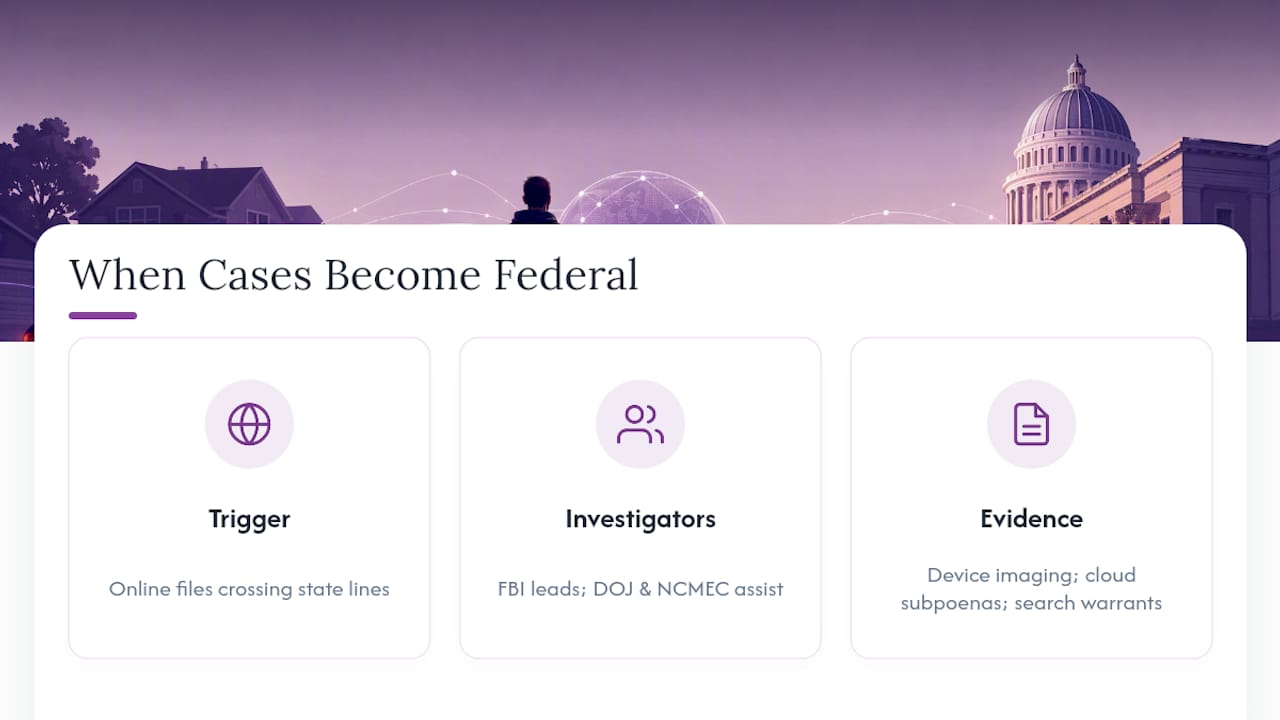
A case moves to federal court when the material or its transmission touches interstate commerce, which in practice means almost any file sent, stored, or viewed online. Federal Law on Child Pornography](https://www.justice.gov/criminal-ceos/citizens-guide-us-federal-law-child-pornography). State charges under California law can still run alongside federal ones, but federal prosecutors frequently take the lead once digital evidence crosses state lines.
The FBI typically leads these investigations, often working with the DOJ's Criminal Division and referrals from the National Center for Missing & Exploited Children, which processes tips from tech platforms required to report suspected material. Evidence usually comes from three sources: forensic imaging of seized devices, subpoenas to cloud and email providers, and search warrants executed at a home or workplace. How that warrant was written, and how far agents went beyond it, often becomes one of the first things defense counsel examines.
What Penalties and Sentencing Guidelines Apply?
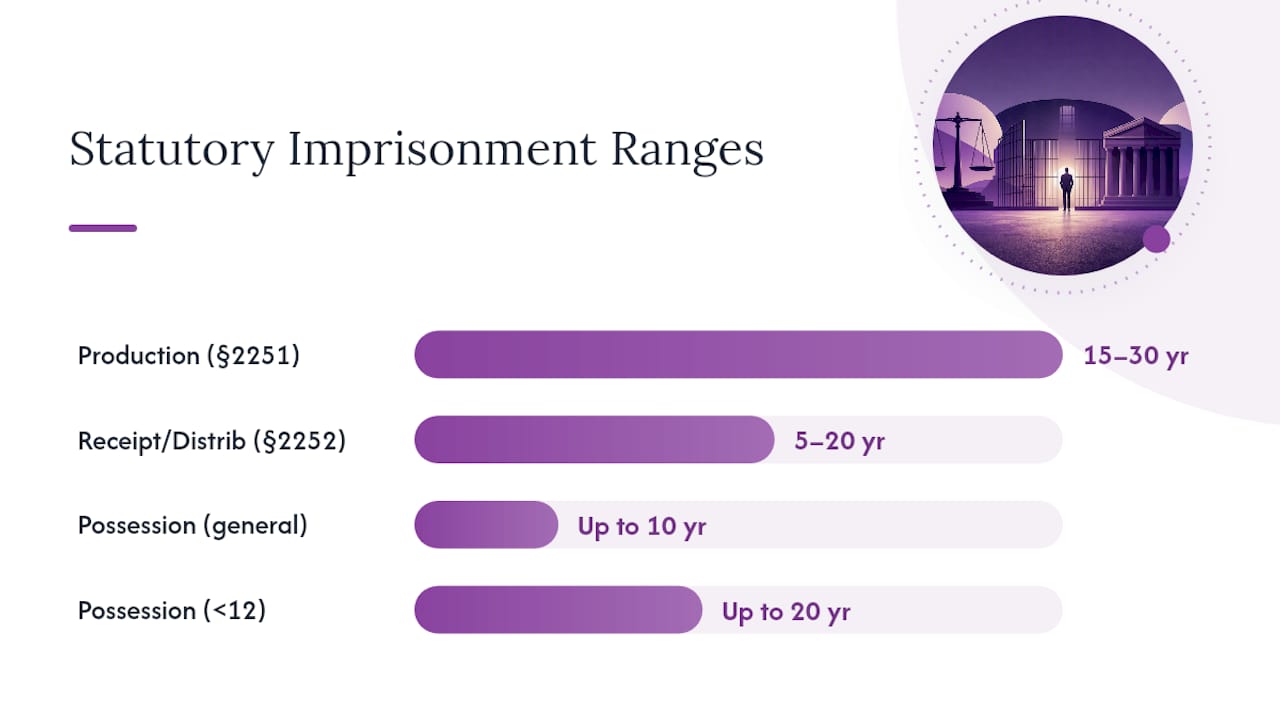
Statutory exposure varies enormously depending on which offense is charged, and the gap between categories is not subtle. A first-time production conviction under §2251 carries a 15-year mandatory minimum and up to 30 years, with prior convictions or aggravating facts pushing that ceiling higher still.
Receipt or distribution under §2252 or §2252A runs 5 to 20 years, with steeper ranges for anyone with a prior sex-offense conviction. Simple possession carries up to 10 years, rising to 20 years when the material depicts a prepubescent child or a child under 12.
Beyond the statute, the U.S. Sentencing Guidelines shape the actual number a judge considers. §2G2.2 sets a base offense level of 18 for possession and 22 for receipt or distribution, before any enhancements apply. Those enhancements stack quickly: victim age, sadistic or violent content, use of a computer, and especially image quantity can each add several levels. Image count enhancements sound mechanical, but counting is not as clean as it seems. Duplicate files, browser thumbnails, and file fragments require a defense-side technical review, since government classification methodology is not always transparent and errors there directly change the guideline math.
None of this locks in the final sentence. Sentencing Commission data show judges frequently sentence below the calculated guideline range, particularly when defense counsel builds a strong factual record and argues effectively under 18 U.S.C. §3553(a) for a lower sentence.
What Defense Strategies Actually Work in These Cases?
Generic denials rarely move a federal judge or prosecutor. Effective defense means attacking the specific elements the government has to prove: knowledge, intent, identity, and the interstate connection that gives the case federal jurisdiction in the first place. A shared household router, an unsecured wireless network, or a device with multiple users can all undercut the government's claim that a specific person, not someone else with access, knowingly possessed the files.
Constitutional challenges often carry real weight in these cases. A warrant that authorized a search of one device but was used to justify seizing five, or that relied on stale probable cause, can support a motion to suppress everything that followed. Comparing what agents claimed they would find against what they actually extracted is where these motions often start.
Forensic review matters just as much:
- File provenance and metadata can show whether content was actively downloaded or passively cached by an app running in the background.
- Cloud storage location and account ownership frequently raise real attribution questions when multiple people share credentials.
- Encryption and deleted-file remnants often get overstated by government analysts without a defense expert checking the underlying methodology.
Pro Tip: Ask your attorney to request the government's forensic examiner's bench notes, not just the final report. The raw notes often reveal counting or classification assumptions the summary report glosses over.
Discovery in these cases comes with real limits. Federal law restricts how CSAM material can be copied or transmitted, so review usually happens under a protective order at a government facility or through a court-approved neutral expert, never on a personal laptop.
What Should You Do Immediately After Contact From Investigators?
The choices made in the first 48 hours after a search, subpoena, or arrest shape everything that follows.
- Do not delete, alter, or forward any files, and do not log into or close any accounts investigators may be examining.
- If agents execute a search, ask for a copy of the warrant and an itemized receipt of everything seized, and note the time the search began and ended.
- Say nothing substantive to investigators beyond identifying yourself. Politely decline to answer questions and state that you want an attorney present.
- Contact federal criminal defense counsel immediately, even before an arrest, if you learn you are under investigation.
- Once counsel is retained, move quickly to request discovery and negotiate a protective review protocol so a defense forensic expert can examine the evidence independently.
Deleting files after learning of an investigation can itself become a separate obstruction charge, so preserving the status quo protects you more than any attempt at cleanup ever could.
How Rubin Law, P.C. Approaches Federal CSAM Defense
Every federal CSAM case gets triaged early, before a plea posture ever gets discussed. That means pulling the warrant apart line by line, checking probable cause against what agents actually extracted, and pushing for supervised, protective-order discovery review so a defense expert sees the same evidence the government's analyst did. When mitigation is the stronger path, that gets built early too, not as an afterthought once trial dates loom.
— Jake
Facing Federal Charges? Here's Your Next Step
Federal CSAM cases move fast, and the government has months or years of investigation behind the charge before you ever see the file. Rubin Law, P.C. brings the same courtroom-tested approach it applies to sex crimes defense across Los Angeles to federal cases: early warrant review, aggressive constitutional motions, and forensic scrutiny that most defendants never think to demand.

What sets this apart from waiting to see how the case unfolds is simple. The earlier a federal defense attorney gets involved, the more options stay open, from suppression motions to negotiated discovery terms to sentencing mitigation built on a real factual record instead of a rushed one. If you are under investigation or have already been contacted by federal agents, do not wait for an indictment to make the call. Visit the criminal defense practice page at Rubin Law, P.C. to schedule a consultation and get a straight assessment of where your case stands.
This article is general information, not a substitute for advice from a qualified lawyer. Consult a qualified legal professional about your own circumstances before acting on anything here.
Sources
- Citizen's Guide To U.S. Federal Law On Child Pornography
- 18 U.S. Code § 2252 - Certain activities relating to material involving the sexual exploitation of minors
FAQ
What federal agency investigates crimes against children?
The FBI leads most federal CSAM investigations, frequently working alongside the Department of Justice's Criminal Division and receiving tips through the National Center for Missing & Exploited Children, which collects reports from tech companies required to flag suspected material.
What federal crimes have a 10-year statute of limitations?
Most non-capital federal crimes, including many CSAM offenses, carry a general 5-year statute of limitations under federal law, though child exploitation offenses often have extended or no limitations period depending on the victim's age and when the abuse was discovered. The specific timeline depends heavily on the exact charge, which is a question worth raising directly with counsel.
What does U.S. law §2256 define?
18 U.S.C. §2256 defines the terms used throughout federal child pornography law, including what counts as a "visual depiction," "sexually explicit conduct," and who qualifies as a "minor" for purposes of these statutes. It is the definitional backbone that every other CSAM statute relies on.
How long do CSAM cases take?
Timelines vary widely, but federal CSAM cases often take a year or more from arrest to resolution once forensic review, discovery negotiation, and possible pretrial motions are factored in. Cases involving contested forensic evidence or suppression motions frequently take longer, since expert review under protective order takes real time to complete properly.
Can Rubin Law, P.C. help with a federal child pornography charge?
Rubin Law, P.C. handles federal crimes defense, including sex offenses, and applies the same courtroom-focused strategy across drug, violent crime, and federal cases. Reach out through the criminal defense page to discuss your specific situation with the firm directly.