A federal proffer agreement is a written promise from a prosecutor that your own statements won't be used directly against you at trial. It will not, in almost every case, stop the government from using what you say to build a case against you anyway. The document trades a narrow slice of protection for a much bigger risk: giving federal agents a roadmap, in exchange for a chance at leniency that isn't guaranteed.
TL;DR:
- The direct-use limit in a proffer agreement is narrow, but prosecutors can still use statements for impeachment or derivative investigations.
- Lying during a proffer can lead to federal false-statement charges under 18 U.S.C. § 1001, even if the initial purpose was to seek leniency.
- Proffers tend to be most beneficial if your information uniquely supports higher-level targets, especially when the case against you is weak or timing favors early cooperation.
- Preparation with detailed knowledge of the government's evidence and active rehearsal can significantly influence whether a proffer session helps or harms your case.
- After a proffer, the government may offer a cooperation deal, decline charges, or indict you regardless of your statements, making strategic decision-making critical beforehand.
Table of Contents
- What Is a Federal Proffer Agreement and How Does a Proffer Session Work?
- What Clauses Actually Matter in a Proffer Letter?
- Can Proffer Statements Be Used Against You Later?
- When Does a Proffer Actually Help Your Case?
- How Should You and Your Lawyer Prepare for a Proffer Session?
- What Happens After the Proffer Session Ends?
- Rubin Law's Approach to Advising Clients on Proffers
- Get Help Before You Sign a Proffer Letter
- Sources
What Is a Federal Proffer Agreement and How Does a Proffer Session Work?
A proffer agreement, sometimes called a "Queen for a Day" letter, is a short written contract from an Assistant U.S. Attorney (AUSA) that sets the rules before you talk to investigators. It is not a court order, not a grant of immunity, and not something a judge signs off on. It's a negotiated deal between your lawyer and the prosecutor's office, and its terms vary case by case.
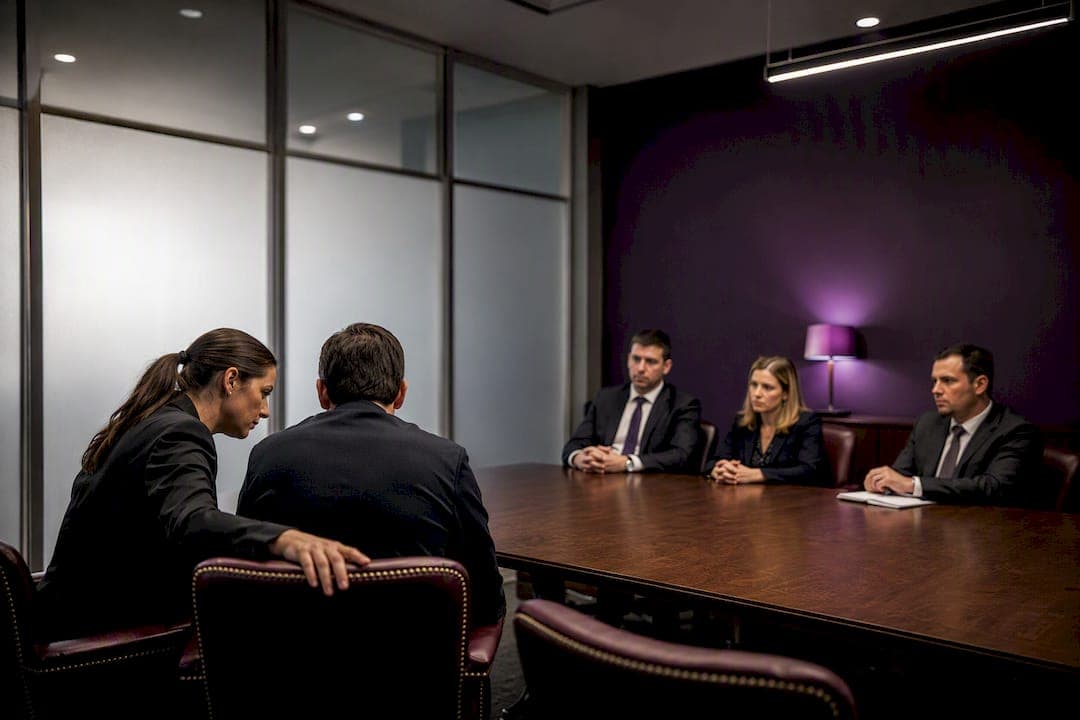
The session itself usually happens in a federal building, not a courtroom. In the room: the AUSA, one or more FBI or DEA agents, your defense attorney, and you. Sessions run anywhere from an hour to most of a day. Agents typically take handwritten notes rather than record audio or video, though practices vary by district and office.
Functionally, a proffer sits between staying silent and formally cooperating. It's a diagnostic step. The government wants to know what you know before deciding whether you're worth a deal. You want to know what they already have before deciding whether to talk at all.
What Clauses Actually Matter in a Proffer Letter?
Every proffer letter reads differently, but the core clauses repeat across federal jurisdictions, and each one shifts risk in a specific direction.
- Direct-use limit. The government agrees not to introduce your exact proffer statements as evidence in its case-in-chief.
- Derivative-use carve-out. Anything your statements lead investigators to (a bank record, a witness, a storage unit) stays fully usable, even though the statement itself is off-limits.
- Mezzanatto waiver. Named for United States v. Mezzanatto, this clause waives your protection under Federal Rule of Evidence 410 and lets prosecutors use your statements to impeach you if you testify inconsistently later.
- Truthfulness condition. Every protection in the letter depends on your being completely honest. Lie, and the deal collapses.
- Kastigar language. This addresses how the government must prove, if challenged, that its evidence didn't derive from your statements. In practice, that burden is often easier for prosecutors to meet than defendants expect.
AUSAs rarely negotiate these terms wholesale, but narrow concessions do happen, such as limiting derivative-use follow-up to specific accounts or defining a fixed topic scope for the session.
Pro Tip: Never treat the direct-use limit as full protection. Ask your attorney to walk through exactly what "derivative use" would mean for your specific facts before you agree to anything.
Can Proffer Statements Be Used Against You Later?
Yes, in more ways than most people expect walking into the room. The direct-use limit is real, but it's also the narrowest protection the letter offers.
- Impeachment. If you later testify at trial and say something inconsistent with your proffer statement, prosecutors can use that statement to attack your credibility in front of a jury.
- Derivative leads. A name you mention can turn into a subpoena. An account number can turn into a search warrant. The government treats proffer statements as an investigative map, not just a confession.
- Rebuttal use. Some circuits allow broader rebuttal use of proffer statements than others, which is one more reason venue and case law matter before you sign.
- False-statement prosecution. Lying to federal agents during a proffer, even about something that seems minor, can be charged under 18 U.S.C. § 1001, a separate federal crime carrying its own prison exposure.
A common pitfall: a client answers questions truthfully about their own conduct but shades details to protect a friend or family member. That single inconsistency can trigger a §1001 charge that didn't exist before the proffer.
When Does a Proffer Actually Help Your Case?
A proffer session can genuinely move the needle in a federal case, but only under specific conditions.
- Your information has unique value. If you can identify or corroborate evidence against higher-level targets that the government doesn't already have, you have leverage.
- Sentencing exposure is severe. When mandatory minimums or guideline ranges are steep, a plausible path to a substantial assistance motion under USSG §5K1.1 can be worth the exposure, since that motion is the main vehicle for a sentence below the guideline range.
- Timing favors you. Proffering before indictment, while the government is still weighing charges, often carries more leverage than proffering after you've already been charged.
- The government's case is weak. If the evidence against you is thin or you have a real defense, walking into a proffer can hand prosecutors the exact facts they were missing.
How Should You and Your Lawyer Prepare for a Proffer Session?
Preparation determines whether a proffer helps or backfires, and most of the real work happens before anyone sits down at the table.
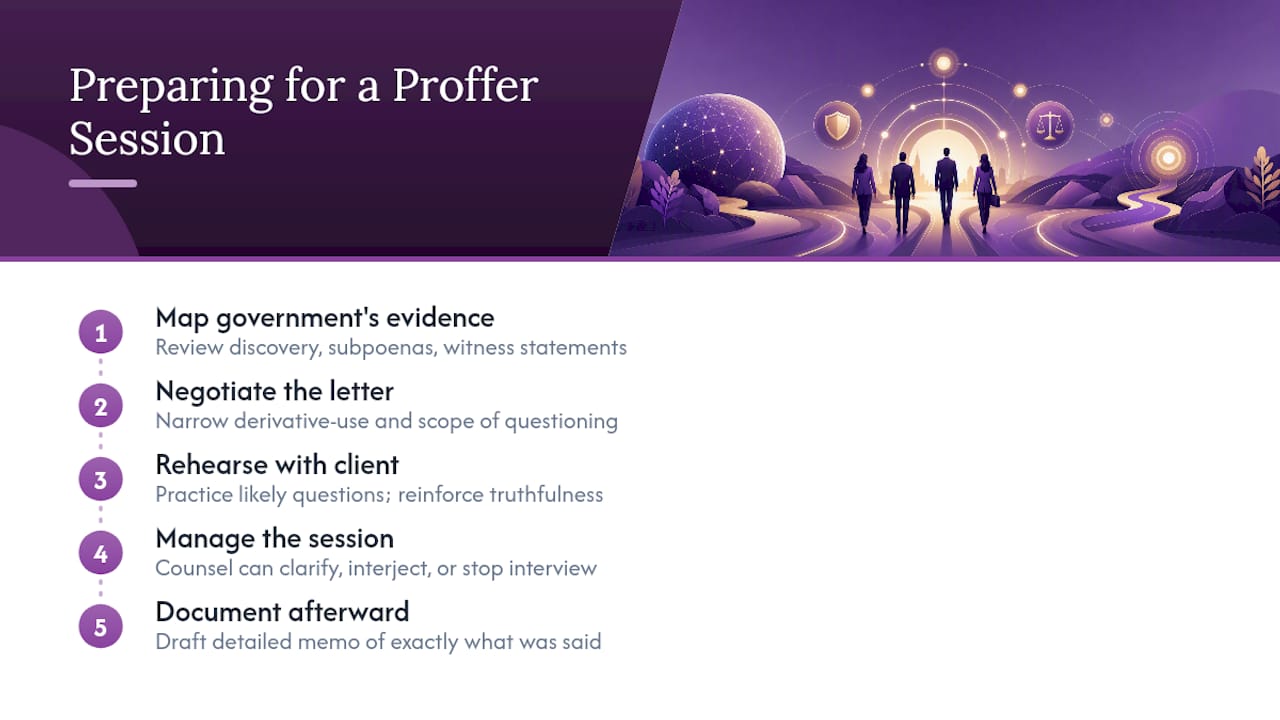
Your attorney should start by mapping what the government likely already has: documents produced under subpoena, witness statements, financial records. Knowing the government's actual knowledge, rather than guessing at it, is often the single most important step in preparing a client for a proffer session. From there, counsel negotiates the letter itself, sometimes securing a narrower derivative-use clause or a defined scope of questioning.
Rehearsal matters just as much. Attorneys typically walk clients through likely questions to reinforce absolute truthfulness while avoiding volunteering information outside the agreed scope. During the session, counsel can interject, clarify questions, and stop the interview if it drifts into dangerous territory. Afterward, a detailed memo documenting exactly what was said protects the client if any dispute arises later.
Pro Tip: If your lawyer hasn't reviewed the government's discovery in detail before the proffer date, ask why. Walking in blind is the single most avoidable mistake in federal proffer practice.
What Happens After the Proffer Session Ends?
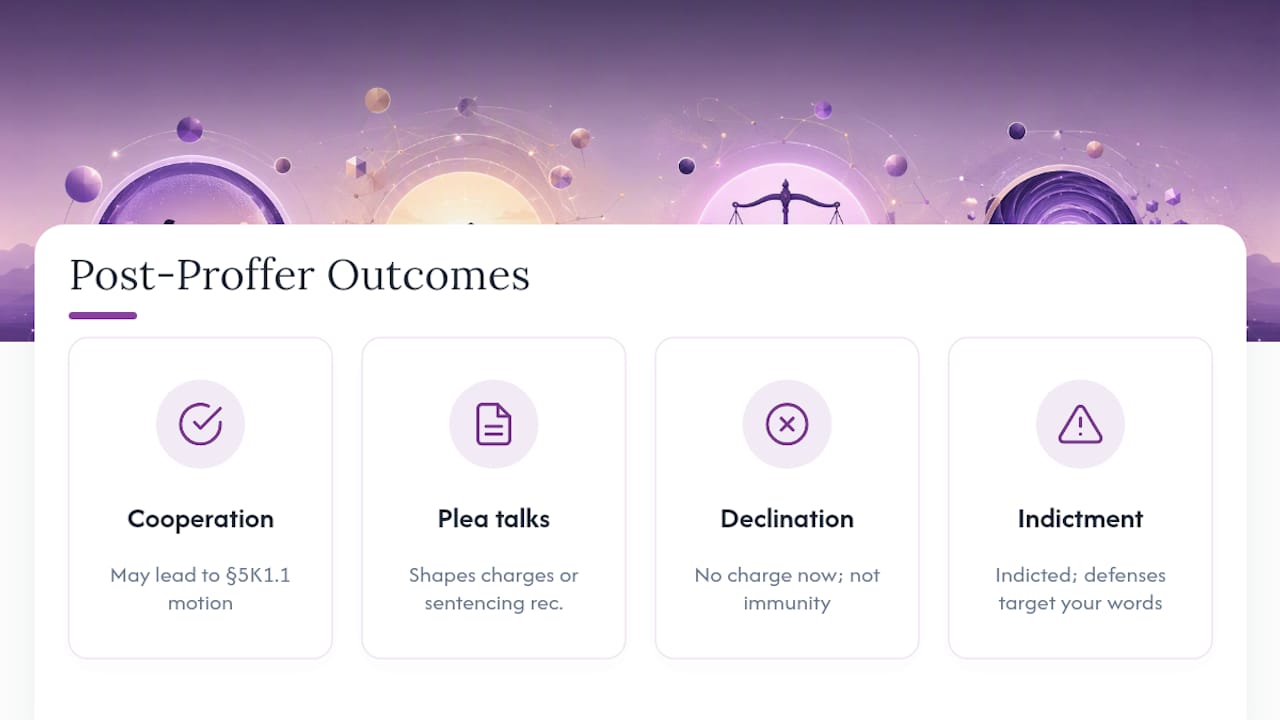
Four paths typically follow a proffer, and each carries different stakes.
A cooperation agreement can follow if the government finds your information valuable, opening the door to an eventual §5K1.1 motion at sentencing. Short of full cooperation, your statements can still shape plea negotiations, affecting the charges offered or the government's sentencing recommendation. A declination means the government decides not to charge you now, but it is not immunity from future charges if new evidence surfaces. And sometimes, despite the proffer, an indictment follows anyway, at which point your defenses shift to whatever the government did or didn't derive from your own words.
Rubin Law's Approach to Advising Clients on Proffers
Deciding whether to proffer comes down to three questions we walk through with every client: how strong is the government's case, what does the client actually know, and what does that information buy in return? [author_bio] [case_study] [internal_data] [brand_signal] Book a consultation before you agree to anything.
— Jake
Get Help Before You Sign a Proffer Letter
There are other ways to approach a federal investigation, including staying silent and letting the government build its case without your help. If you're weighing a proffer, Rubin Law reviews the letter's actual language, maps what prosecutors likely already have, and prepares you for the room itself, so you're not walking in guessing at the risk.
Rubin Law's attorneys appear regularly in Los Angeles federal matters, which means we understand how local AUSAs approach these letters and where they've shown flexibility before. If you're facing a federal drug conspiracy case, a fraud allegation, or any other federal exposure, the time to call is before you agree to talk, not after. Reach out to schedule an initial consultation to go through your specific situation and decide whether a proffer serves you or exposes you.
This article is general information, not a substitute for advice from a qualified lawyer. Consult a qualified legal professional about your own circumstances before acting on anything here.
Sources
- Derivative-use immunity — U.S. Department of Justice
- 18 U.S.C. § 1001 — Statements or entries generally (Cornell LII)