A federal plea agreement is a written offer from the U.S. Department of Justice that resolves federal charges in exchange for a guilty plea — and you should not sign one without experienced defense counsel reviewing every clause. Governed by Rule 11 of the Federal Rules of Criminal Procedure, these agreements can reduce your exposure significantly or lock you into terms that follow you for decades. The U.S. Sentencing Commission and DOJ both have formal procedures that shape what prosecutors can offer and what judges can accept. Before anything else: retain counsel, preserve all written communications about the offer, and do not make any admissions until your attorney has reviewed the full document.
Pro Tip: Request the government's written offer and their guideline calculation in writing before your first substantive negotiation session. Verbal promises from prosecutors are unenforceable — if it is not in the signed agreement, it does not exist.
Table of Contents
- What is a federal plea agreement and why do prosecutors use them?
- What are the three types of federal plea agreements?
- What will you find inside a written plea agreement?
- What happens at the Rule 11 colloquy?
- How does a plea affect your sentence under the federal guidelines?
- What are the real advantages and risks of accepting a federal plea deal?
- What is the typical timeline after you enter a plea?
- How should you evaluate a specific plea offer?
- How do plea agreements affect pretrial detention and bail?
- What is the difference between an open plea and a plea agreement?
- What roles do the federal prosecutor and defense counsel play in plea negotiations?
- Key Takeaways
- A defense attorney's perspective on reviewing federal plea offers
- Facing a federal plea offer? Here is how Rubinlawpc can help
- Useful sources for further reading
What is a federal plea agreement and why do prosecutors use them?
A federal plea agreement is a formal, written contract between the U.S. Attorney's Office and a defendant that resolves criminal charges through a guilty plea rather than trial. Rule 11 of the Federal Rules of Criminal Procedure is the governing authority: it defines what concessions prosecutors may offer, what the court must do before accepting a plea, and what rights a defendant waives.
Prosecutors use plea agreements for straightforward reasons. Trials are expensive, time-consuming, and uncertain. A plea guarantees a conviction, conserves prosecutorial resources, and often produces cooperation that helps build other cases. From the government's perspective, a negotiated resolution is almost always preferable to the risk of an acquittal.
A very large majority of federal criminal charges are resolved through guilty pleas rather than trials, according to practice summaries of federal docket data.
That figure reframes how defendants should think about their situation. Going to trial in federal court is the exception, not the default. Understanding the plea process is not optional preparation — it is the central task.
One point that surprises many defendants: the court is not a party to the agreement. Judges are prohibited from participating in plea negotiations under Rule 11. The DOJ's Justice Manual §625 confirms that plea agreements are permitted but not mandatory, and that the court must be notified of any agreement in open court (unless good cause allows otherwise). The judge's role is oversight, not negotiation.

Pro Tip: Ask your attorney whether the government has disclosed its full guideline calculation. Prosecutors are not always required to share this upfront, but requesting it early gives defense counsel time to challenge loss figures, role enhancements, or other factors that drive the guideline range.
What are the three types of federal plea agreements?
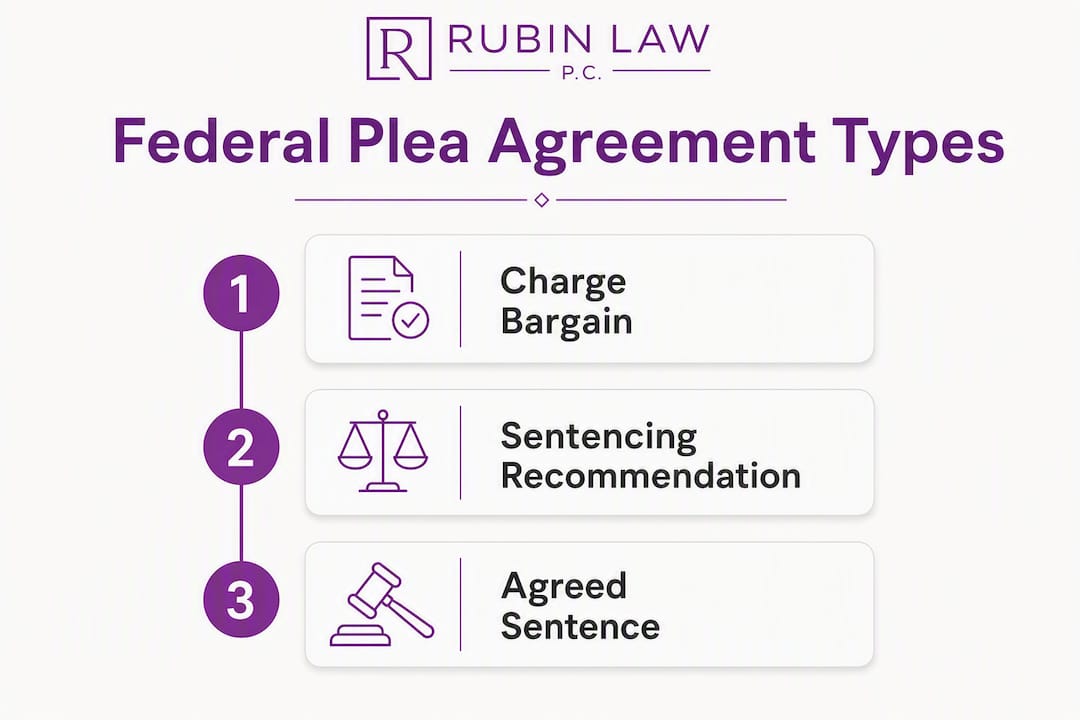
Rule 11(c)(1)(A)–(C) recognizes three distinct types of plea concessions. Knowing which type you are being offered changes everything about how you evaluate the deal.
Charge bargaining under Rule 11(c)(1)(A)
The government agrees to dismiss certain counts or not bring additional charges in exchange for a guilty plea to others. A defendant charged with ten counts of wire fraud might plead to two. The court is not bound by this arrangement on sentencing — the judge still applies the guidelines and imposes whatever sentence they find appropriate on the counts of conviction.

Example: A defendant facing a drug trafficking charge with a firearm enhancement pleads guilty to the trafficking count only, with the firearm count dismissed. The sentencing range drops, but the judge retains full discretion.
Sentencing recommendations under Rule 11(c)(1)(B)
The government agrees to recommend a specific sentence or not oppose the defendant's request for a particular sentence. These recommendations are non-binding. The judge can ignore them entirely, and the defendant generally cannot withdraw the plea just because the judge did not follow the recommendation.
Example: The government agrees to recommend the low end of the guideline range. The judge sentences at the high end anyway. The defendant is stuck.
Agreed-sentence pleas under Rule 11(c)(1)(C)
Both sides agree that a specific sentence or sentencing range is appropriate, and the court is bound if it accepts the agreement. This is the only type that removes judicial sentencing discretion. If the judge rejects it, the defendant may withdraw the plea — but rejection can signal that the judge views the agreed sentence as too lenient, which is not a comfortable position to be in.
| Feature | (A) Charge Bargain | (B) Recommendation | (C) Agreed Sentence |
|---|---|---|---|
| Court bound? | No | No | Yes, if accepted |
| Sentencing discretion | Full judicial | Full judicial | Eliminated |
| Defendant can withdraw if rejected? | N/A | No | Yes |
| Typical use | Pre-indictment, multi-count cases | Post-indictment, guideline-range cases | High-stakes, certainty-driven cases |
| Key negotiation lever | Count reduction | Guideline stipulations | Specific sentence or range |
Pro Tip: Push for a Rule 11(c)(1)(C) agreement when the government's guideline calculation produces a range you can live with and you need certainty. Avoid it when the judge in your district has a history of rejecting agreed sentences as too low — your attorney will know the local pattern.
What will you find inside a written plea agreement?
Federal plea agreements follow a recognizable structure, but the details vary by district and by case. Every clause matters. Here are the standard components your attorney must review line by line:
- Charges admitted: The specific count(s) to which you are pleading guilty, including the statutory citation and maximum penalties.
- Dismissed counts: Any charges the government agrees to drop. Confirm these are dismissed with prejudice.
- Factual basis / statement of facts: A written narrative of what you admit happened. This is one of the most consequential sections — admissions here can be used against you in civil litigation, immigration proceedings, and professional licensing actions.
- Guideline stipulations: Any agreed-upon offense level, criminal history category, or specific guideline factors. These anchor the sentencing range even though guidelines are advisory post-Booker.
- Appellate waiver: Most federal plea agreements include a clause waiving your right to appeal the conviction and often the sentence. The scope varies — some waivers are narrow, some are nearly total. A broad waiver can eliminate your ability to challenge sentencing errors on appeal.
- Cooperation clause / 5K1.1 language: If you are agreeing to cooperate, the agreement should specify what is required and what the government promises in return. A vague cooperation clause is a red flag.
- Restitution and forfeiture: Any financial obligations the government is seeking as part of the resolution.
- Confidentiality provisions: Some agreements restrict what you can say publicly about the case or the investigation.
Watch the factual basis section closely. Admissions that go beyond the elements of the charged offense can expand your civil exposure and affect immigration status, even if they do not change your guideline range.
The court's role at this stage is limited but important. Under Rule 11, the judge must confirm that a factual basis exists for the plea and that it is voluntary. The judge does not negotiate the terms and is not bound by guideline stipulations in the agreement — though those stipulations heavily influence the presentence report (PSR) and the ultimate sentence.
Pro Tip: Ask your attorney to request a carve-out from any admissions that go beyond the statutory elements of the offense. Prosecutors sometimes include broader factual language than the charge requires, and that language can surface in civil suits or immigration removal proceedings years later.
What happens at the Rule 11 colloquy?
The Rule 11 colloquy is the formal court hearing where a judge questions you on the record before accepting your plea. It is a mandatory safeguard, not a formality. Rule 11(g) requires a verbatim record of the entire proceeding.
Here is what to expect, step by step:
- Identity and competency. The judge confirms your name, age, education, and that you are not under the influence of any substance that would impair your judgment.
- Rights advisement. The judge explains the rights you are waiving: the right to trial by jury, the right to confront witnesses, the right against self-incrimination, and the right to compel witnesses in your defense.
- Charge explanation. The judge describes the charges, the elements the government would need to prove at trial, and the maximum and minimum penalties.
- Factual basis. The judge asks you to confirm, in your own words, what you did. This is where the statement of facts in the agreement becomes your sworn admission.
- Voluntariness. The judge asks whether anyone has threatened or coerced you, whether you are satisfied with your attorney, and whether you understand what you are agreeing to.
- Consequence of rejection. For Rule 11(c)(1)(C) agreements, the judge explains that if the court rejects the agreed sentence, you have the right to withdraw the plea.
- Acceptance or deferral. The judge accepts, rejects, or defers a decision pending review of the PSR.
If the judge rejects the plea, you can withdraw it and proceed to trial or renegotiate. But rejection often signals that the judge views the agreed sentence as inadequate, which puts you in a worse negotiating position than before. Prepare for the colloquy the way you would prepare for testimony: know the facts in the statement of facts cold, answer directly, and do not volunteer information beyond what is asked.
Pro Tip: Preserve the record for appeal by making sure your attorney objects on the record to any colloquy deficiency — for example, if the judge fails to advise you of a specific right. Errors not raised at the colloquy are harder to raise later.
How does a plea affect your sentence under the federal guidelines?
Sentencing after a federal plea is governed by the U.S. Sentencing Guidelines, which became advisory after the Supreme Court's decision in United States v. Booker. Advisory does not mean irrelevant. District courts sentence within the guideline range in a substantial share of cases, which is why guideline concessions remain the most practically valuable bargaining chip in any federal plea negotiation.
The key sentencing levers your attorney will try to preserve or negotiate:
- Stipulated offense level: Agreeing on a lower base offense level or avoiding certain enhancements (e.g., role in the offense, obstruction) can move the guideline range down by years.
- Acceptance of responsibility: A two-level reduction under U.S.S.G. §3E1.1 is standard for defendants who plead guilty and accept responsibility. A third level is available if the government moves for it in cases with an offense level of 16 or higher.
- 5K1.1 substantial assistance motion: If you cooperate with the government and provide substantial assistance in the investigation or prosecution of others, the government can file a 5K1.1 motion asking the court to sentence below the guideline range. Courts may also consider cooperation evidence even without a formal 5K1.1 motion.
- Safety valve eligibility: For certain drug offenses, defendants who meet specific criteria (including criminal history, role, and cooperation) can qualify for a sentence below the mandatory minimum. See Rubinlawpc's detailed breakdown of safety valve eligibility for the current requirements.
- Mandatory minimums: Some statutes impose floors that guidelines cannot override. Charge bargaining is often the only way to avoid a mandatory minimum — which is why count dismissals in Rule 11(c)(1)(A) agreements can be more valuable than they appear.
Even in the post-Booker advisory system, negotiating specific guideline factors — loss calculations, role adjustments, drug quantity — can shift the range by multiple years. That technical work is where experienced defense counsel earns its keep.
Pro Tip: If you cooperate but the government declines to file a 5K1.1 motion, preserve all evidence of your cooperation in the record. Courts have sentenced below the guideline range based on cooperation evidence even without a formal government motion, and that record matters on appeal.
For a California-specific breakdown of how federal sentencing guidelines interact with plea negotiations, Rubinlawpc maintains a dedicated resource.
What are the real advantages and risks of accepting a federal plea deal?
Accepting a plea is not a defeat. For many defendants, it is the most rational decision available. But the trade-offs are real and some are permanent.
Advantages:
- Reduced charge exposure and a lower guideline range than a trial conviction would produce
- Certainty: you know the range of outcomes before sentencing
- Acceptance of responsibility reduction (typically two to three levels off the offense level)
- Avoidance of trial-related enhancements that prosecutors sometimes add to indictments as leverage
- Faster resolution, which matters for pretrial detention and family stability
Risks and collateral consequences:
- Loss of all trial rights, including the right to challenge the government's evidence
- Factual admissions that can be used in civil litigation, tax proceedings, or professional licensing actions
- Immigration consequences: a federal conviction can trigger deportation, inadmissibility, or denial of naturalization regardless of the sentence imposed
- Employment and professional licensing: federal felony convictions affect security clearances, bar admissions, medical licenses, and many federal employment categories
- Appellate waiver: most federal plea agreements strip your right to appeal the conviction and often the sentence, leaving post-conviction remedies extremely limited
Red flags that should prompt further negotiation or rejection:
- Overbroad factual admissions that go beyond the elements of the charged offense
- Vague cooperation terms without specific performance benchmarks
- A binding sentence under Rule 11(c)(1)(C) with no mitigation language
- An appellate waiver that covers ineffective assistance of counsel claims
- No explicit dismissal of counts with prejudice
Pro Tip: Before signing, have your attorney run through every collateral consequence in your specific situation: immigration status, professional licenses, civil exposure, and any pending civil litigation. These consequences are often more damaging than the sentence itself.
What is the typical timeline after you enter a plea?
Entering a plea is not the end of the process. Here is what follows:
Pro Tip: Request early disclosure of the draft PSR and submit a mitigation package — letters, employment records, medical history, community ties — before the probation officer finalizes the report. Corrections after the final PSR are harder to make and carry less weight at sentencing.
The sequence after a plea entry typically runs:
- Plea entry: You appear in court, complete the Rule 11 colloquy, and the judge accepts or defers the plea.
- Presentence report (PSR): The U.S. Probation Office interviews you (with counsel present) and prepares a report calculating your guideline range, criminal history, and personal background. You and your attorney have the right to review and object to the draft.
- Sentencing hearing: Typically scheduled 60–90 days after the plea. Your attorney submits a sentencing memorandum, the government submits its recommendation, and the judge imposes sentence. You have the right to allocution — a direct statement to the judge before sentence is imposed. Use it. Judges read allocution statements carefully, and a sincere, specific statement of acceptance of responsibility can influence the sentence.
- Post-sentencing remedies: Limited but real. You can move to withdraw a plea before sentencing if you show a fair and just reason. After sentencing, withdrawal is available only on direct appeal or collateral attack (28 U.S.C. §2255), typically on grounds of ineffective assistance of counsel or newly discovered evidence that could not have been found earlier.
Practical costs to plan for: attorney fees for sentencing preparation and any post-sentencing motions, restitution (which can be substantial in fraud cases), fines, and the financial impact of incarceration on your household. Supervised release conditions after prison can also carry costs — drug testing, electronic monitoring, and travel restrictions.
How should you evaluate a specific plea offer?
Bring this checklist to your attorney before making any decision:
- What type of plea is this under Rule 11(c)(1)? Is the sentence binding or advisory?
- What is the government's guideline calculation, and what specific factors drive it?
- Which counts are being dismissed, and are they dismissed with prejudice?
- Are there cooperation conditions? What exactly is required, and what does the government promise in return?
- What does the appellate waiver cover? Does it include ineffective assistance claims?
- What are the foreseeable collateral consequences for immigration, licensing, and civil exposure?
- Is there a mandatory minimum, and does this plea avoid it?
- What is the realistic trial outcome if you reject the offer?
Red flags that warrant pushing back:
- The government's guideline calculation includes enhancements your attorney disputes but the agreement asks you to stipulate to them anyway
- Cooperation terms are described in general language without specific performance criteria
- The factual basis includes conduct beyond the charged offense
- No mention of safety valve eligibility when you may qualify
Pro Tip: If you decline a plea and go to trial, preserve any ineffective-assistance claim by making sure your attorney documents in writing the advice given about the offer and your reasons for rejecting it. Courts have held that deficient advice about a plea offer can constitute ineffective assistance even when the defendant was later convicted at trial.
Negotiating plea bargaining terms in California follows parallel principles to federal practice, though the procedural rules differ. Rubinlawpc's state-side resource covers the overlap.
Your attorney can also negotiate specific stipulations on guideline factors — loss calculations, drug quantity, role adjustments — rather than just the final sentence. Agreeing on technical guideline inputs can shift the advisory range by years even when a binding sentence under Rule 11(c)(1)(C) is off the table.
How do plea agreements affect pretrial detention and bail?
A pending plea negotiation does not automatically change your detention status, but it can affect it in practical ways. Under the Bail Reform Act, federal pretrial detention decisions turn on risk of flight and danger to the community. A plea offer signals that the case may resolve without trial, which some courts weigh when considering whether continued detention is necessary.
More directly, the role of the prosecutor in bail proceedings matters: if the government agrees to recommend release or not oppose a detention modification as part of plea negotiations, that agreement can be incorporated into the plea terms or raised separately at a detention hearing. Defense counsel should always ask whether the government will modify its detention position as part of any overall resolution.
One practical point: if you are detained and plea negotiations are ongoing, your attorney can argue that the prospect of a near-term plea resolution reduces the justification for continued detention. Courts have discretion here, and a credible, advanced plea negotiation can support a motion for release or modified conditions.
What is the difference between an open plea and a plea agreement?
An open plea is a guilty plea entered without any agreement with the government. You plead guilty to the charged offense, and the judge sentences you with full discretion under the guidelines and 18 U.S.C. §3553(a) factors. There is no charge bargain, no sentencing recommendation, and no binding sentence.
A plea agreement, by contrast, involves at least one concession from the government: dismissed counts, a sentencing recommendation, or an agreed sentence. The difference is significant. An open plea gives you nothing from the government in exchange for your admission of guilt. You are betting entirely on judicial mercy and the strength of your mitigation.
Open pleas make sense in narrow circumstances: when the government refuses to negotiate, when the charges are straightforward and the guideline range is already low, or when a defendant wants to demonstrate genuine acceptance of responsibility without the appearance of bargaining. In most federal cases, entering an open plea without at least attempting to negotiate a formal agreement leaves value on the table.
What roles do the federal prosecutor and defense counsel play in plea negotiations?
The federal prosecutor controls the offer. The Assistant U.S. Attorney (AUSA) decides which charges to bring, which counts to dismiss, what sentencing recommendation to make, and whether to file a 5K1.1 motion. The DOJ's Justice Manual governs internal DOJ policies on plea agreements, including approval requirements for certain types of deals. AUSAs operate within those policies and typically need supervisory approval for significant concessions.
Defense counsel's role is to negotiate from the defendant's position: challenge the government's guideline calculations, push for count dismissals, seek cooperation credit, and protect the defendant's rights in the written terms. Defense counsel also advises the defendant on whether to accept, reject, or counter an offer — and that advice must account for the full picture: guideline range, collateral consequences, trial risk, and the specific judge's sentencing history.
One asymmetry worth understanding: the government drafts the agreement. Defense counsel negotiates changes, but the starting document reflects the government's interests. Every clause that benefits the defendant was either negotiated in or was already there for a reason. Clauses that benefit the government — broad appellate waivers, expansive factual admissions, vague cooperation requirements — are the default. Your attorney's job is to narrow them.
Key Takeaways
A federal plea agreement resolves charges through a written, Rule 11-governed contract between the government and defendant — and the type of plea, the guideline stipulations, and the appellate waiver terms determine most of what happens next.
| Point | Details |
|---|---|
| Three types of pleas | Rule 11(c)(1)(A)–(C) covers charge bargains, sentencing recommendations, and binding agreed sentences — each carries different risk. |
| Guidelines still anchor sentencing | Post-Booker advisory guidelines remain the central negotiation target; stipulated guideline factors can shift the range by years. |
| Appellate waivers are permanent | Most federal plea agreements waive appeal rights broadly; review the scope before signing or you lose most post-conviction remedies. |
| Collateral consequences are real | Immigration, professional licensing, and civil exposure often outlast the sentence itself and must be assessed before any plea is accepted. |
| Rubinlawpc's role | Rubinlawpc reviews every clause of a federal plea offer, challenges guideline calculations, and advises Los Angeles-area defendants on whether to accept, negotiate, or reject. |
A defense attorney's perspective on reviewing federal plea offers
The conventional wisdom about federal plea agreements is that they are essentially take-it-or-leave-it offers from an all-powerful government. That framing is wrong, and it costs defendants real outcomes.
Every federal plea offer has negotiable components. The government's initial guideline calculation almost always includes enhancements that can be challenged: loss figures in fraud cases, drug quantity in trafficking cases, role adjustments in conspiracy cases. These are not cosmetic. A two-level reduction in offense level can mean the difference between 37 months and 57 months under the guidelines. Defense counsel who treats the government's opening calculation as fixed is leaving years on the table.
The appellate waiver is the clause most defendants do not read carefully enough. A broad waiver that covers ineffective assistance of counsel claims is particularly dangerous — it can eliminate your ability to challenge the plea itself if your attorney gave you deficient advice. Rubinlawpc negotiates to narrow these waivers wherever possible, and when the government insists on a broad waiver, that fact gets documented and explained to the client in writing.
Cooperation is the other area where defendants get hurt by vague language. A promise to "consider" filing a 5K1.1 motion is not a promise to file one. If cooperation is part of the deal, the agreement needs to specify what triggers the motion, what happens if the government declines to file, and what remedies exist if the government breaches. Contemporaneous records of every proffer session and every government representation matter enormously if a dispute arises later.
Post-plea remedies are limited but not nonexistent. A motion to withdraw a plea before sentencing requires showing a fair and just reason. After sentencing, the bar is much higher — ineffective assistance of counsel under Strickland v. Washington is the most common ground, and it requires showing both deficient performance and prejudice. Rubinlawpc monitors these issues from the moment a plea is entered, not after something goes wrong.
The bottom line: a federal plea agreement is a legal document with long-term consequences. Treat it like one.
Facing a federal plea offer? Here is how Rubinlawpc can help
When a federal plea deadline is approaching, the margin for error is zero. Rubinlawpc represents defendants facing federal criminal charges in Los Angeles County — including drug trafficking, fraud, RICO, money laundering, and federal firearms offenses — and the firm's approach to plea negotiations is built on the same courtroom familiarity that drives its trial work.
In an initial consultation, Rubinlawpc will review your charging documents, the government's written offer, and any discovery you have received. The firm will identify which type of plea is being offered, challenge the government's guideline calculation, flag collateral consequences specific to your situation, and advise you on whether to accept, counter, or reject the offer. If a plea deadline is imminent, contact the firm immediately — waiting costs options. Schedule your consultation at rubinlawpc.com/service-areas.
This article provides general legal information about federal plea agreements and is not legal advice. Federal criminal law is complex and fact-specific. Consult a qualified federal criminal defense attorney for advice about your particular situation.
Useful sources for further reading
- Rule 11 of the Federal Rules of Criminal Procedure (Cornell LII) — The governing rule for all federal plea proceedings: types of concessions, court acceptance procedures, and defendant rights at the colloquy.
- DOJ Justice Manual §625: Federal Rule of Criminal Procedure 11(e) — Internal DOJ guidance on plea agreement procedures, disclosure requirements, and the court's options on acceptance or rejection.
- U.S. Department of Justice: Plea Bargaining Overview — Plain-language DOJ explanation of how plea bargaining works in federal court and what defendants admit when pleading guilty.
- U.S. Sentencing Commission: Negotiating Federal Plea Agreements in the Post-Booker World — Seminar materials explaining guideline stipulations, 5K1.1 motions, safety valve eligibility, and practical negotiation strategy.
- U.S. Sentencing Commission: 2025 Guidelines Manual — The current guidelines manual, including Chapter Six on sentencing procedures and plea agreement standards (§6B1.1–§6B1.4).
- Rubinlawpc: Federal Sentencing Guidelines in California — How the advisory guidelines apply in California federal districts and how they interact with plea negotiations.
- Rubinlawpc: Safety Valve Federal Sentencing Eligibility — Current eligibility criteria for the safety valve, which allows sentences below mandatory minimums in qualifying drug cases.
- Rubinlawpc: Sentencing Hearing Preparation in California — Practical guidance on mitigation submissions, allocution, and fighting for the minimum sentence at a federal sentencing hearing.