
What is the safety valve exception in federal sentencing?
The safety valve under 18 U.S.C. § 3553(f) lets a federal judge sentence certain drug defendants below an otherwise mandatory minimum prison term, provided they satisfy five statutory criteria. It is one of the only mechanisms in federal criminal law that operates without any government motion or prosecutorial approval. If you qualify, the court must apply it.
The provision applies to a specific list of controlled substance offenses under 21 U.S.C. §§ 841, 844, 846, 960, and 963, as well as certain maritime drug offenses added by the First Step Act of 2018. Beyond waiving the mandatory floor, qualifying defendants also receive a 2-level offense reduction under U.S. Sentencing Guidelines § 2D1.1(b)(18), independent of any other reduction. That combination can move a sentence dramatically.
Congress created the safety valve in 1994 because mandatory minimums were producing equally severe penalties for both kingpins and low-level couriers. The First Step Act later expanded eligibility, and the Supreme Court's march 2024 ruling in Pulsifer v. United States reshaped how courts apply the criminal history criteria. Understanding where the law stands now is the starting point for any federal drug defendant.
Key features of the safety valve at a glance:
- Codified at 18 U.S.C. § 3553(f) and mirrored in U.S. Sentencing Guidelines § 5C1.2
- Applies only to qualifying controlled substance offenses, not all federal mandatory minimums
- Requires the defendant to satisfy five statutory criteria before sentencing
- Grants a 2-level Guidelines reduction under § 2D1.1(b)(18) on top of the mandatory minimum waiver
- Does not require a government motion, unlike substantial assistance under § 5K1.1
The five eligibility criteria you must meet
Meeting safety valve eligibility requires clearing each of the following five requirements. A single failure disqualifies you entirely.
-
Limited criminal history. Since the First Step Act, defendants with up to 4 criminal history points (excluding any one-point offenses) can qualify, provided they have no prior three-point offense and no prior two-point violent offense. The Supreme Court's 2024 Pulsifer ruling confirmed these three sub-conditions are disjunctive: failing any one of them disqualifies you, regardless of whether you satisfy the others.
-
No leadership or supervisory role. You must not have been an organizer, leader, manager, or supervisor in the offense. Courts examine the Presentence Report's role-in-offense findings closely here. Even informal coordination of one other participant can trigger disqualification under some judicial interpretations.
-
No violence, threats, or dangerous weapons. You must not have used violence or credible threats of violence, and must not have possessed a dangerous weapon in connection with the offense. This is not automatic disqualification if a firearm was present. Courts apply a distinct "in connection with the offense" test, so a weapon found at a residence but unrelated to the drug transaction may not bar relief.
-
No death or serious bodily injury. The offense must not have resulted in death or serious bodily injury to any person. This criterion rarely comes into dispute in straightforward drug trafficking cases, but it becomes relevant in overdose prosecutions or cases involving fentanyl distribution.
-
Truthful disclosure to the government. Before sentencing, you must provide the government with all information and evidence you have about the offense and any related criminal conduct. This is the "safety valve proffer," and it is the criterion defendants most commonly stumble on. Incomplete or inconsistent disclosure can sink an otherwise qualifying case.
The burden of proof rests entirely on the defendant. You must convince the sentencing court by a preponderance of the evidence that you satisfy each criterion. The government can oppose your application, but its opposition is not controlling. The judge decides.
How qualifying for the safety valve changes your sentence

The sentencing benefit is concrete and often substantial. A defendant facing a five-year mandatory minimum who qualifies for the safety valve gets sentenced under the Guidelines range instead, which can fall well below that floor depending on offense level and criminal history category.
Benefits of qualifying include:
- Mandatory minimum waiver. The court sentences you "without regard to any statutory minimum sentence," meaning the Guidelines range controls entirely.
- 2-level offense level reduction. Under § 2D1.1(b)(18), qualifying defendants receive a two-level drop independent of any acceptance-of-responsibility reduction. Stack those two reductions together and the Guidelines range can drop significantly.
- No government motion required. Unlike a § 5K1.1 substantial assistance departure, safety valve relief is a statutory right when criteria are met. The prosecutor cannot veto it.
- Plea bargaining leverage. Knowing you can qualify for the safety valve changes the calculus in plea negotiations. Prosecutors understand the sentencing math too, and a defendant who clearly meets all five criteria has real leverage.
- Stacked reductions. The 2-level safety valve reduction stacks with acceptance of responsibility reductions under § 3E1.1, potentially lowering the offense level by four or five levels total.
One distinction worth understanding: the safety valve and substantial assistance are separate tracks. Substantial assistance under § 3553(e) requires a government motion and can apply to any federal mandatory minimum offense. The safety valve requires no motion but is limited to specific drug offenses. A defendant can potentially pursue both, though the disclosure requirements overlap in ways that demand careful legal coordination.
How Pulsifer v. United States reshaped the rules
The Supreme Court's march 2024 decision in Pulsifer v. United States settled a circuit split that had divided federal courts for years after the First Step Act. The question was whether the three criminal history sub-conditions in § 3553(f)(1) operated conjunctively or disjunctively. Under the conjunctive reading, a defendant would only be disqualified if they had all three conditions simultaneously. Under the disjunctive reading, having any single one of the three conditions bars relief.
The Court adopted the disjunctive interpretation, reasoning that the conjunctive reading would render the first sub-condition (more than four criminal history points) superfluous. If a defendant already has a three-point offense and a two-point violent offense, they will almost always exceed four criminal history points anyway. The Court described § 3553(f)(1) as "an eligibility checklist" where each condition independently gates access to relief.
The practical effect is that the Pulsifer ruling narrows safety valve eligibility compared to what defendants in the Fourth, Ninth, and Eleventh Circuits had previously argued. Defendants who had a prior three-point offense but otherwise minimal history no longer qualify under the conjunctive theory. Post-Pulsifer lower court decisions have uniformly applied the disjunctive reading to the corresponding Guidelines provision in § 5C1.2 as well, since the Supreme Court's statutory interpretation controls the Guidelines counterpart.
Congress retains the power to amend § 3553(f)(1) if it disagrees with the Court's reading, and the U.S. Sentencing Commission can propose corresponding Guidelines amendments subject to congressional review. For now, though, Pulsifer is the law.
How the safety valve process actually works
The procedural path to safety valve relief runs through the sentencing hearing, but the groundwork starts much earlier.
- The proffer interview. The truthful disclosure requirement is typically satisfied through a proffer session with prosecutors and law enforcement agents before sentencing. This is legally distinct from cooperation under § 5K1.1. The proffer is not a government cooperation agreement; it is a statutory prerequisite the defendant fulfills to preserve a right.
- Timing matters. Disclosure must occur before sentencing. Defendants who wait too long or attempt disclosure after trial face serious credibility obstacles. Courts have found that post-trial proffers rarely satisfy the truthfulness standard because the context undermines credibility.
- The Presentence Report. The PSR is where most disputes surface. If the probation officer flags a leadership role, a firearm connection, or a criminal history issue, your attorney must file written objections and present evidence at sentencing to rebut those findings.
- Preponderance standard. The defendant bears the burden by a preponderance of the evidence. That means more likely than not, not beyond a reasonable doubt. But it still requires affirmative proof, not just the absence of government evidence.
- Judge decides, not the prosecutor. Even if the government argues your disclosure was incomplete, the sentencing judge makes the final call on whether you qualify. Government opposition is common and worth taking seriously, but it is not a veto.
- Availability after trial. The safety valve is technically available whether you pleaded guilty or went to trial. In practice, post-trial applications are rare because the disclosure requirement is nearly impossible to satisfy credibly after a defendant has contested the government's evidence.
Pro Tip: Start preparing your safety valve proffer well before the sentencing date. Waiting until the PSR is finalized leaves almost no time to address factual disputes about role or criminal history that could disqualify you.
Which offenses qualify and what disqualifies you
The safety valve applies to convictions under specific controlled substance statutes: 21 U.S.C. §§ 841 (drug trafficking and possession with intent), 844 (simple possession), 846 (attempt and conspiracy), 960 (importation offenses), 963 (import/export conspiracy), and 46 U.S.C. §§ 70503 and 70506 (maritime drug offenses). Federal drug trafficking charges involving cocaine, methamphetamine, heroin, fentanyl, and marijuana commonly fall under these statutes.
Common disqualifying factors include:
- A prior three-point offense in criminal history, regardless of total point count
- A prior two-point violent offense, even if total points stay under four
- More than four criminal history points (excluding one-point offenses) under the Guidelines
- Any leadership, managerial, or supervisory role in the drug enterprise
- Use of violence or threats during the offense
- Possession of a firearm "in connection with" the offense (though this test is narrower than the Guidelines enhancement under § 2D1.1(b)(1))
- Death or serious bodily injury resulting from the offense
- Incomplete or untruthful disclosure to the government
The firearm issue deserves specific attention. A Guidelines firearm enhancement under § 2D1.1(b)(1) does not automatically disqualify you from the safety valve. The safety valve uses a distinct "in connection with the offense" standard. If you can demonstrate the weapon was not connected to the drug activity, you may still qualify even if the enhancement applies to your Guidelines calculation.
Procedural steps to apply for the safety valve at sentencing
There is no separate motion form or standalone application for the safety valve. The process is embedded in the standard sentencing procedure, but it requires deliberate preparation at each stage.
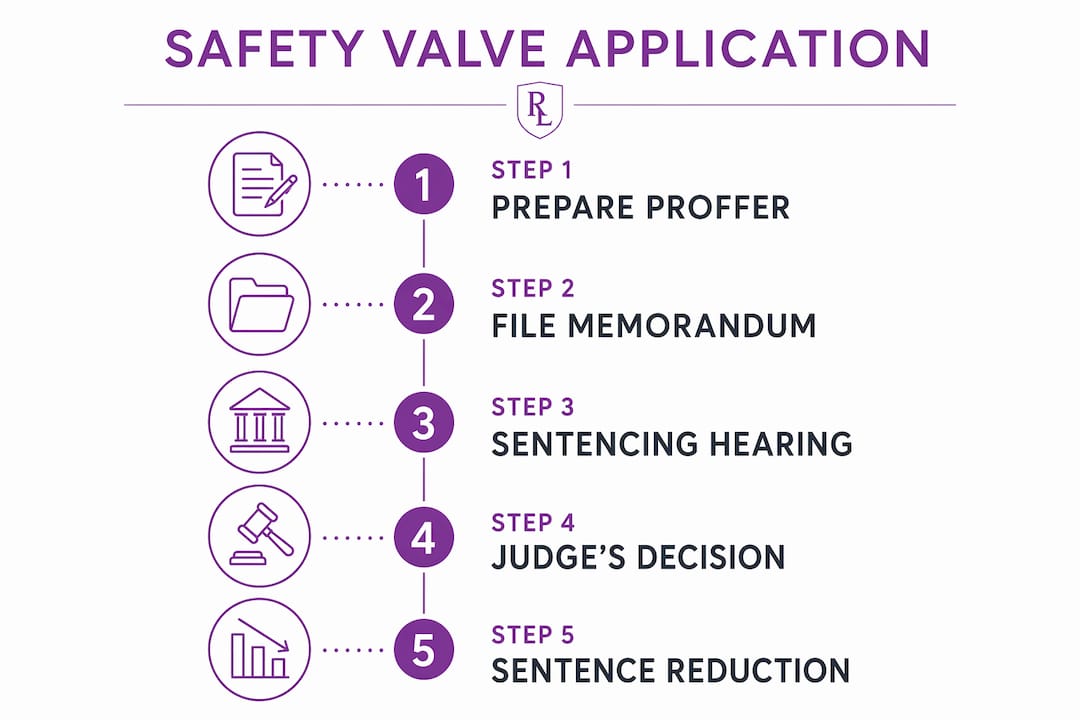
Your attorney should raise safety valve eligibility in the sentencing memorandum filed before the hearing, citing the specific criteria you satisfy and addressing any PSR findings that could create problems. If the PSR contains inaccurate role-in-offense findings or overstated criminal history, written objections must be filed within the deadline set by the court, typically 14 days after the PSR is disclosed.
At the sentencing hearing itself, the judge will hear argument on any disputed safety valve criteria. Your attorney can present testimony, documentary evidence, and legal argument. The government will have the opportunity to respond. After hearing both sides, the judge rules on eligibility and then proceeds to calculate the Guidelines range with or without the safety valve reductions applied.
The proffer session with prosecutors should occur well before sentencing, ideally during the pre-sentencing investigation period. Your attorney should be present for the proffer and should prepare you thoroughly. Anything you say can be used against you if the proffer agreement is breached, so the scope and terms of any proffer agreement matter.
Case law beyond Pulsifer: what courts have actually decided
Federal circuit courts have produced a body of decisions that illustrate how the five criteria play out in real cases, and the outcomes are instructive.
Courts have granted safety valve relief where a defendant possessed a firearm at home but the government could not establish a direct connection between the weapon and the drug transactions at issue. The "in connection with" standard gave the defendant room to argue disconnection, and the court agreed. Conversely, courts have denied relief where a defendant's firearm was found in the same location as the drugs and cash, treating proximity as sufficient connection.
On the role-in-offense criterion, courts have denied safety valve relief to defendants who recruited others into the conspiracy, even when those defendants argued they were low-level participants overall. Recruiting a single co-conspirator has been enough to trigger the leadership bar in some circuits. Other courts have required more substantial coordination before finding a supervisory role.
The disclosure requirement has generated its own line of cases. Courts have denied safety valve relief where defendants provided information about their own conduct but withheld details about co-conspirators, finding the disclosure incomplete. The statute requires disclosure of all information about the offense and related criminal conduct, not just the defendant's personal role. Partial cooperation does not satisfy the standard.
For defendants exploring sentencing minimization options in federal cases, these decisions underscore why the specific facts of each case determine the outcome.
How the safety valve interacts with other sentencing reductions
The safety valve does not operate in isolation. It stacks with, and sometimes competes with, other sentencing mechanisms.
Acceptance of responsibility under § 3E1.1 provides a two-level reduction (and potentially a third level on government motion for defendants with offense levels of 16 or higher) for defendants who clearly demonstrate acceptance. Combined with the safety valve's two-level reduction, a qualifying defendant can see a four or five-level total drop in offense level before the court even considers any other factors under 18 U.S.C. § 3553(a).
Substantial assistance under § 5K1.1 is a separate track that requires a government motion but can produce departures below the mandatory minimum for any federal offense, not just drug cases. A defendant who qualifies for both the safety valve and substantial assistance gets the benefit of both, though the practical overlap in disclosure requirements means the two processes are often coordinated.
The Guidelines safety valve provision in § 5C1.2 also applies to defendants convicted of drug trafficking offenses that do not carry a mandatory minimum, giving those defendants the two-level reduction even when there is no mandatory floor to waive. That is a broader application than the statutory safety valve under § 3553(f), which only waives mandatory minimums for the specific listed offenses.
How prosecutors use their discretion to affect safety valve outcomes
The safety valve does not require a government motion, but prosecutors still influence the outcome in several meaningful ways.
Prosecutors control the proffer process. They decide whether to conduct a proffer session at all, what questions to ask, and whether to challenge the completeness of your disclosure at sentencing. A prosecutor who believes your proffer was incomplete or untruthful will say so on the record, and the judge will weigh that assessment even though it is not controlling.
Charging decisions also matter. Prosecutors choose which statutes to charge under, and only convictions under the specific listed statutes qualify for the safety valve. A defendant charged under a qualifying statute has access to the safety valve; one charged under a different federal drug statute does not. Plea agreements sometimes involve charge bargaining that affects safety valve eligibility, making the negotiation stage critical.
Prosecutors also influence role-in-offense findings indirectly through the information they provide to the probation officer preparing the PSR. If the government characterizes a defendant as a manager or supervisor in its sentencing submission, that framing shapes the PSR and creates a hurdle the defense must overcome. Understanding how prosecutors approach these cases in your specific district, and in front of your specific judge, is where experienced local counsel makes a concrete difference. For defendants facing federal drug charges in Los Angeles, the prosecutorial dynamics in the Central District of California add another layer of complexity.
Expert perspective: what skilled defense actually changes
The legal burden on the defendant is heavier than most people realize going in. Proving eligibility by a preponderance of the evidence across five separate criteria, while opposing a government that may challenge your disclosure and your role, requires preparation that starts months before sentencing.
Experienced defense counsel challenges PSR findings on role and criminal history before they become fixed. A PSR that labels you a "manager" without sufficient factual support can be contested with evidence, and winning that objection can be the difference between qualifying and not. Attorneys who appear regularly in federal court know which objections judges take seriously and how to frame the argument.
The proffer preparation is equally important. Disclosing everything truthfully sounds simple, but determining what "everything" means in a complex conspiracy case requires legal judgment. Disclosing too little risks disqualification; disclosing information that implicates other charges requires careful analysis of proffer agreement terms.
Key pitfalls that cost defendants safety valve relief:
- Incomplete proffer disclosure, particularly about co-conspirators
- Firearm possession that the defense fails to factually disconnect from the drug activity
- PSR role findings left unchallenged that the court accepts as accurate
- Criminal history miscalculations that push a defendant over the four-point threshold
- Waiting too long to initiate the proffer process
Pro Tip: Stacking the safety valve's 2-level reduction with a full acceptance of responsibility reduction under § 3E1.1 can lower your offense level by four or five levels. That arithmetic should be part of your defense strategy from the moment you retain counsel.
Rubinlawpc brings frequent courtroom experience in federal cases and a detailed understanding of how sentencing hearings actually unfold in Los Angeles federal court. The firm's approach to federal drug defense includes early intervention on PSR findings, thorough proffer preparation, and aggressive use of every available sentencing reduction. If you are facing a federal drug charge where a mandatory minimum is in play, federal criminal defense counsel who knows the safety valve process is not optional.

Rubinlawpc handles federal drug cases across Los Angeles County. Contact the firm directly to discuss your safety valve eligibility and sentencing options.
Key Takeaways
Qualifying for the federal safety valve requires satisfying all five statutory criteria under 18 U.S.C. § 3553(f), and the 2024 Pulsifer ruling means a single disqualifying criminal history condition bars relief regardless of the others.
| Point | Details |
|---|---|
| Statutory basis | The safety valve is codified at 18 U.S.C. § 3553(f) and applies only to specific controlled substance offenses. |
| Sentencing benefit | Qualifying defendants avoid the mandatory minimum and receive a 2-level offense reduction under § 2D1.1(b)(18). |
| Pulsifer impact | The Supreme Court's march 2024 ruling adopted a disjunctive reading, meaning any single disqualifying criminal history condition bars relief. |
| Burden of proof | The defendant must prove eligibility by a preponderance of the evidence; government opposition is common but not controlling. |
| Stacked reductions | Combining the safety valve reduction with acceptance of responsibility can lower the offense level by four or five levels total. |