
Money laundering defense is the legal process of contesting criminal charges that allege a defendant knowingly handled funds derived from unlawful activity. Federal prosecutors rely on 18 U.S.C. §§ 1956 and 1957 to bring these charges, and a conviction carries prison sentences, massive fines, and mandatory asset forfeiture under 18 U.S.C. § 982. The stakes are severe enough that understanding what the government must prove, and where its case can break down, is the first step toward protecting yourself. Rubinlawpc has built its practice on exactly that kind of aggressive, detail-driven defense.
What does the government have to prove in a money laundering case?
The prosecution carries a heavy burden in every money laundering case. Each element must be proven beyond a reasonable doubt, and a single gap in the evidence can collapse the entire charge.
Under 18 U.S.C. § 1956, prosecutors must establish all of the following:
- A financial transaction occurred. The defendant conducted or attempted to conduct a financial transaction involving the proceeds of a specified unlawful activity (SUA). SUAs include drug trafficking, fraud, bribery, and dozens of other predicate offenses.
- The funds were criminally derived. The money or property involved must actually be the proceeds of that SUA. The government cannot simply allege the funds looked suspicious.
- The defendant had knowledge. The defendant must have known the funds came from some form of unlawful activity. Prosecutors do not need to prove the defendant knew the specific crime involved, only that criminal origins were known.
- Intent to conceal or promote. Under § 1956, the defendant must have intended to conceal the illicit source of the funds, evade taxes, or promote the underlying criminal activity.
Under 18 U.S.C. § 1957, the bar shifts slightly. Prosecutors must prove the defendant knowingly engaged in transactions over $10,000 involving criminally derived property through a financial institution. This section does not require proof of intent to conceal. The transaction amount and the defendant's knowledge of the criminal origin are the core elements.
One critical distinction separates § 1956 from § 1957: the intent requirement. Section 1956 demands proof of a concealment or promotion purpose. Section 1957 requires only that the defendant knowingly moved more than $10,000 in tainted funds. That difference shapes which defense strategies apply most directly.
Prosecutors also face a "distinctness" requirement. The laundering charge must be separate from the predicate offense. A defendant cannot be convicted of laundering the same act that constitutes the underlying crime. Courts have dismissed laundering counts where the government failed to show a distinct transaction beyond the predicate crime itself.
Common defense strategies against money laundering charges
Defending against money laundering charges requires attacking the government's case at its weakest points. The most effective legal defense for money laundering targets the knowledge element, the source of the funds, or the procedural integrity of the evidence.
-
Lack of knowledge. The most direct defense is proving the defendant did not know the funds came from criminal activity. Courts accept circumstantial evidence and willful blindness to establish knowledge, so the defense must present documented evidence of legitimate business purpose, due diligence, and good-faith reliance on professional advice. Bank records, contracts, and compliance documentation all serve this purpose.
-
Challenging the "proceeds" element. If the government cannot prove the specific funds involved were actually derived from criminal activity, the charge fails. Defense counsel can argue that the money came from a lawful source, even if the defendant was separately involved in illegal conduct.
-
Tracing and commingling defenses. Forensic accounting can refute the government's claim about the source and amount of illicit funds. When legitimate and illegitimate money flows through the same accounts, precise tracing can show that the specific funds in question were lawful. This defense requires a skilled forensic accountant working alongside defense counsel.
-
Multiplicity and duplicative charges. Prosecutors sometimes stack multiple laundering counts for what is effectively one transaction. A multiplicity challenge argues that separate counts punish the same conduct twice, violating the Double Jeopardy Clause.
-
Statute of limitations. Federal money laundering charges carry a five-year statute of limitations. If the alleged transaction falls outside that window, the charge is time-barred. Defense counsel must review the timeline of every alleged transaction carefully.
-
Suppression of evidence. If law enforcement obtained financial records through an unlawful search, a Fourth Amendment suppression motion can exclude that evidence. Without the financial records, the government's case often cannot survive.
Pro Tip: Document every legitimate business transaction with contracts, invoices, and compliance records before any investigation begins. Prosecutors use willful blindness to satisfy the knowledge element, and documented due diligence is your strongest counter to that theory.
Retaining counsel early is not optional in these cases. Early counsel engagement allows independent forensic analysis of financial records before the government locks in its narrative. Once prosecutors build their case theory around a particular reading of the evidence, challenging it becomes significantly harder.

Penalties, forfeiture, and the procedural timeline
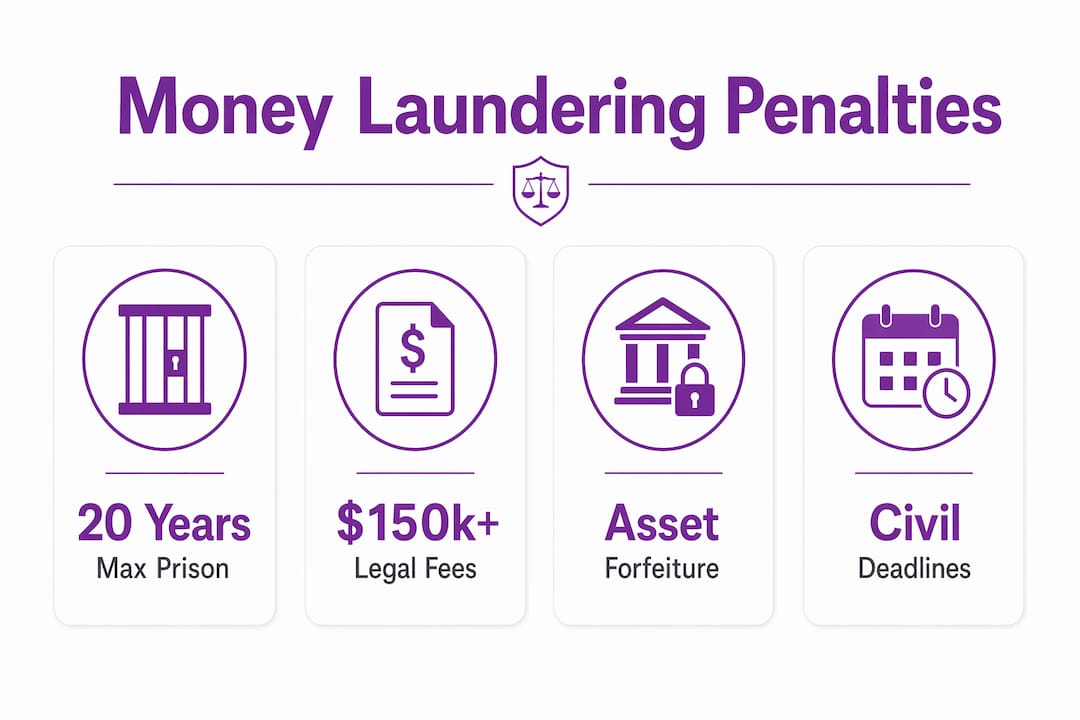
The consequences of a money laundering conviction extend well beyond prison time. Understanding the full scope of exposure shapes every decision in a money laundering case defense.
| Consequence | Details |
|---|---|
| Prison (§ 1956) | Up to 20 years per count under federal law |
| Prison (§ 1957) | Up to 10 years per count under federal law |
| Fines | Up to $500,000 or twice the amount laundered, whichever is greater |
| Mandatory forfeiture | All assets traceable to the offense under 18 U.S.C. § 982 |
| Civil forfeiture | Separate proceeding with independent deadlines, often 90 days to file a claim |
Asset forfeiture is where many defendants suffer the most lasting damage. Federal law mandates forfeiture of all property involved in or traceable to the offense. That includes bank accounts, real estate, vehicles, and business interests. The government does not need a criminal conviction to pursue civil forfeiture. Civil forfeiture proceedings operate under separate rules and strict deadlines, and missing a filing deadline can result in permanent asset loss regardless of how the criminal case resolves.
Defense costs reflect the complexity of these cases. Legal fees typically range from $15,000 to over $150,000, with cases lasting 12–36 months. That range reflects the volume of financial records, the number of counts, and whether the case goes to trial.
Pro Tip: File your forfeiture claim immediately upon receiving notice. Missing the civil forfeiture deadline, often as short as 90 days, means losing assets permanently, even if you win the criminal case.
Federal and state charges can run in parallel. California's money laundering statute, Penal Code § 186.10, mirrors federal law in many respects but carries its own penalties and procedural rules. A defendant can face prosecution in both forums simultaneously. Defense counsel must coordinate across both jurisdictions to prevent duplicative punishment and conflicting legal strategies.
Focusing defense efforts only on the predicate offense is a serious mistake. Laundering convictions carry independent sentencing enhancements that can result in a longer sentence than the underlying crime itself. Every count on the indictment demands its own defense strategy.
How to choose an experienced money laundering defense attorney
Selecting the right attorney is the most consequential decision you will make after being charged or investigated. The qualities that matter most in a money laundering defense attorney go beyond general criminal defense experience.
- Forensic financial expertise. Your attorney must understand how to read bank records, trace fund flows, and work with forensic accountants. A lawyer who cannot independently analyze the government's financial evidence cannot effectively challenge it.
- Federal court experience. Most serious money laundering cases are prosecuted federally. An attorney without substantial federal court experience will be at a disadvantage against experienced federal prosecutors.
- Pre-indictment track record. Skilled pre-indictment advocacy can leverage prosecutorial policies to prevent duplicative charges or persuade prosecutors to decline charges entirely. Ask specifically about outcomes at the investigation stage, not just at trial.
- Familiarity with forfeiture law. Asset forfeiture is a parallel proceeding with its own rules. Your attorney must be prepared to fight on both fronts simultaneously.
- Suppression motion experience. Financial records are often obtained through subpoenas and search warrants. An attorney who has successfully challenged the legality of those methods can remove the foundation of the government's case.
If you receive a federal target letter, retain counsel that same day. A target letter means the government has already identified you as a subject of a grand jury investigation. Every day without counsel is a day the prosecution builds its case unopposed.
Ask prospective attorneys directly: Have you handled cases under 18 U.S.C. § 1956 and § 1957? Have you retained forensic accountants in financial crime cases? What is your experience with civil forfeiture challenges? The answers reveal whether the attorney has the specific depth these cases demand. For broader context on criminal defense strategies and how they apply across jurisdictions, reviewing resources from experienced defense practitioners can sharpen your questions before that first consultation.
Key Takeaways
A successful money laundering defense attacks the government's proof of knowledge, the criminal origin of funds, and the procedural integrity of the evidence, while simultaneously protecting assets through timely forfeiture challenges.
| Point | Details |
|---|---|
| Knowledge is the core battleground | Prosecutors use willful blindness to prove knowledge; documented due diligence is the strongest counter. |
| Proceeds must be proven, not assumed | The government must trace specific funds to criminal activity; commingling defenses can break that link. |
| Forfeiture runs on its own clock | Civil forfeiture deadlines can be as short as 90 days; missing them causes permanent asset loss. |
| Early counsel changes outcomes | Retaining an attorney before indictment allows forensic challenges that are far harder to mount at trial. |
| Defense costs and timelines are significant | Cases typically last 12–36 months and cost $15,000 to over $150,000, making early strategy critical. |
What I've learned defending financial crime cases
The biggest misconception I encounter is that money laundering charges are just a secondary add-on to the "real" crime. Clients often assume that if they beat the predicate offense, the laundering count disappears with it. That is wrong. Laundering convictions carry independent enhancements, and I have seen defendants receive longer sentences on the laundering count than on the underlying crime.
The second thing clients consistently underestimate is how much the knowledge element can be contested. Prosecutors love the willful blindness theory because it lowers their burden. But willful blindness requires proof that the defendant deliberately avoided learning the truth. That is a specific legal standard, not a catch-all. When a client has compliance records, professional advice in writing, and documented business rationale, willful blindness arguments often fall apart under cross-examination.
Tracing defenses are underused. Forensic accountants can reconstruct fund flows in ways that directly contradict the government's narrative. I have seen cases where the prosecution's entire "laundered amount" was reduced dramatically once a forensic accountant applied proper tracing methodology. That reduction changes sentencing exposure significantly.
The most important advice I can give: do not talk to investigators without counsel present. Every statement you make becomes evidence. Silence is not guilt. It is your constitutional right, and exercising it costs you nothing.
— Jake
Rubinlawpc: aggressive defense for financial crime charges in Los Angeles
Facing a money laundering charge in Los Angeles means confronting federal prosecutors, complex financial evidence, and parallel forfeiture proceedings at the same time.
Rubinlawpc brings courtroom-tested criminal defense experience to every financial crime case, with deep familiarity with federal and California state courts. The firm conducts thorough case evaluations, coordinates forensic financial analysis, and files suppression and forfeiture challenges from day one. Rubinlawpc's attorneys understand local prosecutorial strategies and use that knowledge to anticipate and counter the government's moves. If you are under investigation or have already been charged, contact Rubinlawpc for a confidential consultation and get a defense team working for you immediately.
FAQ
What is money laundering defense?
Money laundering defense is the legal process of contesting charges that allege a defendant knowingly handled funds from criminal activity. It focuses on disproving the government's proof of knowledge, criminal origin of funds, and intent.
What are the penalties for federal money laundering?
A conviction under 18 U.S.C. § 1956 carries up to 20 years in prison per count, while § 1957 carries up to 10 years. Fines can reach $500,000 or twice the laundered amount, and mandatory asset forfeiture applies under 18 U.S.C. § 982.
Can I lose my assets before a money laundering trial?
Yes. Civil asset forfeiture operates independently of the criminal case and can proceed before trial. Filing deadlines can be as short as 90 days, and missing them results in permanent asset loss regardless of the criminal outcome.
What is the willful blindness doctrine in money laundering cases?
Willful blindness allows prosecutors to prove knowledge by showing a defendant deliberately avoided learning that funds were criminally derived. Courts accept this theory, which is why documented due diligence and compliance records are critical defense tools.
When should I hire a money laundering defense attorney?
Retain an attorney immediately upon learning you are under investigation, especially if you receive a federal target letter. Early counsel can independently analyze financial evidence and engage prosecutors before charges are formally filed.