
A federal target letter is an official notice from a U.S. Attorney's Office that the government considers you the primary suspect in a federal criminal investigation. The Justice Department defines "target" as a person against whom prosecutors or a grand jury have substantial evidence and who is a putative defendant. Receiving this letter does not mean you have been charged. It means the investigation has matured to a point where federal prosecutors believe they have enough to build a case against you. The time to act is now, not after an indictment arrives.
What does a federal target letter mean for your legal status?
The Department of Justice classifies individuals in a federal investigation into three categories: witness, subject, and target. A witness has information but is not under suspicion. A subject falls somewhere in between. A target is the person prosecutors believe committed the crime.
Being classified as a target carries serious weight. The DOJ's use of "substantial evidence" is deliberately imprecise. It signals more than mere suspicion but does not necessarily mean prosecutors have enough for a conviction. What it does mean is that the government has committed significant institutional resources to building a case against you.
The DOJ classification system is dynamic. A witness can become a subject, and a subject can become a target as new evidence surfaces. The target letter is often the first formal notice that this shift has already happened.
Receiving a federal target letter signals a critical turning point in the investigation. Many recipients mistakenly believe it reflects a misunderstanding that can be cleared up with a quick phone call. That belief is one of the most dangerous mistakes a person can make.
The letter does not guarantee indictment. Investigations can continue for months or years as the grand jury gathers evidence. But the window between receiving the letter and formal charges is the most important period in the entire case.
What does a federal target letter typically contain?
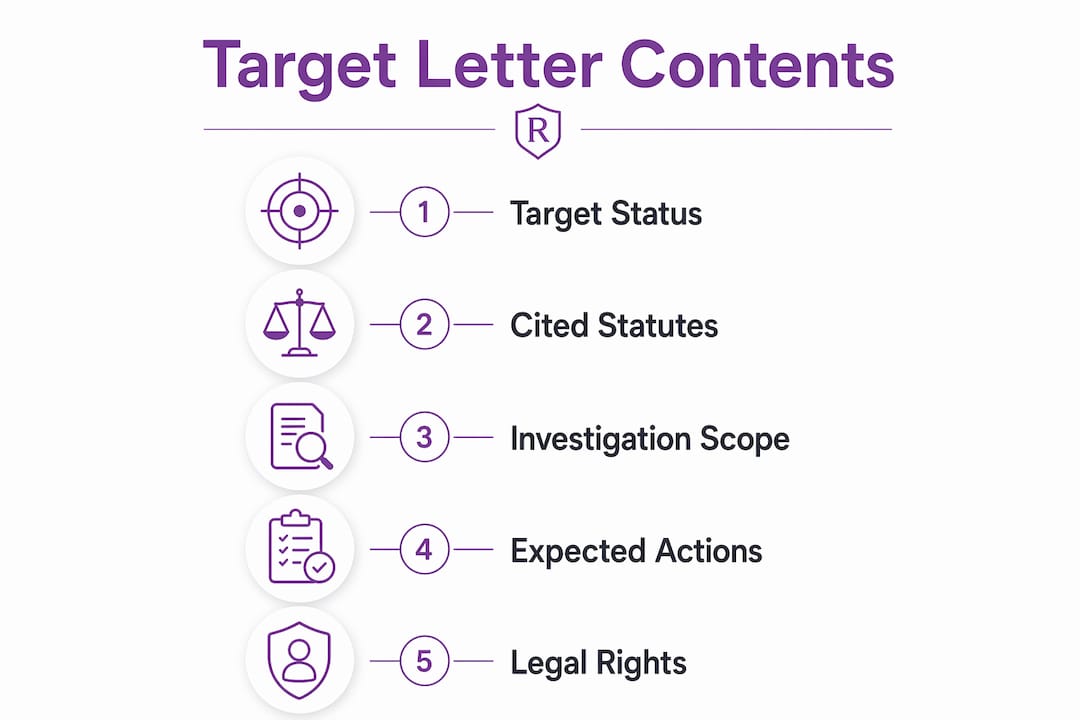
A target letter follows a recognizable structure. Understanding each component helps you respond correctly and avoid costly errors.
Most letters include the following elements:
- Notice of target status: A direct statement that you are the target of a federal grand jury investigation.
- Cited federal statutes: References to specific laws the government believes you violated. These citations reveal the government's legal theory and the potential charges you face.
- Invitation to testify: An offer to appear before the grand jury and present your side. This sounds like an opportunity. It is almost never one.
- Fifth Amendment reminder: A notice that you have the right against self-incrimination. The government is legally required to include this.
- Advice to seek counsel: An explicit or implicit suggestion that you retain an attorney before responding or contacting prosecutors.
- Evidence preservation warning: A caution that destroying or altering documents constitutes obstruction of justice under 18 U.S.C. § 1519.
The cited statutes deserve particular attention. A letter referencing wire fraud under 18 U.S.C. § 1343 tells a very different story than one citing drug trafficking statutes. Your attorney will use these citations to map the government's theory and identify weaknesses before charges are filed.
| Letter Component | What It Signals |
|---|---|
| Target status notice | You are the primary suspect, not a witness or peripheral figure |
| Cited statutes | The specific crimes prosecutors are building a case around |
| Grand jury invitation | An opportunity that carries serious legal risk without counsel |
| Fifth Amendment notice | Your right to refuse testimony that could incriminate you |
| Evidence preservation warning | Destruction of documents now constitutes a separate federal crime |
What risks and mistakes should you avoid after receiving a target letter?
The period immediately after receiving a federal investigation notice is when most people make their worst decisions. Panic, confusion, and the instinct to "explain yourself" lead to actions that prosecutors use against defendants at trial.
The most common and damaging mistakes include:
- Contacting prosecutors directly: Any statement you make, even an informal phone call, can be recorded and used as evidence. Avoid direct contact with law enforcement until you have retained counsel.
- Testifying before the grand jury without an attorney: Grand jury proceedings are one-sided. Only prosecutors are present. Testimony is given under oath and is legally binding. A single misstatement can result in a perjury charge on top of the original investigation.
- Destroying or deleting documents: This is the single fastest way to turn a difficult situation into a catastrophic one. Shredding files or wiping hard drives after receiving the letter creates an independent federal crime.
- Contacting co-investigated parties: Reaching out to others who may be under investigation can be characterized as witness tampering or obstruction.
- Ignoring the letter entirely: There is no legal deadline to respond, but inaction is not the same as safety. The investigation continues whether you engage or not.
Pro Tip: Do not discuss the contents of the letter with anyone other than your attorney. Conversations with friends, family, or colleagues are not protected by attorney-client privilege and can be subpoenaed.
The Fifth Amendment protections available to you must be carefully invoked. Waiving them, even partially, can have consequences that extend well beyond the grand jury room. Your response strategy depends heavily on your classification under DOJ policy, which is exactly why counsel must guide every decision.

What immediate steps should you take after receiving a federal target letter?
Speed matters. The pre-indictment period is the most valuable time in your entire case, and every day without counsel is a day of opportunity lost.
- Preserve all documents and electronic records. Do not delete emails, texts, financial records, or any files that could be relevant to the investigation. Preservation is both a legal obligation and a defense tool.
- Retain a federal criminal defense attorney immediately. Not a general practice attorney. Not a state criminal lawyer. You need someone with specific experience in federal investigations and grand jury procedures. Experienced federal defense counsel negotiates with prosecutors, guides your response, and protects your rights at every stage.
- Let your attorney handle all communications. Do not call the prosecutor's office. Do not respond to the letter yourself. Your attorney's first job is to take over every line of communication with the government.
- Write down everything you remember. Create a detailed, chronological account of relevant events while your memory is fresh. Do this in writing and share it only with your attorney. This document is protected by attorney-client privilege.
- Understand the timeline. The gap between a target letter and indictment varies widely. There is no fixed deadline. That flexibility works in your favor if you use the time to build a defense.
- Ask about pre-indictment opportunities. Counsel can present exculpatory evidence to prosecutors, negotiate cooperation agreements, or seek a declination before charges are ever filed.
Pro Tip: There is no legal deadline to respond to a target letter. Use that time to secure experienced counsel rather than rushing into contact with prosecutors. Your attorney can also request deadline extensions when needed.
How can legal counsel influence outcomes after a target letter?
The pre-indictment period is where skilled defense work has the greatest impact. Once charges are filed, the government's position hardens and options narrow. Before that point, a defense attorney has real leverage.
Counsel's most important contributions during this phase include:
- Interpreting the cited statutes: The specific laws referenced in the letter reveal the government's theory. An experienced attorney reads those citations and identifies the weakest points in the prosecution's case before it is fully built.
- Negotiating directly with prosecutors: Defense attorneys can request meetings with the U.S. Attorney's Office to present exculpatory evidence, challenge the scope of the investigation, or explore cooperation arrangements.
- Seeking reclassification: The pre-indictment window is the best opportunity to argue that you should be reclassified from target to subject or witness, which dramatically changes your exposure.
- Advising on grand jury testimony: The decision to testify is one of the most consequential choices in a federal case. Counsel evaluates whether invoking the Fifth Amendment, negotiating immunity, or testifying under specific conditions best serves your interests.
- Managing the investigation timeline: Attorneys can engage prosecutors in ways that slow the pace of the investigation, buy time for evidence gathering, and prevent rushed decisions that harm your case.
Early legal intervention changes the trajectory of federal cases. The government's position is not fixed at the target letter stage. Prosecutors make decisions based on the information and arguments in front of them, and a skilled defense attorney controls what they see.
Key Takeaways
A federal target letter is the government's formal signal that you are the primary suspect in an active federal investigation, and the pre-indictment period is your best window to influence the outcome.
| Point | Details |
|---|---|
| Target letter definition | Formal notice from the U.S. Attorney's Office that you are the primary suspect with substantial evidence against you. |
| Do not self-incriminate | Never contact prosecutors directly or testify without counsel; grand jury testimony is under oath and irrevocable. |
| Preserve all evidence | Destroying documents after receiving the letter is a separate federal crime under 18 U.S.C. § 1519. |
| Retain federal defense counsel | Hire an attorney with specific federal investigation experience immediately, not a general practice lawyer. |
| Pre-indictment window | The period before charges are filed is the best opportunity to negotiate, present exculpatory evidence, or seek declination. |
What I've learned from watching clients misread this letter
Most people who receive a federal target letter spend the first 48 hours convincing themselves it is a mistake. I understand that instinct. The letter is formal, bureaucratic, and feels almost abstract. It does not look like a threat. That is exactly what makes it dangerous.
The clients who fare best are the ones who treat the letter as the serious legal event it is, not as an administrative nuisance. They call an attorney the same day. They stop talking to anyone about the case. They preserve everything. They do not try to "get ahead of it" by calling the prosecutor's office to explain themselves.
The clients who struggle are the ones who wait. They think they have time. They think a conversation with the prosecutor will clear things up. By the time they retain counsel, they have already made statements, deleted files, or tipped off co-investigated parties. Every one of those actions becomes a problem.
The target letter is not the end of the road. It is a signal that the road is narrowing fast. The right attorney, retained quickly, can widen it again. I have seen cases where early, aggressive defense work resulted in no charges at all. That outcome is not guaranteed, but it is only possible if you act before the indictment arrives.
— Jake
Rubinlawpc defends clients facing federal investigations
Rubin Law, P.C. represents clients at every stage of federal criminal investigations, including those who have just received a target letter and need immediate guidance.
Rubinlawpc's attorneys understand how federal prosecutors build cases, which statutes they rely on, and where investigations are most vulnerable to challenge. That knowledge matters most in the pre-indictment period, when defense work can still shape the outcome. If you have received a federal target letter, the time to retain experienced criminal defense counsel is today. Contact Rubinlawpc for a confidential consultation to assess your situation and protect your rights before charges are filed.
FAQ
What is a federal target letter?
A federal target letter is formal written notice from a U.S. Attorney's Office that you are the primary suspect in a federal grand jury investigation. It means prosecutors have substantial evidence linking you to a crime and consider you a putative defendant.
Does a target letter mean I will be charged?
Not necessarily. A target letter signals an advanced investigation but does not guarantee indictment. The pre-indictment period is a critical window where defense counsel can negotiate, present exculpatory evidence, or seek a declination of charges.
Should I testify before the grand jury after receiving a target letter?
Testifying without counsel is almost never advisable. Grand jury proceedings are one-sided, testimony is given under oath, and any statement can be used against you in a later prosecution. Consult a federal criminal defense attorney before making any decision about testimony.
How long do I have to respond to a federal target letter?
There is no legal deadline to respond to a target letter. Use that time to retain experienced federal defense counsel. Your attorney can also request extensions and manage all communications with prosecutors on your behalf.
What happens if I destroy documents after receiving a target letter?
Destroying or altering documents after receiving the letter constitutes obstruction of justice under 18 U.S.C. § 1519 and carries its own severe federal penalties, separate from the original investigation.