A federal detention hearing is the courtroom proceeding where a magistrate judge decides whether you stay locked up or go home while your case moves forward, and the decision runs through the standards set out in 18 U.S.C. § 3142, the statute Congress passed as part of the Bail Reform Act of 1984. Nothing about this moment is passive. What you or your family do in the hours after arrest often shapes the outcome more than anything argued in the courtroom itself.
Do these things immediately:
- Ask the court for appointed counsel or call a criminal defense attorney the moment you're arrested, before you say anything else.
- Find out whether the hearing is happening now or whether a continuance has been requested, since that window is either your biggest asset or your biggest risk.
- Start collecting pay stubs, a lease or mortgage statement, and any letters that show stable ties to your community.
- Line up a third-party custodian, someone willing to supervise you and vouch for your compliance if released.
- Pull together medical or treatment records if substance use or mental health is part of your story.
Pro Tip: Cite 18 U.S.C. § 3142 by name when you or your attorney talk to the pretrial services officer or the judge. Referencing the actual statute signals you understand the legal test, not just the stakes.
Key Takeaways
Federal detention hearings hinge on preparation speed: the strength of your documentation and release plan within the first 72 hours after arrest usually determines whether you go home or stay in custody.
| Point | Details |
|---|---|
| Statute governs the test | 18 U.S.C. § 3142 requires the government to prove danger by clear and convincing evidence or flight risk by a preponderance. |
| Continuances buy prep time | The defense can request up to five business days, the government up to three, to gather evidence before the hearing. |
| Evidence beats arguments | Verified employment, a third-party custodian, and treatment placement carry more weight than general assurances. |
| Detention isn't final | A motion to reopen under §3142(f) can revisit the order once material new information becomes available. |
| Rubinlawpc offers rapid response | The firm represents clients at federal detention hearings across Los Angeles, from bail packages to reopen motions. |
Table of Contents
- What Does 18 U.S.C. § 3142 Actually Say?
- When Does the Detention Hearing Happen?
- Who Attends and What Rights Do You Have?
- What Factors Decide Detention or Release?
- Who Has to Prove What, and How Much?
- What Can the Judge Actually Order?
- How Should You Prepare for the Hearing?
- What If the Judge Orders Detention Anyway?
- What Role Does Pretrial Services Play?
- What Actually Happens in the Room?
- What Federal Defense Teams Prioritize in the First 72 Hours
- Rubinlawpc Handles Federal Detention Hearings With Same-Day Urgency
- Sources
What Does 18 U.S.C. § 3142 Actually Say?
The Bail Reform Act of 1984 starts from a presumption of release, not detention. Congress built the statute so that pretrial detention is the exception, reserved for cases where the government proves it's genuinely necessary, not the default response to a federal indictment.
A detention hearing only happens when the case fits one of the categories listed in §3142(f). Those categories include crimes of violence, offenses carrying life imprisonment or the death penalty, certain drug trafficking crimes with a maximum sentence of ten years or more, repeat serious offenders, and any case where the government can show a serious risk of flight or an attempt to obstruct justice or intimidate a witness. If your charge doesn't fall into one of those buckets, you're generally not facing a detention hearing at all.
Here's the plain-language version of what the judge is actually testing for:
- Danger to the community: could you hurt someone or reoffend if released?
- Risk of flight: are you likely to skip court or leave the jurisdiction?
- Least restrictive conditions: even if some risk exists, can conditions like monitoring or a curfew manage it without full detention?
Some charges trigger a "rebuttable presumption" that no condition will work, meaning the burden temporarily shifts to you to produce evidence pushing back. This usually applies to certain drug trafficking offenses and crimes involving firearms during violent felonies. It's not a conviction and it's not automatic detention. It just means you walk into the hearing needing to counter the presumption with real evidence: a job, a home, family ties, a lack of criminal history.
One more distinction worth understanding early: a detention hearing is not a trial. Nobody is deciding whether you're guilty. The only question is whether you're safe to release while the case against you gets litigated.
When Does the Detention Hearing Happen?
The hearing is supposed to happen at your initial appearance, the first time you stand in front of a magistrate judge after arrest. In practice, it almost always gets pushed back at least slightly because either side needs time.
- You're arrested and brought before a magistrate judge, usually within 48 to 72 hours depending on the district and day of arrest.
- The government or the defense requests a continuance if either side isn't ready to argue detention that day.
- The government can get up to three business days; the defense can request up to five business days for good cause, and both windows exclude weekends and federal holidays.
- You remain in custody during any continuance, which is the tradeoff for the extra prep time.
- The hearing itself takes place before the same magistrate judge who handled your initial appearance, in the courthouse where you were arraigned.
During a continuance, use the clock. Contact family about a third-party custodian, request medical or treatment documentation, and have your attorney start drafting a release proposal instead of waiting for the hearing date to arrive.
Pro Tip: A five-day continuance sounds like a delay, but it's often the single best tool the defense has. Judges are far more receptive to a verified job offer or a signed treatment placement letter than a vague promise that "something will come through."
Who Attends and What Rights Do You Have?
The room is smaller and less formal than most people expect. You'll see the magistrate judge, an Assistant U.S. Attorney representing the government, your defense counsel, a Pretrial Services Officer, and often a U.S. Marshal. Witnesses appear occasionally, but far less often than in a trial.
You have real rights at this hearing, even though it moves fast:
- The right to counsel, appointed if you can't afford one.
- The right to testify on your own behalf, though your attorney will weigh this carefully since anything said can surface later in the case.
- The right to present witnesses and evidence supporting release.
- The right to cross-examine the government's witnesses, though the government usually proceeds by proffer instead of live testimony.
- The benefit of relaxed evidentiary rules: hearsay and unsworn statements are routinely allowed because the rules of evidence do not strictly apply at this stage.
That last point cuts both ways. It means the government can rely on secondhand summaries of the investigation, but it also means your attorney can proffer employment verification, a lease agreement, a signed treatment plan, or character letters without dragging witnesses into court to authenticate every document.
What Factors Decide Detention or Release?
Judges work through four factors under §3142(g), and understanding what each one actually measures tells you what evidence matters and what doesn't.
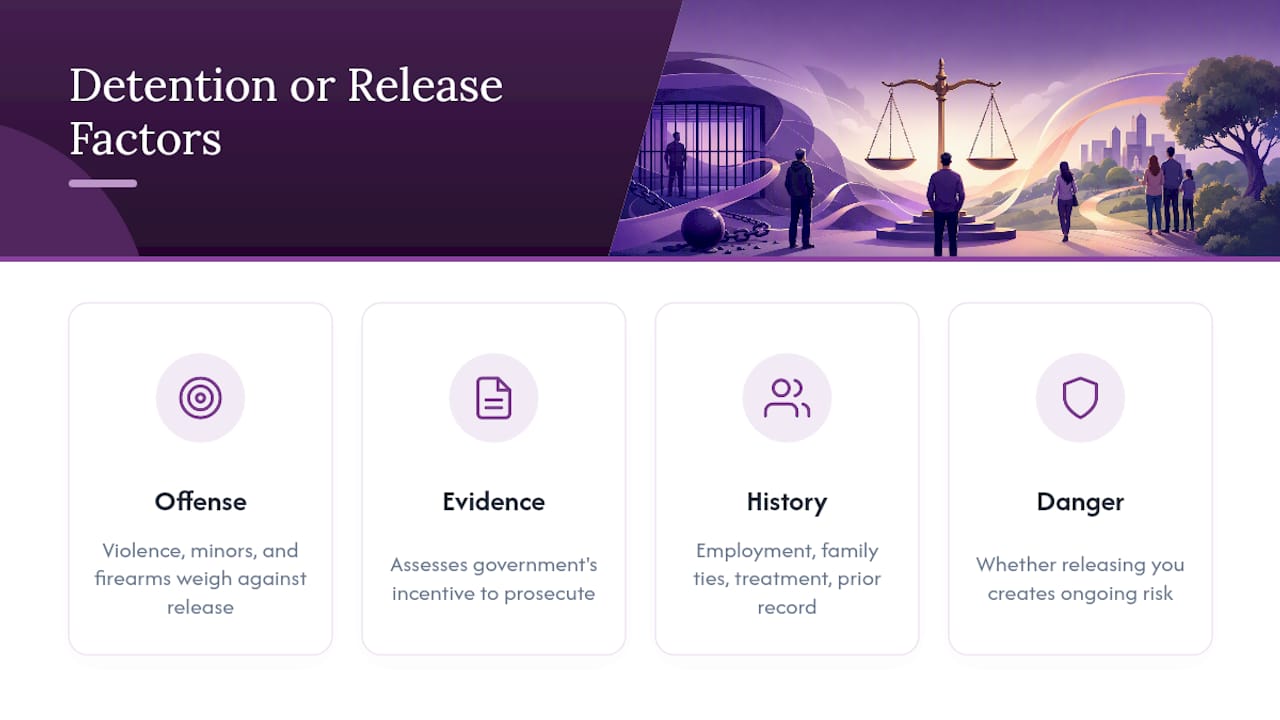
Nature and circumstances of the offense. Violent crimes, offenses involving minors, and cases involving firearms weigh more heavily against release than a nonviolent white collar charge with no victim contact.
Weight of the evidence against you. This is the one factor that brushes closest to guilt, but courts are supposed to use it narrowly, mainly to gauge how strong the government's incentive is to prosecute aggressively, not to pre judge the case.
History and characteristics. Employment record, family ties, mental health and substance history, criminal record, and past court appearances all live here. This is where most of your defense evidence lands.
Danger to the community. Separate from the offense itself, this asks whether releasing you specifically creates ongoing risk, which is why judges often ask about firearm access, prior violence, or gang affiliation even in cases unrelated to those issues.
Helpful evidence tends to include: verified job offers, a stable residence with a named landlord, a willing third-party custodian, documented treatment enrollment, and character letters from people outside your immediate family. Evidence that tends to hurt you: unverified claims of employment, a history of failing to appear in prior cases, recent travel to countries without extradition treaties, or access to firearms when the underlying charge involves violence.
Pro Tip: If you only have 48 hours to prepare, prioritize the third-party custodian and one piece of verified documentation, like a pay stub or lease, over a stack of character letters. Judges weigh concrete, checkable facts over volume.
Who Has to Prove What, and How Much?
The burden sits entirely with the government, and the standard shifts depending on what it's arguing. If the government claims you're a danger to the community, it has to prove that by clear and convincing evidence, a fairly high bar. If the argument is flight risk instead, the standard drops to a preponderance of the evidence, meaning just more likely than not.
The Supreme Court's decision in United States v. Salerno upheld the constitutionality of pretrial detention but made clear it was meant for a narrow slice of cases, not a routine tool. Detention is supposed to feel like the exception a judge reaches reluctantly, not a default setting.
Here's what each side typically brings to meet or beat that burden:
- The government usually leans on the criminal complaint, prior record, and agent proffers about the investigation.
- The defense typically counters with employment verification, a custodian's sworn willingness to supervise, and documentation undercutting the government's flight or danger narrative.
- Either side can ask the judge to reopen the hearing later if genuinely new, material information surfaces that wasn't available the first time around.
What Can the Judge Actually Order?
The range of outcomes is wider than most people expect, and detention is only one point on that spectrum.
- Release on recognizance (ROR): you're released on your promise to appear, no bond required.
- Unsecured bond: you owe money only if you violate conditions or fail to appear.
- Secured bond: property or cash is pledged upfront as collateral.
- Conditional release: the most common middle ground, combining things like GPS monitoring, home confinement, third-party custodianship, travel restrictions, or drug testing.
- Detention order: the judge finds no combination of conditions will work, and you remain in custody through trial.
Conditions sound manageable on paper until you're the one living under them. GPS monitoring restricts travel for work. Home confinement can conflict with a job that requires you to leave the house. Reporting requirements mean regular check ins with Pretrial Services that you cannot skip without consequences.
This is where negotiation matters. If your attorney knows you need to travel for work three days a week, that needs to be on the table before the judge signs an order, not after you've already violated a condition you never mentioned. A workable order beats a strict one you'll struggle to follow.
Pro Tip: Ask your attorney to propose specific, realistic conditions rather than simply arguing against detention in the abstract. Judges respond better to "here's exactly how release would work" than to a general plea for freedom.
How Should You Prepare for the Hearing?
Preparation in the days or hours before a detention hearing determines most of what happens inside it. Here's the order that tends to work:
- Gather identification, proof of residence, and recent pay stubs or an employer letter confirming your job.
- Line up a third-party custodian and get them ready to speak or submit a signed statement.
- Collect letters of support from people who know your daily life, not just character references.
- Pull medical or treatment records if relevant, along with confirmation of any scheduled treatment intake.
- Build a short bail package, one to two pages summarizing your ties to the community, with the supporting documents attached.
A bail package doesn't need to be exhaustive. Judges are reading dozens of these a week. A tight summary with strong attachments beats a thick binder nobody has time to read closely.
You'll also likely sit down with a Pretrial Services Officer before the hearing. Answer their questions honestly on objective facts like your address and employment history, but coordinate with your attorney beforehand about what you should and shouldn't volunteer regarding the case itself. The interview shapes the officer's report to the judge, so it matters more than most defendants realize going in.

Pro Tip: Organize your exhibits in the order the judge will actually need them: identity and residence first, employment and community ties second, custodian availability last. Detention hearings move fast, and a disorganized file wastes precious minutes.
What If the Judge Orders Detention Anyway?
Detention isn't the end of the conversation. You have real paths forward, and courts recognize that circumstances change.
- Motion to reopen under §3142(f): if material information surfaces that wasn't available at the original hearing, like a verified job offer, a treatment placement, or a newly available custodian, your attorney can ask the judge to revisit the order.
- District court review: if a magistrate judge ordered detention, you can seek review by the district judge assigned to your case, which is a fresh look rather than a rubber stamp.
- Appeal: further appellate review is available, though it moves slower and works better as a backstop than a primary strategy.
File a reopen motion as soon as you have something genuinely new, not just a restated version of the argument you already lost. Courts want to see actual change: an employer who wasn't reachable before now confirming a start date, a residential treatment bed that just opened up, a relative who was traveling and is now available as a custodian.
Pro Tip: Build your reopen motion around one strong, verifiable fact rather than several weak ones. A single confirmed job offer with a named employer and start date carries more weight than five vague assurances.
What Role Does Pretrial Services Play?
Pretrial Services interviews you shortly after arrest, verifies what you tell them, and prepares a report for the judge that includes a Pretrial Risk Assessment, or PTRA, score. That score and report shape the judge's starting point walking into the hearing, even though the judge isn't bound by it.
Bring documentation to the interview: ID, proof of address, and any records that support your employment or treatment history. Be truthful about verifiable facts, but let your attorney guide anything that touches the underlying allegations.
The national trend is worth knowing going in. Federal pretrial release rates have declined in recent years, according to Administrative Office of the U.S. Courts research covering 2008 through 2017, and some districts that incorporated PTRA scores into bail reports saw mixed results rather than a clean improvement. That downward trend makes strong, individualized preparation more important, not less.
What Actually Happens in the Room?
Most detention hearings run short, often 15 to 30 minutes, especially when both sides proceed by proffer instead of calling witnesses. This is not a mini trial, and treating it like one wastes the limited time you have.
A few corrections to common misunderstandings:
- Myth: the judge is deciding guilt. Fact: the only question is risk and whether conditions can manage it.
- Myth: you need a full witness list. Fact: a tight, verified proffer usually outperforms a long list of unprepared witnesses.
- Myth: losing the hearing means you're stuck. Fact: reopening and review remain available if circumstances change.
Pro Tip: If you're detained, contact your attorney immediately to establish a communication plan, ask family to set up commissary funds, and have someone start compiling the documentation your legal team will need for a future reopen motion.
What Federal Defense Teams Prioritize in the First 72 Hours
The first three days after arrest decide more than most people realize. Defense teams spend that window verifying employment, confirming a custodian, and pulling together anything that counters the government's flight or danger narrative before the hearing even starts.
One recurring pattern: a defendant initially detained on a drug trafficking charge got the order reopened weeks later after defense counsel secured a verified treatment placement and a custodian willing to supervise daily check ins. Nothing about the underlying case changed. What changed was the strength of the release plan.
The most common mistakes are avoidable: oversharing with Pretrial Services before talking to counsel, missing a continuance deadline, or showing up to the hearing without employment proof already verified. None of those require legal sophistication to fix, just preparation.
Rubinlawpc Handles Federal Detention Hearings With Same-Day Urgency
If you or a family member is facing a federal detention hearing, the preparation window is short and the stakes are custody itself. Rubinlawpc is built for exactly this kind of urgency: frequent courtroom appearances across Los Angeles federal and state matters mean the firm knows how local magistrate judges tend to weigh release conditions before the hearing even starts.

Rubinlawpc's federal defense work covers direct representation at detention hearings, building bail packages that pair a tight written summary with verified documentation, filing motions to reopen when new facts emerge, and coordinating directly with Pretrial Services so nothing said in that interview undercuts your defense. The firm also works closely with clients pursuing treatment placement as part of a release plan through its mental health defense practice.
If you're facing a detention hearing or expect one soon, reach out through Rubin Law's Los Angeles County service page for an urgent consultation. Every hour before the hearing matters, and having counsel who can move fast on documentation often makes the difference between a release plan the judge accepts and one that arrives too late.
Sources
- 18 U.S.C. § 3142 - Release or detention of a defendant pending trial | LII / Legal Information Institute
- Criminal Resource Manual | 26. Release And Detention Pending Judicial Proceedings (18 U.S.C. 3141 Et Seq.) | U.S. Department of Justice
- Examining federal pretrial release (Administrative Office of the U.S. Courts research article)
This article is general information, not a substitute for advice from a qualified lawyer. Consult a qualified legal professional about your own circumstances before acting on anything here.