
An indictment is a formal charge that a grand jury votes to return after reviewing the prosecutor's evidence; an information is a charge the prosecutor files directly, no grand jury required. For many federal felonies, the Fifth Amendment demands an indictment unless the defendant agrees to waive it. The practical fallout: indictments come with citizen review and secrecy, while informations move faster but usually require either a waiver or a preliminary hearing first.
TL;DR:
- Federal and some state courts require an indictment for most serious felonies, but defendants can waive this through a court-recorded agreement.
- Indictments are kept sealed until arrest, while informations are publicly filed immediately, affecting case secrecy and timing.
- Waiving grand jury review accelerates case processing but eliminates citizen review, which may influence early case strategy and leverage.
- Prosecutors can amend informations more easily before verdict, while changing an indictment usually requires returning to the grand jury.
- Jurisdiction and case specifics heavily influence whether cases start with grand jury indictments or informations, especially at the federal level.
Table of Contents
- Indictment vs Information: A Side-by-Side Comparison
- How Each Charging Path Actually Starts
- When the Law Requires an Indictment, and How Waiver Works
- What This Means for Your Defense Strategy
- What to Do Right Now if You're Facing Either Charge
- The Crimes Most Often Charged Each Way
- Terminology and Practice Vary More Than People Expect
- How Often Each Path Actually Gets Used
- Your Rights and Options Before Trial Even Starts
- When a Waiver Makes Sense, and When It Doesn't
- Talk to Rubin Law Before You Decide Anything
- Sources
Indictment vs Information: A Side-by-Side Comparison
The two documents look similar on paper. Both list charges, cite the statute, and lay out the factual basis for each count. The difference is who decides the charge is worth bringing, and how fast it happens.
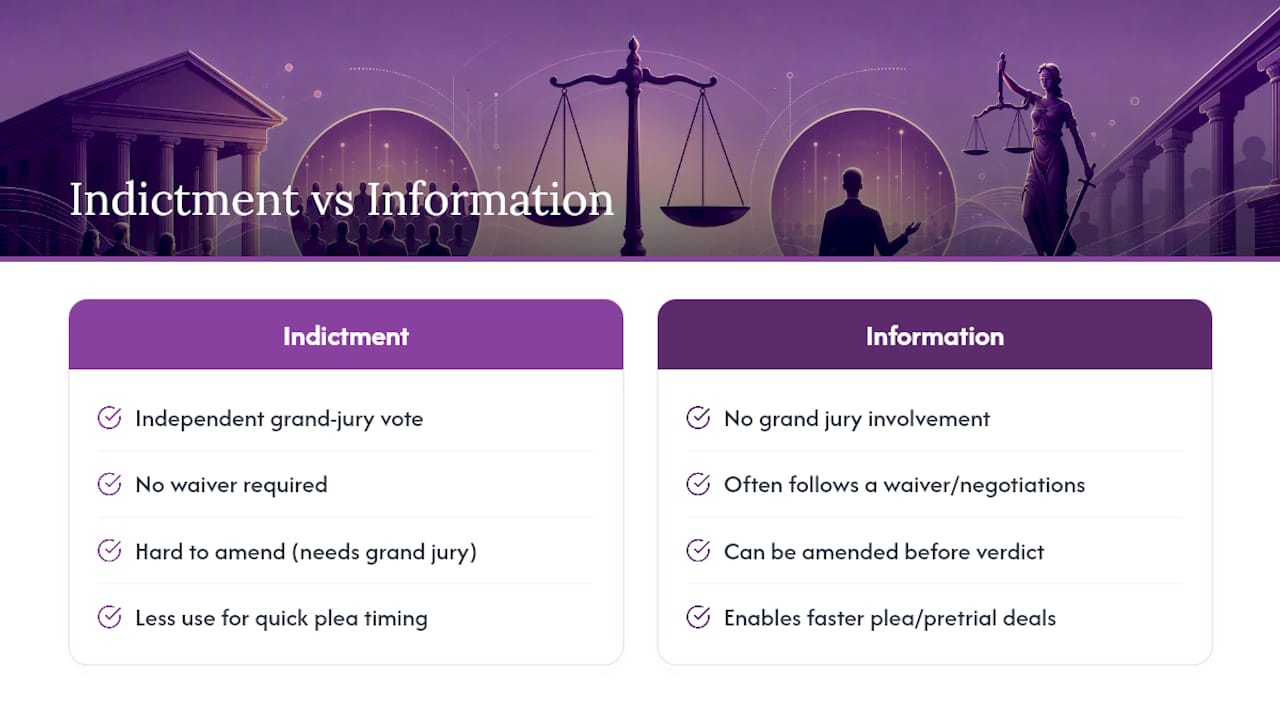
- Who files it: A grand jury returns an indictment after hearing the prosecutor's evidence; a U.S. Attorney or state prosecutor files an information on their own authority.
- When it's used: Indictments are the default for most federal felonies; informations show up when a defendant waives grand jury review, or in jurisdictions and offense categories (often misdemeanors and some state felonies) where a grand jury was never required.
- Secrecy: Grand jury sessions are private, and an indictment can stay sealed until an arrest happens. An information is a public filing from the moment it's entered on the court docket.
- Amendment rules: Rule 7 demands that both documents be "plain, concise, and definite," but informations can typically be amended before verdict as long as no new offense is added and no substantial right of the defendant is harmed. Indictments are far more rigid. Changing the substance of an indictment usually means going back to the grand jury.
None of this changes the seriousness of the charge. A felony charged by information carries the same potential sentence as the same felony charged by indictment. What changes is the path that got the charge on the docket, and that path shapes almost everything that happens next.
How Each Charging Path Actually Starts
Every criminal case begins somewhere specific, and the starting point tells you a lot about what's coming.
- Grand jury presentation. A prosecutor brings evidence to a panel of ordinary citizens, without the defendant or defense counsel present. Sessions are secret, and grand jurors hear only what the government chooses to show them.
- Vote and return. If enough jurors agree probable cause exists, the panel returns the indictment. The document may sit sealed until police make an arrest.
- Criminal complaint route. In many jurisdictions, an arrest starts with a sworn complaint rather than a grand jury. That triggers a preliminary hearing, where a judge, not a grand jury, decides whether probable cause supports moving forward. Defendants can waive this hearing, and often do as part of a broader strategy.
- Filing the information. When a defendant waives grand jury review, or when the offense simply doesn't require one, the prosecutor files an information that meets the content requirements in Rule 7(c): the charge, the statute, and a plain statement of the facts.
- Arraignment. Regardless of which document started the case, the defendant appears in court, hears the formal charges, and enters a plea. This is usually the first moment the case starts moving on a fixed schedule.
Anyone who's received a federal grand jury subpoena already knows how much happens before charges ever become public.
When the Law Requires an Indictment, and How Waiver Works
The Fifth Amendment sets the baseline: most federal felonies require a grand jury indictment unless the defendant chooses otherwise. Rule 7(a) codifies that requirement for federal court. State rules vary, and a fair number of states allow felony prosecution by information without ever convening a grand jury.
A federal grand jury usually has 16 to 23 members, and it takes at least 12 votes to return an indictment. That threshold matters less than people assume, since grand juries evaluate probable cause, a far lower bar than the "beyond a reasonable doubt" standard a trial jury applies.
Waiver isn't a quiet formality. It happens in open court, on the record, after the judge confirms the defendant understands the charges and the right being given up. Counsel is present. Common reasons defendants waive:
- Locking in a cooperation agreement that depends on moving quickly.
- Securing favorable plea terms that require an information rather than a grand jury process.
- Avoiding the delay and uncertainty of waiting for a grand jury's schedule.
Pro Tip: If your attorney raises waiver early, ask exactly what you gain in exchange, whether it's cooperation credit, sentencing input, or speed. A waiver traded for nothing concrete is a waiver you shouldn't sign.
What This Means for Your Defense Strategy
Grand jury secrecy cuts against the defendant in one specific way: your lawyer can't walk into that room. There's no cross examination, no rebuttal evidence, no opportunity to argue the case before the vote happens. The government builds its record alone, and by the time you see the indictment, that decision is already made.
An information flips the sequence. Because it often follows a waiver, it tends to show up when negotiations are already underway, and that changes the leverage calculus. Waiving the grand jury can accelerate a favorable resolution, but it also means giving up the one moment where an independent panel might have pushed back on a shaky case. That's not a small trade. A grand jury occasionally declines to indict, and you never learn whether yours would have been one of those cases if you waive the process before it starts.
The amendment rules add another layer of strategy. Because informations can typically be amended before verdict without a fresh grand jury vote, prosecutors have more room to adjust charges as facts develop, provided the defendant isn't prejudiced. Indictments are stiffer. If the government wants to materially change the charge, it often needs to go back to the grand jury, which creates a real opening for defense motions challenging the sufficiency or particularity of what was originally returned.
Timing decisions early in a case, including whether to push for a preliminary hearing or accept a fast plea, connect directly to how a federal plea agreement eventually gets structured. Every delay or acceleration has a downstream effect on sentencing exposure.
What to Do Right Now if You're Facing Either Charge
Speed matters here, but so does not talking your way into a worse position before you've even hired anyone.
- Contact an experienced criminal defense attorney before answering any investigator's questions, even informal ones.
- Bring every document you have: any subpoena, complaint, arrest paperwork, or written notice, to your first consultation.
- Ask directly whether a waiver is being discussed, what it would trade for, and how it affects your plea timeline.
- Ask what discovery you're entitled to under either charging path, and what defenses the facts might support.
- Stop giving statements to police, prosecutors, or coworkers about the underlying facts until counsel has reviewed the case.
- Write down a timeline of events while your memory is fresh. Preserve texts, emails, and financial records that could matter later.
The Crimes Most Often Charged Each Way
Serious federal felonies, drug trafficking conspiracies, RICO counts, large scale fraud, and violent federal crimes typically move through grand jury indictment because the Fifth Amendment requires it absent a waiver. Cases built around federal firearms charges or multi-defendant conspiracies almost always start there, since prosecutors want the grand jury's imprimatur before committing to a complex case.
Informations show up more often at the lower end of the severity scale, misdemeanors, some state felonies, and any case where a defendant has agreed to cooperate. A defendant negotiating a plea in a fraud or drug case will frequently see the government file an information specifically because a waiver was already part of the deal. State practice varies widely: some states, including California in a large share of felony cases, rely on informations following a preliminary hearing rather than grand jury indictment as the standard path.
The common thread isn't the label of the crime. It's how much the prosecution wants the extra insulation a grand jury provides, or how much a defendant is trading away by skipping it. A drug trafficking case charged federally is far more likely to run through a grand jury than the same conduct charged at the state level.
Terminology and Practice Vary More Than People Expect
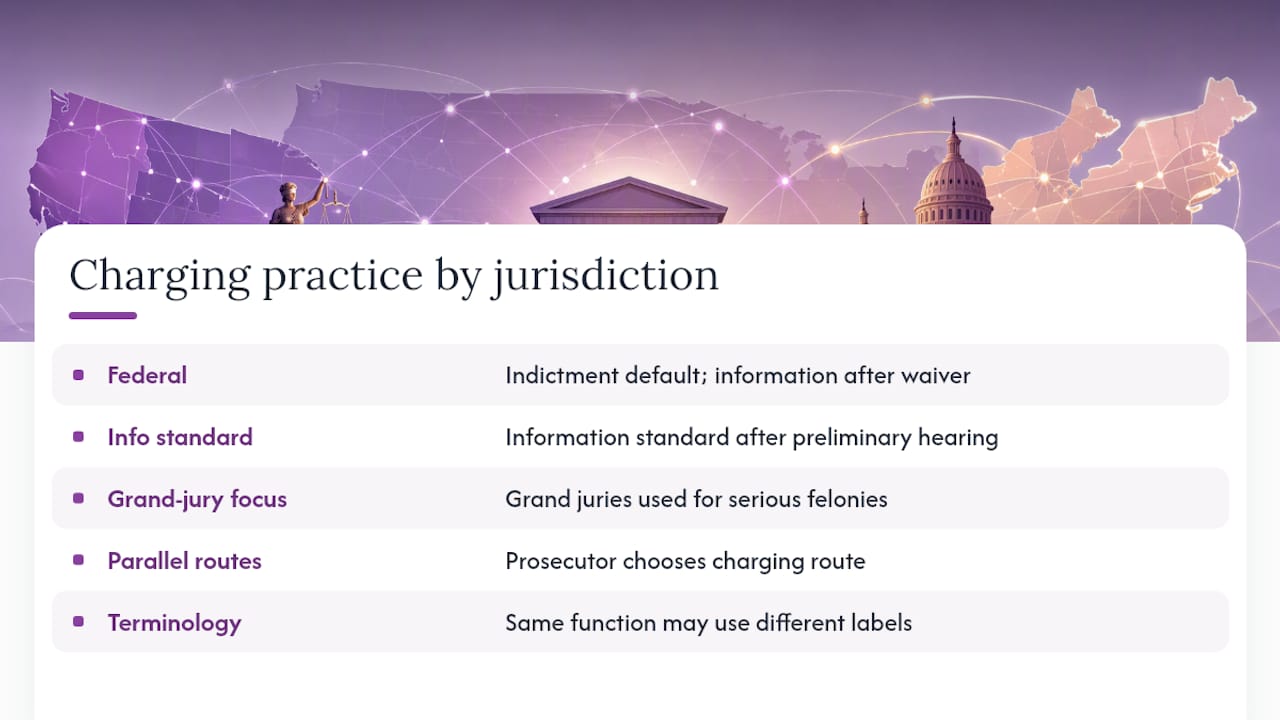
Federal court follows one clean rule: indictment by default for felonies, information only after waiver. State systems are messier, and the terminology doesn't always match what federal practitioners assume.
Some states use "information" as the standard felony charging document after a preliminary hearing, treating grand juries as the exception rather than the rule. Others lean heavily on grand juries for serious felonies while reserving informations for lower level offenses. A handful of states use both routes in parallel, letting the prosecutor choose depending on the case. Even the vocabulary shifts. What one state calls an information, another might label something closer to a felony complaint, though the underlying function stays consistent: a prosecutor filed the charge without a grand jury vote.
If you're facing charges, don't assume the process you've read about federally applies to your state case, or vice versa. A tax attorney handling an IRS dispute faces a different charging framework entirely than someone charged with a state drug offense, and even neighboring states can diverge sharply on when a grand jury gets involved. Anyone trying to understand what a prosecutor's office actually does at the state level will find that charging authority and terminology shift from one jurisdiction to the next.
How Often Each Path Actually Gets Used
Grand juries return indictments in the overwhelming majority of cases prosecutors bring to them. That's not because the process is a rubber stamp; it's because prosecutors generally don't present a case to a grand jury unless they already believe the evidence clears the probable cause bar, and that threshold is comparatively low next to a trial standard. Declined indictments happen, but they're the exception, not the norm.
Informations, meanwhile, dominate the misdemeanor caseload nationally and make up a meaningful share of felony filings in states that don't require grand jury review for most offenses. Federal informations cluster heavily around cases where cooperation or plea negotiation started before any charge was filed, since the whole point of the waiver is to move fast once terms are settled.
What's harder to pin down is a single national ratio, because charging practice is set state by state and even office by office within the federal system. Some U.S. Attorney's offices lean on grand juries for nearly everything above misdemeanor level. Others use informations more liberally in cases where cooperation is already locked in. The honest takeaway isn't a clean percentage. It's that the mix depends heavily on the jurisdiction, the office, and whether a deal was already on the table before charges were filed.
Your Rights and Options Before Trial Even Starts
The charging document you're facing doesn't just set the tone, it sets the clock. If you're indicted, your case has already cleared a grand jury's probable cause review, which can limit certain pretrial challenges to the sufficiency of the charge. If you're proceeding by information, you likely still have a preliminary hearing right unless you've waived it, and that hearing is your first real shot at testing the government's evidence in front of a judge.
Either path preserves your right to challenge the charging document itself under Rule 7 if it's not specific enough, or to request a bill of particulars when the facts alleged are too vague to prepare a defense. Discovery obligations attach regardless of which document started the case, though the practical timing often differs since informations move through the system faster.
Bail, detention hearings, and the overall pace toward arraignment and trial don't change based on which document charged you. What changes is how much runway your defense had before that document existed. A grand jury proceeding gives the government weeks or months to build its case in private. A waived information can compress that same runway into days, which is exactly why the waiver decision deserves scrutiny before anyone signs off on it.
When a Waiver Makes Sense, and When It Doesn't
Some criminal defense attorneys use waivers strategically when a client's cooperation timeline genuinely benefits from moving fast, locking in favorable plea terms before the government's position hardens. That approach works when the trade is clear and the client understands exactly what's being given up.
Caution is warranted when a waiver gets pushed as a shortcut under pressure, before defense counsel has had time to evaluate whether the grand jury might actually decline to indict. Losing that citizen review permanently isn't a decision to rush. Early involvement from experienced counsel is what separates a waiver that helps from one that simply speeds up a bad outcome.
— Jake
Talk to Rubin Law Before You Decide Anything
An experienced criminal defense law firm is worth considering when you're facing a waiver decision, a preliminary hearing, or an indictment that just got unsealed. Firms with frequent courtroom appearances and familiarity with local judges and prosecutors can provide advice on timing, cooperation, and plea strategy based on watching similar decisions play out in local courts.

A consultation with Rubin Law starts with a straight review of your charging document, whether it's an indictment, an information, or a complaint, and a plain explanation of what your realistic options actually are. If you're weighing a grand jury waiver, exploring diversion, or trying to understand what happens at your upcoming arraignment, that's the conversation to have before you agree to anything. Rubin Law also handles matters ranging from drug offenses to domestic violence charges throughout Los Angeles County. Reach out and get your case reviewed before your next court date.
This article is general information, not a substitute for advice from a qualified lawyer. Consult a qualified legal professional about your own circumstances before acting on anything here.
Sources
- Criminal Resource Manual 205 — When indictment required (U.S. Department of Justice)
- Federal Rules of Criminal Procedure — Rule 7 (govinfo)