
A federal grand jury subpoena is a court-issued command that requires you to testify, produce documents, or both in connection with a federal criminal investigation. Ignoring it is not an option. Noncompliance can result in civil or criminal contempt, and the subpoena itself often signals that federal prosecutors have already built a significant portion of their case.
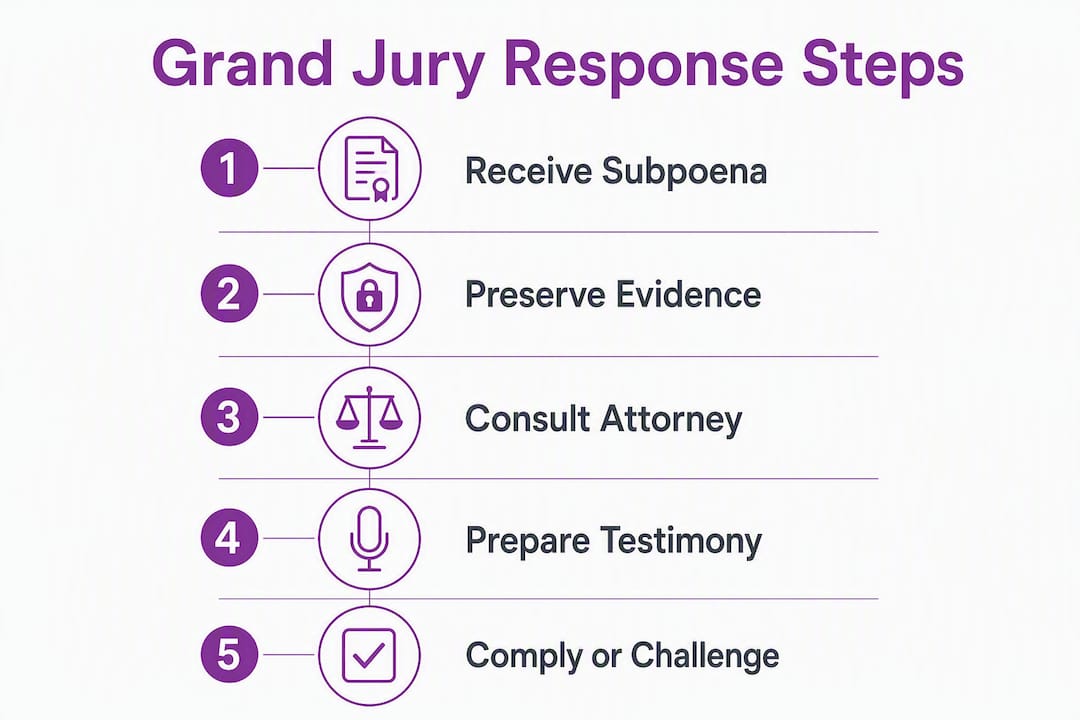
If you just received one, take these three steps immediately:
- Preserve everything. Stop any scheduled document destruction, suspend auto-delete settings, and do not wipe devices. Destroying materials after receiving a subpoena can constitute obstruction.
- Do not speak to federal agents without counsel present. Anything you say can be used against you or others in the investigation. Agents may approach you informally; decline politely and refer them to your attorney.
- Contact an experienced federal criminal defense attorney today. Not next week. The return date on the subpoena may be closer than you think, and the window for filing a motion to quash or negotiating a narrowed scope is short.
"Being named a target in a federal grand jury investigation typically means the government has substantial evidence indicating your potential involvement. Early counsel is not a precaution — it is your most effective defense tool at this stage." Source: DOJ Justice Manual, 9-11.000 Grand Jury
Table of Contents
- What is a federal grand jury and why does Rule 6(e) secrecy matter?
- What does a grand jury subpoena actually demand?
- Are you a witness, subject, or target?
- How to respond when you receive a grand jury subpoena
- What happens when you testify before a grand jury?
- Can you challenge or limit a grand jury subpoena?
- What are the consequences of not complying?
- What happens after you comply?
- How early counsel changes the outcome
- Key Takeaways
- The urgency most people underestimate
- Rubin Law, P.C. can help you respond to a federal subpoena
- Authoritative sources for further reading
What is a federal grand jury and why does Rule 6(e) secrecy matter?
A federal grand jury is a panel of citizens convened by a federal court to determine whether probable cause exists to indict someone for a federal crime. It is not a trial. No judge presides over the questioning, no defense attorney participates in the proceedings, and the standard of proof is far lower than "beyond a reasonable doubt." The grand jury's role is investigatory: it hears evidence presented by the government and decides whether to issue a "true bill" (an indictment) or a "no bill" (a decision not to charge).
That distinction matters for strategy. Because grand jury hearings are non-adversarial and the government presents evidence without defense participation, your attorney cannot walk into the grand jury room and challenge witnesses or cross-examine testimony. Defense work at this stage happens outside the room, through privilege assertions, motions practice, and negotiation with prosecutors.
The secrecy rule and what it means for you
Rule 6(e) of the Federal Rules of Criminal Procedure makes grand jury proceedings, records, and orders presumptively secret. Grand jurors, government attorneys, court reporters, and interpreters are all bound by this secrecy obligation. Courts have imposed civil and criminal sanctions for unauthorized disclosures, and some circuits treat violations seriously.
Practically, this affects you in two ways. First, you generally cannot discuss the subpoena with others who are not your attorney, and you should assume that any conversation you have about it could reach the government. Second, the secrecy cuts both ways: you will not know what evidence the grand jury has already seen, which makes it harder to assess your exposure without experienced counsel reviewing the subpoena's scope and the investigation's context.
Local district practices vary. Some districts are more aggressive about enforcing secrecy obligations; others are more permissive about what prosecutors will share informally with defense counsel. That local knowledge is one reason a firm with federal courtroom experience in your district is worth more than a generalist.
What does a grand jury subpoena actually demand?
There are two types, and knowing which one you received changes everything about how you respond.
Subpoena ad testificandum: the order to testify
This subpoena commands you to appear before the grand jury and answer questions under oath. You are not charged with anything. You are being called as a witness. But the questions asked, and your answers, can directly shape whether you or someone else is indicted. The subpoena will specify a date, time, and location for your appearance.

Subpoena duces tecum: the order to produce records
Governed by Rule 17(c) of the Federal Rules of Criminal Procedure, this subpoena commands you to produce documents, records, or other tangible items. Common requests include financial records, bank statements, emails, text messages, business contracts, accounting files, and associated metadata. The subpoena may be returnable directly to the grand jury or to a specific government attorney.
| Feature | Subpoena Ad Testificandum | Subpoena Duces Tecum (Rule 17(c)) |
|---|---|---|
| What it demands | Live testimony under oath | Documents, records, or tangible items |
| Where you appear | Grand jury room | May produce to grand jury or government counsel |
| Privilege issues | Fifth Amendment, attorney-client | Attorney-client, work product, Fifth Amendment (act of production) |
| Key challenge grounds | Scope of questioning, immunity | Overbreadth, burden, relevance, privilege log |
| Immediate action | Prepare with counsel; assert privileges question-by-question | Preserve all responsive materials; prepare privilege log |
The DOJ Justice Manual imposes special handling rules for certain categories of subpoenas. Subpoenas targeting attorneys or members of the news media require prior internal DOJ approval before they can be issued. Financial records subpoenas carry additional procedural requirements. If your subpoena falls into one of these categories, that procedural context can become a defense argument.
Federal grand jury subpoenas can be served anywhere in the United States. Evidence located overseas requires separate legal processes, including ECPA procedures or Mutual Legal Assistance Treaty (MLAT) requests, and counsel should coordinate preservation notices with foreign custodians immediately.
Pro Tip: If your documents are stored in cloud services or on third-party servers, your attorney should send preservation notices to those custodians right away. Failure to preserve cloud data after receiving a subpoena can expose you to spoliation or obstruction charges, even if you never personally deleted a file.
Are you a witness, subject, or target?
Your legal status in the investigation determines how much risk you face and what your defense strategy should look like. The DOJ Justice Manual defines three categories.
Witness. You have information relevant to the investigation, but the government does not currently consider you a suspect. You are being called to provide evidence about someone or something else. That said, witness status is not permanent. Answers you give can shift your status quickly.
Subject. Your conduct falls within the scope of the grand jury's investigation. You are not yet a target, but the government is looking at you. Subjects occupy the most ambiguous position: they have more exposure than witnesses but have not yet been formally identified as likely defendants.
Target. The government has substantial evidence indicating your involvement in a crime and considers you a likely defendant. If you receive a subpoena as a target, prosecutors are typically required to notify you of that status and advise you of your rights. A federal target letter often accompanies or precedes a target subpoena.
The practical difference is stark. A witness who testifies truthfully and completely may walk away with no further involvement. A target who testifies without counsel's guidance risks providing the government with exactly the evidence it needs for an indictment. Subjects sit in between: they may benefit from asserting the Fifth Amendment on specific questions while cooperating on others, depending on the investigation's direction.
If you are unsure of your status, ask your attorney to contact the government attorney handling the matter. The government is not required to tell you your status in every circumstance, but experienced counsel can often get a candid answer that shapes the entire defense approach.
How to respond when you receive a grand jury subpoena
Speed matters. Here is the sequence to follow from the moment the subpoena arrives.
- Read the subpoena carefully. Note the return date, the issuing court, the type of subpoena (testimony, documents, or both), and the specific requests. A "forthwith" subpoena demands immediate compliance; a standard returnable date gives you more time, but not much.
- Preserve all potentially responsive materials immediately. This means suspending any document-destruction policies, disabling auto-delete on email accounts, and issuing a litigation hold to anyone in your organization who may have relevant records. Do this before you do anything else.
- Do not contact the investigating agents or prosecutors directly. Direct all inquiries to your attorney. Unsupervised conversations with federal agents, even casual ones, can create statements that are later used against you.
- Retain federal criminal defense counsel. Bring the subpoena, any cover letter, and any prior communications with federal agents to your first meeting.
- Index the document requests. Work with your attorney to map each numbered request paragraph to the categories of documents you hold. This is the foundation of your privilege log and your production.
- Separate responsive from privileged materials. Do not produce attorney-client communications, work-product materials, or documents protected by other privileges. Your attorney will prepare a privilege log identifying withheld documents by category without revealing their contents.
- Assess whether a motion to quash or a protective order is warranted. If the subpoena is overbroad, unduly burdensome, or seeks privileged materials, your attorney may file a motion or negotiate a narrowed scope with the government.
Pro Tip: Never produce original documents without retaining copies. Bates-stamp every page you produce so you have a complete record of exactly what was turned over and when.
The subpoena's return date is the deadline by which you must comply or file a challenge. Missing it without a valid legal basis or a negotiated extension puts you at risk of contempt sanctions. Courts take these deadlines seriously.
| Document Type | Preservation Action | Privilege Risk |
|---|---|---|
| Emails and attachments | Suspend auto-delete; preserve server-side copies | Attorney-client if with counsel |
| Financial records | Freeze accounting files; notify bookkeeper | Generally not privileged |
| Text messages and chats | Preserve device; disable cloud sync deletion | Varies by content |
| Cloud storage | Send preservation notice to provider | Work product if litigation-related |
| Physical documents | Secure originals; restrict access | Attorney-client if with counsel |
For guidance on responding to a subpoena step by step, regional legal resources can supplement your attorney's advice, though federal procedure governs your situation.
What happens when you testify before a grand jury?
Walking into a grand jury room without understanding the procedure is one of the most common mistakes witnesses make. The setting is unfamiliar, the questioning can feel aggressive, and the absence of a judge means there is no one to rule on objections in real time.
How the session runs
You will be placed under oath. A government attorney, typically an Assistant U.S. Attorney, will question you. Grand jurors may also ask questions, though this is less common. There is no judge present. There is no opposing counsel. The proceeding is recorded by a court reporter.
The grand jury's non-adversarial structure means the government controls what evidence the jury sees. Your attorney cannot object to questions, cross-examine other witnesses, or present evidence on your behalf during the session itself.
Counsel access: the outside-the-room rule
You do not have the right to have your attorney sit beside you in the grand jury room. This is a firm rule. What you do have is the right to step outside and consult with counsel before answering any question. You can request a break at any point. Experienced witnesses use this right liberally, particularly when a question touches on sensitive areas or when the scope of a question is unclear.
CRS materials confirm this outside-consultation practice is standard and expected. Do not let a government attorney pressure you into answering before you have had a chance to confer with your lawyer.
Asserting the Fifth Amendment
The Fifth Amendment protects you from being compelled to give testimony that incriminates yourself. In a grand jury setting, you can assert this privilege on a question-by-question basis. You must appear when subpoenaed; a blanket refusal to show up at all is not protected and can trigger enforcement. But once you are in the room, you may decline to answer specific questions by invoking the privilege.
The Federal Grand Jurors' Handbook makes clear that a witness asserting the Fifth must do so carefully. A blanket refusal to answer everything, without counsel's guidance on which questions actually implicate self-incrimination, can waive the privilege on questions where it would otherwise apply. Invoke it question-by-question, with counsel's input during breaks.
Immunity
If the government wants your testimony and you have asserted the Fifth, prosecutors can seek a court order compelling your testimony in exchange for immunity. Use immunity (sometimes called derivative-use immunity) protects you from the government using your compelled testimony or its fruits against you directly. Transactional immunity is broader, covering the entire transaction you testify about. Immunity does not protect you from prosecution based on independently obtained evidence, and it does not protect you from perjury charges if you lie.
Can you challenge or limit a grand jury subpoena?
Yes, but the odds of a full quash are lower than most people expect. Courts give grand jury subpoenas broad deference. That said, Rule 17(c) explicitly authorizes courts to quash or modify a subpoena if compliance would be unreasonable or oppressive, and there are real grounds that succeed.
Common grounds for a motion to quash or modify:
- Overbreadth and lack of particularity. A subpoena that demands "all documents relating to any financial transaction" without a defined time period or subject matter is vulnerable. Courts require reasonable specificity.
- Undue burden. Producing millions of documents at enormous cost, on short notice, can support a motion to modify the scope or extend the return date.
- Privilege. Attorney-client communications and work-product materials are not producible. A motion to quash specific requests, backed by a privilege log, is often the right vehicle.
- Venue and forum issues. Subpoenas must comply with service rules; defects in service or venue can support a challenge.
- Illegally obtained evidence. If the subpoena is based on evidence obtained through an unconstitutional search or seizure, that can be grounds to challenge the subpoena's foundation, though this argument is harder to win at the grand jury stage.
The more practical path in most cases is negotiated narrowing. Prosecutors often prefer a cooperative production to a contested motion, and a well-drafted letter from defense counsel proposing a narrowed scope can achieve more than a motion that the court denies. Protective orders are another tool, particularly when the subpoena seeks sensitive business or personal information that could cause harm if disclosed.
Timing is critical. File promptly. A motion to quash filed after the return date, without a prior extension, is likely to be denied as moot.
The DOJ Justice Manual also requires special internal approvals before subpoenas targeting attorneys or journalists can issue. If you fall into one of those categories, that procedural requirement is a separate line of challenge.
What are the consequences of not complying?
Flat refusal without a valid legal basis is one of the worst decisions a subpoena recipient can make. The enforcement tools available to federal courts are serious.
Civil contempt is the more common sanction for noncompliance with a document subpoena. A court can order you confined until you comply. There is no fixed sentence; you hold the key to your own release by producing the materials. Civil contempt is coercive, not punitive.
Criminal contempt is punitive. It carries fines and a fixed term of imprisonment. Criminal contempt is typically reserved for willful, deliberate defiance of a court order, not for good-faith privilege disputes. But the line between the two is not always clear, and prosecutors have discretion.
Perjury and false statements. If you testify before a grand jury and lie, you face federal perjury charges under 18 U.S.C. § 1621 and false-statement liability under 18 U.S.C. § 1001. These are separate federal crimes, prosecuted independently of whatever the grand jury was investigating. Grand jury perjury prosecutions are real and they happen.
The CRS analysis of federal grand jury practice confirms that witnesses subpoenaed to a grand jury may be held in civil or criminal contempt for unjustified failure to comply. "Unjustified" is the operative word. A valid privilege assertion, properly documented and presented to the court, is not contempt. Silence without any legal basis is.
The practical message: assert your rights through proper legal channels. Do not simply refuse to show up or refuse to produce documents without a privilege log and a motion on file.
What happens after you comply?
Compliance with a grand jury subpoena is rarely the end of the matter. Here is a realistic picture of what comes next.
Federal investigations run on their own timeline. An investigation can last weeks, months, or years. After your production or testimony, you may receive follow-up subpoenas for additional documents, requests for voluntary interviews, or nothing at all for an extended period. The grand jury process is not linear.
After the investigation phase, the grand jury votes. A majority vote to indict produces a "true bill," which becomes a formal indictment. A vote against indictment produces a "no bill," and the matter ends there, at least for now. The government can re-present evidence to a new grand jury if circumstances change.
If an indictment issues, the defendant is arraigned and the case moves into the adversarial phase of federal criminal proceedings, where defense counsel can fully participate. This is when constitutional challenges to search and seizure, suppression motions, and other pretrial motions come into play.
Pre-file intervention is worth discussing with your attorney before any of this happens. If you are a subject or target, your attorney may be able to approach the prosecutor before an indictment is returned to present exculpatory evidence, propose alternative resolutions, or negotiate cooperation terms. This window closes once an indictment issues. Pre-trial diversion programs may also be available in appropriate cases, particularly for first-time offenders in certain categories of federal cases.
The timeline after compliance also includes the possibility of being called back. A single production does not immunize you from further subpoenas if the investigation expands or new evidence surfaces. Maintaining a litigation hold and keeping your attorney engaged is the right posture throughout.
How early counsel changes the outcome
The grand jury process is non-adversarial by design, which means your attorney cannot walk into the room and fight for you in real time. What counsel can do, starting the day the subpoena arrives, is substantial.
Here is what an experienced federal defense attorney does immediately:
- Issues a litigation-hold letter to all custodians of potentially responsive materials, stopping any destruction and documenting the preservation effort.
- Reviews the subpoena paragraph by paragraph to identify overbroad requests, privilege issues, and potential grounds for a motion to quash or modify.
- Contacts the government attorney to assess the investigation's scope, your client's status, and whether a negotiated narrowing is possible.
- Prepares a detailed privilege log tied to each subpoena paragraph, identifying withheld documents by category without revealing privileged content.
- Coordinates forensic preservation of electronic evidence, including cloud data and third-party custodians, to prevent spoliation claims.
- Advises on Fifth Amendment strategy before any testimony session, including which questions to answer and which to decline.
- Files a motion to quash or for a protective order when the legal grounds are strong enough to justify the effort.
- Pursues pre-file intervention with prosecutors when the client is a subject or target and exculpatory evidence or mitigating circumstances exist.
Rubin Law, P.C. handles federal criminal defense matters including fraud, drug trafficking, RICO, and money laundering investigations, all of which commonly involve grand jury subpoenas. The firm's courtroom experience in Los Angeles federal courts and its familiarity with local prosecutorial strategies shapes every tactical decision at this stage. Early engagement is not about slowing the process down. It is about controlling what the government sees, preserving every appellable error, and keeping the door open to outcomes short of indictment.
Key Takeaways
A federal grand jury subpoena demands an immediate, legally informed response: preserve all materials, assert privileges through proper channels, and retain federal criminal defense counsel before the return date passes.
| Point | Details |
|---|---|
| Preserve immediately | Stop all document destruction and suspend auto-delete settings the moment you receive the subpoena. |
| Know your status | Witness, subject, and target carry very different risk levels; ask your attorney to determine your status early. |
| Counsel access at testimony | You cannot bring your attorney into the grand jury room, but you may step out to consult before answering any question. |
| Challenge options exist | Rule 17(c) allows courts to quash or modify subpoenas that are overbroad, unduly burdensome, or seek privileged materials. |
| Rubinlawpc's role | Rubin Law, P.C. provides immediate federal defense intake, litigation-hold steps, privilege review, and pre-file intervention for subpoena recipients in Los Angeles. |
The urgency most people underestimate
Most people who receive a federal grand jury subpoena spend the first 48 hours trying to figure out whether it is serious. It is. Every hour spent in that uncertainty is an hour the government is not spending in uncertainty.
The conventional advice is "get a lawyer." That is right, but it understates the point. What you actually need is an attorney who contacts the AUSA handling the matter, reads the subpoena against the investigation's known scope, and makes a tactical decision about whether to produce, assert privileges, negotiate, or file a motion, all before the return date. That sequence takes time, and the return date does not move because you were slow to act.
There is also a subtler risk that most guides skip over. Witnesses who cooperate fully and honestly sometimes inadvertently provide the government with the final piece of evidence it needed to indict someone else, or themselves. Truthful testimony is required. But the scope of what you are asked, and how you answer, can be shaped by counsel in ways that protect you without crossing into obstruction. That shaping only happens if your attorney is involved before you walk into the room.
The other thing worth saying plainly: grand jury subpoenas are not always the prelude to indictment. Many investigations end with no bill. Many witnesses testify and are never charged. Early, competent defense work increases the odds of that outcome significantly, by narrowing what the government receives, preserving your credibility, and keeping pre-file options open. The goal is not to fight the subpoena for its own sake. The goal is to manage your exposure intelligently from day one.
Rubin Law, P.C. can help you respond to a federal subpoena
Receiving a federal grand jury subpoena while trying to understand your legal exposure on your own puts you at a serious disadvantage. Rubin Law, P.C. offers immediate intake for subpoena recipients, with same-day review of the subpoena's scope, status assessment, and a litigation-hold plan in place before you leave the first consultation.
The firm handles the full sequence: privilege review, document indexing, communication with the government attorney, and, when the grounds exist, motions to quash or negotiate a narrowed production. Federal defense work in Los Angeles requires knowing how local AUSAs approach investigations and how federal judges in the Central District handle privilege disputes. That local knowledge is built into every step Rubin Law, P.C. takes on your behalf.
To prepare for your consultation, bring the subpoena itself, any cover letter or accompanying documents, a list of the records or devices that may be responsive, and a brief timeline of any prior contact with federal agents. The earlier you call, the more options remain available.
Contact a Los Angeles federal criminal defense attorney at Rubin Law, P.C. before the return date passes.
This article provides general legal information, not legal advice. Laws and procedures vary by jurisdiction and individual circumstances. Consult a qualified federal criminal defense attorney to evaluate your specific situation.
Authoritative sources for further reading
The following primary sources and official publications back the guidance in this article and are worth consulting directly:
- Federal Rules of Criminal Procedure, Rule 6(e) — Confidentiality of Proceedings: The controlling rule on grand jury secrecy, disclosure exceptions, and enforcement.
- Federal Rules of Criminal Procedure, Rule 17 — Subpoena: The procedural rule governing all federal subpoenas, including the authority to quash or modify.
- DOJ Justice Manual, 9-11.000 Grand Jury: The Department of Justice's internal policies on grand jury practice, including special-category subpoenas and target notification.
- Handbook for Federal Grand Jurors — U.S. Courts: The official procedural handbook explaining the grand jury's role, voting process, and how sessions are conducted.
- The Federal Grand Jury — Congressional Research Service: A thorough CRS analysis of grand jury law, contempt powers, and witness rights.
- Federal Grand Juries: The Law in a Nutshell — CRS: A concise CRS overview of Rule 17(c) challenges, quash standards, and subpoena scope limits.
- Secret Justice: Grand Juries — Reporters Committee for Freedom of the Press: Documents how courts have enforced Rule 6(e) secrecy and sanctioned disclosures.