
California law requires an ignition interlock device (IID) for most DUI convictions, and in many cases the device can replace a hard license suspension entirely. Under California Vehicle Code §23575.3, a court must notify any person convicted of a qualifying DUI offense that they are required to install a functioning, certified IID on every vehicle they operate. The IID requirements California imposes depend on your offense category, whether injury was involved, and how many prior DUI convictions appear on your record within the past 10 years.
Here are the typical minimum installation periods by offense:
- First DUI, no injury: Six months (IID may replace suspension under the statewide pilot program)
- First DUI with injury: One year mandatory IID
- Second DUI within 10 years: One year mandatory IID
- Third DUI within 10 years: Two years mandatory IID
- Fourth or subsequent DUI within 10 years: Three years mandatory IID
- DUI with injury, second or subsequent offense: Three years mandatory IID
TL;DR: For a first-offense DUI without injury, installing an IID often lets you drive immediately rather than serving a hard suspension. For injury-involved or repeat offenses, the IID is mandatory regardless of whether your license is also suspended. Recent legislative changes through 2026 have extended and clarified the mandates for repeat and injury-involved offenders.
Table of Contents
- When California law requires an IID by conviction type
- How to get an IID installed and what it does to your driver's license
- Who can install an IID in California and what it actually costs
- What counts as an IID violation and the legal consequences
- IID exemptions, medical exceptions, and restricted license alternatives
- Moving, traveling, and what happens to an IID if you leave California
- How IID data is collected, reported, and used by courts and the DMV
- Lawyer-reviewed next steps: how Rubin Law recommends handling IID orders and violations
- Key Takeaways
- Why legal help with IID orders matters more than most drivers expect
- Rubin Law handles IID orders, violations, and DUI defense in Los Angeles
- Primary sources and further reading
When California law requires an IID by conviction type
The statutory trigger is conviction, not arrest. The court issues the IID order at sentencing, and the DMV enforces it through your driving record and reinstatement process.
First DUI without injury is where the pilot program matters most. Under the statewide IID pilot program, a first-time offender who installs a certified IID can often drive without restriction during the IID period instead of serving a four-month hard suspension. That is a significant practical difference: you keep your job, your commute, and your independence.
First DUI with injury under VC §23153 carries a one-year mandatory IID period. There is no pilot-program workaround here. The device is required on every vehicle you operate, and the DMV will not reinstate your license without proof of installation.
Second DUI within 10 years triggers a one-year mandatory IID. The 10-year lookback period is calculated from arrest date to arrest date, not conviction to conviction. If you are facing a second offense, the penalties escalate sharply beyond the IID requirement itself.
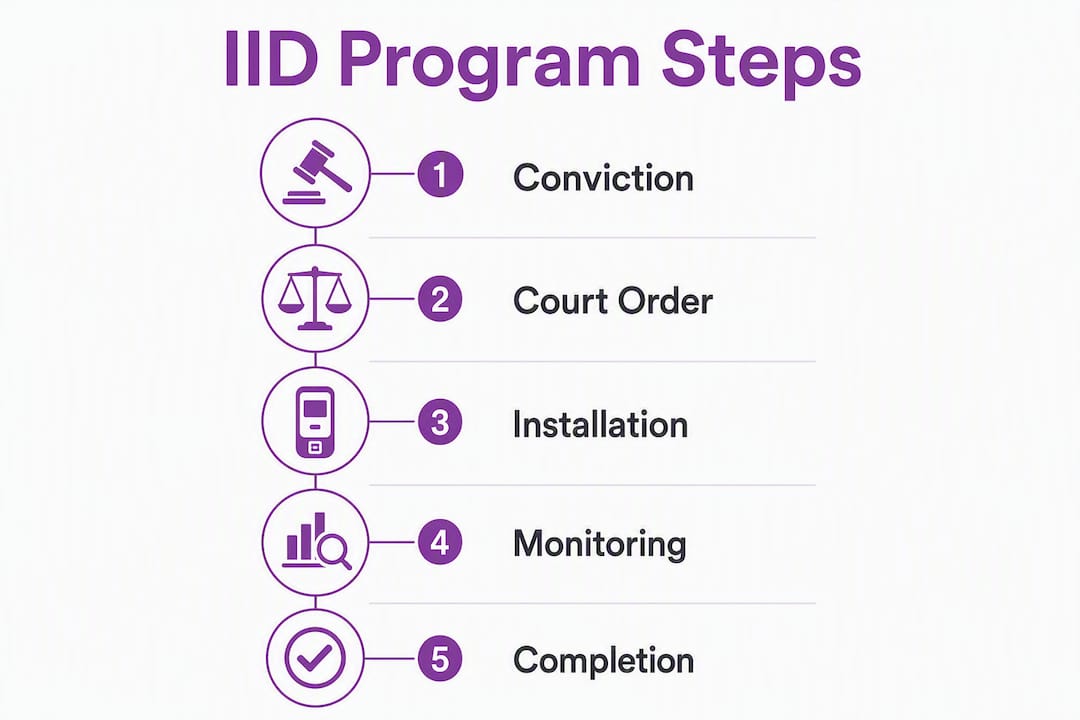
Third and fourth offenses carry two-year and three-year IID mandates respectively. At this level, the DMV treats the IID as a long-term condition of any driving privilege, and courts frequently impose additional probation conditions that interact with the device requirement.
Commercial drivers face a separate and harsher track. A first DUI conviction while operating a commercial vehicle triggers a one-year disqualification from a commercial driver's license (CDL), and a second conviction results in lifetime CDL disqualification. The IID requirement applies to personal vehicles during any period when a personal license is reinstated.
| Offense | Minimum IID Period | Notes |
|---|---|---|
| 1st DUI, no injury | 6 months | May replace hard suspension under pilot program |
| 1st DUI with injury | 12 months | Mandatory; no pilot-program substitution |
| 2nd DUI within 10 years | 12 months | Mandatory on all operated vehicles |
| 3rd DUI within 10 years | 2 years | Mandatory; probation conditions often apply |
| 4th+ DUI within 10 years | 3 years | Mandatory; habitual offender status possible |
| 2nd+ DUI with injury | 3 years | Mandatory; enhanced penalties apply |
How to get an IID installed and what it does to your driver's license
Getting the device installed is a multi-step administrative process. Missing one document or paying fees in the wrong order can delay your reinstatement by weeks.
- Obtain the court order. At sentencing, the court issues a written IID order. Keep a certified copy. You will need it at the installer and at the DMV.
- Choose a BAR-licensed installer. The Bureau of Automotive Repair (BAR) licenses IID installers in California. Only a BAR-licensed provider can install a device that the DMV will accept. The DMV maintains a list of approved manufacturers and their authorized service centers.
- Get the DL-920 form completed. After installation, the provider fills out DL-920 (Verification of Installation), which confirms the device is certified and properly installed. This form goes to the DMV.
- File an SR-22. Your auto insurer must file an SR-22 certificate of financial responsibility with the DMV. No SR-22, no reinstatement. Period.
- Pay DMV fees. The DMV requires various reissue, restriction, and administrative fees before it will reinstate your driving privilege. Pay these before submitting your paperwork.
- Submit all documents to the DMV. Send the DL-920, proof of SR-22, court order, and fee receipts together. Incomplete submissions are rejected and restart the clock.
How the IID affects your license status:
- Under the pilot program, a first-offense driver who installs an IID can receive an IID-restricted license that allows driving any vehicle equipped with a functioning device, rather than serving a hard suspension.
- For mandatory IID cases (injury, repeat offenses), the device does not lift the suspension. It is a condition of reinstatement after the suspension period ends.
- A restricted license without an IID (the old "work-only" restriction) is generally no longer available for DUI offenses that fall under the IID mandate.
Pro Tip: Before submitting your reinstatement package, call the DMV to confirm there are no other outstanding holds on your record. A separate administrative suspension from a DMV hearing, an unpaid fine, or a failure-to-appear can block reinstatement even after you have installed the IID and paid all fees. Resolve every hold first.
Who can install an IID in California and what it actually costs
BAR licensing is the gating requirement. An installer who is not BAR-licensed cannot produce a DL-920 the DMV will accept, which means the installation is legally worthless regardless of how well the device works.
How to verify an installer:
- Ask the provider for their BAR license number and verify it on the BAR website before scheduling.
- Confirm the device manufacturer is on the DMV's approved IID manufacturer list.
- Ask whether the location handles DL-920 submission directly or whether you must deliver it yourself.
- Ask about vehicle compatibility upfront. Newer vehicles with complex wiring or push-button ignitions can require special installation procedures and cost more.
What you will actually pay:
A realistic all-in 12-month IID program commonly reaches $1,500 to $2,000 once every cost component is counted. The advertised monthly rate is just one piece.
| Cost Component | Typical Range |
|---|---|
| Installation fee | $70 (one-time) |
| Monthly device lease | $70/month |
| Calibration visits (every 30 days) | Included or $20/visit |
| Removal fee | $50 (one-time) |
| SR-22 insurance premium increase | Varies by insurer |
| 12-month program total (estimated) | $1,500–$2,000 |
California operates an income-based financial assistance program tied to the federal poverty level. Discount tiers range from 10% of device cost for drivers at or below 100% of the federal poverty level up to 90% of device cost for drivers at 301–400% of the federal poverty level. The DMV and your provider typically handle the application during intake, but you need to bring documentation of your income.
Some providers will process court-issued assistance documentation directly, which simplifies the paperwork considerably. Ask at intake whether the provider handles this or whether you need to submit separately.
Pro Tip: Never book based on the advertised monthly rate alone. Ask for a written, itemized quote that includes installation, all calibration visits, removal, and any administrative fees. Some flat-rate providers bundle everything; others charge separately for each calibration. The difference can add hundreds of dollars over a 12-month program.
What counts as an IID violation and the legal consequences
The device logs everything. Every start attempt, every failed breath test, every missed calibration, and every circumvention indicator goes into a record that courts and the DMV can access. Thinking you can beat the system is a serious miscalculation.
Behaviors that constitute violations under California law:
- Asking or allowing another person to blow into the device to start the vehicle
- Using a bypass device or any method to circumvent the IID
- Operating a vehicle that is not equipped with a functioning IID when one is required
- Lending your vehicle to someone with an IID restriction when your vehicle lacks a functioning device
- Missing scheduled calibration appointments
- Tampering with or attempting to disable the device
- Failing to install the IID within the required timeframe after a court order
California Vehicle Code §23247 makes it unlawful to lend a vehicle to a person with an IID restriction unless the vehicle has a functioning certified IID installed. Operating without a functioning device when one is required is a separate criminal and administrative offense that can trigger immediate suspension or revocation and additional fines or imprisonment.
California Vehicle Code §23247 states: It is unlawful for any person to knowingly rent, lease, or lend a motor vehicle to a person who the lending person knows is required to have a functioning ignition interlock device installed on that vehicle, unless the vehicle is equipped with a functioning, certified ignition interlock device. A violation of this section is a misdemeanor.
Penalties for violations:
- Immediate termination of IID driving privilege by the DMV
- Extension of the IID requirement period
- Suspension or revocation of driving privileges
- Possible misdemeanor criminal charges with fines and potential jail time
- Probation violation proceedings if the IID was a condition of probation
If your device logs an event or you receive a violation notice:
- Contact a motorcycle accident legal help attorney immediately. Do not wait.
- Preserve all records: calibration receipts, provider reports, any communication with the installer.
- Do not attempt to explain the event to the DMV or court without counsel. Device logs can be challenged, but only with the right documentation and legal strategy.
- Request a copy of the device's event log from your provider as soon as possible.
A DUI probation violation triggered by an IID event carries consequences that extend well beyond the IID program itself. Courts treat circumvention as a direct challenge to the terms of probation, and judges respond accordingly.
IID exemptions, medical exceptions, and restricted license alternatives
Exemptions exist, but the criteria are strict and the deadline is unforgiving. Most people who think they qualify do not.
The DL-4062 exemption criteria:
To qualify for an IID exemption under DMV Form DL-4062, you must meet all three of the following conditions simultaneously:
- You do not own a vehicle
- You do not have access to a vehicle at your residence
- You did not have access to the vehicle involved in the arrest
The form must be postmarked within a strict deadline of a month after the suspension or revocation notice. Late submissions are denied without exception. If you gain access to a vehicle at any point after the exemption is granted, the exemption terminates immediately and you must install an IID before driving.
Medical exemptions are narrow. A documented medical condition that physically prevents you from providing a breath sample may support an exemption request, but the DMV requires physician documentation and evaluates each case individually. This is not a loophole; it is a genuine hardship provision for people with respiratory conditions or similar issues.
Out-of-state residency can support an exemption request if you have genuinely relocated and can demonstrate you have no access to a vehicle in California. However, your California license restrictions remain in effect until California formally clears the underlying suspension. Moving out of state does not erase the IID requirement.
Restricted licenses as an alternative: For some offense categories, a restricted license that limits driving to work, school, and DUI program attendance may be available. However, for offenses that fall under the mandatory IID mandate, the restricted license typically requires IID installation rather than replacing it.
Pro Tip: If you gain access to a vehicle after receiving an exemption, even temporarily, you must notify the DMV and arrange IID installation before driving. Driving without an IID after your exemption has terminated is treated the same as any other IID violation.
Moving, traveling, and what happens to an IID if you leave California
Your California IID obligation does not end at the state line. The underlying suspension or restriction on your California driving record remains until California formally reinstates your license, regardless of where you live.
If you are moving out of state:
- Notify the DMV of your change of address.
- Determine whether you qualify for an out-of-state exemption under DL-4062 criteria (no vehicle access at new residence, no owned vehicle).
- Understand that most states have entered into the Driver License Compact, which means your new state's DMV will likely see your California suspension and may impose its own restrictions.
- If you obtain a license in another state while your California license is suspended, you may face additional complications when you eventually return to California.
If you are traveling temporarily:
- Carry proof of your IID enrollment and your court order whenever you drive.
- IID rules vary by state. Some states have their own IID requirements that may apply to you as a visitor; others do not. Know the rules before you drive.
- Your California IID-restricted license is generally valid in other states for driving purposes, but the device requirement travels with you.
The risk of leaving without resolving your IID obligations:
Leaving California without completing your IID program or resolving your suspension creates a compounding problem. California will not reinstate your license until all program requirements are met, and the longer the delay, the more fees and administrative steps accumulate. Some drivers discover years later that an unresolved California suspension is blocking them from getting a license in another state.
How IID data is collected, reported, and used by courts and the DMV
The device is a continuous compliance monitor. Every interaction with it generates a timestamped log entry that your provider stores and periodically transmits to the DMV and, in many cases, directly to the court or probation department.
Types of data the device collects:
- Successful start attempts (breath test passed, vehicle started)
- Failed start attempts (breath test failed, BAC above threshold)
- Rolling retests (tests required while the vehicle is in motion)
- Lockout events (too many consecutive failures)
- Circumvention indicators (unusual patterns, tampering signals)
- Missed calibration appointments
- Power interruptions or disconnection events
Who receives compliance reports:
| Recipient | Frequency | How It Is Used |
|---|---|---|
| DMV | Monthly or at calibration | Reinstatement decisions, violation notices |
| Court | Per court order (often monthly) | Probation compliance review |
| Probation department | Per probation terms | Violation proceedings |
| Driver | On request | Dispute preparation, personal records |
What records you should keep:
- Installation receipt and DL-920 copy
- Every calibration receipt (date, location, technician)
- Provider compliance reports (request copies at each calibration)
- Any written communication from the provider about device events
- Your court order specifying the IID requirement and duration
If you need to dispute a logged event, the provider's raw data log is your starting point. Request it in writing as soon as you become aware of an issue. Providers are required to maintain these records, but retrieval becomes harder over time.
Lawyer-reviewed next steps: how Rubin Law recommends handling IID orders and violations
Whether you just received an IID order or you are dealing with an alleged violation, the steps you take in the first 72 hours matter more than most people realize.
If you just received an IID order:
- Get a certified copy of the court order and read every condition carefully.
- Contact a BAR-licensed installer within the first week. Waiting creates scheduling risk and can push your installation past any deadline the court or DMV has set.
- Gather income documentation immediately if you may qualify for financial assistance. The discount application happens at intake.
- File your SR-22 with your insurer before going to the DMV. The DMV will not process reinstatement without it.
- Submit your complete reinstatement package (DL-920, SR-22, fee receipts, court order) to the DMV in one submission. Piecemeal submissions delay the process.
- Ask your attorney whether the IID period can be challenged or shortened based on the specific facts of your case.
If you received a notice of alleged IID violation:
- Do not respond to the DMV or court without speaking to an attorney first.
- Request the device's full event log from your provider in writing, same day if possible.
- Preserve every piece of documentation: calibration receipts, provider communications, any records that establish your location or activity at the time of the alleged event.
- Understand that device logs can contain errors. Calibration failures, power interruptions, and sensor malfunctions can generate false positive readings. These are challengeable with the right evidence.
- If the violation notice involves a probation condition, treat it as a probation violation proceeding and engage counsel immediately.
Documents to request or demand:
- DL-920 reports from your provider
- Full calibration logs for the device
- The specific court order language governing your IID requirement
- Any DMV correspondence related to your driving record
When legal counsel makes the biggest difference:
Contesting a device log, seeking a hardship exemption, negotiating a shorter IID period, or challenging the underlying DUI charge all benefit from attorney involvement. The DUI laws in California create multiple procedural points where an experienced attorney can intervene. Waiting until a violation notice arrives to hire counsel often means the most valuable intervention windows have already closed.
Key Takeaways
California's IID program is mandatory for most DUI convictions, with installation periods ranging from six months to three years depending on offense history and injury involvement, and a complete reinstatement package including DL-920, SR-22, and DMV fees is required before you can legally drive again.
| Point | Details |
|---|---|
| IID periods by offense | Six months to three years depending on offense category and prior convictions within 10 years. |
| Pilot program benefit | First-offense drivers without injury can often drive immediately with an IID instead of serving a hard suspension. |
| All-in 12-month cost | Expect $1,500–$2,000 once device lease, calibration, installation, removal, and DMV fees are totaled. |
| Exemption deadline | DL-4062 must be postmarked within 30 days of the suspension notice; late submissions are denied without exception. |
| Rubin Law's role | Rubinlawpc handles IID violation challenges, exemption requests, and DUI defense in Los Angeles County. |
Why legal help with IID orders matters more than most drivers expect
The paperwork looks manageable until it is not. A missed calibration appointment, a device log event you cannot explain, or a DMV hold you did not know existed can unravel weeks of compliance work in a single afternoon. The IID program is designed to be self-executing, but the penalties for missteps are anything but forgiving.
What attorneys see repeatedly is that drivers who handle IID orders without counsel tend to underestimate two things: the number of administrative steps that must happen in the right sequence, and how aggressively the DMV and courts treat device log events. A failed rolling retest that was caused by mouthwash or a medical condition looks identical in the log to a genuine BAC reading. Without documentation and legal advocacy, the distinction rarely gets made.
The other underestimated issue is the IID period itself. Courts have discretion in some cases, and the specific facts of a DUI stop, the strength of the underlying evidence, and the presence of constitutional issues in the arrest can all affect whether the IID requirement is imposed at all or whether its duration can be reduced. Those arguments have to be made at the right time, which is usually before sentencing, not after.
Rubin Law handles IID orders, violations, and DUI defense in Los Angeles
Facing an IID order is stressful enough without navigating the DMV's reinstatement process alone. Rubinlawpc is a Los Angeles criminal defense firm that handles the full range of DUI-related legal matters, from contesting the underlying charge to challenging device log violations and pursuing financial hardship relief.
Rubinlawpc's DUI practice covers court defense, DMV hearing representation, motions to contest IID violations, and advocacy for income-based cost reductions. The firm's attorneys appear regularly in Los Angeles County courts and understand how local judges and prosecutors approach IID conditions and probation compliance. For drivers facing a first offense or a repeat DUI, early legal involvement consistently produces better outcomes than waiting until a violation notice arrives.
To speak with a Los Angeles DUI attorney about your IID order or DUI charge, contact Rubin Law, P.C. directly. Initial consultations are available for clients throughout Los Angeles County.
What to expect after contacting the firm:
- A case review focused on your specific offense category and IID timeline
- Identification of any procedural or constitutional issues in your arrest or DMV action
- Guidance on the reinstatement package and which documents to gather first
- Assessment of whether your IID period or underlying charge can be challenged or reduced
- Direct representation at DMV hearings and in court
This article provides general legal information about California IID requirements and is not a substitute for advice from a licensed attorney about your specific situation. Consult a qualified DUI defense attorney or the California DMV directly to confirm current rules and deadlines that apply to your case.
Primary sources and further reading
These are the authoritative sources to verify facts, download forms, and confirm current statutory requirements. Keep these links accessible when gathering paperwork or working with counsel.
- California Vehicle Code §23575.3: — The primary statute governing IID requirements, court notification duties, and the DMV's enforcement role. Read this before any DMV hearing.
- DMV Statewide IID Pilot Program: — The DMV's program page explaining enrollment procedures, the DL-920 form, SR-22 requirements, and reinstatement steps. Start here for procedural questions.