
A DUI hit and run in California means you drove under the influence, caused a collision, and left the scene without stopping to fulfill your legal duties. Three statutes govern the exposure: VC §23153 (DUI causing injury), VC §20001 (felony hit and run involving injury or death), and VC §20002 (misdemeanor hit and run for property damage). Combined, these charges can land you in state prison and cost you your license before you ever see a courtroom.
- Criminal exposure: Misdemeanor DUI causing injury carries up to county jail time; a felony filing under VC §23153 carries multiple years in state prison, increasing when a victim suffers great bodily injury.
- DMV exposure: Your license faces automatic suspension. You have 10 days from arrest to request an administrative hearing or the DMV suspends your driving privilege by default.
- Immediate step: Contact an experienced Los Angeles DUI attorney and request that DMV hearing before the deadline passes.
Key Takeaways
A DUI hit and run in California triggers both criminal prosecution under VC §23153 and VC §20001/§20002 and an automatic DMV license suspension unless you request a hearing within 10 days of arrest.
| Point | Details |
|---|---|
| Statutes that apply | VC §23153 covers DUI causing injury; VC §20001/§20002 cover hit-and-run duties and penalties. |
| Misdemeanor vs. felony | Felony filing under VC §23153 carries 2–4 years in prison, rising to 3–6 years for great bodily injury. |
| 10-day DMV deadline | Request an administrative hearing within 10 days of arrest or your license is suspended automatically. |
| Key defenses | Lack of knowledge of the collision, causation gaps, BAC test timing, and field test reliability are all challengeable. |
| Rubin Law, P.C. | The firm files DMV hearings, challenges chemical test evidence, and pursues pre-file intervention for Los Angeles County clients. |
Table of Contents
- What happens after a DUI hit-and-run arrest in California?
- Civil and insurance consequences you should expect
- How DUI and hit-and-run charges interact
- How a prior DUI record changes your exposure
- What the DMV hearing process actually looks like
- Chemical tests versus field sobriety tests: what actually matters at trial
- How bail works after a DUI hit-and-run arrest
- Diversion programs and probation alternatives
- Why early defense decisions define the outcome
- Rubin Law, P.C. defends DUI hit-and-run cases from day one
- Primary statutes and resources
- Sources
What happens after a DUI hit-and-run arrest in California?
Arrest triggers two parallel tracks. On the criminal side: booking, bail, arraignment (typically within 48–72 hours), pretrial motions, and either a plea or trial. On the administrative side: the DMV clock starts the moment you are arrested. Miss the 10-day window to request a hearing and the suspension is automatic.
At arraignment, prosecutors decide whether to file VC §23153 as a misdemeanor or felony. That decision shapes everything. A felony conviction typically means formal probation or prison, mandatory restitution, an ignition interlock device (IID), and a lengthy license revocation. Diversion is rarely available once a felony is filed, though it remains possible in some misdemeanor cases with no prior record.
Civil and insurance consequences you should expect
A criminal conviction is not the end of the financial exposure. Victims can sue you in civil court for medical bills, lost wages, and pain and suffering, independent of the criminal case. Courts also order mandatory restitution as part of sentencing, covering the victim's out-of-pocket losses.
Your insurer may deny coverage if the policy excludes intentional acts or criminal conduct. Even when coverage applies, your rates will spike sharply after a DUI conviction. An SR-22 certificate of financial responsibility becomes mandatory, and carriers often require it for three years or more.
How DUI and hit-and-run charges interact
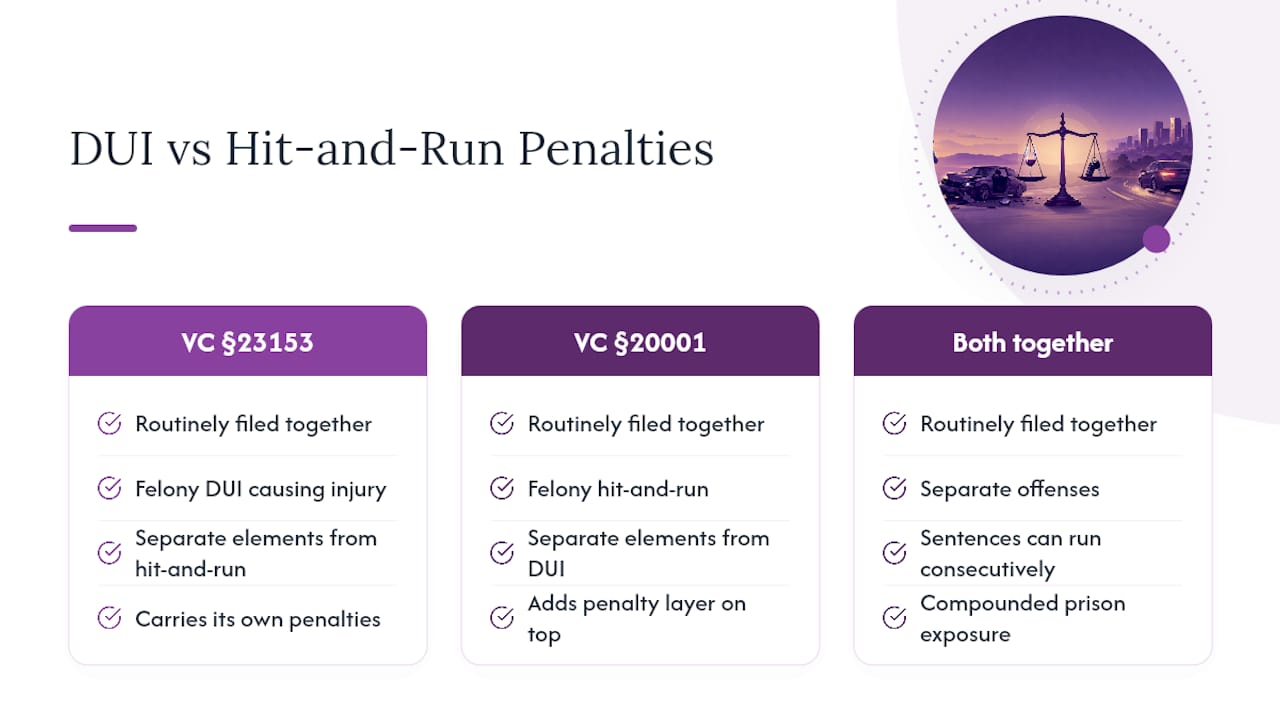
Prosecutors routinely file both the DUI causing injury count and the hit-and-run count in the same complaint. They are separate offenses with separate elements, so sentences can run consecutively. A defendant facing felony VC §23153 plus felony VC §20001 is looking at compounded prison exposure, not a single merged sentence. The hit-and-run statutes add their own penalty layer on top of whatever the DUI charge carries.
How a prior DUI record changes your exposure
California uses a 10-year look-back period for DUI priors. A second DUI within that window raises mandatory minimums; a third makes felony filing far more likely even without serious injury. A prior Watson murder advisement — a warning judges give after a DUI conviction that you know alcohol kills — can elevate a subsequent fatal DUI to second-degree murder. Prior convictions also eliminate most diversion eligibility.
What the DMV hearing process actually looks like
The DMV administrative hearing is separate from criminal court and has its own rules of evidence. A hearing officer, not a judge, decides three issues: whether the officer had lawful cause to stop you, whether you were lawfully arrested, and whether your BAC was at or above the legal limit. You can subpoena the arresting officer, challenge the calibration records of the breathalyzer, and present expert testimony. Winning the DMV hearing does not end the criminal case, but losing it means suspension begins immediately.
Chemical tests versus field sobriety tests: what actually matters at trial
Chemical tests carry the most weight. A blood test showing 0.08% BAC or above triggers the legal presumption under VC §23153; commercial drivers face a 0.04% threshold. But timing matters: BAC rises after drinking stops, so a test taken an hour after driving may not reflect your BAC at the wheel. Toxicologists use retrograde extrapolation to estimate the earlier figure, and a skilled defense attorney can challenge that calculation.
Field sobriety tests — the walk-and-turn, one-leg stand, horizontal gaze nystagmus — are far more subjective. Medical conditions, fatigue, uneven pavement, and officer training gaps all affect results. Learn more about your rights during field sobriety tests before assuming those results are airtight evidence.
How bail works after a DUI hit-and-run arrest
Bail amounts vary by county and charge severity. A misdemeanor DUI hit and run may carry bail in the low thousands; a felony with great bodily injury can reach $100,000 or more. An attorney can argue for release on your own recognizance if you have community ties and no flight risk factors.
Diversion programs and probation alternatives
Standard PC §1000 drug diversion does not apply to DUI cases. However, some counties offer DUI court programs or deferred entry of judgment in limited misdemeanor situations with no injury and no prior record. Informal diversion through a prosecutor's agreement is occasionally possible at the pre-file stage, which is why contacting counsel before charges are formally filed can matter enormously. Rubin Law's diversion program experience covers exactly these pre-charge intervention strategies.
Why early defense decisions define the outcome
The conventional wisdom is that you fight a DUI case at trial. The reality is that most outcomes are shaped in the first two weeks: whether the DMV hearing was requested, whether surveillance footage was preserved before it overwrites, whether witnesses were identified, and whether a pre-file intervention was possible. By the time a case reaches a jury, the best leverage points are often gone.
Prosecutors know that defendants who wait are defendants who have already lost their administrative license battle, handed over BAC evidence without challenge, and missed the window to negotiate from strength. The charge itself is serious. The timing of your response is what separates a manageable outcome from a catastrophic one.
Rubin Law, P.C. defends DUI hit-and-run cases from day one
When the stakes include prison time and a permanent record, you need a firm that shows up in court regularly and knows the prosecutors across the table. Rubin Law, P.C. handles DUI causing injury defense in Los Angeles County, filing DMV hearing requests within the 10-day window, subpoenaing dashcam and surveillance footage, challenging breathalyzer calibration records, and pursuing every pre-file intervention available.
At your first consultation, bring the arrest report if you have it, any DMV paperwork received, and the names of any witnesses. Rubin Law will assess the charge level, the DMV timeline, and the realistic defense options before you make any decisions. Call or contact the firm online to schedule that consultation now.
Primary statutes and resources
- VC §23153 — DUI causing injury; sets BAC presumptions (0.08% general, 0.04% commercial) and the causation element prosecutors must prove.
- VC §20001/§20002 — Hit-and-run duties to stop, render aid, and exchange information; penalties escalate when injury or death is involved.
- California DMV — DUI guidance — Covers implied consent, administrative hearing procedure, and the 10-day request deadline.
- Rubin Law — VC §23153 defense — Firm resource on penalties, IID requirements, and defense strategies for DUI causing injury cases.
- Rubin Law — DUI laws overview — Explains constitutional challenges, DMV defense, and diversion options after a California DUI arrest.
This article provides general legal information, not legal advice. Laws and procedures change; confirm current rules with a qualified California criminal defense attorney before making any decisions about your case.
This article is general information, not a substitute for advice from a qualified lawyer. Consult a qualified legal professional about your own circumstances before acting on anything here.