VC 23152(a) punishes driving while actually impaired by alcohol or drugs, judged by how you performed behind the wheel. Prosecutors in Los Angeles almost always file both against the same driver, and a conviction on either one carries the same DMV consequences, separate from whatever happens in criminal court.
TL;DR:
- Prosecutors often file both impairment and per se BAC charges to preserve fallback options if chemical evidence is invalidated.
- The three-hour rebuttable presumption links BAC test results to driving performance, but can be challenged with evidence of rising BAC levels.
- First-time DUI penalties typically include fines up to $1,000, license suspension, several months of probation, and possible jail time or probation in lieu.
- DMV suspensions occur independently from criminal convictions, with only a 10-day window to request an administrative hearing to preserve driving privileges.
- Defenses often focus on challenging test timing, machine calibration, officer observations, and physiological factors affecting BAC readings.
Table of Contents
- What Is the Difference Between 23152(a) and 23152(b)?
- What Does the Prosecution Have to Prove for Each Charge?
- Why Prosecutors File Both Charges at Once
- First-Time DUI Penalties and DMV Consequences
- What Defenses Work Against BAC Evidence vs Impairment Evidence?
- How Does the DMV Process Differ from the Criminal Case?
- What Rubin Law Does After a 23152(a) or 23152(b) Arrest
- What Actually Determines the Outcome of These Cases
- Sources
What Is the Difference Between 23152(a) and 23152(b)?
VC 23152(a) is the subjective charge. It asks whether alcohol or drugs actually impaired your ability to drive safely, regardless of what a breath machine says.
That distinction shapes how each case gets built and attacked. Under the California Vehicle Code, section 23152(a) prohibits driving under the influence of an alcoholic beverage, drugs, or both, while 23152(b) sets the numeric 0.08% threshold as its own standalone violation.
- 23152(a): Focuses on observed impairment. Officers rely on driving pattern, slurred speech, field sobriety test results, and general demeanor.
- 23152(b): Focuses on a chemical test result. Breath or blood evidence carries the case, and the fight usually happens over how that number was obtained.
- Typical evidence for (a): Body camera footage, dashcam video, officer notes, and field sobriety test performance.
- Typical evidence for (b): Breathalyzer printouts, blood lab reports, calibration logs, and chain of custody records.
- When prosecutors lean on which: A high BAC with clean driving often gets prosecuted almost entirely under (b). A borderline or missing BAC with obvious erratic driving pushes the case toward (a).
The Vehicle Code also includes related subdivisions worth knowing. Section 23152(c) covers driving under the influence of both alcohol and drugs, (d) and (f) address DUI causing injury in combination with other code sections, and (g) extends the per se concept to certain commercial and specially licensed drivers with lower BAC thresholds. Those subsections matter mostly if your case involves an accident, a commercial license, or polydrug use, but the core fight in most first-time DUI cases stays between (a) and (b).
What Does the Prosecution Have to Prove for Each Charge?
Getting a conviction under either subdivision requires the state to establish specific elements, not just an arrest report and a hunch.
- For 23152(a): The prosecution must prove you drove a vehicle, and that alcohol or drugs impaired your physical or mental abilities to the point you could no longer drive with the caution of a sober person using ordinary care.
- For 23152(b): The prosecution must prove you drove a vehicle and that your BAC was 0.08% or higher at the time of driving, not just at the time of testing.
- The three-hour rule: If a chemical test taken within three hours of driving shows 0.08% or more, California law creates a rebuttable presumption that your BAC was also 0.08% or higher while you were actually driving.
- Documentary evidence for (b): Breath machine calibration and maintenance logs, blood draw and lab chain-of-custody paperwork, and the specific test timestamp relative to the traffic stop.
- Documentary evidence for (a): Officer field notes, field sobriety test scoring sheets, and any body or dash camera recording of the stop and arrest.
The three-hour presumption matters enormously in practice. It is rebuttable, not automatic, meaning a defense attorney can challenge it by showing your BAC was rising rather than falling between driving and testing, a pattern common in people who drank shortly before getting behind the wheel.
Why Prosecutors File Both Charges at Once
Filing both 23152(a) and 23152(b) is not overkill. It is insurance. If the chemical test gets thrown out on a calibration or chain-of-custody problem, the prosecutor still has the impairment theory to fall back on. If the field sobriety tests get dismantled on cross-examination, the BAC number can carry the case alone.
- Dual charging preserves two independent legal theories against a single set of facts.
- A conviction on both counts for the same act typically merges into a single punishment under Penal Code section 654, which bars double punishment for one underlying act.
- Sentencing courts generally impose one set of consequences even when the jury or judge finds guilt on both subdivisions.
- Separate punishment becomes more likely only with aggravating facts, such as a DUI causing injury charged alongside the base offense, or evidence of two distinct driving episodes.
This merger principle is exactly why the "which charge is worse" question misses the point for most first-time defendants. The practical outcome usually comes down to one sentence, not two, which means the real battle is over avoiding a conviction on either count in the first place.
First-Time DUI Penalties and DMV Consequences
A first offense under either subdivision typically carries the same range of consequences once you're convicted, since the court sentences the underlying act, not the specific letter of the statute.
Pro Tip: Don't assume DMV and criminal court move on the same clock. The DMV can suspend your license before your criminal case is even arraigned, so acting inside the 10-day window matters more than waiting to see how the criminal charge shakes out.
- Fines up to $1,000, not counting penalty assessments that routinely push the real cost several times higher, according to FindLaw's summary of California DUI penalties.
- Probation commonly lasting several years.
- A mandatory DUI education program generally lasting several months for a first offense.
- Driver's license suspension administered separately by the DMV, commonly lasting several months.
- Jail exposure ranging from a few days to several months, though courts frequently substitute probation for actual custody on a first offense.
First-time convictions rarely mean a defendant serves real jail time, but the combination of fines, a multi-year probation term, and a license suspension adds up to a heavier burden than most people expect walking into their arraignment.
Beyond the criminal sentence, an insurer will typically require an SR-22 filing to reinstate driving privileges, and that filing alone can keep premiums elevated for years. None of this touches the DMV's own administrative suspension, which runs on its own separate schedule from the day of your arrest.
What Defenses Work Against BAC Evidence vs Impairment Evidence?
The two subdivisions get attacked differently, because they rest on different kinds of proof. A defense built for a breath test case rarely works unchanged against an impairment case, and vice versa.
- Timing challenges: Argue the chemical test happened outside or at the edge of the three-hour window, weakening the relation-back presumption.
- Machine and lab issues: Request calibration records, maintenance logs, and operator certification for the breath device, or challenge blood sample handling and chain of custody.
- Absorption and elimination arguments: Point to physiological factors, such as a rising BAC curve, that make the test result an unreliable snapshot of your BAC while actually driving.
- Field sobriety test reliability: Challenge how the tests were administered, whether the officer followed standardized procedure, and whether medical conditions or fatigue explain poor performance.
- Officer observation credibility: Use body and dashcam footage to contradict subjective claims about slurred speech, odor, or driving pattern.
Requesting full DUI evidence files early, before memories fade and video gets overwritten, gives an attorney the best shot at finding the crack in either theory.
How Does the DMV Process Differ from the Criminal Case?
California operates under implied consent: driving on a California road means you've already agreed to chemical testing if lawfully arrested for DUI. Refusing that test triggers its own administrative penalty, separate from whatever happens with the underlying 23152(a) or 23152(b) charge.
- Upon arrest for a BAC of 0.08% or higher, or refusal to test, the officer typically confiscates your license and issues a temporary permit.
- You have only 10 days from the date of arrest to request a DMV administrative hearing, according to the California DMV's driver handbook guidance on implied consent and per se suspensions.
- Missing that deadline means an automatic suspension takes effect, regardless of what eventually happens in criminal court.
- The DMV hearing can result in suspension, an ignition interlock device requirement, or, in some cases, no suspension at all if the arresting evidence is weak.
The criminal case and the DMV case run on entirely separate tracks, with separate standards of proof and separate outcomes. A dismissed or reduced criminal charge does not automatically undo a DMV suspension. That is exactly why the 10-day window deserves immediate attention, not "after I talk to a lawyer next week" attention.
What Rubin Law Does After a 23152(a) or 23152(b) Arrest
If you've been arrested, the clock on your DMV rights is already running, and the choices you make in the first days shape everything that follows. Avoid making statements to police beyond identifying information, preserve any receipts, medical records, or witness contacts that support your timeline, and get the DMV hearing request filed inside that 10-day window.
Drivers seeking a defense built around courtroom relationships and prosecutorial patterns that shape how DUI cases resolve may benefit from early requests for calibration records, lab reports, and body camera footage, with strategies tailored to the case's weakest prosecution theory. Diversion or reduced-charge negotiations may be explored before trial when applicable.
Bring your citation, any DMV paperwork, and a written timeline of the stop to your first meeting. Review the firm's DUI law overview or the broader California criminal laws page to see how these cases typically get handled, and reach out to schedule a consultation before your 10-day DMV window closes.
What Actually Determines the Outcome of These Cases
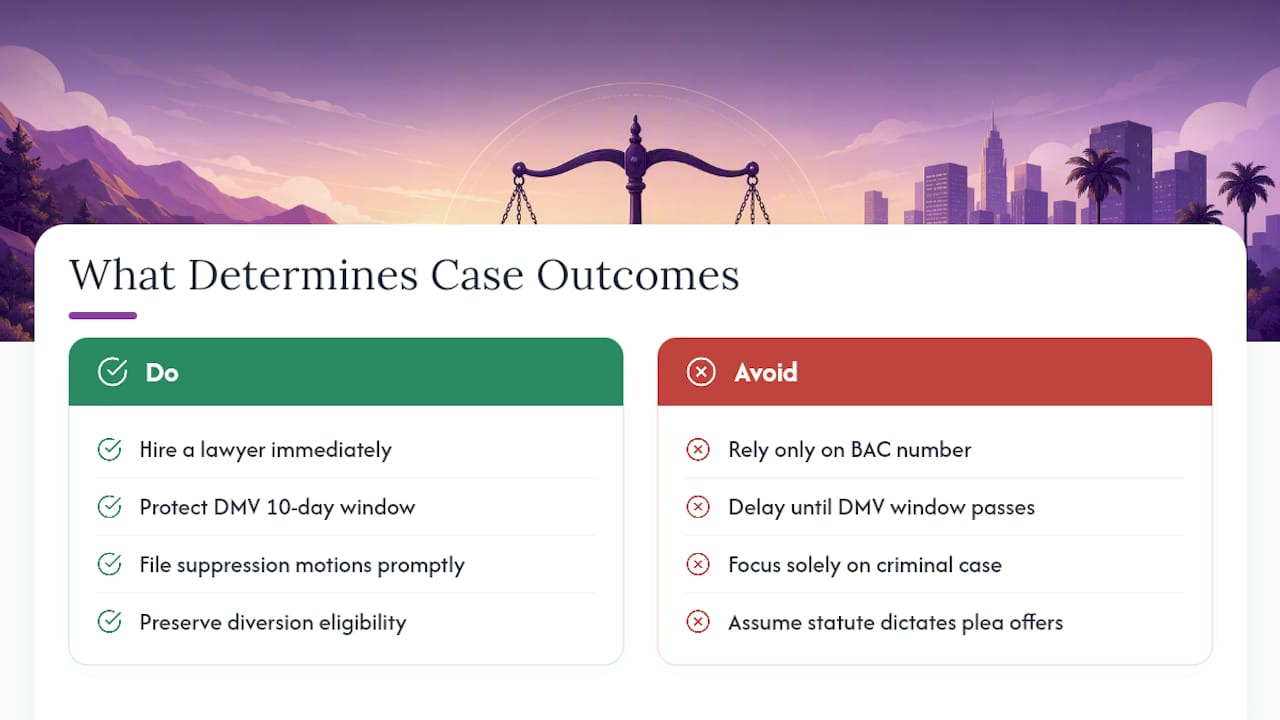
Most drivers assume the BAC number decides everything, and that assumption is exactly backwards. In my read of how these cases play out, the impairment charge under 23152(a) often ends up mattering more than people expect, because it survives even when the breath or blood evidence gets thrown out. Local prosecutors know which judges scrutinize calibration logs and which ones wave them through, and that local knowledge shapes plea offers more than the statute itself ever will.
The timeline trap catches people constantly: they focus on hiring a lawyer for the criminal case and forget the DMV clock runs independently. By the time they've picked an attorney, the 10-day hearing window is gone. Early involvement is not about looking prepared. It is about preserving options, suppression motions, diversion eligibility, and DMV hearing rights, that disappear fast once the deadlines pass.
— Jake
This article is general information, not a substitute for advice from a qualified lawyer. Consult a qualified legal professional about your own circumstances before acting on anything here.