
Yes: if the California DMV or a court orders it after your DUI, you must carry an SR-22 to get your license back and keep driving legally. Three facts matter more than anything else right now. First, either the DMV or the sentencing court decides whether you need one, and you won't file it on your own initiative. Second, the standard term is three years, and that clock generally starts on your reinstatement date, not your arrest date. Third, the SR-22 filing itself is cheap, usually a $25 to $35 one-time fee, but the insurance premium behind it climbs fast after a DUI.
Here's what to do next:
- Read your DMV notice or court order carefully to confirm the SR-22 requirement and any deadline.
- Contact your insurer or an independent agent to buy a qualifying policy and have them file the SR-22 electronically.
- Finish any other reinstatement conditions, like DUI school or an ignition interlock device, since the DMV won't reinstate you until everything is complete.
Key Takeaways
An SR-22 after a California DUI generally lasts three years starting at reinstatement, and any coverage lapse resets that clock to zero.
| Point | Details |
|---|---|
| Who orders it | The DMV or the court decides you need an SR-22; you never file one on your own initiative. |
| Standard duration | Three years of continuous coverage, with the clock starting at license reinstatement, not arrest. |
| Cost reality | Expect a $25 to $35 filing fee plus a premium averaging around $180 a month versus $72 for clean records. |
| No grace period | Even a brief lapse in coverage triggers DMV notification and causes the required SR-22 period to restart. |
| Legal help matters | Rubin Law, P.C. handles DMV hearings and DUI defense that can shorten suspensions and set an earlier SR-22 start date. |
Table of Contents
- What Is an SR-22, Exactly?
- When Will the DMV or a Court Require an SR-22 After a DUI?
- How Long Do You Need SR-22 After a DUI in California?
- How Much Does SR-22 Insurance Cost After a DUI in California?
- How to File an SR-22 in California: Step by Step
- What Happens if Your SR-22 Lapses or Gets Cancelled?
- How and When Does the SR-22 Requirement End?
- Ways to Lower Your SR-22 Insurance Costs
- When Should You Talk to a DUI Attorney About Your SR-22?
- A California Defense Attorney's View on SR-22 Mistakes
- How Rubin Law, P.C. Helps With DUI and DMV Reinstatement
- Frequently Asked Questions
- Sources
What Is an SR-22, Exactly?
An SR-22 is not an insurance policy. It's a certificate of financial responsibility that your insurance company files electronically with the California DMV to confirm you carry at least the state's minimum liability coverage. Think of it as your insurer vouching for you in writing, on file with the state, for as long as the requirement lasts.
Your insurer handles the paperwork, not you. You buy a qualifying auto policy, and the company transmits the SR-22 form directly to the DMV, usually within a day or two of purchase, according to GEICO's explanation of the process.
A few situations commonly trigger the requirement:
- A DUI conviction that led to license suspension.
- Driving without insurance.
- License suspension or reinstatement following certain violations.
- Repeat serious violations or a negligent-operator finding.
One clarification worth making up front: some states use a form called FR-44 for serious offenses like DUI, but California doesn't use that form at all. Every qualifying case here, DUI included, uses the SR-22.
When Will the DMV or a Court Require an SR-22 After a DUI?
The DMV or the court will tell you when an SR-22 is required. You won't need to guess, and you shouldn't file one preemptively before you're instructed to.
The most common DUI-related triggers include:
- A DUI conviction that resulted in a license suspension.
- Refusal to submit to a chemical test, which triggers a separate administrative suspension.
- An at-fault accident while uninsured.
- A negligent-operator designation from the DMV based on your driving record.
If you don't own a vehicle, you're not off the hook. You'll typically need a non-owner SR-22 policy instead, which satisfies the same DMV requirement without insuring a specific car. And if you're comparing notes with someone who got a DUI in another state, don't be confused by FR-44 requirements there. California sticks with SR-22 across the board.
Pro Tip: Coordinate your SR-22 filing with every other outstanding requirement at once. If you still owe DUI program enrollment fees, a reinstatement fee, or IID installation, handle all of it in the same window. Filing your SR-22 early does nothing if the DMV is still waiting on a separate piece of paperwork; reinstatement only happens when everything clears together.
How Long Do You Need SR-22 After a DUI in California?
The standard SR-22 requirement in California runs for three years of continuous coverage. That's the figure attorneys and insurance guides cite most consistently, and it holds for the large majority of DUI-related cases, according to LegalClarity's analysis of California SR-22 rules.
Here's the detail people miss: the three years usually starts counting from your reinstatement date, not your arrest or conviction date. If your suspension lasted six months and you spent that time completing DUI school, the SR-22 clock hadn't even started yet. It begins the day the DMV actually restores your driving privilege.
A few things can extend or restart that timeline:
- A lapse in coverage, even briefly, resets the three-year period back to zero.
- A new qualifying offense during the filing period extends your obligation.
- Moving out of state doesn't cancel your California SR-22 duty. You generally have to maintain the California filing until the period ends, and you may need a separate filing in your new state too.
The most expensive mistake is buying an SR-22 policy before your reinstatement date actually arrives, or letting a payment lapse partway through. Community legal forums back this up consistently: real-world timelines often run longer than three years in practice, not because the legal requirement changed, but because suspensions, education programs, and coverage gaps push the effective end date back.
How Much Does SR-22 Insurance Cost After a DUI in California?
The SR-22 filing fee itself is small: expect $25 to $35 as a one-time charge from most insurers. The real cost driver is the insurance premium sitting behind that filing, and a DUI moves that number significantly.
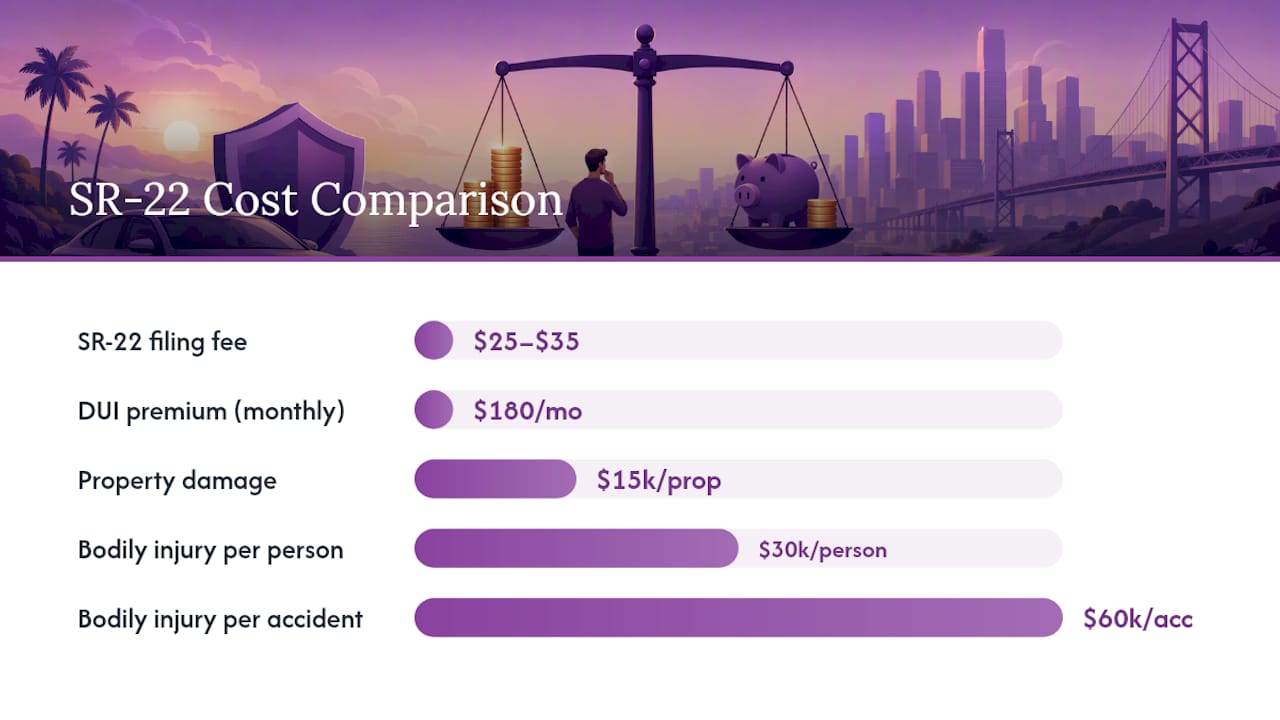
California drivers with a clean record pay a lower monthly premium for state-minimum coverage on average. Drivers with a DUI on their record pay closer to $180 a month for the same minimum coverage, more than double. Over a year, that gap adds up to well over $1,000 in extra premium, on top of the filing fee.
That 30/60/15 change matters more than it looks. Since January 2025, California drivers need $30,000 per person and $60,000 per accident for bodily injury, plus $15,000 for property damage to meet the state minimum. That's a higher bar than the old limits, and it's the baseline policy you now have to carry to satisfy your SR-22.
One quirk of California pricing works in your favor here: Proposition 103 bans insurers from using your credit score to set auto rates. That means your SR-22 surcharge reflects your driving record and where you live, not your credit history, which isn't true in every state.
Carriers price DUI risk differently, and shopping around pays off. National names like GEICO, Progressive, Mercury Insurance, Farmers Insurance, State Farm, and Allstate all write SR-22 policies in California, but their underwriting models for DUI risk vary enough that quotes between them can differ by hundreds of dollars a year. Getting quotes from at least three or four before committing is worth the hour it takes.
A few factors push your premium even higher than the average:
- A second or third DUI within ten years.
- An injury or fatality involved in the incident.
- A vehicle still under a loan or lease, which usually requires higher coverage limits than the state minimum.
How to File an SR-22 in California: Step by Step
Filing itself is mechanically simple once you know the order of operations.
- Confirm the exact requirement in your DMV notice or court order, including the required term and any special conditions.
- Buy a qualifying California liability policy, or a non-owner policy if you don't currently own a car.
- Ask your insurer to file the SR-22 electronically with the DMV. Most companies handle this within a day of your policy taking effect, per Express Lane Insurance's overview of the SR-22 process.
- Confirm the DMV has received the filing before assuming your reinstatement is complete.
Before you call your insurer, gather what you'll need:
- A valid ID and driver's license number.
- Payment for the SR-22 filing fee and any outstanding DMV reinstatement fee.
- Proof of a completed DUI program, or documentation of IID installation if the court ordered one.
Electronic filing is fast on the insurance side, often same-day, but DMV record updates can lag by several business days. If your insurer refuses to file an SR-22, or the DMV's system doesn't reflect it after a week or so, call the DMV's financial responsibility unit directly and have your policy number ready. Don't assume silence means it worked.
What Happens if Your SR-22 Lapses or Gets Cancelled?
There's no grace period here, and that catches people off guard. The moment your insurer cancels or lapses your SR-22 policy, they're required to notify the DMV automatically, and the DMV can suspend your license again almost immediately.
A single day without coverage can undo months of compliance. MoneyGeek's research on California SR-22 rules confirms there's effectively no buffer: even a brief gap restarts your three-year filing period from zero and can trigger a new reinstatement fee.
That reinstatement fee typically runs $55 to $100, on top of whatever premium increase follows from having a lapse on your record. If a lapse happens to you, move fast:
- Contact your insurer immediately to understand why coverage lapsed.
- Check your DMV status online or by phone to see if a suspension has already posted.
- Reinstate coverage and re-file the SR-22 as soon as possible.
- Pay any reinstatement fees and keep written confirmation of the new filing date.
How and When Does the SR-22 Requirement End?
Once you've completed the full three-year term with no lapses, the obligation ends automatically, but you shouldn't just assume it and stop paying attention. Confirm it.
- Check your official DMV driving record to verify the SR-22 requirement shows as satisfied.
- Ask your insurer, in writing, to confirm the SR-22 filing has been removed from your policy.
- Keep that written confirmation somewhere accessible for at least a few years, in case a future insurer or employer asks about your driving history.
Pro Tip: Don't cancel your entire auto policy just to get rid of the SR-22 endorsement. Ask your insurer to remove the SR-22 filing specifically while keeping your coverage active. Canceling the whole policy risks an accidental gap, and a gap here creates the exact restart problem you just spent three years avoiding.
Ways to Lower Your SR-22 Insurance Costs
You can't skip the SR-22, but you have real control over what you pay for the policy underneath it.
- Get quotes from several carriers rather than renewing automatically with whoever insured you before the DUI. DUI-risk pricing swings widely between GEICO, Progressive, Mercury Insurance, Farmers Insurance, State Farm, and Allstate.
- If you don't drive regularly or don't own a vehicle, ask about a non-owner SR-22 policy instead of a full auto policy.
- Bundling home or renters insurance with your auto policy often unlocks a discount even with an SR-22 attached.
- Raising your deductible lowers your monthly premium, though it means more out of pocket if you file a claim.
- Ask specifically about defensive driving course discounts; not every carrier offers them post-DUI, but some do.
Because Prop 103 bans credit-based pricing in California, your driving record and where you live carry more weight in your rate than they would elsewhere. That makes carrier selection and location genuinely more important here than your credit score ever will be.
Longer term, the surest way to bring your rate down is simple, if not easy: keep a spotless record, finish your DUI program requirements on schedule, and never let coverage lapse. Every year you go without a new violation chips away at the DUI surcharge.
When Should You Talk to a DUI Attorney About Your SR-22?
Not every SR-22 situation calls for legal help, but several common scenarios genuinely do, especially if you are a first-time or repeat offender who needs to understand your DUI timelines and legal options (DUI First-Time & Repeat Offender | Contant Law, P.C.). If you're disputing a DMV suspension, if there's a technical defense that could shorten your suspension period, or if you're trying to negotiate a restricted license or IID arrangement instead of a longer suspension, a lawyer's involvement can directly change your reinstatement date, and therefore when your SR-22 clock starts.

Errors happen more often than people expect, too. A notice with the wrong dates, a missed DMV hearing deadline, or confusion between administrative and court-ordered suspensions can all add unnecessary months, as outlined in this breakdown of California DUI penalties.
Call an attorney before you file your SR-22 if any court or DMV issue remains unresolved. Bring your DMV notice, any court paperwork, and your DUI arrest report to the consultation. If this isn't your first DUI, the stakes are higher still, since repeat offenses extend the underlying suspension period even though the SR-22 filing term itself generally stays at three years.
A California Defense Attorney's View on SR-22 Mistakes
The pattern I see most often isn't confusion about what an SR-22 is. It's timing. Clients buy the policy too early, assume the DMV updated instantly when it didn't, or let a payment lapse during a month when money was tight, not realizing that single gap resets three years of compliance back to zero.
Good legal representation on the DUI itself often prevents these problems before they start, by shortening suspension periods, securing restricted licenses, or catching DMV notice errors that would otherwise add months to the timeline.
The SR-22 rules are rigid. The path to reinstatement doesn't have to be, if the underlying case is handled correctly.
How Rubin Law, P.C. Helps With DUI and DMV Reinstatement
The SR-22 itself is an insurance matter, but everything that determines when your clock starts is a legal matter: your suspension length, your eligibility for a restricted license, and whether DMV or court errors are adding delay you shouldn't have to accept.
Rubin Law, P.C. represents clients through DMV administrative hearings, court DUI defense, IID compliance issues, and the reinstatement paperwork that ties directly into your SR-22 start date. An attorney who regularly appears in Los Angeles courtrooms and knows local DMV procedure can catch the kind of notice error or eligibility issue that costs an unrepresented driver months of extra suspension, and months of extra SR-22 premium along with it. If you're facing a DUI charge or already navigating a suspension, get a consultation through our Los Angeles DUI attorney page or review the specifics of California's DUI law before your next DMV deadline arrives.
Frequently Asked Questions
Do I have to get an SR-22 myself, or does my insurer handle it? Your insurance company files it electronically with the DMV once you buy a qualifying policy. You don't submit any paperwork to the state yourself.
Can I drive at all before my SR-22 is filed and DMV reinstatement is complete? No. Driving before reinstatement is finalized, even with insurance purchased, can lead to a separate charge for driving on a suspended license.
Does a second DUI extend my SR-22 filing period beyond three years? The SR-22 filing term itself generally stays at three years even after a repeat offense. What actually extends is the underlying suspension or revocation period, which pushes your total timeline back.
What if I move out of California during my SR-22 period? You still have to maintain the California SR-22 filing until your term ends, and your new state may require a separate filing depending on its own laws.
Will my SR-22 cost less if I have good credit? Not in California. Proposition 103 bars insurers from using credit scores to set auto insurance rates here, so your driving record and location matter more than your credit history.
This article is general information, not a substitute for advice from a qualified lawyer. Consult a qualified legal professional about your own circumstances before acting on anything here.
Sources
- California DMV - Insurance requirements (Financial responsibility)
- Cheapest SR-22 Car Insurance in California: 2026 Rates and Requirements | MoneyGeek
- SR-22 & Insurance - What is it and how does it work? | GEICO
- How Long Do You Need an SR-22 After a DUI in California? - LegalClarity