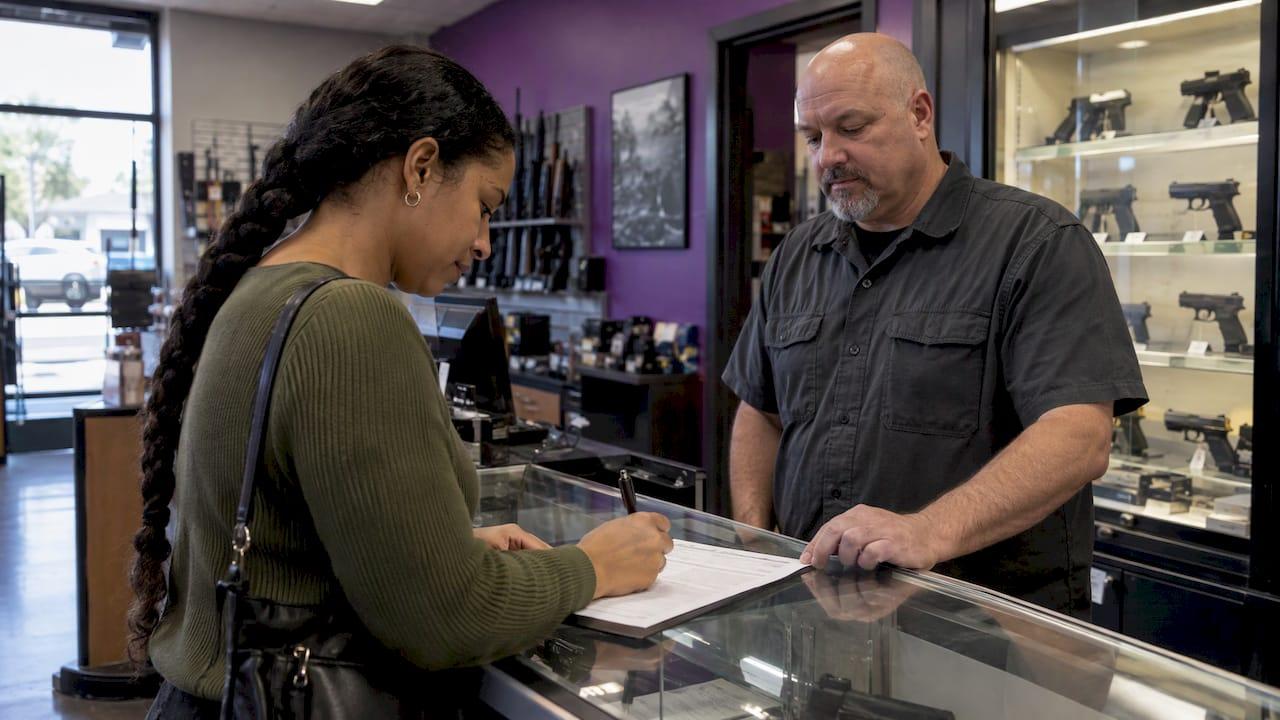
A straw purchase charge in federal court usually rests on one of three statutes: 18 U.S.C. § 932, § 922(a)(6) or § 924(a)(1)(A). Penalties run up to 15 years in prison under § 932, and up to 25 years when prosecutors say the gun was bought for use in a felony. If agents have contacted you, a search warrant has been served or you have been charged, the outcome is often shaped in the first weeks, before any indictment is final. Rubin Law, P.C. defends federal firearm cases in Los Angeles, including constitutional search and seizure challenges and pre-file intervention.
TL;DR
- A straw purchase means buying a firearm for someone else while presenting yourself as the real buyer. It can be a federal crime even if the background check came back clear.
- Three statutes are commonly charged together: § 932 (up to 15 years, or 25 with a felony connection), § 922(a)(6) (up to 10 years) and § 924(a)(1)(A) (up to 5 years).
- Prosecutors must prove you knowingly made a false statement. The question on Form 4473 about being the "actual buyer" is the center of most cases.
- A genuine gift is different from a straw purchase, but the line depends on who paid and who is allowed to own the gun.
- Early action matters: what you say to agents and how a search was carried out can shape the whole case.
Table of Contents
- What counts as a straw purchase
- The three federal statutes behind most charges
- What prosecutors must prove
- Abramski and the "eligible buyer" problem
- Gift or straw purchase
- How these cases begin
- Where a defense can be built
- Why representation here is different from an ordinary gun case
- How we handle federal firearm and straw purchase cases
- Our perspective
- FAQ
- Sources
What counts as a straw purchase
The ATF says a straw purchase happens when someone buys a firearm for a person who is not legally allowed to buy or own one, and that the purchase is illegal even if the buyer passes a background check. The "straw" is the person whose name goes on the paperwork.
The people who are federally barred from owning guns include those convicted of a crime punishable by more than one year, fugitives, unlawful users of or people addicted to controlled substances, people committed to a mental institution, people under certain domestic violence restraining orders, and people convicted of misdemeanor domestic violence. That list matters to many of our readers. Someone facing a drug case or a domestic violence accusation may suddenly fall into a prohibited category, and the person who bought a gun for them may be pulled into the case.
There is a second version of the offense that surprises people. Federal law also reaches a buyer who lies about being the real buyer when the person they bought for could have lawfully owned the gun. The Supreme Court decided that in Abramski v. United States (2014), which we cover below.
The ATF's own program page lists how people end up in these situations: pressure from friends, family or partners, an offer of money, threats or manipulation, or simply not realizing the purchase was illegal. Regardless of the reason, the agency treats the act as a federal crime. Reasons do not decide guilt, but they matter a great deal to how a defense lawyer frames the facts and to what a judge hears at sentencing.
The three federal statutes behind most charges
Until 2022, there was no statute titled "straw purchase." A May 2026 Federal Register document notes that federal law traditionally did not define the term in a statute or regulation, and that the doctrine involves 18 U.S.C. §§ 922(a)(6), 924(a)(1)(A) and 932. Prosecutors could charge a false statement on the dealer's form, which some critics called a paperwork offense. The Congressional Research Service reports that Congress added a standalone offense in the 2022 Bipartisan Safer Communities Act because paperwork charges were seen as inadequate to deter gun trafficking.
| Statute | What it covers | Maximum prison |
|---|---|---|
| 18 U.S.C. § 932 | Knowingly buying a firearm for another person who is prohibited, or who intends to use or pass it on in a felony, terrorism offense or drug trafficking crime; also conspiracy to do so | 15 years; 25 years with a felony, terrorism or drug trafficking connection |
| 18 U.S.C. § 922(a)(6) | Knowingly making a false statement to a licensed dealer that is material to the lawfulness of the sale | 10 years |
| 18 U.S.C. § 924(a)(1)(A) | Knowingly making a false statement in records a licensed dealer must keep | 5 years |
The text of 18 U.S.C. § 932 sets the 15-year and 25-year ceilings, and the Sentencing Commission's 2026 Primer on Firearms Offenses confirms the 10-year ceiling for § 922(a)(6). The Congressional Research Service gives the 5-year ceiling for § 924(a)(1)(A) and notes that a person can be charged under the older provisions and under § 932 or § 933 for the same conduct.
The ATF's program page also cites fines of up to $250,000 for these offenses.
Those are ceilings, not predictions. Actual sentences are driven by the Sentencing Guidelines. The Sentencing Commission's primer says §§ 932 and 933 are referenced to guideline § 2K2.1 following an amendment effective November 1, 2023. That guideline looks at the number of guns, the type of gun, the buyer's history and what happened to the guns afterward. We explain how the process works in our guide to federal sentencing guidelines in California.

What prosecutors must prove
Most cases turn on knowledge and on a form, so it helps to understand both.
The Form 4473 question
When you buy from a licensed dealer, you fill out ATF Form 4473 (the Firearms Transaction Record). Question 21.a. asks whether you are the actual buyer. The ATF's June 2021 FFL Newsletter explains that you are not the actual buyer if you are acquiring the gun on behalf of another person, and gives a clear example: a person given money by the intended recipient is not the actual transferee. Buying with your own money as a gift, with nothing provided by the recipient, makes you the actual buyer.
The 2026 rulemaking text adds that a gift is not bona fide if someone else offered or gave money, services or items of value to acquire the firearm, or if the recipient is prohibited from having the gun.
Knowledge, but not knowledge of the law
Under § 922(a)(6), the Sentencing Commission explains, the government must prove you knew your statement was false. It does not have to prove you knew lying was unlawful, or that you knew the other person was prohibited. Those limits narrow some defenses and sharpen others. The knowledge element becomes the main battleground.
The Eleventh Circuit set out the elements in United States v. Frazier (2010): the defendant knowingly made a false written or oral statement in connection with buying a firearm from a licensed dealer, and the fact was material to the lawfulness of the sale. Each piece can be tested. Did you actually make the statement? Was it knowingly false? Was the fact material?
Section 932 asks for more
Section 932 requires that you knew, or had reasonable cause to believe, that the other person was prohibited or intended to use or move the gun in a felony, terrorism offense or drug trafficking crime. Reasonable cause to believe is a lower bar than certain knowledge, but it is still something the government has to prove with evidence: messages, payment records, surveillance video, what the other person later did with the gun.
Abramski and the "eligible buyer" problem
Many people assume that if the person they bought for could legally own a gun, nothing wrong happened. The Supreme Court rejected that in Abramski. Cornell's Legal Information Institute summarizes the holding: a person who buys from a licensed dealer on behalf of someone else violates § 922(a)(6) by falsely claiming to be the actual buyer, even if the ultimate buyer could have legally purchased the firearm.
The Sixth Circuit applied the same reasoning in United States v. Morales (2012). It held that the actual purchaser's identity is material even when that person is eligible, rejected an argument that the statute is too vague, and found that an outdated circular the defendant never saw did not support a good-faith defense. Those rulings mean the defense often has to focus on the facts of who really bought the gun, who paid, and what the buyer knew, instead of relying on a technical argument that the form was ambiguous.
Gift or straw purchase
The practical dividing line is who the gun belongs to when you walk out of the store. A few questions investigators ask:
- Whose money paid for it? If the recipient gave you cash, or promised to repay you, that points toward a straw purchase.
- Who chose the gun? A recipient who picked the model and told you to buy it looks more like the real buyer.
- When did you decide to give it? A gun you bought for yourself and later gave or sold is treated differently from one bought to order. The CRS notes that straw purchases are hard to spot because illegality may become apparent only after a later transfer reveals the buyer's intent, so the timeline of what happened afterward becomes evidence of what you intended at the counter.
- Is the recipient allowed to own a gun? A gift to a prohibited person is not a bona fide gift under the ATF's guidance.
The May 2026 Federal Register document is a proposed rule, not a final one. It would bar straw purchasing by regulation and would exclude bona fide gifts, parental purchases for minor children, and certain pawn, consignment, repair and raffle transactions. Because it is only proposed, the statutes above are what prosecutors use. Check the Federal Register for any final version.
How these cases begin
Straw purchase cases rarely start at the gun counter. They usually begin after a firearm turns up somewhere it should not be: a traffic stop, a drug investigation, a domestic violence call, a search of a home. Agents run the serial number through a trace and find the original buyer. The Federal Register document explains the policy reason: properly identifying the buyer in dealer records is critical to tracing firearms used in violent crime.
That means the first contact is often a visit or a phone call from an ATF or FBI agent who wants to "just ask a few questions." You are not required to answer, and anything you say can become the evidence that proves knowledge. Speak to a criminal defense attorney before you answer questions about a gun purchase.
Where a defense can be built
Every case is different, and what follows is the range of issues a federal defense attorney examines.
- The search and the seizure. If the gun, phone or records came from an unlawful search, a constitutional challenge can reduce or remove that evidence. This is one of our core tools.
- Knowledge. Did you know the statement was false, or did you honestly believe you were the buyer because you paid and the gun was yours to give?
- Materiality and the facts of payment. Who funded the purchase and what the messages actually say can separate a gift from a straw purchase.
- Intent under § 932. The government must show you knew or had reasonable cause to believe about the other person's status or plans.
- Pressure and coercion. The ATF itself acknowledges that people are pushed into these purchases by relatives, partners and others. That background is relevant to how a prosecutor and judge view you, even though it does not erase the offense.
- Pre-file intervention. When you learn you are under investigation before charges are filed, an attorney can engage with the prosecutor early, sometimes before an indictment.
Straw purchase allegations also tend to arrive bundled with other counts. If a gun is tied to drug trafficking, the exposure can multiply under 18 U.S.C. § 924(c), and if you are alleged to be a prohibited person yourself, the case may involve § 922(g) defenses. Our overview of federal weapons charges in California shows how these statutes fit together.
Why representation here is different from an ordinary gun case
A straw purchase case is rarely only about the purchase. It is about a paper trail, a second person and a timeline, and the federal government has the resources to build all three. A lawyer's first job is to find out which statute is actually being considered, because the difference between a 5-year, a 10-year and a 15-year ceiling changes every conversation about resolution. The second job is to control what the government learns from you before the lawyer has read the file.
Federal court also runs on sentencing guideline calculations. A good defense plan works backward from those calculations: the number of firearms, whether the gun was tied to another offense, and what mitigating facts can be proven.
How we handle federal firearm and straw purchase cases
Rubin Law, P.C. is a Los Angeles criminal defense firm that represents clients in federal crimes cases, including federal firearms charges. Our attorneys appear in court frequently and give each client direct attention. Our services include constitutional search and seizure challenges, pre-file intervention and alternative sentencing or diversion programs where they are available.
If you are under investigation or have been charged, you can see the full range of our work on our criminal defense practice page.
We review the charging statute, the paperwork and the evidence trail, and we build the response around what the government must prove.
Our perspective
Most people who call us about a straw purchase did not think of themselves as criminals. They bought a gun for a boyfriend, a cousin, a friend who said they would pay them back. Then a trace, a search or a knock on the door changed that.
What we see in the law is that the stakes depend on details the client rarely thinks about: who handed over money, what box was checked, what happened to the gun afterward. Our approach is built on frequent courtroom appearances in Los Angeles County and on understanding how local prosecutors approach a case. We use constitutional challenges where the evidence was gathered improperly, and we look for diversion or alternative sentencing where the facts support it.
We believe a federal gun case is won or lost early, which is why we push clients to call us before they speak to investigators. Direct attention from your attorney, not a handoff, is how we think a serious case should be handled.
Jake
FAQ
Is it illegal to do a straw purchase?
Yes. Buying a firearm for someone who is prohibited from owning one, or falsely claiming to be the actual buyer on Form 4473, can violate federal law. The ATF says the purchase is illegal even if the buyer passes the background check. Both the statutes and the Supreme Court's Abramski decision apply.
How serious is a federal straw purchase charge?
It is a felony. Section 932 carries up to 15 years in prison, and up to 25 years if the gun was bought knowing it would be used in a felony, terrorism offense or drug trafficking crime. False statement charges under § 922(a)(6) carry up to 10 years. Actual sentences depend on the Sentencing Guidelines and the facts of the case.
Can a gift of a gun be a straw purchase?
A genuine gift paid for with your own money and given to someone allowed to own a gun is different from a straw purchase. A gift is not bona fide if the recipient provided money or something of value for it, or if the recipient is prohibited. Who paid and what you knew are the central facts.
What should I do if agents contact me about a gun I bought?
Contact a criminal defense attorney before answering questions. What you say about who paid, who chose the gun and where it went can be used to prove knowledge. A lawyer can speak with the agents or prosecutor for you and, before charges are filed, may be able to engage early.
Sources
- Don't Lie for the Other Guy, ATF
- 18 U.S.C. § 932: Straw purchasing of firearms
- Firearms Transactions and Straw Purchases, Federal Register, May 6, 2026
- Primer on Firearms Offenses, U.S. Sentencing Commission, 2026
- Gun Control: Straw Purchase and Gun Trafficking Provisions, Congressional Research Service
- FFL Newsletter, June 2021, ATF
- United States v. Frazier (11th Cir. 2010)
- United States v. Morales, 687 F.3d 697 (6th Cir. 2012)
- Straw purchase, Legal Information Institute, Cornell Law School