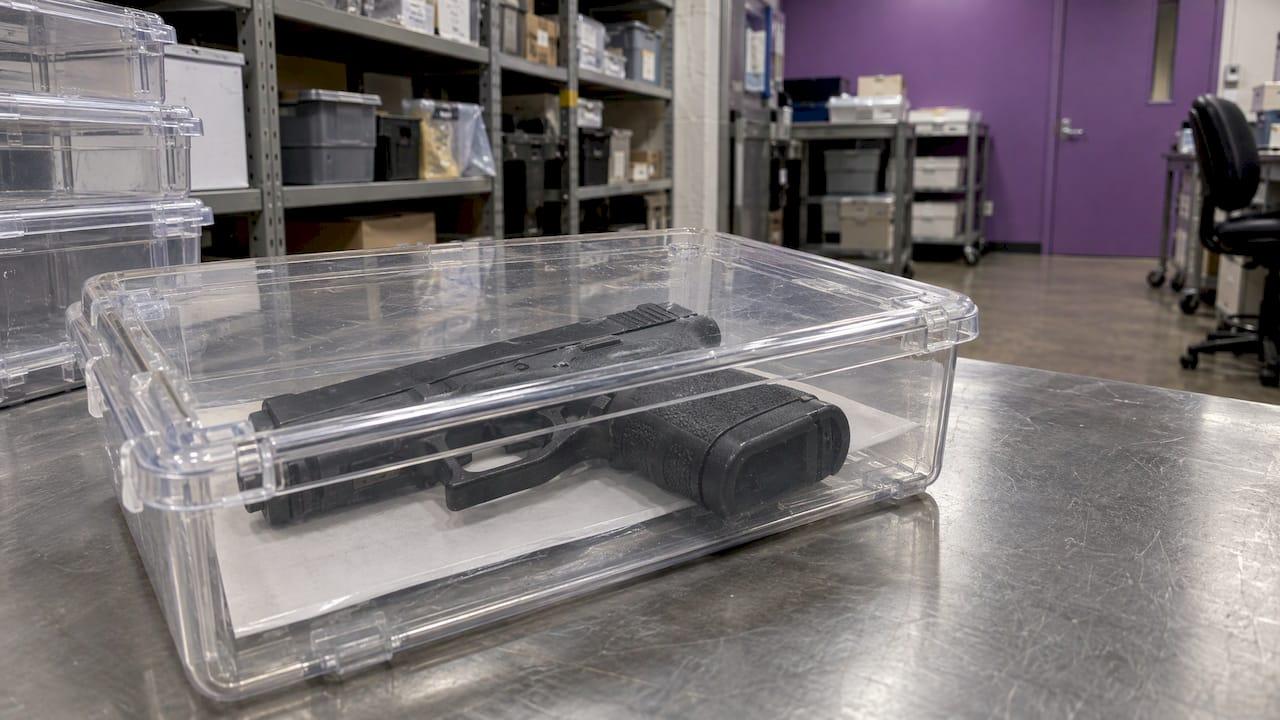
The strongest 922(g) defenses attack one of four things: whether you are really in a prohibited category, whether you knew you were, whether you knowingly possessed the gun or ammunition, and whether the police got the evidence legally. A newer fifth line, the Second Amendment, is moving quickly in the courts. Which defense fits depends on which subsection you are charged under and which federal circuit your case sits in. Our firm defends federal crimes and felon-in-possession cases in Los Angeles, and the earlier a lawyer is involved, the more of these options are still open.
TL;DR
- Section 922(g) bars nine categories of people, from felons to unlawful drug users, from possessing firearms or ammunition. The maximum sentence is 15 years.
- The government must prove the prohibited status, that you knew of it, that you knowingly possessed the item, and a link to interstate commerce. Each is a place to fight.
- Suppressing the gun through a search and seizure challenge often decides the case. If the gun comes out, the charge usually goes with it.
- Second Amendment challenges are succeeding in some circuits and failing in others. The Supreme Court has taken up the drug-user provision.
- Prior convictions can trigger a 15-year mandatory minimum under the Armed Career Criminal Act. Challenging those priors is its own defense.
Table of Contents
- What 922(g) actually prohibits
- What the government has to prove
- Defenses that challenge your status
- Defenses that challenge possession
- Suppression: the defense that often ends the case
- Second Amendment challenges
- Penalties, the ACCA and the guidelines
- Can gun rights be restored?
- Our perspective
- If you are under investigation or charged
- FAQ
- Sources
What 922(g) actually prohibits
18 U.S.C. § 922(g) makes it illegal for nine categories of people to ship, transport, possess or receive firearms or ammunition that have crossed state lines. The categories are:
- People convicted of a crime punishable by more than one year in prison (the "felon in possession" charge, subsection (g)(1))
- Fugitives from justice
- Unlawful users of, or people addicted to, a controlled substance
- People adjudicated mentally defective or committed to a mental institution
- Certain noncitizens
- People dishonorably discharged from the military
- People who renounced U.S. citizenship
- People subject to a qualifying domestic violence restraining order
- People convicted of a misdemeanor crime of domestic violence
The ATF's guidance on prohibited persons adds two related rules: § 922(n) bars someone under indictment for a crime punishable by more than a year from shipping, transporting or receiving firearms, and § 922(d) makes it illegal to sell or give a gun to a prohibited person.
A key point for many readers: "punishable by more than a year" looks at the possible sentence, not the one you received. A California wobbler, an offense that can be charged as a felony or a misdemeanor, can still matter depending on how it was resolved. We explain the California side of this in our page on federal weapons charges under 18 USC 922.
What the government has to prove
Every defense starts from the elements. In a felon-in-possession case, the Third Circuit's 2024 pattern jury instructions and the U.S. Sentencing Commission's primer on firearms offenses describe the same four elements, which come from the Supreme Court's decision in Rehaif v. United States:
- You had been convicted of a crime punishable by more than one year.
- You knew you had that status.
- You knowingly possessed a firearm or ammunition.
- The firearm or ammunition was in or affecting interstate commerce.
The government does not have to prove you knew that possessing the gun was illegal. According to the Sentencing Commission, most circuits read Rehaif as requiring knowledge of your status, not knowledge of the prohibition. Jury instructions say the same.
The fourth element is usually the easiest for prosecutors. A gun made in another state has, by definition, crossed state lines at some point, and the jury may infer that. You do not need to have known it.
This matters for your defense because the case is only as strong as its weakest element. Prosecutors tend to build the case on the gun and the record, and the cracks tend to be in how they connect those to you.
Defenses that challenge your status
The prior conviction does not qualify
In a (g)(1) case, the first thing to check is whether the predicate really is a crime punishable by more than a year. Records of old convictions are often incomplete or misread. Questions worth asking:
- Was the offense a felony, or a misdemeanor with a lower maximum?
- Was it reduced, dismissed or expunged, and does that change its effect under the law that governs your case?
- Was the plea knowing and valid?
Whether an expungement or reduction removes the federal prohibition depends on the conviction and the jurisdiction, so it should be reviewed by a lawyer rather than assumed. If you have a record you are trying to clean up, our pages on expungement under PC 1203.4 and how to seal or expunge a record in California explain the state process.
You did not know your status
After Rehaif, the government must prove you knew you belonged to the prohibited category. For a long-ago conviction, or one where the sentence was probation only, that can be a real issue. The Sentencing Commission notes the Supreme Court's later decision in Greer v. United States limits relief on appeal for defendants who did not raise the issue at trial, which is one reason to raise it early rather than after a plea.
Drug user and domestic violence categories
The unlawful-user provision, (g)(3), does not turn on a conviction. It turns on a condition, which prosecutors must prove from evidence such as admissions, drug tests or paraphernalia. The NACDL's January 2026 amicus brief in the Supreme Court's Hemani case argues that this prong gives poor notice of who is covered and should not be used to prosecute someone based only on marijuana use. A knowing violation is punishable by up to 15 years under 18 U.S.C. § 924(a)(8), and the government must prove you knew both that you had the gun and that you were in the prohibited category.
For subsection (g)(8), the restraining order category, the defense looks at whether the order meets the statutory requirements: notice, a hearing and the required findings. In (g)(9), it looks at whether the underlying misdemeanor truly had the required elements. If you are facing a domestic violence allegation that may trigger either one, handling the state case well is part of protecting yourself in any later federal one. See our page on domestic violence defense in Los Angeles.
Defenses that challenge possession
"Knowing possession" is where many cases are won. The gun was in a shared car, a shared home or a bag you did not pack. Possession can be actual (on your person) or constructive (you had the power and intent to control it), and the government must prove you knew it was a firearm.
What the defense looks at:
- Who else had access. Roommates, family members, passengers and co-owners of a vehicle.
- Proximity versus control. Being near a gun is not the same as controlling it.
- Forensics. Fingerprint and DNA results, or the absence of them.
- Statements. What you said, when, and whether you had been read your rights.
We cover how this works in state court in our post on constructive possession in California, and the same reasoning applies in federal court.
Two defenses people often hope for are narrow. The Tenth Circuit's en banc opinion in Baker refused to recognize an "innocent possession" defense for a felon's ammunition possession, describing federal firearms law as imposing something approaching absolute liability. It kept open the necessity defense, which requires that you had no legal alternative, faced imminent harm, and that your act directly avoided it. Other circuits have their own versions, so the rule that applies depends on where you are charged.
The Sentencing Commission also identifies the antique-firearm exception (guns made in or before 1898 and certain replicas) as an affirmative defense rather than an element, in line with the Ninth Circuit's decision in United States v. Benamor. California is in the Ninth Circuit.
Suppression: the defense that often ends the case
Gun cases usually begin with a stop, a search or a warrant. If the police found the firearm through an unlawful traffic stop, a search without a warrant or valid consent, a defective warrant, or a pat-down that went beyond what the law allows, the defense can move to suppress it. Without the gun, there is often no case.
This is the kind of fight a trial lawyer's courtroom experience counts for. Constitutional search and seizure challenges are part of how we defend our clients, and they depend on knowing how local judges rule on these motions and how prosecutors present them. In practice that means looking at:
- The reason given for the stop, and the body camera and dispatch records that test it
- Whether a search was consensual or whether consent was assumed
- Whether a warrant's affidavit actually supported the search
- Whether statements followed proper warnings
If you learn that you are under investigation but have not been charged, there may be an opening to intervene before a case is filed. We do pre-file intervention for exactly that stage, and the page on federal crimes defense lists what we handle.
Second Amendment challenges
This is the fastest-moving area. In United States v. Rahimi (2024), the Supreme Court rejected a facial challenge to § 922(g)(8), applying the history-and-tradition test from Bruen to a criminal provision for the first time. Since then, circuits have split in how they treat (g)(1):
| Court | Result |
|---|---|
| Fourth Circuit, Jacobs (January 2026) | Facial and as-applied challenges to (g)(1) are blocked by prior circuit decisions. The court sent an as-applied (g)(9) challenge back for further fact-finding. |
| Eighth Circuit, Gaten (2026) | Prior circuit precedent forecloses Second Amendment challenges to (g)(1). An equal-protection argument also failed because the predicate drug sale was a felony in every state. |
| Fifth Circuit, Hembree (2026) | (g)(1) was unconstitutional as applied to a defendant whose only felony was a 2018 simple drug possession conviction. The conviction was reversed. |
The Fifth Circuit itself noted that the law here is "rapidly evolving." The Supreme Court also agreed to hear Hemani, which concerns the unlawful-user provision, according to the Congressional Research Service, and held other petitions pending it. Because that ruling can change the analysis for every (g) subsection, check its current status with your lawyer before building a strategy on any older case.
Three practical points follow:
- Preserve the issue. Even where your circuit currently rejects the argument, it must be raised in the trial court to be available if the law changes.
- The predicate matters. The Hembree result turned on the nature of the underlying felony. A nonviolent or simple possession predicate presents a different argument than a violent one.
- Your circuit controls. Federal cases in Los Angeles are in the Ninth Circuit. Decisions from the Fourth, Fifth and Eighth Circuits show the range of arguments but do not bind a California federal court.
Penalties, the ACCA and the guidelines
The Sentencing Commission's primer states that the maximum for a § 922(g) violation is 15 years in prison, raised from 10 by the Bipartisan Safer Communities Act of 2022. The firearm and ammunition can be seized and forfeited.
The guideline that usually applies, § 2K2.1, sets a base offense level between 6 and 26. The level depends mostly on the type of firearm, on prior violent or drug felony convictions, and on whether you were a prohibited person. Enhancements for the number of guns, a stolen gun, or use in another felony can raise it.
The larger risk is the Armed Career Criminal Act, 18 U.S.C. § 924(e). If you have three prior convictions, on separate occasions, for a "serious drug offense" or a "violent felony," the minimum becomes 15 years and the maximum is life. The ACCA is a sentencing enhancement, not a separate crime, so it can be fought at sentencing. In Johnson v. United States (2015), the Supreme Court struck down the ACCA's residual clause as unconstitutionally vague. In one Third Circuit case, a probation report recommended offense level 34 and a 15-year minimum based on ACCA status, and the district court later sustained the defendant's objection to the enhancement. That shows why every prior must be examined individually: its elements, its dates and whether the offenses happened on separate occasions.

If you are also facing a charge for using a gun in connection with drug trafficking or a violent crime, read our explanation of how 924(c) sentences stack.
Can gun rights be restored?
Restoration is not a defense to a pending charge. It is a separate administrative route to regain rights after a prohibition, and relief is not automatic. Federal rules on it have been changing, so ask your lawyer for the current process before relying on it. A state expungement does not by itself guarantee restoration of federal rights, and California has its own firearm laws, including PC 29800 felon in possession, which apply separately.
Our perspective
We see 922(g) cases as cases about proof. People come to us believing that a prior conviction and a gun in the same room end the discussion. They do not. The government has to connect every element to you, and each connection can be tested.
What we bring to that is time in the courtroom. We appear before Los Angeles County judges and prosecutors often, and we know how motions to suppress are argued and how prosecutors build possession cases. We use constitutional challenges, and where the facts allow, diversion and alternative sentencing, to reach reduced or dismissed charges.
Federal firearm law is changing as courts decide how the Second Amendment applies to each subsection. We think the right approach is to look at your case against the current law in your circuit, raise every available argument early, and give you direct attention from the attorney handling it.
Jake
If you are under investigation or charged
If agents have contacted you, searched your home or vehicle, or charged you under § 922(g), we can review the stop, the search, the predicate record and the possession evidence. We handle federal crimes and felon-in-possession cases in Los Angeles, including pre-file intervention when you are under investigation but not yet charged.
See our criminal defense practice areas or reach us through rubinlawpc.com. Do not talk to investigators about the gun before you have spoken to a lawyer.
FAQ
Is a 922(g) charge unconstitutional?
Sometimes, as applied to a particular person. The Fifth Circuit reversed a conviction in Hembree where the only predicate was simple drug possession, while the Fourth and Eighth Circuits have rejected similar challenges to (g)(1). The Supreme Court has taken up the unlawful-user provision, so this is changing. Where your case is filed matters.
What is the maximum sentence for a 922(g) conviction?
The statutory maximum is 15 years, according to the U.S. Sentencing Commission. If the Armed Career Criminal Act applies, the minimum is 15 years and the maximum is life. Guidelines under § 2K2.1 set a base offense level from 6 to 26 before adjustments.
Does the government have to prove I knew it was illegal to have the gun?
No. It must prove you knew you possessed the firearm and that you knew you belonged to the prohibited category, such as having a prior felony. It does not have to prove you knew the law barred you from having the gun.
Does it matter that the gun was not mine?
Yes. The government must show knowing possession, either on your person or through the power and intent to control the gun. Shared spaces, other people's access and missing forensic evidence can all weaken that proof. Ownership is not required for a conviction, though, so the facts of control are what count.
Sources
- 18 U.S.C. § 922: Unlawful acts
- Identify Prohibited Persons, ATF
- Firearm Offenses pattern jury instructions, Third Circuit (2024)
- Primer on Firearms Offenses, U.S. Sentencing Commission (2022)
- Tenth Circuit en banc opinion, April 29, 2008
- United States v. Jacobs, Fourth Circuit (January 21, 2026)
- Congressional Research Service legal sidebar (November 24, 2025)
- United States v. Gaten, Eighth Circuit (2026)
- United States v. Hembree, Fifth Circuit (2026)
- NACDL amicus brief in Hemani (January 30, 2026)
- Third Circuit sentencing filing, No. 24-1302 (October 3, 2025)