
18 U.S.C. § 924(c) adds mandatory consecutive prison time when a firearm is used, carried, or possessed in furtherance of a crime of violence or a drug trafficking crime, starting at 5 years and climbing steeply for brandishing, discharge, certain weapons, and second convictions. That time gets tacked onto whatever sentence the underlying offense carries. The First Step Act narrowed how prosecutors can pile up multiple counts, but it didn't reach back to help everyone already sentenced under the old rules.
TL;DR:
- Most § 924(c) charges depend on a predicate crime of violence or drug trafficking that qualifies under strict definitions, which prosecutors must prove independently.
- Mandatory minimum sentences range from five to thirty years, stacking consecutively without judicial discretion, and increase significantly with weapon type or repeat offenses.
- The First Step Act of 2018 limited stacking of § 924(c) counts in new cases, but retroactivity leaves many pre-2018 sentences disproportionately long, often requiring legal relief.
- Early suppression or evidentiary challenges to firearm possession and the "in furtherance" link are crucial for reducing exposure before sentencing.
- Rigorous, early legal intervention focusing on searches, possession, and weapon classification can profoundly impact case outcomes and sentence severity.
Table of Contents
- What Does 18 U.S.C. § 924(c) Actually Say?
- How Severe Are the Mandatory Minimums Under § 924(c)?
- What Was "Stacking" and How Did the First Step Act Change It?
- What Sentencing Relief Options Exist for a § 924(c) Conviction?
- How Have Courts Interpreted "Use," "Carry," and "In Furtherance"?
- How Common Are § 924(c) Convictions, and Who Do They Affect?
- What Should You Do Right Away After a Federal Firearms Arrest?
- What Firearms and Devices Trigger § 924(c) Enhancements?
- How Does § 924(c) Differ From Other Federal Firearm Statutes?
- What Happens to Your Rights After a § 924(c) Conviction?
- What Are the Most Effective Defenses to a § 924(c) Charge?
- Why Early Strategy Determines the Outcome in § 924(c) Cases
- How Rubin Law, P.C. Defends Federal Firearms Charges
- Where to Verify These § 924(c) Rules Directly
- Sources
What Does 18 U.S.C. § 924(c) Actually Say?
The statute is built around a single operative clause, repeated with escalating consequences. Under 18 U.S.C. § 924, anyone who "uses or carries a firearm" during and in relation to a crime of violence or drug trafficking crime, or who "possesses a firearm" in furtherance of one of those crimes, faces a separate, mandatory sentence on top of the underlying offense.
That single sentence hides three distinct legal theories prosecutors can charge under: use, carry, and possession in furtherance. They are not interchangeable, and the distinction matters enormously at trial.
- "Use" generally requires active employment of the firearm during the crime, not mere presence near it.
- "Carry" covers transporting a firearm on the person or in a vehicle during the offense, even without brandishing it.
- "Possession in furtherance" is the broadest theory. It applies when a firearm's presence advances, facilitates, or emboldens the underlying crime, even if it never leaves a closet.
Prosecutors lean on that last theory constantly in drug cases, because it doesn't require proof the gun was fired, shown, or even touched during the offense. A model jury instruction used in the Ninth Circuit lays out exactly what jurors must find: that the defendant possessed a firearm, that the possession was during and in relation to a qualifying drug or violent crime, and that the possession helped, promoted, or advanced that crime in some way, per the 9th Circuit's model instruction on firearms possession in furtherance.
The statute also leans hard on definitions borrowed from elsewhere in the federal code. "Firearm" and "destructive device" both pull their meaning from 18 U.S.C. § 921, which is the definitions section governing federal firearms law generally. That cross-reference is why § 924(c) sweeps in items many people wouldn't think of as ordinary guns: sawed-off shotguns, pipe bombs, and certain semiautomatic weapons modified beyond factory specification all qualify as "firearms" or "destructive devices" for sentencing purposes, even though they're treated very differently under state law.
One trap worth flagging early: § 924(c) is not itself a standalone crime of violence. The predicate offense, the underlying charge like robbery, carjacking, or drug distribution, has to independently qualify as a "crime of violence" or "drug trafficking crime" under the statute's own definitions. A Congressional Research Service explainer on the statute's legislative background traces how Congress has repeatedly amended these predicate-offense rules since the 1980s, often in response to court rulings that narrowed the statute's reach.
That layering, predicate crime plus firearm conduct plus definitional cross-references, is why § 924(c) charges rarely stand alone. They ride on top of another federal count, and the strength of that underlying case often determines how much leverage prosecutors actually have.
How Severe Are the Mandatory Minimums Under § 924(c)?
The penalty structure is tiered by conduct and weapon type, and every tier is a floor, not a ceiling. A judge cannot go below these numbers regardless of mitigating circumstances, absent a cooperation departure or specific statutory exception.
Base tiers, tied to conduct:
- 5 years for simple possession in furtherance of the crime
- 7 years if the firearm was brandished
- 10 years if the firearm was discharged
Weapon-based tiers, which override the conduct tiers:
- 10 years if the firearm is a short-barreled rifle, short-barreled shotgun, or semiautomatic assault weapon
- 30 years if the firearm is a machinegun, destructive device, or equipped with a silencer or muffler
Second-or-subsequent conviction:
- 25 years minimum, or a mandatory life sentence if the second offense involves a machinegun or destructive device
According to USSC data on Section 924(c) firearms cases, these minimums apply regardless of the defendant's role in the underlying offense, meaning a getaway driver who never touched the gun can face the same weapon-based enhancement as the person who carried it, if the possession-in-furtherance theory reaches them.
Pro Tip: The weapon-type enhancements apply even if the defendant didn't personally know the specific technical classification of the firearm. Courts have generally held that knowledge of the weapon's general character, not its precise regulatory category, is enough to trigger the higher tier. That single legal nuance has decided entire sentencing hearings.
The part that catches people off guard isn't the individual number. It's the consecutive stacking rule. Every § 924(c) sentence must run consecutively to the underlying offense and to any other § 924(c) count, by statute, per the Justice Department's quick reference on federal firearms laws. A judge has zero discretion to run these terms concurrently.
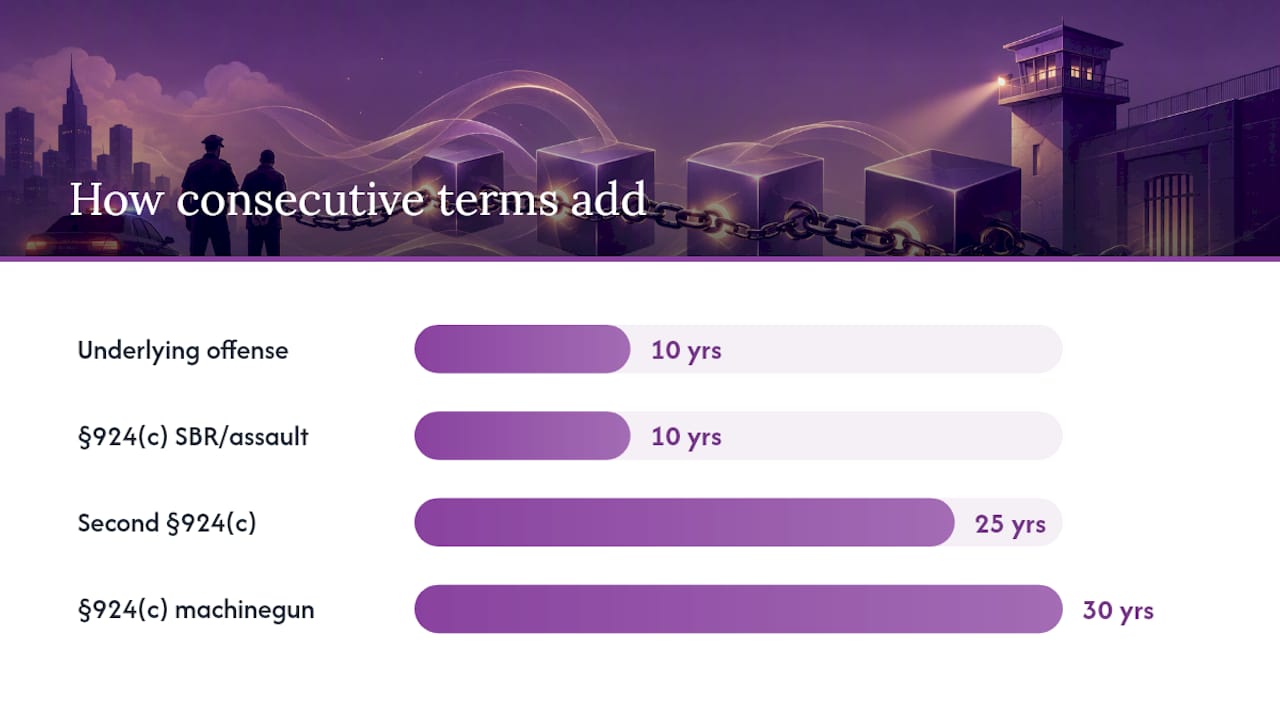
Here's what that looks like in practice. Take a defendant convicted of armed drug trafficking carrying a 10-year sentence on the underlying charge, plus a § 924(c) count for possession in furtherance involving a short-barreled shotgun. That's 10 years for the trafficking, plus 10 years mandatory and consecutive for the firearm, for a 20-year floor before any other enhancement, criminal history factor, or additional count enters the calculation. Add a second § 924(c) count from a separate, already-final conviction, and the math jumps by another 25 years minimum. This is precisely why federal firearm charges function less like an add-on penalty and more like a second, independent prosecution running on its own clock.
What Was "Stacking" and How Did the First Step Act Change It?
Stacking used to let prosecutors turn a single indictment into a life sentence by charging multiple § 924(c) counts in one case and treating each one after the first as a "second or subsequent" conviction, even when the defendant had never been convicted of anything before. Prosecutors could charge someone with three drug transactions in one indictment, attach a § 924(c) count to each, and demand the 25-year second-or-subsequent minimum on counts two and three, all in the same proceeding, against a first-time defendant.
Here's a numeric example of how brutal that got before 2018. A defendant charged with three armed drug sales in one indictment would face:
- Count one: 5-year mandatory minimum for the first § 924(c) violation
- Count two: 25-year mandatory minimum, stacked as a "second" offense despite arising from the same case
- Count three: another 25-year mandatory minimum, stacked again
That's 55 years of mandatory, consecutive firearm enhancement time alone, before adding a single day for the underlying drug counts, imposed on someone with no prior record.
The First Step Act of 2018 closed that loophole. It amended § 924(c) so the 25-year second-or-subsequent minimum now applies only when the defendant already has a prior § 924(c) conviction that became final before the new offense was committed, not when multiple counts are simply charged together in one indictment. Legal analysts describe this as Congress returning meaningful discretion to district judges, who had spent decades watching mandatory stacking override every other sentencing factor, according to Oregon Law Review's analysis of stacked § 924(c) convictions.
The catch is retroactivity, or the lack of it. Congress declined to apply the amendment retroactively, so anyone sentenced before December 21, 2018 under the old stacking regime remains subject to those decades-long consecutive terms, no matter how disproportionate the sentence looks under current law. People sentenced after that date benefit immediately. People sentenced before it are left with narrower, fact-specific relief options, which is exactly where compassionate release motions have started to fill the gap.

What Sentencing Relief Options Exist for a § 924(c) Conviction?
Total exposure calculations for § 924(c) cases have to account for two separate math problems: the underlying offense's guideline range, and the mandatory consecutive add-on that sits entirely outside that range. Defense counsel who treats these as one combined number, rather than two stacked calculations, routinely underestimates real exposure by years.
Before trial, the fight is almost always about whether the government can actually prove the firearm element, not just the underlying crime.
- Challenging whether possession was genuinely "in furtherance" of the offense, versus merely present in the same location
- Contesting the legality of the search or seizure that recovered the firearm
- Attacking chain-of-custody gaps between recovery and trial
- Arguing insufficient evidence connecting a specific defendant to a firearm found in a shared space like a vehicle or residence
Prosecutors often bring possession-in-furtherance charges whenever a firearm turns up on premises tied to a drug case, even when nobody brandished or fired it, which is exactly why early investigative work on constructive possession matters so much, per the 9th Circuit's model instruction.
After conviction, the paths narrow considerably. Section 3582 compassionate release remains the most viable route for people sentenced under the old stacking regime, allowing a court to reduce a sentence for "extraordinary and compelling reasons," which some courts have found includes the sheer disparity between a pre-2018 stacked sentence and what the same conduct would draw today. Direct appeals can challenge jury instructions, evidentiary rulings, or statutory interpretation, but they generally cannot undo a stacked sentence purely on non-retroactivity grounds, since Congress made that choice explicitly.
Pro Tip: A compassionate release petition built around § 924(c) stacking works best when it pairs the legal disparity argument with a detailed release plan, documented rehabilitation, and coordination with the Bureau of Prisons on timing. Petitions filed as bare legal arguments, without that supporting record, tend to stall.
The immediate priority for anyone facing a fresh § 924(c) charge is simple: preserve every fact that might undercut the possession-in-furtherance theory, and get counsel involved before any statement to investigators, because early motion practice on suppression issues often does more to reduce eventual exposure than anything filed after conviction.
How Have Courts Interpreted "Use," "Carry," and "In Furtherance"?
Judicial interpretation of § 924(c) has shifted the statute's boundaries more than any single act of Congress, and two cases anchor most of that history.
Deal v. United States addressed what counts as a "second or subsequent conviction" for stacking purposes, and the Supreme Court's answer, that multiple counts in a single indictment could qualify, is precisely what made pre-2018 stacking so devastating. That ruling stood for over two decades until the First Step Act legislatively overrode its practical effect for future cases.
Bailey v. United States went the other direction, narrowing what counted as "use" of a firearm to require active employment rather than mere accessibility, like a gun found in a glove compartment. Congress responded almost immediately by amending the statute to add the "possession in furtherance" theory, specifically to recapture conduct that Bailey had placed out of reach. That back-and-forth between the courts narrowing the statute and Congress widening it again is the defining pattern of § 924(c)'s history.
- Deal established that stacked counts within one indictment satisfied the second-or-subsequent trigger, later legislatively limited by the First Step Act
- Bailey narrowed "use" to active employment, prompting Congress to add the broader "possession in furtherance" language
- Circuit courts continue to split on how much connection between the firearm and the underlying crime satisfies "in furtherance," with some circuits requiring a closer nexus than others
- Current Supreme Court filings continue probing how stacking and judicial discretion interact with broader sentencing factors under 18 U.S.C. § 3553(a), reflected in recent amicus briefing on stacking and § 924(c) sentencing
For anyone facing charges today, these circuit splits are not academic. Where a case is charged and appealed can genuinely change which legal standard applies to the "in furtherance" element, which in turn shapes both charging decisions and how much leverage a defendant has at the plea table.
How Common Are § 924(c) Convictions, and Who Do They Affect?
Federal firearm enhancement cases represent a defined slice of the broader federal caseload, not a rare outlier. The U.S. Sentencing Commission tracks § 924(c) convictions annually, and its data shows the statute applies overwhelmingly to cases where a firearm accompanied a drug trafficking offense rather than a standalone violent crime.
| Metric | Pattern observed |
|---|---|
| Predicate offense type | Drug trafficking crimes account for the largest share of § 924(c) predicate offenses |
| Sentencing structure | Nearly all § 924(c) sentences run fully consecutive to the underlying offense, as required by statute |
| Post-First Step Act trend | Fewer multi-count stacked sentences in new cases since December 2018 |
| Weapon type in cases | Standard firearms far outnumber machinegun or destructive device enhancements |
The USSC's Section 924(c) firearms snapshot tracks these patterns across the federal system, offering the closest thing to a real-time picture of how the statute gets applied. That snapshot data also carries demographic detail that matters directly for mitigation arguments and compassionate release petitions, since sentencing courts increasingly look at population-level patterns when evaluating whether an individual sentence is an outlier, a point legal commentators have raised when discussing how USSC quick facts inform relief requests.
Since the First Step Act took effect, the data shows a meaningful drop in stacked multi-count sentencing for new cases, exactly the outcome Congress intended. The unresolved piece is the population still serving pre-2018 stacked sentences, a group large enough that compassionate release litigation around it continues actively in federal courts.
What Should You Do Right Away After a Federal Firearms Arrest?
The first 48 hours after an arrest involving a § 924(c) allegation often determine how much leverage a defense ultimately has. Evidence gets processed fast, and statements made without counsel present are almost impossible to walk back later.
- Say nothing substantive to investigators before an attorney is present, regardless of how routine the questions seem
- Identify and preserve any evidence bearing on who had actual access to or control over the firearm
- Document the circumstances of any search, including whether a warrant existed and what it authorized
- Flag immediately whether the case involves brandishing, discharge, or a weapon classification like a short-barreled firearm or suppressor, since those facts drive which mandatory minimum tier applies
- Get a defense attorney reviewing the discovery before any plea offer is evaluated
Rubin Law, P.C. approaches federal firearms cases the same way it approaches every serious charge: frequent courtroom presence and familiarity with how local federal prosecutors actually build these cases, not just how the statute reads on paper. That matters most in the early investigative window, when a possession-in-furtherance theory can sometimes be undercut before it hardens into an indictment.
Pro Tip: If a firearm was recovered from a shared space, a car, a shared apartment, a storage unit, get every fact about who else had access documented immediately. Constructive possession arguments often live or die on details that are easy to lose if nobody preserves them in the first week.
Anyone facing this kind of charge should treat the initial consultation as the most consequential meeting in the case, not a formality before the real work starts.
What Firearms and Devices Trigger § 924(c) Enhancements?
The statute's reach extends well past what most people picture as a "gun." Because § 924(c) borrows its definitions from § 921, the category of covered firearms includes standard handguns and rifles, but also several classifications that carry their own elevated mandatory minimums.
Short-barreled rifles and short-barreled shotguns, firearms modified below standard barrel-length thresholds, trigger the 10-year weapon-based tier rather than the standard conduct-based tiers. Semiautomatic assault weapons fall into that same 10-year category. Machineguns, meaning any weapon capable of firing more than one round per trigger pull, along with destructive devices like grenades or pipe bombs and firearms equipped with a silencer or muffler, trigger the steepest 30-year minimum.
Ordinary handguns and rifles without those modifications still fall under § 924(c), just at the lower conduct-based tiers of 5, 7, or 10 years depending on possession, brandishing, or discharge. The classification question, whether a weapon meets the technical definition of "short-barreled" or "assault weapon" under federal law, frequently becomes its own contested issue at trial, since the difference between tiers can mean 20 additional years.
Antique firearms and certain collector's items are generally excluded from these definitions, but that exclusion is narrow and fact-specific, and prosecutors don't hesitate to challenge a defense claim that a weapon qualifies for it.
How Does § 924(c) Differ From Other Federal Firearm Statutes?
Section 924(c) gets confused with several neighboring statutes, but the distinctions matter enormously for both charging strategy and sentencing exposure. Unlike straightforward firearm possession statutes, § 924(c) always requires a connection to an underlying predicate crime; it is never charged as a standalone offense.
Compare that to 18 U.S.C. § 922(g), the felon-in-possession statute, which criminalizes possession of a firearm by a prohibited person, someone with a prior felony conviction, a domestic violence conviction, or certain other disqualifying histories, regardless of whether that person was committing any other crime at the time. A § 922(g) case can stand entirely on its own. Section 924(c) cannot; it always rides alongside a separate violent or drug trafficking charge.
Section 924(a) covers different violations entirely, generally involving false statements in connection with firearm records or licensing violations, carrying far lower penalties than the mandatory minimums under § 924(c).
The practical significance is charging strategy. Prosecutors often stack a § 922(g) felon-in-possession count alongside a § 924(c) count in the same indictment when a defendant has a prior felony and was found with a firearm during a drug offense, creating overlapping but legally distinct exposure. Readers dealing with a parallel state-level possession issue, such as California's felon-in-possession statute under PC 29800(a)(1), should understand that state and federal firearm exposure can run on entirely separate tracks, sometimes simultaneously.
What Happens to Your Rights After a § 924(c) Conviction?
A § 924(c) conviction's consequences extend well beyond the years served. Federal law permanently bars anyone convicted of a felony, which every § 924(c) conviction is, from lawfully possessing a firearm or ammunition for the rest of their life, absent a rare restoration of rights.
Employment consequences follow close behind. Many professional licenses, security clearances, and federal contracting opportunities become permanently unavailable to anyone with a federal firearm-related felony on their record. Background check systems flag § 924(c) convictions specifically, since they signal firearm involvement in a serious federal crime, which tends to draw more scrutiny from employers than a nonviolent federal offense might.
Housing applications, professional certifications, and even certain forms of federal benefits eligibility can be affected as well, depending on the underlying predicate offense that accompanied the § 924(c) charge. Because § 924(c) never stands alone, these collateral consequences typically stack on top of whatever consequences the underlying drug trafficking or violent crime conviction already carries, compounding rather than replacing them.
For noncitizens, a § 924(c) conviction frequently triggers immigration consequences as well, including potential grounds for removal, since federal firearm and violent crime convictions are treated seriously under immigration law regardless of how long someone has held status in the United States.
These downstream effects are exactly why fighting the charge itself, or negotiating it down before conviction, carries weight far beyond the prison sentence alone.
What Are the Most Effective Defenses to a § 924(c) Charge?
Because § 924(c) requires proof of both a qualifying predicate offense and a specific connection between a firearm and that offense, defense strategy typically attacks one of those two links rather than the case as a whole.
Challenging the "in furtherance" element head-on is often the strongest available defense in possession cases, since prosecutors must show the firearm's presence actually advanced the crime, not merely coincided with it. A firearm locked in a safe in a different room than where drug activity occurred is a materially weaker case for the government than one found within arm's reach of drugs and cash.
Constructive possession disputes come up constantly in shared spaces. When a firearm is recovered from a car, apartment, or storage unit used by multiple people, the government has to prove the specific defendant had knowledge of and control over that firearm, not just proximity to it.
Suppression motions targeting the underlying search remain one of the most effective pretrial tools, since a successful Fourth Amendment challenge to how the firearm was recovered can eliminate the § 924(c) count entirely, regardless of how strong the underlying predicate case looks.
Finally, because § 924(c) depends entirely on a valid predicate offense, undermining that predicate charge, through insufficient evidence, statute-of-limitations issues, or a flawed indictment, can take the firearm enhancement down with it, since there's no crime for the firearm to have been used, carried, or possessed "in furtherance of."
Why Early Strategy Determines the Outcome in § 924(c) Cases
The mandatory minimums built into § 924(c) don't just set a sentencing floor. They shape every conversation that happens before sentencing ever comes up. When a prosecutor knows a possession-in-furtherance count adds a mandatory, consecutive five, ten, or thirty years, that number becomes the anchor for every plea negotiation from day one, regardless of how strong or weak the underlying evidence actually is.
That's precisely why aggressive motion practice early in a case, challenging the search, attacking constructive possession, testing the "in furtherance" nexus, matters more here than in almost any other area of federal criminal defense. A suppressed firearm doesn't just weaken the government's case. It can eliminate the mandatory minimum entirely, which changes the entire calculus of what a fair resolution looks like. Waiting until sentencing to make these arguments is waiting far too long.
— Jake
How Rubin Law, P.C. Defends Federal Firearms Charges
Federal firearms cases move fast, and the mandatory minimums built into § 924(c) leave almost no room for a passive defense. Rubin Law, P.C. builds its approach to federal weapons charges around early, aggressive motion practice, challenging searches, contesting possession theories, and pushing back on weapon classifications before they harden into an indictment.

That early intervention often determines whether a case ends in a stacked mandatory sentence or a resolution that actually reflects the facts. If you or someone in your family is facing a federal firearm allegation in Los Angeles County, the criminal defense team at Rubin Law, P.C. reviews the discovery, the search history, and the charging documents before any plea offer gets accepted. Reach out now to schedule a case review before critical deadlines pass.
Where to Verify These § 924(c) Rules Directly
Primary sources are worth reading directly, especially given how much sentencing exposure rides on precise statutory language.
- The USSC's Section 924(c) firearms snapshot tracks current sentencing data and case characteristics
- The DOJ's quick reference on federal firearms laws summarizes penalty structures in plain language
- The Oregon Law Review analysis of stacked § 924(c) convictions covers First Step Act retroactivity in depth
None of these substitute for case-specific legal advice. The stakes under this statute are too high to rely on general information alone.
This article is general information, not a substitute for advice from a qualified lawyer. Consult a qualified legal professional about your own circumstances before acting on anything here.
Sources
- Section 924(c) Firearms — United States Sentencing Commission
- Quick reference to federal firearms laws — U.S. Department of Justice
- Stacked Injustice and an Avenue for Relief: The Interplay of 'Stacked' § 924(c) Convictions and Expanded Compassionate Release — Oregon Law Review