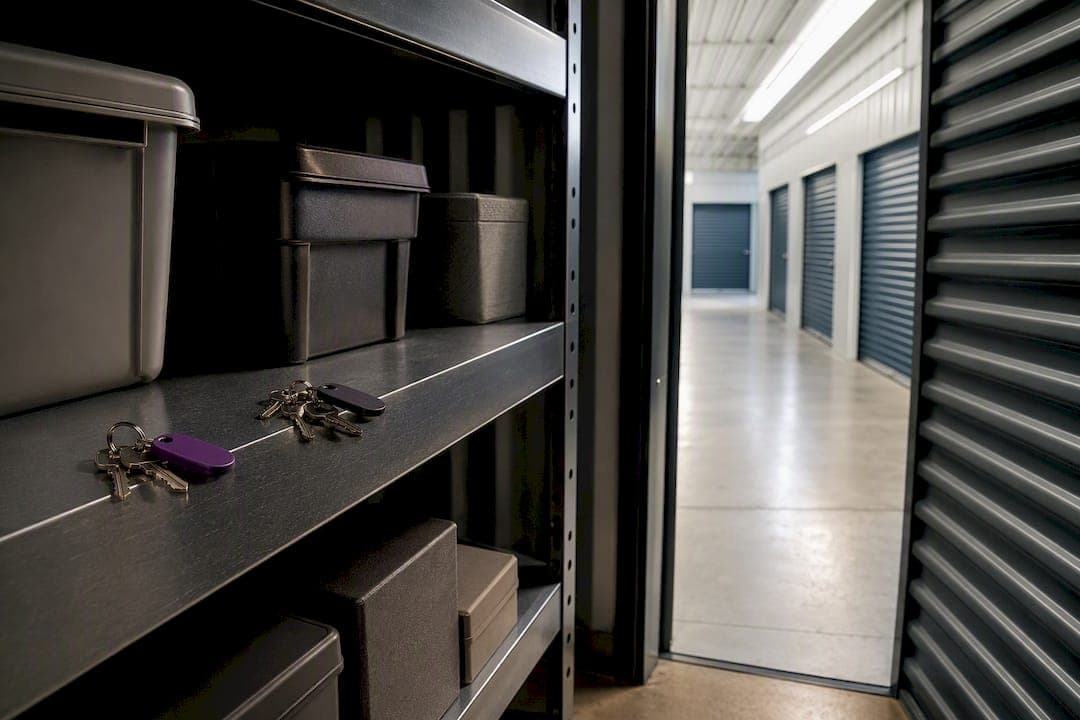
Constructive possession in California means you can be charged as if you physically held an illegal item, even if you never touched it, so long as you knew about it and had the ability or right to control it. The controlling authorities are Health and Safety Code §11350, Penal Code §29800, and CALCRIM No. 2304. That means a locked glove box, a shared closet, or a stash under a passenger seat can all lead to the same criminal exposure as if the drugs or gun were in your hand.
TL;DR:
- Prosecutors must prove knowledge of the item's presence and the ability to control it, even if the item was not physically on the defendant.
- Evidence such as keys, address registration, text messages, fingerprints, and prior statements are used to establish control and knowledge circumstantially.
- Shared spaces weaken the case unless additional evidence specifically links the defendant to the contraband, as proximity alone is insufficient.
- Effective defenses often involve challenging unlawful searches, asserting lack of knowledge, or demonstrating a genuine mistake about the item's nature.
- Preserving records, invoking the right to silence, and avoiding assumptions about search legality are critical immediately after an arrest to strengthen a defense.
Table of Contents
- What Constructive Possession Means Under California Law
- The Legal Elements Prosecutors Must Prove
- Real Scenarios: Drugs, Guns, Cars, and Storage Units
- When Roommates, Passengers, or Storage Renters Share Access
- Common Defenses Against Constructive Possession Charges
- Search Issues, Suppression Motions, and the Standing Paradox
- What to Do Immediately, and How a Defense Lawyer Evaluates Your Case
- How Constructive Possession Differs From Ownership and Custody
- Sentencing and Penalty Exposure for Constructive Possession Convictions
- How Investigators Build a Constructive Possession Case
- Where the Constructive Possession Doctrine Runs Into Trouble
- Why the Standard Advice on Possession Charges Falls Short
- How Rubin Law Approaches Constructive Possession Defense
- Sources
What Constructive Possession Means Under California Law
Actual possession is simple: the item is on your body or literally in your grip. Constructive possession is the legal workaround prosecutors use when nothing was found on the defendant directly. Under Cornell Law School's Wex definition, a person has constructive possession when they know an item exists and have the power to exercise control over it, whether or not they are anywhere near it at the moment of discovery.
California's jury instructions capture this same idea in plainer language. CALCRIM No. 2304 tells jurors that a defendant possessed a controlled substance if they knew of its presence, knew of its nature as a drug, and had control over it, either alone or with someone else. Notice what is missing from that instruction: physical contact. That is the entire point of the doctrine, and it is why so many California possession cases involve no fingerprints, no confession, and no eyewitness who saw the defendant holding anything.
A few quick contrasts make the line easier to see:
- Actual possession: Officers find a Magpie of methamphetamine in your jacket pocket during a pat down.
- Constructive possession: Officers find the same baggie in the center console of a car you were driving alone, with no one else's belongings inside.
- Immediate control: A firearm sits in your lap or waistband.
- Non-immediate but still constructive control: A firearm sits in a locked safe in your bedroom, and you own the only key.
The distance between "in your hand" and "in your space" is where most constructive possession fights happen. Prosecutors do not need proximity at the moment of arrest. They need proof you knew the item was there and could have accessed or directed it if you chose to. That single requirement, knowledge plus control, drives nearly every drug and firearm possession case built on circumstantial evidence rather than a direct catch.
The Legal Elements Prosecutors Must Prove
Every constructive possession case in California rests on the same two pillars: knowledge and control. Prosecutors cannot simply show an item existed near you. They have to connect it to your state of mind and your practical ability to do something with it.
The knowledge requirement actually has two layers, and missing either one can sink a case. The prosecution must prove you knew the item was physically present, and separately, that you knew what it was. LegalClarity's breakdown of California constructive possession law notes that many defenses succeed precisely because they knock out one of these two layers rather than denying the item existed at all. Someone might genuinely not know a duffel bag left by a friend contains a firearm. Someone else might know a bag is in their trunk but reasonably believe it holds clothing, not a controlled substance.
The control element gets proven through circumstantial evidence, since there is rarely anything direct. Courts and prosecutors typically look at:
- Who holds keys to the vehicle, room, safe, or storage unit where the item was found
- Whose name is on the lease, registration, rental agreement, or utility bill for the location
- Text messages, calls, or admissions referencing the item
- Fingerprints, DNA, or handwriting connecting the person to the container
- Prior statements to police, informants, or coconspirators
For drug cases, HSC §11350 criminalizes unlawful possession of specified controlled substances and does not require the drugs to be found on the defendant's body. For firearms, PC §29800 bars certain previously convicted individuals from having a gun, and its language explicitly covers "possession, custody, or control," a phrase broad enough to reach a weapon locked in a garage the defendant rarely visits.
Constructive possession cases almost never hinge on a single piece of evidence. They are built from a stack of smaller facts, keys, lease terms, texts, statements, that together persuade a jury the defendant knew and controlled the item. Weaken enough of those individual facts, and the whole stack can collapse.
Real Scenarios: Drugs, Guns, Cars, and Storage Units
Constructive possession plays out differently depending on where the item turns up and who else had access to that space.
- Contraband in a bedroom closet or safe. If drugs or a firearm surface in a closet inside your bedroom, and you are the sole occupant, prosecutors have an easy circumstantial argument: exclusive access plus knowledge is often inferred from occupancy alone. Add a personal item stored next to the contraband, and the case strengthens further.
- Contraband in a locked glove box. If you are the driver and the only person with keys or the combination to a locked glove compartment, courts routinely treat that exclusive access as strong evidence of control, even if you claim you never opened it recently.
- A passenger in someone else's car. This is where mere proximity often fails. In People v. Palaschak, California courts made clear that simply being near contraband, say, a passenger sitting above drugs stashed under a seat, does not by itself establish constructive possession. Prosecutors need something linking that specific passenger to the drugs: a statement, a prior connection to the substance, or evidence the passenger placed it there.
- A shared storage unit. When a unit is rented under one person's name but multiple people have the entry code, courts look at who actually used the unit, who paid for it, and whether any personal items tie a specific renter to the contraband inside.
The pattern across these examples is consistent. Exclusive access strengthens the state's case dramatically. Shared or incidental access weakens it, unless prosecutors bring additional evidence tying a specific person to the item.
When Roommates, Passengers, or Storage Renters Share Access
California law does not require exclusive control for a possession conviction. More than one person can constructively possess the same drugs or firearm at the same time, according to the Justia legal dictionary's entry on constructive possession. A married couple sharing a bedroom, three roommates sharing a common area, or two people who split rent on a storage unit can all theoretically face possession charges over the same item.
That rule sounds harsh until you look at how it plays out in practice. Because multiple people can be charged, prosecutors carry a heavier burden to link each individual defendant to the contraband specifically, not just to the shared space generally. Living in an apartment where drugs are found in a common closet does not automatically make every roommate guilty.
Defense attorneys look for the gaps in that individual linkage:
- No fingerprints, DNA, or handwriting connecting this specific defendant to the item or its container
- No texts, calls, or social media showing awareness of the item
- Testimony or evidence that another occupant had sole access to the specific location where the item was found
- Inconsistent police reports about who was present or who had keys at the relevant time
Shared-access cases often turn on exactly this kind of granular evidence. A defense built around "yes, I lived there, but there is nothing connecting me personally to that safe" has real traction when the prosecution's proof is thin on individual linkage.
Common Defenses Against Constructive Possession Charges
Because these cases rest so heavily on circumstantial inference, they are also unusually vulnerable to a well built defense. Four strategies come up again and again.
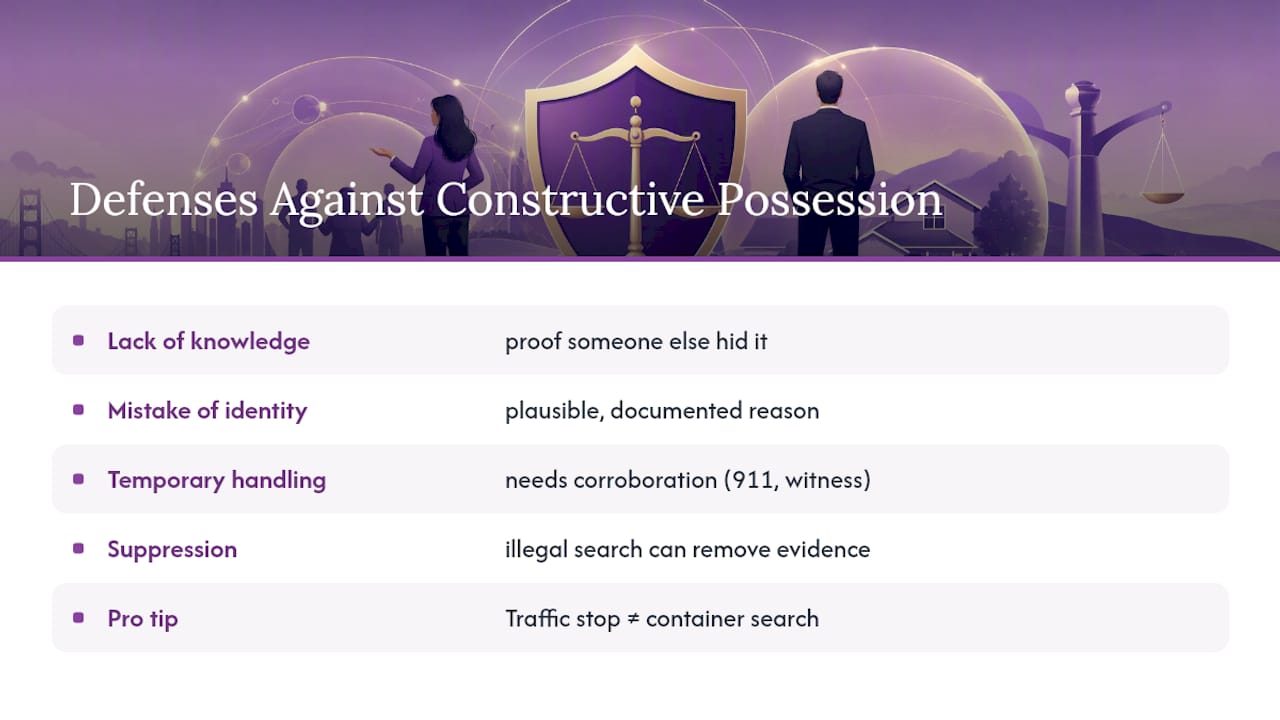
Lack of knowledge. If a third party hid the item without your awareness, that defeats the knowledge element outright. Evidence that helps here includes testimony from the person who actually placed the item, phone records showing you were elsewhere when it arrived, or evidence someone else had recently accessed the space without your permission.
Mistake of fact about the item's identity. Sometimes a person knows something is present but reasonably misidentifies it, mistaking a prescription bottle for something else, or believing a package contains a legal substance. This defense works best when there is a plausible, documented reason for the misunderstanding.
Temporary handling or disposal. Momentarily handling an item to dispose of it, say, picking up a bag someone dropped and intending to throw it away, can be a narrow defense. Courts scrutinize this closely, though, and it rarely succeeds without corroborating evidence like a 911 call or immediate voluntary disclosure to police.
Suppression of unlawfully obtained evidence. Since constructive possession cases run on circumstantial proof, the physical item itself is often the single most damaging piece of evidence. If it was found through an illegal search, a motion to suppress can remove it entirely. FindLaw's overview of California drug possession law notes that suppression frequently becomes the deciding factor in these prosecutions, because without the physical contraband, the state's circumstantial case often has nothing left to stand on.
Pro Tip: Do not assume a search was legal just because officers had a reason to stop you. A valid traffic stop does not automatically authorize a search of every locked container inside the vehicle. That distinction alone has ended more than one constructive possession case before it reached a jury.
Search Issues, Suppression Motions, and the Standing Paradox
Suppression motions are available whenever a search exceeded the scope of a warrant, occurred without one and without a recognized exception, or extended beyond what a routine traffic stop legally permits. If officers searched a locked trunk during a stop for a broken taillight with no independent justification, that search may be challengeable.
Standing to bring a suppression motion creates a genuine paradox in possession cases. To challenge a search, you generally need to show you had a reasonable expectation of privacy in the place searched, which means asserting some connection to that space or container. But asserting that connection is exactly the kind of admission that can also support the prosecution's constructive possession theory.
A few practical points on how this plays out:
- Claiming ownership or a right to access a glove box to challenge a search can simultaneously hand the prosecution evidence of your control over it.
- Defense attorneys sometimes challenge standing on behalf of a client while separately preserving arguments that undercut knowledge or control at trial.
- Courts weigh the totality of circumstances, so a successful suppression argument in one case might not translate cleanly to a similar case with different facts.
This tension is why suppression strategy in constructive possession cases requires careful sequencing. Raise the wrong argument at the wrong time, and you can inadvertently strengthen the very possession theory you are trying to defeat.
What to Do Immediately, and How a Defense Lawyer Evaluates Your Case
The hours right after an arrest or search matter more than most people realize.
- Invoke your right to counsel and stop talking. Anything you say about who owns an item, who had access, or why something was where it was found can be used to establish knowledge or control. Silence protects both defenses.
- Preserve records rather than deleting them. Texts, call logs, and location data can cut either way, but deleting them looks like concealment and can destroy a legitimate defense before it starts.
- Write down what you remember about the search itself. Note the time, what officers said, whether they had a warrant, and exactly what areas they searched. These details fade fast and often decide suppression motions.
- Gather witness information. Anyone who had access to the space, roommates, passengers, prior occupants, becomes relevant to a shared-access defense.
When defense counsel evaluates a constructive possession case, the intake process typically involves pulling police reports and body camera footage, subpoenaing phone and device records, checking the chain of custody on any seized evidence, identifying every person with access to the relevant space, and assessing whether a suppression motion is viable. That last step often determines the entire strategy, since a strong suppression argument can end a case before trial ever becomes necessary.
How Constructive Possession Differs From Ownership and Custody
People often assume owning something or having custody of it is the same as possessing it under criminal law. It is not, and the differences matter for anyone facing charges.
Ownership is a property law concept. You can own a car, a gun safe, or a storage unit without ever having constructive possession of illegal contents someone else placed inside it, provided you did not know they were there. Ownership creates a presumption worth addressing, but it is not itself proof of knowledge or control.
Custody typically refers to temporary physical charge of an item, often without full control over its disposition. A valet holding your car keys has custody of your vehicle for a few minutes, but almost certainly lacks the knowledge or independent control needed to be constructively possessing anything illegal inside it.
Constructive possession requires both knowledge and control together, regardless of ownership or custody labels. You can own something and not possess it constructively if you did not know about the illegal item. You can lack any ownership interest and still be found in constructive possession if you knew about the item and could direct what happened to it, like a renter with no lease in their name who nonetheless controls access to a storage unit.
The overlap between these three concepts is exactly where a lot of possession cases get won or lost, because prosecutors sometimes conflate ownership with knowledge when the two are legally distinct.
Sentencing and Penalty Exposure for Constructive Possession Convictions
A constructive possession conviction carries the same penalties as an actual possession conviction for the same offense. California law does not create a lesser sentencing tier for cases built on circumstantial proof rather than a direct physical catch.
That means a conviction under HSC §11350 for constructively possessing a controlled substance exposes a defendant to the same range of consequences as if the drugs were found in their pocket, including potential jail time, fines, and a criminal record that can affect employment and housing. A PC §29800 felon-in-possession conviction based on constructive possession of a firearm carries the same felony exposure as physically holding the weapon.
This equal treatment is precisely why the doctrine draws criticism, and why building a defense early matters so much. Because the penalty stakes are identical to actual possession, but the evidentiary path to conviction is often thinner and more circumstantial, a case built on constructive possession can sometimes be more vulnerable to a strong defense than one built on a direct physical find. The flip side is that prosecutors know this too, and they typically stack circumstantial evidence carefully before filing charges.
How Investigators Build a Constructive Possession Case
Law enforcement rarely stumbles into a constructive possession case by accident. Officers and detectives build these cases methodically, often over the course of days or weeks before an arrest ever happens.
Investigators typically start with the physical layout: who has keys, who has access codes, whose name appears on leases, registrations, or rental agreements. From there, they look for corroborating detail, surveillance footage showing who entered or exited a space, informant statements, or prior police contacts placing a suspect near the location repeatedly.
Digital evidence has become central to how these cases get built. Text messages discussing a stash location, photos stored on a phone, location data placing a suspect at a storage facility at a relevant time, and even smart device data can all become part of the government's proof of knowledge and control. Detectives frequently seek search warrants specifically for phone records once they identify a person of interest in a shared-access situation.
Interviews matter as much as physical evidence. Investigators will ask roommates, family members, and associates pointed questions designed to establish who knew what and who controlled which spaces. A single offhand statement, "that's my closet, nobody else touches it," can become the linchpin of an entire prosecution. This is exactly why defense counsel stresses silence immediately after any search or arrest.
Where the Constructive Possession Doctrine Runs Into Trouble
Constructive possession is not without serious critics, and the doctrine's flexibility is both its strength for prosecutors and its biggest vulnerability for defendants.
The core critique is that the doctrine can punish proximity and relationship status as much as actual wrongdoing. Someone who shares a home, a car, or a storage unit with a person who commits a crime can face identical charges and identical penalties, even when their actual involvement was minimal or nonexistent. Critics argue this creates pressure on people in shared households, particularly in domestic situations, to inform on partners or family members to avoid shared liability.
There is also a consistency problem. Because these cases rest on circumstantial inference rather than direct evidence, similar fact patterns can produce different outcomes depending on the jury, the judge, and how aggressively the defense challenges the state's linking evidence. People v. Palaschak drew a clear line against convicting on proximity alone, but the line between "mere proximity" and "sufficient circumstantial evidence" still gets litigated case by case, with outcomes that are not always predictable.
The standing paradox described earlier compounds this problem. A doctrine that can penalize someone for asserting the very privacy rights meant to protect them raises legitimate fairness concerns that California courts continue to wrestle with.
Why the Standard Advice on Possession Charges Falls Short
Most explainers treat constructive possession like a simple formula: knowledge plus control equals guilt. That framing undersells how much these cases actually turn on the quality of circumstantial linkage, not just its existence. A prosecutor can technically satisfy both elements on paper and still lose in front of a jury if the evidence connecting a specific defendant to a specific item feels thin.
The advice that gets overlooked most often involves timing. People fixate on trial strategy when the suppression motion, filed weeks or months earlier, is frequently what actually decides the case. Remove the physical evidence, and a circumstantial prosecution built on inference has almost nothing left to argue.
If you take one thing from this, prioritize documentation over explanation in the immediate aftermath of an arrest. Do not try to talk your way out of a search or explain access to a space. Preserve records, identify witnesses, and let counsel evaluate the search itself before anyone builds a theory of the case. The defendants who fare best are usually the ones who said the least and preserved the most.
— Jake
How Rubin Law Approaches Constructive Possession Defense
Constructive possession cases reward attorneys who know how local prosecutors build circumstantial arguments and how local judges rule on suppression motions. Rubin Law, P.C. appears frequently in Los Angeles County courtrooms, which shapes how the firm anticipates charging decisions and evidentiary weaknesses before they surface at trial.
A common approach centers on constitutional challenges to search and seizure, combined with diversion program options where a client's situation qualifies. If you are facing a drug possession charge under HSC §11350 or a firearm charge under PC §29800, the specific facts about access, knowledge, and how the item was found determine everything about possible defense options. Consider seeking consultation and bringing any relevant records, texts, lease documents, and witness names for case evaluation.
 Some law firms also handle related charges that often arise alongside possession cases, including possession for sale allegations where quantity or packaging is used to argue intent to distribute. For readers outside the immediate Los Angeles area researching related criminal definitions, resources like High Desert Family Law Group's overview of bigamy charges illustrate how California statutes generally define criminal conduct and penalties across different offense categories.
If you have been arrested or are under investigation for a possession-related offense, the fastest way to protect yourself is to speak with a Los Angeles drug crimes lawyer before making any statements to police. Call to schedule a consultation and bring your case details so the firm can begin assessing search issues, evidence gaps, and diversion eligibility right away.
This article is general information, not a substitute for advice from a qualified lawyer. Consult a qualified legal professional about your own circumstances before acting on anything here.
Sources
- Constructive possession — Wex Legal Dictionary / Cornell Law School
- California Health and Safety Code §11350 — California Legislative Information
- Constructive possession in California: Charges and defenses — LegalClarity