
If you need more time, investigation, or specialist expertise on your case, hire private counsel. If you qualify financially and your charges are relatively straightforward, a well-resourced public defender is a genuinely strong choice — not a fallback. The decision turns on three things: how serious the charges are, whether your defense requires outside investigators or expert witnesses, and whether you can realistically pay for private representation.
A few anchors worth knowing up front. The Sixth Amendment guarantees appointed counsel for any defendant facing potential incarceration. A CAPI Policy Lab study of San Francisco cases found defendants with public defenders were 6% less likely to be convicted and 22% less likely to receive a prison sentence compared with co-defendants who had private, court-appointed counsel. That finding alone should put to rest the idea that a public defender is automatically the inferior option.
Three fastest decision triggers:
- Case complexity and seriousness: Felony charges, potential prison time, or charges with collateral consequences (immigration, sex offender registration, professional licensing) almost always warrant private counsel.
- Need for outside resources: Cases involving digital forensics, toxicology, accident reconstruction, or expert witnesses require someone who can fund and direct that work quickly.
- Ability to pay or access funding: If you qualify for appointed counsel and your case is a first-time, lower-level offense, a public defender may serve you well. If you're on the line financially, weigh the stakes before assuming cost savings are worth it.
Table of Contents
- What is a public defender and how does the appointment process work?
- How do public defenders and private lawyers compare across the dimensions that matter?
- What are the real advantages and challenges of using a public defender?
- What are the real advantages and challenges of hiring private counsel?
- Do outcomes actually differ between public defenders and private lawyers?
- What does private counsel actually cost, and what extra expenses should you plan for?
- How do you request a public defender, and what makes you eligible?
- How do you decide which route to take, and what should you ask at your first meeting?
- Key Takeaways
- What the public defender vs. private lawyer debate usually gets wrong
- Facing serious charges in Los Angeles? Here is how Rubinlawpc can help
- Useful sources and where to read more
What is a public defender and how does the appointment process work?
Public defenders are licensed attorneys employed by government-funded offices to represent defendants who cannot afford private counsel. They hold the same law degrees and bar admissions as private lawyers — Franklin County's official FAQ confirms that public defenders graduate from accredited law schools and are admitted to the bar just like their private counterparts. The difference is structural: billing, caseload, and the scope of available resources.
The constitutional foundation is the Sixth Amendment, reinforced by Gideon v. Wainwright (1963), which requires states to provide counsel to any defendant facing potential imprisonment who cannot afford an attorney. In practice, this means that at your arraignment — your first court appearance after charges are filed — you tell the judge you cannot afford counsel. The court then runs a financial eligibility determination, asking about your income, assets, and dependents.
How appointment typically works:
The structural constraint that matters most is caseload. National bodies including the NLADA and ABA have documented public defender caseloads that far exceed those of private practitioners, which directly limits the time any one attorney can spend on your file. Most public defender offices have procedures to request funding for outside investigators or expert witnesses, but those requests go through an approval process and take time. State court rules and statutes govern how that funding is authorized and what conditions must be met, and statutory authority varies considerably by jurisdiction.
How do public defenders and private lawyers compare across the dimensions that matter?
| Dimension | Public Defender | Private Attorney |
|---|---|---|
| Cost / fees | No cost if eligible (some states charge nominal fees) | Private attorney fees vary widely depending on case type and complexity |
| Choice of counsel | Assigned by the court; no selection | You choose who represents you |
| Caseload / time per client | High caseloads documented by NLADA/ABA; limited hours per case | Typically lower caseloads; more hours available per file |
| Communication / responsiveness | Constrained by volume; in-person meetings often brief | Generally faster; direct access to your attorney |
| Specialization / experience | Deep courtroom experience in local dockets; may lack niche expertise | Varies widely; you can select a specialist (e.g., DUI science, sex offenses, federal RICO) |
| Access to investigators / experts | Available but requires court approval and takes time | Retained directly and quickly at client expense |
| Continuity of representation | Staff rotation possible; may change attorneys mid-case | Same attorney from intake through resolution (typically) |
| Plea bargaining / outcomes | Strong local relationships; efficient in routine dockets | More time to build leverage; better positioned for complex negotiations |
For high-stakes cases, three rows on that table carry the most weight. First, access to investigators and experts: a weapons charge involving ballistics, a DUI with disputed blood-alcohol science, or a money laundering defense requiring forensic accounting all need outside resources that a private attorney can deploy faster. Second, specialization: if your charge carries mandatory minimums, sex offender registration, or federal sentencing guidelines, you want someone who works that specific area regularly. Third, continuity: changing attorneys mid-case is disruptive and can cost you strategic momentum.
The three most decisive rows for high-stakes cases:
- Access to investigators and expert witnesses (speed and funding)
- Specialization in your specific charge type
- Continuity of representation through trial
What are the real advantages and challenges of using a public defender?
Public defenders bring genuine strengths that private attorneys often cannot match on one specific axis: local courtroom experience. An attorney who appears in the same courthouse every day knows the prosecutors, the judges' preferences, and the unwritten norms of that docket. As the National Law Review notes, this courtroom workgroup dynamic can enable efficient plea negotiations and outcomes comparable to private counsel in many routine dockets.
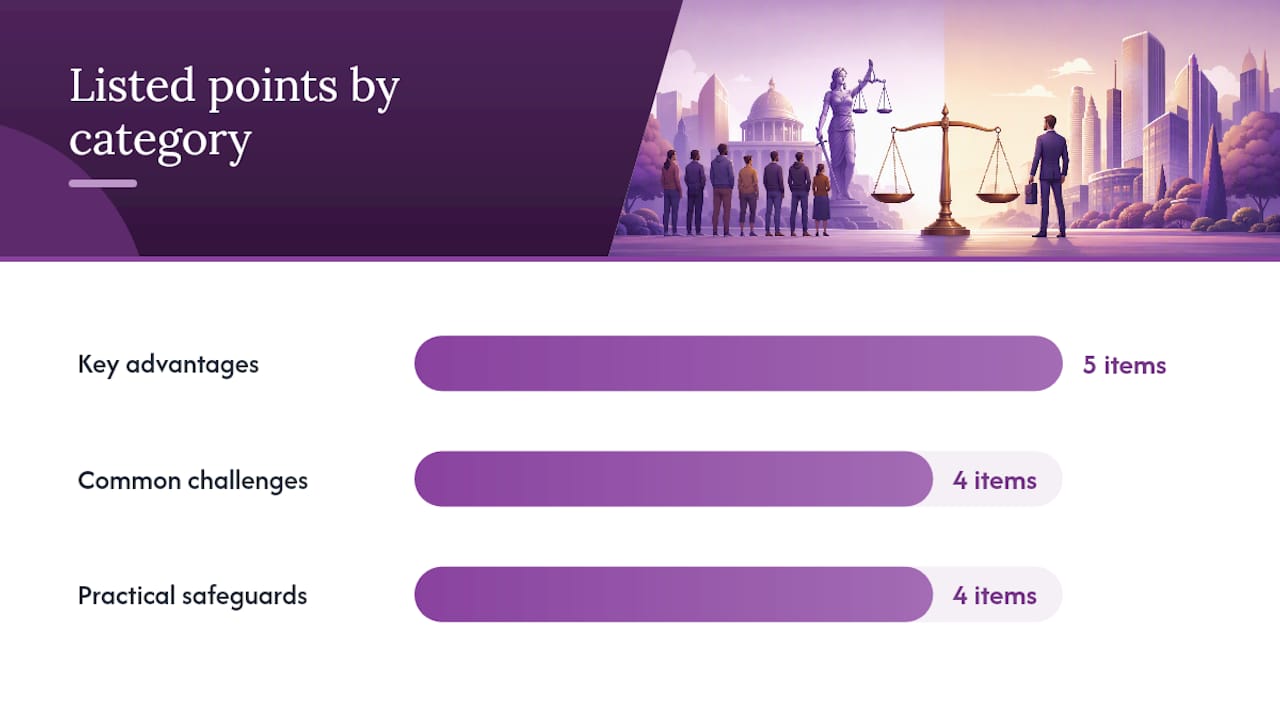
Key advantages:
- No cost if you qualify financially
- Deep familiarity with local prosecutors and judges
- Proven motion practice in common case types (drug possession, DUI, domestic violence)
- Institutional knowledge of local diversion programs and alternative sentencing options
Common challenges:
- High caseloads mean less time per client — this is the most documented structural limitation
- Slower access to outside investigators or expert witnesses (requires court approval)
- Possible attorney rotation, especially in large offices
- Communication is often limited to brief meetings before court dates
Pro Tip: Before your first meeting with a public defender, organize everything: write a one-page timeline of events, gather contact information for any witnesses, and bring documentation of employment, treatment history, or anything that supports mitigation. The more organized you are, the more productive that limited meeting time becomes.
What are the real advantages and challenges of hiring private counsel?
The core advantage of private representation is time and resources. A private attorney with a manageable caseload can spend more hours on your file, respond to your calls the same day, and hire an investigator without waiting for court approval. For cases where the facts are genuinely contested — or where the difference between a conviction and a dismissal depends on a suppression motion or an expert's testimony — that time and resource access matters.
Key advantages:
- More hours available per case
- Direct, faster access to investigators, expert witnesses, and private lab testing
- You choose your attorney and keep them through the case
- Ability to select someone with specific expertise in your charge type
- Faster pre-file intervention, which can sometimes prevent charges from being filed at all
Common challenges:
- Significant cost, with serious felony cases routinely running into five figures before trial
- Quality varies enormously among private attorneys — a high fee does not guarantee high effort
- Extra costs (investigators, experts, travel) stack on top of attorney fees
- Some attorneys take large retainers and then delegate work to less experienced associates
Practical safeguards before signing a retainer:
- Confirm in writing who will actually handle your case day-to-day
- Ask for a written fee agreement that specifies what is and is not included
- Clarify how investigative costs are billed and whether they require your approval above a threshold
- Ask directly: "Have you taken cases like mine to trial, and what were the results?"
Understanding what a criminal defense lawyer's duties actually include helps you hold any attorney accountable, whether public or private.
Do outcomes actually differ between public defenders and private lawyers?
The honest answer is: it depends, and the research is genuinely mixed.
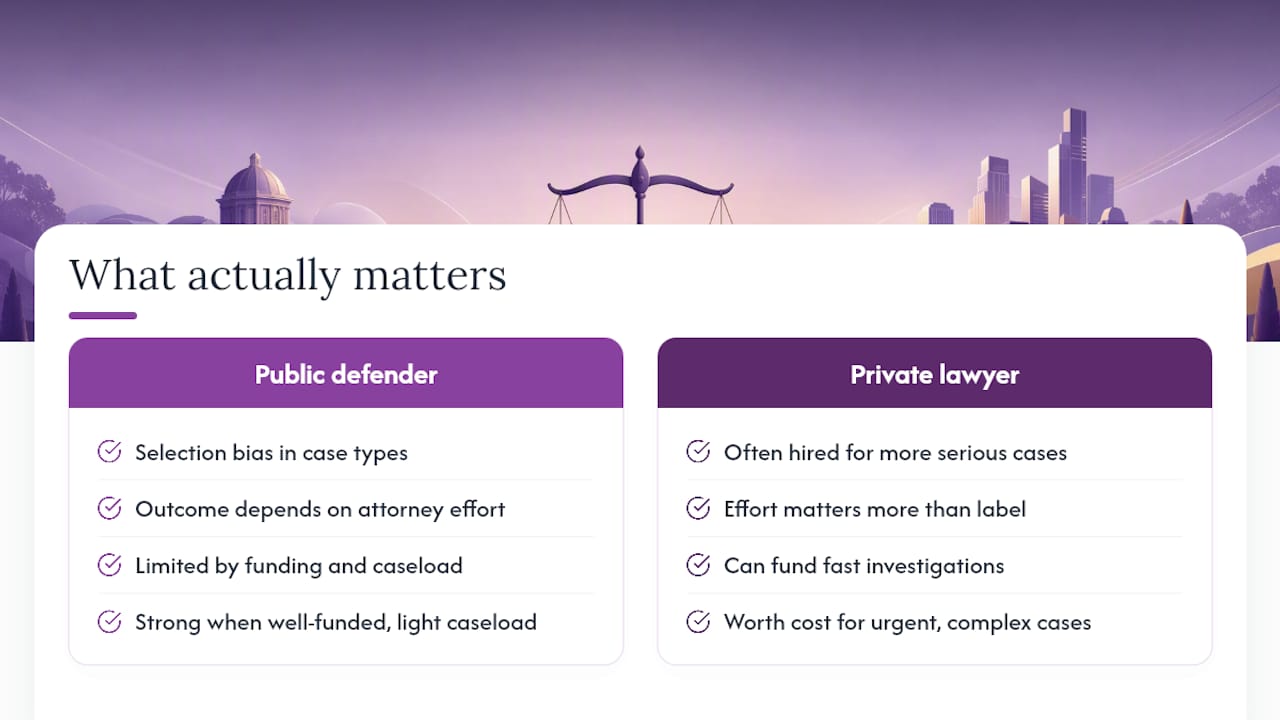
The San Francisco CAPI Policy Lab study found defendants with public defenders were 6% less likely to be convicted and 22% less likely to receive a prison sentence compared with co-defendants who had private, court-appointed counsel. That is a striking finding in favor of public defenders — in that jurisdiction, at that time.
A Journal of Criminal Justice study of a large Midwestern jurisdiction found no consistent direct effect of counsel type on case outcomes once other variables were accounted for. Results varied by charge type and individual case factors.
An econometric study of Denver cases found private counsel achieved better sentence outcomes on average — but the authors identified a critical confounding factor: "marginally indigent" defendants who can sometimes afford counsel tend to hire private attorneys specifically for their most serious or most winnable cases. That self-selection skews the comparison, making private counsel look better statistically even when the underlying attorney quality may not differ.
The most important variable in outcome research is not whether the attorney was public or private — it is whether the attorney actually did the work: filed motions, investigated the facts, and prepared for trial. Counsel type is a proxy for resources and time, not a guarantee of effort.
What this means practically: Do not choose based on the label. Choose based on whether the specific attorney handling your case has the time, resources, and track record to do the work your case requires.
What does private counsel actually cost, and what extra expenses should you plan for?
Private criminal defense fees vary widely by charge type, jurisdiction, and attorney experience. Misdemeanor and felony representation costs vary widely, with serious or complex cases potentially costing significantly more. Federal cases and those involving complex financial crimes or sex offense charges with registration consequences typically require higher fees.
Fee models to understand:
- Flat fee: Covers defined stages. Read the agreement carefully — many flat fees cover only through a preliminary hearing, not trial.
- Retainer plus hourly: The retainer is a deposit; you are billed against it at an agreed hourly rate. When it runs out, you replenish it.
- Payment plans: Some firms allow installment payments, but the full amount is typically owed regardless of case outcome.
Extra costs that stack on top of attorney fees:
- Private investigator: typically billed hourly, often $75–$150/hour
- Expert witnesses: forensic toxicologists, accident reconstructionists, and digital forensics specialists commonly charge $200–$500/hour for review and more for testimony
- Private lab testing (independent blood or DNA analysis)
- Court filing fees and transcript costs
As one practitioner summary notes, the critical factor is not the fee level but whether the attorney will actually do the work — file motions, investigate, and prepare for trial. A $500/hour attorney who delegates everything to a paralegal is a worse deal than a $250/hour attorney who personally handles your file.
If you are weighing whether a first offense warrants private counsel, this guidance on first criminal offenses is worth reading before you decide.
How do you request a public defender, and what makes you eligible?
The process starts at your first court appearance. Tell the judge — or the court clerk before you enter the courtroom — that you cannot afford an attorney and want appointed counsel. The court will give you a financial eligibility form to complete.
What the court will ask for:
- Monthly income (wages, benefits, any other sources)
- Assets (bank accounts, property, vehicles)
- Number of dependents
- Monthly expenses
Step-by-step process:
- At arraignment, state that you are requesting appointed counsel.
- Complete the financial eligibility form the court provides.
- The judge reviews the form and makes a determination, often the same day.
- If approved, a public defender is assigned. In conflict-of-interest situations (e.g., multiple co-defendants), the court may appoint a private attorney at public expense.
- If denied, you have the right to appeal the determination or hire private counsel.
Common reasons for denial:
- Income or assets above the county threshold
- Ownership of significant property or liquid assets
- Prior determination that you can afford counsel
If you are denied and genuinely cannot afford private representation, you can ask the court to reconsider with updated financial documentation. Some counties also have nonprofit legal aid organizations that handle criminal matters for low-income defendants who fall just above the eligibility line.
How do you decide which route to take, and what should you ask at your first meeting?
Three-step triage:
- Assess stakes and complexity. A felony with potential prison time, mandatory minimums, immigration consequences, or sex offender registration almost always warrants private counsel. A first-time misdemeanor with no collateral consequences may not.
- Evaluate time-sensitive investigative needs. If witnesses need to be interviewed quickly, surveillance footage needs to be preserved, or a blood sample needs independent testing, you need someone who can act now — not after a court approval process.
- Check ability to pay. If you qualify for a public defender and your case is relatively contained, the cost savings are real. If you are on the financial margin, weigh the stakes honestly before deciding that saving money is the right call.
Questions to ask any attorney at your first meeting:
- How many active cases are you currently handling?
- Who will do the day-to-day work on my file — you, or an associate?
- Have you handled cases with this specific charge, and what were the outcomes?
- What does your retainer cover, and what triggers additional billing?
- How will we communicate, and how quickly do you respond to calls or messages?
- What is your approach to suppression motions and pre-trial investigation?
Red flags to watch for:
- Evasive or vague answers about who actually handles the work
- No written fee agreement or a fee agreement that does not specify what is included
- Promises of guaranteed outcomes (no attorney can guarantee a result)
- No discussion of a trial strategy or investigation plan
- Pressure to sign a retainer before you have had time to review it
Pro Tip: If you are assigned a public defender and cannot switch to private counsel, you can still improve your outcome. Bring organized documentation to every meeting: a written timeline, witness contact information, employment records, and any mitigation materials (treatment completion letters, character references). Attorneys who receive organized clients can work faster and more effectively.
Consultation checklist:
- Confirm the attorney's name and direct contact information
- Ask for the fee agreement in writing before signing anything
- Clarify who handles court appearances if your attorney is unavailable
- Ask about plea bargaining in California and whether diversion is an option for your charge
- Request a written summary of the proposed defense strategy within two weeks of retention
Key Takeaways
A private attorney gives you more time, resources, and choice — but a well-resourced public defender with strong local courtroom experience can deliver comparable outcomes in many cases, and research confirms it.
| Point | Details |
|---|---|
| Case stakes drive the decision | Felony charges, collateral consequences, or contested facts almost always justify private counsel. |
| Research shows mixed results | San Francisco data favored public defenders; Denver data favored private counsel after controlling for selection bias. |
| Caseload is the core constraint | Public defenders carry far higher caseloads than private attorneys, limiting time and investigative resources per client. |
| Vetting matters more than the label | Ask who does the work, confirm it in writing, and watch for red flags regardless of whether counsel is public or private. |
| Rubinlawpc handles high-stakes LA cases | Rubin Law, P.C. provides private criminal defense in Los Angeles for DUI, drug crimes, domestic violence, sex offenses, and federal charges. |
What the public defender vs. private lawyer debate usually gets wrong
The conventional framing treats this as a quality contest: private attorneys are better, public defenders are overwhelmed. That framing misses the actual variable. The research does not consistently show that private attorneys produce better outcomes. What it shows is that defendants with more resources tend to hire private counsel for their most serious cases, which skews the comparison. Strip out that selection effect, and the gap narrows considerably — or reverses, as the San Francisco data shows.
The real question is not "public or private?" It is "will this specific attorney do the work?" A public defender who files suppression motions, investigates the facts, and knows the local docket cold can outperform a private attorney who takes a large retainer and then phones it in. The San Francisco finding is not a fluke. Public defenders in well-funded offices with manageable caseloads are formidable attorneys. The problem is that not every office is well-funded, and not every caseload is manageable.
Where private counsel genuinely earns its cost is in cases that require fast, funded investigation — a blood draw that needs independent testing before the sample degrades, a witness who needs to be interviewed before they disappear, a forensic expert who needs to be retained before the prosecution's expert shapes the narrative. Those are time-sensitive resource decisions that a private attorney can make without a court approval process. For those cases, the cost is not a luxury. It is the defense.
What I tell people who are on the margin: if you are facing a charge that could follow you for life — a sex offense, a federal conviction, a DUI with injury — the cost of private counsel is not the right variable to optimize. The stakes are.
Facing serious charges in Los Angeles? Here is how Rubinlawpc can help
When the charges are serious and the stakes are high, Rubinlawpc offers what a public defender structurally cannot: dedicated time, funded investigation, and attorneys who appear in Los Angeles courtrooms regularly enough to know exactly how local prosecutors and judges approach specific charge types.
Rubin Law, P.C. handles DUI defense, drug crimes, domestic violence, sex offenses, violent crimes, and federal charges across Los Angeles County. The firm uses constitutional search-and-seizure challenges, pre-file intervention, and diversion programs to pursue reduced or dismissed charges. For complex cases, the firm funds investigators and expert witnesses directly. To schedule a consultation, contact Rubin Law, P.C. through rubinlawpc.com/criminal-defense — bring your charging documents, a written timeline of events, and any paperwork you have received from the court or law enforcement.
Useful sources and where to read more
- Public Defenders Effective As Private Attorneys? (NatLawReview)
- An Empirical Study of Public Defender Effectiveness: Self-Selection by the 'Marginally Indigent' (bepress)
- What is the difference between public defenders and private attorneys? (Franklin County PA FAQ)
- Private Attorney vs. Public Defender: The Question Nobody Answers Honestly (ImNotAnAttorney blog)
- Maryland courts: rules and supporting documents (mdcourts.gov)
- Maryland statute on public counsel appointment (mgaleg.maryland.gov)