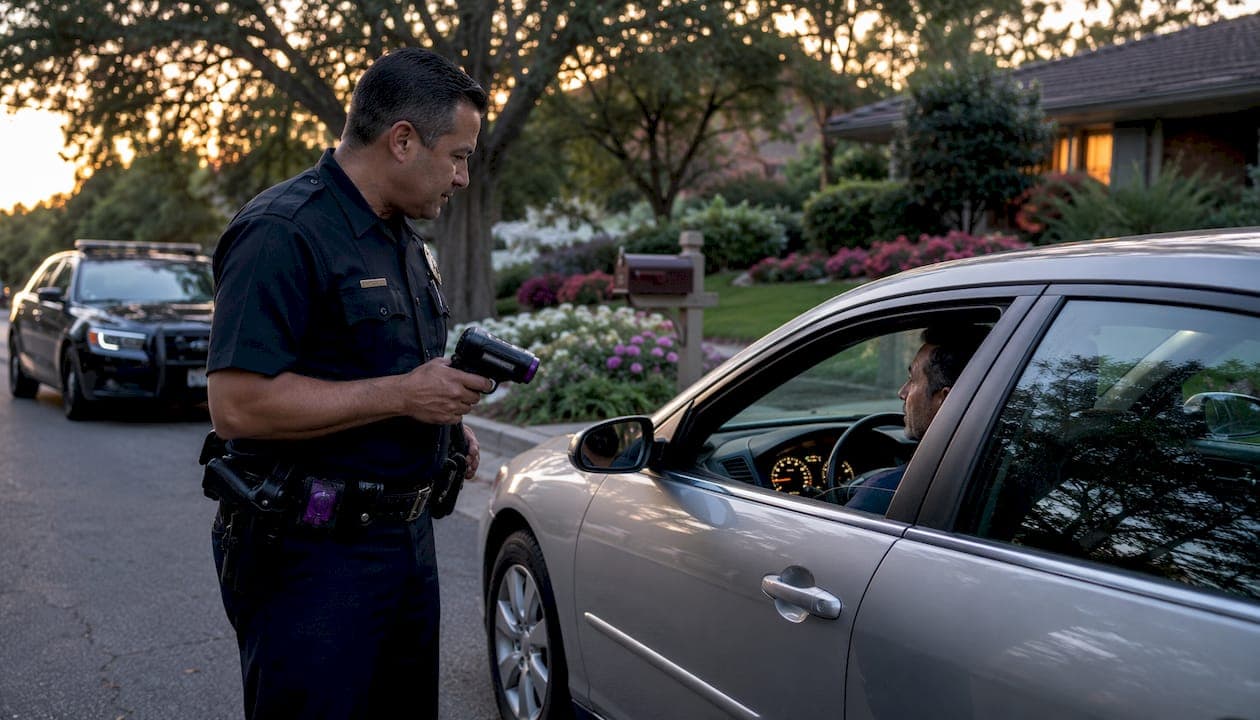
A police officer may stop your car when they have at least reasonable suspicion of a traffic violation or criminal activity. Probable cause is the higher standard and is required for arrests, full vehicle searches, and certain detention scenarios. Three authorities control this area of law: the Fourth Amendment, Terry v. Ohio (1968), and Whren v. United States (1996). A fourth case, Rodriguez v. United States (2015), sets the outer time limit on how long a stop may last.
What typically meets reasonable suspicion:
- Weaving between lanes or erratic driving
- A broken taillight or expired registration sticker
- An officer's observation that a driver appears impaired
- A tip from a credible informant about a specific vehicle
What commonly rises to probable cause:
- An officer smells marijuana or alcohol from inside the vehicle
- Contraband is visible in plain view on the seat
- A driver fails field sobriety tests
- A valid warrant exists for the registered owner
Prouse established that random stops without any individualized suspicion violate the Fourth Amendment. Terry authorized brief investigatory stops on reasonable suspicion alone. Whren confirmed that an officer's subjective motive is irrelevant when objective probable cause supports the stop.
Table of Contents
- What is the difference between reasonable suspicion and probable cause?
- When is a traffic stop legally justified?
- What searches are permitted during a traffic stop?
- How long can an officer legally detain you during a stop?
- Can a stop based on an officer's legal mistake still be valid?
- What should you do during a traffic stop to protect your rights?
- How do you challenge an unlawful stop or search in court?
- Practitioner perspective: when to call a lawyer and what to tell them
- What probable cause standards apply specifically to DUI stops?
- How does probable cause affect sobriety checkpoints?
- How does probable cause application vary by state?
- Key Takeaways
- Why traffic-stop challenges are worth taking seriously
- Facing charges after a traffic stop? Rubin Law, P.C. can help
- Useful sources and primary authorities
What is the difference between reasonable suspicion and probable cause?
These two standards sit on the same constitutional spectrum but require very different levels of proof.
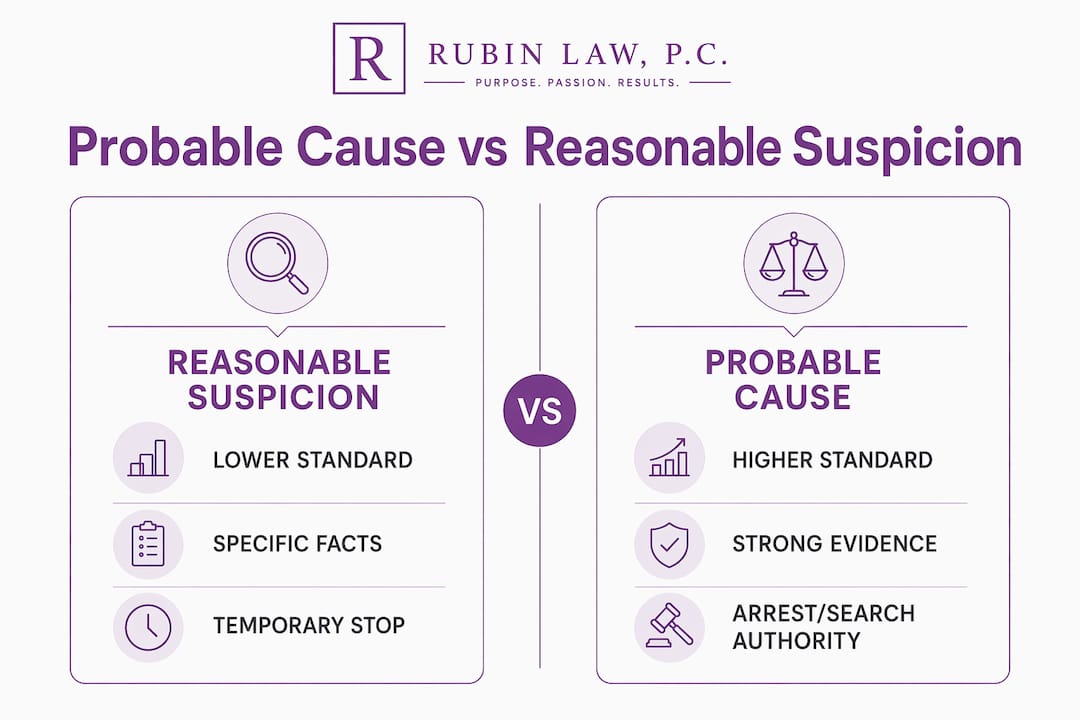
Reasonable suspicion means an officer can point to specific, articulable facts that, taken together with rational inferences, support a belief that criminal activity is occurring or about to occur. It is deliberately a lower bar. The Supreme Court designed it in Terry v. Ohio to allow brief, limited investigatory stops without requiring the full evidentiary weight of probable cause. An officer who sees a driver run a red light at 2 AM and then swerve has reasonable suspicion. That is enough to pull the car over.
Probable cause demands more. Under Cornell Law's LII definition, probable cause exists when the facts and circumstances within an officer's knowledge would lead a reasonable person to believe that a crime has been committed or that evidence of a crime is present in a specific location. It is the constitutional floor for arrests, search warrants, and most warrantless vehicle searches.
A quick illustration: an officer who sees a car drifting has reasonable suspicion to stop it. Once the driver rolls down the window and the officer smells alcohol and sees an open bottle on the passenger seat, probable cause has arrived. The stop was lawful on reasonable suspicion; the arrest and search that follow require the higher standard.
When is a traffic stop legally justified?
Courts have recognized several categories of facts that satisfy the traffic stop legal requirements under the Fourth Amendment.
Accepted bases for a lawful stop include:
- Observed moving violations: speeding, running a red light, failure to signal, illegal lane change
- Equipment defects: broken taillights, cracked windshields, missing license plates
- Registration or licensing issues: expired tags, a plate that returns to a different vehicle
- Signs of impairment: swerving, slow reaction at signals, the odor of alcohol
- Reasonable suspicion of other criminal activity: matching a BOLO description, fleeing a known crime scene
- Administrative checkpoints: sobriety checkpoints and license-check roadblocks (discussed separately below)
Delaware v. Prouse drew a firm line: an officer cannot randomly pull over a car simply to check the driver's license and registration with no individualized suspicion. The stop must be tethered to specific, observable facts about that particular vehicle or driver.
Whren v. United States addressed the pretext question directly. Two plainclothes officers in Washington, D.C., stopped a truck for a traffic violation but were primarily interested in suspected drug activity. The Court held unanimously that probable cause for a traffic violation makes a stop reasonable under the Fourth Amendment regardless of the officer's subjective motivation. If the objective facts support the stop, the officer's real reason does not matter.
Passengers are also "seized" during a stop, even though the stop is directed at the driver. Brendlin v. California (2007) confirmed that passengers may challenge the constitutionality of the stop itself, not just any search directed at them. Jurisdictional variations exist: some states give passengers broader rights to refuse to identify themselves; others require identification from all vehicle occupants. California, for example, does not require passengers to provide ID unless they are being detained on independent suspicion.
What searches are permitted during a traffic stop?
The stop itself does not automatically authorize a search. Each type of search requires its own legal justification.
| Search Type | What the Court Requires | Typical Triggering Facts |
|---|---|---|
| Consent search | Voluntary, uncoerced consent from the driver or owner | Officer asks; driver agrees without pressure |
| Search incident to arrest | Lawful custodial arrest of an occupant | Driver arrested for DUI, outstanding warrant, or discovered offense |
| Vehicle exception (Carroll doctrine) | Probable cause to believe the vehicle contains contraband or evidence | Odor of drugs, plain-view contraband, informant tip |
| Plain view / plain smell | Contraband immediately apparent without any search | Open bag of marijuana visible on seat; strong odor of alcohol |
| K-9 sniff (exterior) | No warrant or suspicion required for exterior sniff — but stop cannot be prolonged to wait for the dog | Dog already on scene or arrives before stop concludes |
| Inventory search | Lawful impoundment of the vehicle | Arrest leads to impoundment; standard department policy governs |
You have a constitutional right to refuse a consent search. Refusing does not give the officer probable cause to search. However, if the officer already has probable cause from an independent source (the smell of drugs, something in plain view), your refusal does not block the search. Stating your refusal clearly on the record still matters: it preserves the argument later that any search was not consensual, which can strengthen a suppression motion.
On consent searches, do and don't:
- Do say clearly: "I do not consent to a search of my vehicle."
- Do remain calm and keep your hands visible while saying it.
- Don't physically resist if the officer proceeds anyway.
- Don't assume silence equals consent; courts sometimes treat silence ambiguously.
- Do note the time, the officer's badge number, and any witnesses.
Rodriguez v. United States (2015) is the controlling case on K-9 sniffs. The Court held that extending a completed traffic stop, even by a few minutes, solely to wait for a drug-detection dog violates the Fourth Amendment unless the officer has independent reasonable suspicion of drug activity. The stop's mission is to address the traffic infraction; once that is done, the detention must end or fresh justification must exist.
How long can an officer legally detain you during a stop?
A traffic stop must be temporary and limited in scope. The officer may take the time reasonably needed to handle the reason for the stop, and no more.
A typical stop follows this sequence:
- Vehicle pulled over — the seizure begins the moment you comply with the officer's signal.
- Officer approaches, requests license and registration — this is the core of the stop's lawful mission.
- Officer runs license and warrant checks — standard procedure, constitutionally permissible.
- Officer issues citation or warning — the stop's purpose is now complete.
- Officer must allow you to leave — unless new, independent facts justify continued detention.
Steps 1 through 4 are the lawful window. Any investigation that goes beyond addressing the traffic infraction, such as questioning about unrelated crimes, asking you to step out for a drug investigation, or waiting for a K-9 unit, requires fresh reasonable suspicion or probable cause developed during the stop.
Rodriguez made this bright-line rule explicit: a seven-to-ten minute extension of a completed stop to conduct a dog sniff was unconstitutional because the officer had no independent basis to suspect drug activity. The duration of the original stop was not the issue; the issue was that the stop's mission had ended.
Red flags that suggest an unlawful prolongation:
- The officer has already issued the citation but continues to question you about unrelated matters.
- You are asked to wait in the patrol car while the officer "checks a few things" with no explanation.
- A K-9 unit arrives after the stop's purpose has concluded and there was no pre-existing suspicion of drugs.
- The officer repeatedly asks the same questions about your travel plans or passengers.
If any of these happen, stay calm, do not argue, and document everything. These facts are exactly what a defense attorney needs to file a suppression motion.
Can a stop based on an officer's legal mistake still be valid?
Sometimes. The Supreme Court addressed this directly in Heien v. North Carolina (2014), holding that an officer's objectively reasonable mistake of law can provide the reasonable suspicion needed for a valid stop. In Heien, an officer stopped a car because one brake light was out, believing North Carolina law required two working brake lights. The statute actually required only one. The Court upheld the stop because the officer's reading of the law was reasonable, even though it was wrong.
State courts vary in how far they extend this doctrine. Some states follow Heien closely; others limit it, requiring that any mistake of law be particularly reasonable or that the statute be genuinely ambiguous. Wisconsin's Supreme Court, for example, has analyzed the Heien framework and applied it with attention to whether the officer's interpretation was objectively defensible at the time.
On pretext, Whren is the federal rule: subjective officer motive does not invalidate a stop supported by objective probable cause. An officer who genuinely wants to investigate drug activity but stops you for a broken taillight has made a lawful stop, provided the taillight violation is real. The Fourth Amendment asks whether the objective facts justified the stop, not why the officer chose to make it.
A stop may still be contestable when:
- The alleged violation did not actually occur (dashcam footage contradicts the officer's account).
- The officer's mistake of law was not objectively reasonable (the statute was clear, not ambiguous).
- The stop was based on a description so general that it could apply to thousands of vehicles.
- The officer relied on a tip that lacked sufficient reliability or corroboration.
What should you do during a traffic stop to protect your rights?
Safety comes first, every time. The ACLU and AAMVA both emphasize that asserting rights at the scene rarely resolves a dispute and can escalate a situation. The place to fight a bad stop is in court, not on the roadside.
- Signal and pull over promptly to a safe location, as far right as possible. At night, turn on your interior light.
- Turn off the engine, roll down your window, and place your hands on the steering wheel. Do not reach for anything until asked.
- Provide your license, registration, and proof of insurance when requested. In most states, drivers must provide these; passengers generally do not have to identify themselves unless independently detained.
- Stay calm and speak respectfully. You do not have to answer questions about where you are going or what you have been doing.
- If asked to step out of the vehicle, comply. Pennsylvania v. Mimms (1977) gives officers the right to order drivers out of a stopped car.
- If asked for consent to search, decline clearly: "Officer, I do not consent to a search of my vehicle." Say it once, calmly, and do not repeat it aggressively.
- Do not physically resist any search even if you believe it is unlawful. Resistance creates new legal problems and physical danger.
- Document everything afterward: officer's name and badge number, patrol car number, exact location, time, what was said, and any witnesses. If your phone was recording, do not delete the footage.
Pro Tip: Write down or voice-memo your account of the stop within an hour of the encounter, while details are fresh. Courts give significant weight to contemporaneous notes, and your memory of specific words and sequence will fade quickly.
The ACLU's guidance is direct: de-escalation and documentation are your primary tools at the scene. Accountability happens later, through legal channels.
How do you challenge an unlawful stop or search in court?
The primary remedy for a Fourth Amendment violation is the exclusionary rule: evidence obtained as a result of an unlawful stop or search is suppressed and cannot be used against you at trial. The mechanism is a motion to suppress, filed before trial, asking the court to exclude the tainted evidence.
Before you see an attorney, gather:
- Any dashcam or phone footage of the stop
- The officer's name, badge number, and patrol car number
- Names and contact information for any witnesses
- The citation or arrest paperwork you received
- Medical records if you were injured during the stop
- A written timeline of events you prepared immediately after
Timing matters. Suppression motions in criminal cases are typically filed before arraignment or at a pretrial hearing, and deadlines vary by jurisdiction. Missing the filing window can waive the suppression argument entirely. Consulting a criminal defense attorney as soon as possible after an arrest is not just good advice; it is often the difference between evidence being excluded and evidence being used against you.
Civil remedies also exist. Under 42 U.S.C. § 1983, a person whose constitutional rights were violated by a government actor may sue for damages. These cases are complex and require proof of a constitutional violation and, in most circumstances, that the officer was not entitled to qualified immunity. If you believe you have a civil-rights claim, a civil-rights attorney should evaluate it separately from your criminal defense.
Any traffic stop can trigger criminal consequences, and individuals who believe their rights were violated should preserve evidence and seek legal counsel to pursue suppression or other remedies.
Practitioner perspective: when to call a lawyer and what to tell them
Most people who contact a criminal defense attorney after a traffic stop are not sure whether what happened to them was actually unlawful. That uncertainty is normal, and it is exactly why early consultation matters.
Get an attorney involved immediately if:
- You were arrested during or after the stop
- Officers searched your vehicle and found anything, whether it was yours or not
- You were charged with DUI or drug possession
- You were injured during the encounter
- Witness accounts conflict with the officer's report
- You believe the stop was based on your race or appearance rather than observed conduct
Pro Tip: Do not delete any phone recordings of the stop, even if the audio or video quality is poor. Partial footage showing the officer's demeanor, the duration of the stop, or the absence of the alleged violation can be decisive in a suppression hearing.
Rubin Law, P.C. handles search-and-seizure challenges as a core part of its criminal defense practice in Los Angeles. Early suppression investigations typically include retrieving body-cam and dash-cam footage, subpoenaing dispatch logs, and conducting factual witness interviews to reconstruct the stop timeline. For readers facing Miranda rights questions after a custodial stop, the firm's blog addresses those rights in detail.
What probable cause standards apply specifically to DUI stops?
DUI stops follow the same two-tier framework, but the triggering facts are specific to impairment.
Reasonable suspicion for a DUI stop can arise from a single observed behavior: weaving within a lane, driving significantly below the speed limit late at night, stopping at a green light, or making an unusually wide turn. Courts have consistently held that one or two objective indicators of impaired driving are enough to justify the initial stop.
Probable cause for a DUI arrest requires more. An officer typically needs a combination of factors: the odor of alcohol, slurred speech, bloodshot or watery eyes, poor performance on field sobriety tests, or a preliminary alcohol screening result. No single factor is automatically sufficient, and courts evaluate the totality of the circumstances the officer observed before making the arrest decision.
Once probable cause for DUI exists, the vehicle exception and search-incident-to-arrest doctrine both apply. Officers may search the passenger compartment and may require a breath or blood test under implied-consent laws. Refusing a chemical test in California triggers administrative license suspension under Vehicle Code § 23612, separate from any criminal charge. The DUI evidence standards in California are detailed and fact-specific; a DUI arrest does not automatically mean the probable cause was adequate.
For readers facing DUI charges after a stop, consulting a Los Angeles DUI attorney who understands both the traffic-stop constitutional issues and the evidentiary requirements is the right first step.
How does probable cause affect sobriety checkpoints?
Sobriety checkpoints operate under a different constitutional framework than ordinary traffic stops. The Supreme Court addressed this in Michigan Dept. of State Police v. Sitz (1990), holding that properly conducted sobriety checkpoints do not violate the Fourth Amendment even though officers stop vehicles without individualized suspicion.
The key is that checkpoints must follow neutral, predetermined criteria. Officers cannot choose which cars to stop based on personal discretion. The checkpoint must be publicly announced, operate under written guidelines, and apply the same procedure to every vehicle or to vehicles selected by a fixed pattern (every third car, for example). California courts have added additional requirements under the state constitution, including advance public notice.
At a checkpoint, the initial stop requires no probable cause or reasonable suspicion at all. However, if the brief interaction at the checkpoint produces observable signs of impairment, the officer now has reasonable suspicion to conduct a more thorough investigation and, if that investigation produces enough evidence, probable cause to arrest. The checkpoint is the gateway; individual probable cause still governs what happens next.
Some states have rejected sobriety checkpoints entirely under their own state constitutions. Michigan, Oregon, Idaho, Minnesota, Rhode Island, Texas, Wisconsin, and Wyoming, among others, either prohibit them by statute or have found them unconstitutional under state law. If you were stopped at a checkpoint outside California, the applicable rules depend on that state's specific constitutional framework. A DUI defense attorney familiar with that jurisdiction, such as a DUI defense attorney in your state, can evaluate whether the checkpoint procedures were followed correctly.
How does probable cause application vary by state?
The Fourth Amendment sets the federal floor, but states can and do provide greater protections under their own constitutions. This creates real variation in how traffic-stop standards apply across the country.
Key areas where states diverge:
Mistake-of-law doctrine: After Heien, states split on how broadly to apply the reasonable-mistake rule. Some follow the federal standard closely; others require that the statutory ambiguity be genuine and significant before excusing an officer's legal error.
Passenger identification: About half of U.S. states have "stop and identify" statutes that require individuals to provide their name when lawfully detained. California does not require passengers to identify themselves during a routine traffic stop unless they are independently detained.
Pretextual stops and racial profiling: Several states have enacted statutes or court rules that go beyond Whren and require officers to document the stated reason for a stop. Washington State, for example, has enacted legislation addressing racially disparate stops, and some state courts have shown more willingness than federal courts to examine the circumstances surrounding allegedly pretextual stops.
Search and seizure under state constitutions: States like Oregon and Washington have interpreted their state constitutions to require more than the federal minimum for vehicle searches. An Oregon officer, for instance, generally needs a warrant to search a vehicle even when federal law would allow a warrantless search under the automobile exception.
Cannabis and probable cause: As more states legalize marijuana, courts are wrestling with whether the odor of cannabis alone still constitutes probable cause for a vehicle search. In California, the smell of marijuana is no longer automatically sufficient to establish probable cause for a search, given that adult possession is legal. Other states have reached different conclusions. The California criminal laws page at Rubin Law, P.C. tracks relevant state-specific standards.
The practical takeaway: the federal cases set the baseline, but your rights in a specific state may be stronger. A local criminal defense attorney who knows the state constitutional landscape is the right person to evaluate whether a stop in your jurisdiction met the applicable standard.
Key Takeaways
The Fourth Amendment requires at least reasonable suspicion for any traffic stop, probable cause for arrests and most searches, and Rodriguez prohibits extending a completed stop without fresh justification.
| Point | Details |
|---|---|
| Reasonable suspicion vs. probable cause | Reasonable suspicion justifies the stop; probable cause is required for arrest, most searches, and DUI charges. |
| Controlling Supreme Court cases | Terry, Whren, Rodriguez, and Prouse define when stops, searches, and prolonged detentions are lawful. |
| Your right to refuse a search | You may decline a consent search; state your refusal clearly and calmly, then document it for later use in court. |
| Act at the scene, fight in court | Comply safely during the stop, document everything afterward, and challenge unlawful conduct through a suppression motion. |
| Rubin Law, P.C. | Rubin Law, P.C. handles search-and-seizure challenges and DUI defense in Los Angeles, including suppression motions and constitutional stop challenges. |
Why traffic-stop challenges are worth taking seriously
Traffic stops are the most common point of contact between civilians and law enforcement in the United States, and they are also the most common gateway to serious criminal charges. A drug possession case, a DUI, a firearms charge — a large share of them begin with a car being pulled over.
What I find most underappreciated is how often the stop itself is the weakest link in the prosecution's case. Prosecutors build their entire case on what officers found during the stop, but if the stop lacked reasonable suspicion, or the search lacked probable cause, or the detention ran longer than Rodriguez permits, the evidence can be suppressed. Without the evidence, the case often collapses.
The mistake most people make is assuming that because an officer found something, the stop must have been legal. That is not how the Fourth Amendment works. The legality of the stop is evaluated on what the officer knew before pulling you over, not on what was discovered afterward. A bad stop does not become a good one because contraband turned up.
If you were stopped and something was found, the first question your attorney should ask is not "what did they find?" It is "why did they stop you in the first place?"
Facing charges after a traffic stop? Rubin Law, P.C. can help
When a traffic stop leads to an arrest, a search, or criminal charges, the constitutional questions that follow are not abstract. They determine whether evidence gets suppressed, whether charges get reduced, and whether you walk away with a conviction on your record.
Rubin Law, P.C. is a criminal defense firm in Los Angeles with deep courtroom experience in search-and-seizure challenges, DUI defense, drug possession cases, and the full range of charges that follow traffic stops. The firm's approach starts with the stop itself: retrieving body-cam and dash-cam footage, reviewing dispatch logs, and building a factual timeline before the suppression window closes. If you were stopped, searched, or arrested and you believe the stop was unlawful, contact Rubin Law, P.C. for a consultation. Bring your citation, any footage you have, and a written account of what happened. The earlier the firm gets involved, the more options remain open.
Useful sources and primary authorities
These sources cover the legal tests, case law, and practical rights guidance cited throughout this article. Use the Supreme Court opinions for the controlling legal standards and the ACLU and AAMVA materials for safety and rights primers.
| Authority | Type | What It Covers |
|---|---|---|
| Fourth Amendment / Probable Cause — Cornell LII | Legal definition | Defines probable cause and its relationship to reasonable suspicion |
| Traffic Stop Overview — Cornell LII | Legal primer | Baseline rules for lawful stops, license and registration checks |
| Delaware v. Prouse, 440 U.S. 648 (1979) | Supreme Court opinion | Prohibits random stops without individualized suspicion |
| Whren v. United States, 517 U.S. 806 (1996) | Supreme Court opinion | Objective probable cause controls; officer motive is irrelevant |
| Terry v. Ohio (1968) | Supreme Court opinion | Authorizes brief investigatory stops on reasonable suspicion |
| Rodriguez v. United States (2015) | Supreme Court opinion | Prohibits prolonging a completed stop without fresh reasonable suspicion |
| Heien v. North Carolina (2014) | Supreme Court opinion | Objectively reasonable mistake of law can support a valid stop |
| Wisconsin Supreme Court — Heien analysis | State court opinion | State-level application of the reasonable-mistake doctrine |
| Traffic Stop Laws — FindLaw | Legal primer | Common stop bases, consent searches, vehicle exception |
| Stopped by Police — ACLU | Rights guide | Safety, de-escalation, and documentation guidance |
| What to Do When Stopped — AAMVA | Safety guide | Step-by-step motorist safety recommendations |
This article is general legal information, not legal advice. Laws vary by state, and your specific situation may turn on facts and local rules that require evaluation by a qualified criminal defense attorney.