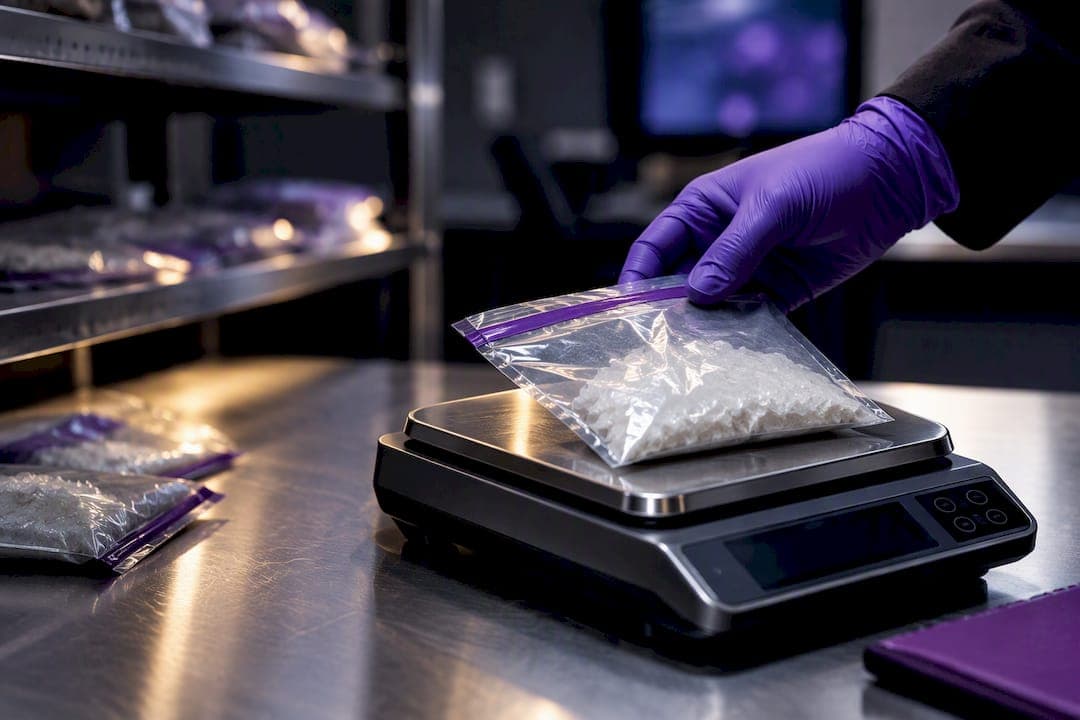
Under California law, possession with intent to sell a controlled substance is charged mainly under Health and Safety Code §11351, and it requires prosecutors to prove three things: possession, knowledge of the drug's nature, and intent to sell it. It is a felony that can carry a sentence of several years under Penal Code §1170(h). Intent almost never comes from one obvious fact. If you're facing this charge, say nothing to investigators beyond identifying yourself and call a criminal defense attorney before you answer another question.
TL;DR:
- Evidence such as packaging, cash, cell phones, or weapons alone does not prove intent; the totality of circumstances and context are crucial for prosecution.
- Suppression motions can often exclude evidence if police procedures were improper, significantly weakening the case against the defendant.
- A defendant’s prior criminal history and the quantity of drugs involved heavily influence sentencing range, which can be two, three, or four years under California law.
- Federal charges, if applicable, often involve mandatory minimums and different procedures that can dramatically increase sentencing risk.
- Timely legal action immediately after arrest, including preserving evidence and asserting rights, is essential to mount an effective defense and prevent evidence loss.
Table of Contents
- Possession With Intent California: The Statutory Elements
- How Prosecutors Prove Intent to Distribute
- Building a Defense Against Possession-for-Sale Charges
- Sentencing Ranges and the Collateral Fallout of a Conviction
- Why State vs. Federal Charges Change Everything
- What to Do Immediately After an Arrest or During an Investigation
- How Rubin Law, P.C. Approaches Possession-for-Sale Cases
- The Real Problem With How This Charge Gets Talked About
- Getting Legal Help for a Possession With Intent Charge
- Statutes and Court Resources Worth Reviewing
- Sources
- FAQ
Possession With Intent California: The Statutory Elements
HSC §11351 makes it a crime to possess for sale, or to purchase for the purpose of selling, specified controlled substances, including cocaine, heroin, and certain prescription drugs held without authorization. The statute does not stand alone. It leans on Penal Code §1170(h) for the actual sentencing range, which is why two people charged under the same code section can face very different outcomes depending on quantity, priors, and county sentencing practices.
To convict, a prosecutor has to establish each of the following beyond a reasonable doubt:
- Possession — either actual (the drugs were on your person) or constructive (you had the right to control them even if they were in a car, a house, or a bag that wasn't in your hands).
- Knowledge — you knew the substance was present and knew of its nature as a controlled substance, not necessarily its exact chemical name.
- Intent to sell — you intended to sell, furnish, or distribute the drugs rather than keep them for personal use.
A detail people miss constantly: quantity by itself does not prove intent. Someone can legally possess a large amount for reasons that have nothing to do with sales, and someone with a small amount can still be charged with intent to sell if other evidence points that way. This is a big part of why possession-for-sale cases turn less on the drugs themselves and more on everything found around them. It's also the core distinction separating this charge from simple possession under HSC §11350, covered in more detail below.
How Prosecutors Prove Intent to Distribute
Prosecutors rarely have a confession sitting on a silver platter. Most possession-for-sale cases are built from circumstantial evidence stacked together until a jury is asked to draw an inference. CALCRIM jury instructions direct juries to weigh the totality of the evidence rather than any single fact, which matters enormously for how a defense gets built.
The evidence prosecutors typically point to includes:
- Packaging — small individual baggies or divided containers rather than one bulk quantity.
- Scales or cutting agents — tools associated with weighing or preparing product for distribution.
- Large amounts of cash, especially small bills consistent with street-level transactions.
- Multiple cell phones or coded text messages referencing quantities, prices, or meeting locations.
- Weapons found near the drugs, which prosecutors argue signal protection of a sales operation.
- Direct observation by police of an apparent hand-to-hand transaction.
- Admissions, whether to police, informants, or recorded jail calls.
None of these factors work in isolation, and that's the piece most defendants don't realize until they're sitting across from an attorney. A stack of cash could be rent money. A second phone could be a work phone. Baggies could belong to a roommate. The prosecution's real burden isn't just producing these items; it's connecting them specifically to the accused person, especially in shared apartments, borrowed cars, or group travel situations where multiple people had access to the same space. This is where constructive possession becomes contested territory, and where questions about who actually had control over a location start to matter more than the drugs found inside it.
Pro Tip: If police found the alleged contraband in a shared space, start documenting everyone who had access to that location, room, or vehicle in the days before the arrest. That list often becomes the backbone of a knowledge-and-control defense.

Building a Defense Against Possession-for-Sale Charges
No two possession-for-sale cases look alike, and the right defense depends entirely on how the evidence was gathered and what it actually shows. A good defense attorney evaluates several angles simultaneously, not just the strongest one.
- Suppression motions. If police lacked reasonable suspicion for a stop, exceeded the scope of a search, or executed a warrant improperly, a motion to suppress can remove the physical evidence from the case entirely.
- Lack of knowledge or control. In shared apartments, rideshares, or group travel, the defense often argues the accused didn't know the drugs were there or had no real ability to control them.
- Lawful possession defenses. A valid prescription can explain possession of certain controlled substances, though this defense only covers personal, authorized use and collapses quickly if sales evidence exists alongside it.
- Lab and chain-of-custody challenges. Errors in how a substance was tested, stored, or transferred between evidence custodians can undercut the prosecution's ability to prove what the substance actually was.
- Diversion and negotiated resolutions. Depending on the county, prior record, and facts, some cases resolve through negotiated pleas to lesser charges or alternative sentencing programs rather than trial.
| Defense Strategy | What It Targets | Best Fit For |
|---|---|---|
| Suppression motion | How evidence was obtained | Illegal stops, warrantless searches, defective warrants |
| Lack of knowledge/control | Constructive possession claims | Shared housing, borrowed vehicles, group travel |
| Prescription/lawful use | The possession element | Legally obtained medication with no sales evidence |
| Lab/chain-of-custody challenge | Reliability of drug identification | Cases with testing delays or handling errors |
| Negotiated plea or diversion | Overall exposure | First-time offenders, weaker priors, cooperative facts |
The strongest cases rarely rely on just one of these. A suppression motion that succeeds can end a case outright; a knowledge defense that falls short on its own can still shape a better plea offer.
Sentencing Ranges and the Collateral Fallout of a Conviction
A conviction under HSC §11351 is a felony sentenced through Penal Code §1170(h), which sets a range of two, three, or four years. Where a specific case lands inside that range depends heavily on the quantity involved, the defendant's criminal history, and whether the case involves aggravating factors like a weapon or a sale near a protected zone.

Prior convictions change the math fast. A defendant with no criminal history and a clean record has a real shot at the low end of the range, diversion, or a negotiated plea to a lesser offense. Someone with prior drug sales convictions faces enhanced exposure and a judge far less inclined toward leniency.
Beyond the sentence itself, a felony possession-for-sale conviction carries consequences that outlast probation:
- Immigration status — a controlled substance felony can trigger removal proceedings or bar future relief for non-citizens, regardless of how the criminal sentence resolves.
- Professional licensing — nursing, real estate, teaching, and other licensed professions often require disclosure of felony convictions and can suspend or deny licenses.
- Employment background checks — a felony drug conviction shows up on standard background screenings for years, even after probation ends.
- Housing applications — many landlords and property management companies run criminal background checks that flag felony drug convictions.
FindLaw's overview of California drug laws notes that legislative changes like Proposition 47 and Proposition 64 reshaped penalties for some drug offenses, but possession for sale under §11351 remained a felony, unlike certain simple possession charges that Proposition 47 reduced to misdemeanors.
Why State vs. Federal Charges Change Everything
If your case gets picked up by federal agents instead of local police, the entire framework shifts. Federal prosecutions fall under 21 U.S.C. §841, which prohibits knowingly manufacturing, distributing, or possessing a controlled substance with intent to distribute. Federal sentencing ties directly to drug type and quantity, and mandatory minimums can apply in ways California state law doesn't use.
Signs a case may be heading federal include DEA agent involvement instead of only local police, interstate travel or shipping tied to the alleged distribution, federal search warrants, or a grand jury subpoena rather than a standard state complaint. Once a case moves federal, several things change at once:
- Discovery rules differ, often giving the defense less immediate access to certain evidence than state procedure allows.
- Sentencing exposure can increase sharply, particularly for larger quantities or repeat offenses.
- Plea negotiation dynamics shift, since federal prosecutors operate under different charging guidelines than county district attorneys.
Knowing early whether a case is state or federal changes how a federal drug charge defense gets built from day one.
What to Do Immediately After an Arrest or During an Investigation
The first 24 to 48 hours after an arrest or the first sign of an investigation shape the entire case. Small mistakes here are hard to undo later.
- Stay silent beyond basic identification. Do not explain, justify, or try to talk your way out of the situation with police.
- Do not consent to any search of your phone, car, or home. Consent given voluntarily removes a suppression argument your attorney could otherwise raise.
- Ask for an attorney immediately and repeat the request if it's ignored.
- Preserve every document tied to the arrest — booking paperwork, bail records, and any inventory list of seized items.
- Gather prescriptions and medical records if any part of the case involves a controlled substance you're lawfully prescribed.
- Save phone records, texts, and messages before they're deleted or lost, since these often cut both ways in intent disputes.
- Write down a private timeline of who had access to the location or vehicle where items were found, while memories are still fresh.
- Preserve any dashcam, bodycam, or surveillance footage you're aware of before it gets overwritten or deleted.
Pro Tip: Ask booking staff for a copy of the property/evidence inventory sheet before you leave custody. It's often the fastest way to see exactly what officers claim they found and where, which your attorney needs to evaluate suppression options.
How Rubin Law, P.C. Approaches Possession-for-Sale Cases
A criminal defense firm in Los Angeles may approach possession-for-sale charges by focusing on early suppression analysis and preserving evidence quickly before it disappears or is reinterpreted by the prosecution.
In practice, that means:
- Reviewing the stop, search, and warrant paperwork immediately for suppression opportunities.
- Identifying who else had access to a shared space, vehicle, or device before the prosecution locks in its constructive-possession theory.
- Requesting lab and chain-of-custody records early, while errors are still traceable.
- Evaluating diversion or negotiated resolutions realistically rather than defaulting straight to trial posture.
Constitutional challenges and attentive attorney involvement can be important factors clients cite when describing progress toward reduced charges or dismissal in similar cases.
The Real Problem With How This Charge Gets Talked About
Most explainers on possession with intent treat the charge like a math problem: hit a quantity, get charged with intent. That's not how HSC §11351 actually works, and treating it that way leads people to either panic unnecessarily or underestimate a case that looks thin on the surface.
The evidence that actually decides these cases is almost always circumstantial and contestable. Cash, phones, and packaging all have innocent explanations, and juries are instructed to weigh the whole picture, not check boxes. That means the earliest moves in a case, what gets preserved, what gets challenged, and whether a search holds up, matter more than most defendants realize until it's too late to fix them.
If there's one thing worth prioritizing above everything else, it's speed. Evidence disappears, memories fade, and suppression windows close. The conventional advice to "wait and see what the DA offers" ignores how much of the strongest defense work has to happen before that offer is even made.
— Jake
Getting Legal Help for a Possession With Intent Charge
Rubin Law, P.C. is a Los Angeles criminal defense firm built for exactly this kind of case: charges where the outcome depends on catching evidence problems and suppression opportunities early, not after the prosecution has already built its narrative. The firm handles drug crimes defense, including cases charged under HSC §11351 and federal possession with intent charges, with the same frequent courtroom involvement that shapes how it anticipates prosecutorial strategy county by county.

If you're facing a possession-for-sale investigation or arrest, bring what you can to an initial consultation: any booking paperwork, lab results if you've received them, phone records, and prescriptions if a controlled substance was lawfully prescribed to you. Those documents let an attorney start suppression and knowledge-and-control analysis immediately instead of losing days to information gathering. Los Angeles County residents facing these charges can review the firm's drug possession defense services and reach out for a consultation before speaking with investigators again.
Statutes and Court Resources Worth Reviewing
These are the primary legal sources behind the standards covered in this article:
- California Health and Safety Code §11351 — the statutory text defining possession for sale and its sentencing reference.
- California Health and Safety Code §11350 — the simple possession statute, distinct from possession for sale.
- CALCRIM jury instructions — the Judicial Council's framework for how juries evaluate intent and related evidence.
- 21 U.S.C. §841 — the federal statute governing possession with intent to distribute.
- DEA Controlled Substances Act overview — background on drug scheduling relevant to federal charging decisions.
This article is general information, not a substitute for advice from a qualified lawyer. Consult a qualified legal professional about your own circumstances before acting on anything here.
Sources
- California Health and Safety Code §11351
- CALCRIM jury instructions (Judicial Council of California)
- 21 U.S.C. §841 (United States Code)
- FindLaw: California drug possession laws
FAQ
How much time can you get for drug possession in California?
Simple possession under HSC §11350 typically carries lighter consequences, often eligible for misdemeanor treatment or diversion. Possession for sale under HSC §11351 is a felony sentenced under Penal Code §1170(h) at two, three, or four years, with the actual term depending on quantity, priors, and case facts.
How do you fight an intent to distribute charge?
Effective defenses usually target either how the evidence was obtained (suppression motions for illegal stops or searches) or whether the prosecution can actually tie possession and intent to you specifically, especially in shared spaces. Lab testing challenges and lack-of-knowledge arguments are also common, and an attorney at a firm like Rubin Law evaluates all of these angles together rather than picking just one.
What's the difference between simple possession and possession for sale in California?
Simple possession under HSC §11350 involves holding a controlled substance for personal use with no intent to sell it. Possession for sale under HSC §11351 requires the added element of intent to distribute, proven through evidence like packaging, cash, communications, or observed transactions, and it carries substantially heavier felony penalties.
What's the most common felony drug charge in California?
Possession for sale under HSC §11351 is among the most frequently charged felony drug offenses in the state, largely because it covers a wide range of controlled substances and fact patterns, from small-scale street sales to larger distribution cases.
What should you do immediately if you're arrested for possession with intent?
Say nothing beyond identifying yourself, do not consent to any search, and ask for an attorney right away. Preserve booking paperwork, phone records, prescriptions, and any documentation of who had access to where the items were found, since that evidence often determines whether suppression or knowledge defenses are available later.