
California's misdemeanor diversion program under Penal Code §1001.95 (AB 3234) lets a judge pause most misdemeanor cases and, if you complete the court-ordered conditions, dismiss the charges entirely. No guilty plea required. The arrest is treated as if it never happened in most contexts.
Here's what matters most right now:
- Duration: Diversion can last up to 24 months, though many cases resolve faster.
- Judge's authority: The court can grant diversion even when the prosecutor objects.
- End result: Successful completion triggers mandatory dismissal of the action. Sealing of the arrest record is available, but may require an additional motion or notice to the Department of Justice depending on the diversion statute used.
Table of Contents
- What is PC §1001.95 (AB 3234) and why did California create it?
- Who qualifies for diversion, and which charges are excluded?
- How does misdemeanor diversion work, step by step?
- What judges consider, and how to ask the court for diversion
- Benefits of completing diversion, and the limits you need to know
- How Rubin Law, P.C. helps you pursue misdemeanor diversion
- Key Takeaways
- Why diversion is often the right call, not just the easy one
- Rubin Law, P.C. can help you pursue diversion in Los Angeles
- Authoritative sources and when to get legal help
What is PC §1001.95 (AB 3234) and why did California create it?
AB 3234, effective 2021, created the court-initiated misdemeanor diversion framework now codified at PC §1001.95. Before this statute, diversion in California was largely prosecutor-controlled or limited to specific conditions like mental illness or military service. AB 3234 shifted that power to judges and broadened access dramatically.
The Legislature's goal was straightforward: reduce unnecessary misdemeanor convictions, ease court congestion, and prioritize rehabilitation over punishment for low-level offenses. PC §1001.95 is pre-plea diversion, meaning you don't admit guilt to get it. The case is simply paused while you complete conditions the court sets.
A related statute worth knowing: PC §1001.36 covers mental-health diversion and applies to defendants with qualifying mental disorders. If that describes your situation, it may offer additional protections alongside or instead of §1001.95.
Who qualifies for diversion, and which charges are excluded?
Eligibility under PC §1001.95 is intentionally wide. The statute applies to most misdemeanors regardless of your criminal history. A prior record is not an automatic disqualifier. You don't need to show a mental illness, substance-use disorder, or any special circumstance.
That said, PC §1001.95(e) explicitly excludes certain offenses:
- Domestic violence: PC §273.5 (corporal injury to a spouse) and PC §243(e)(1) (domestic battery)
- Stalking: PC §646.9
- Sex offenses requiring registration under PC §290
- DUI offenses under Vehicle Code §23152 and §23153
- Certain firearm offenses listed under PC §29805
A few nuances worth flagging: vehicular manslaughter without gross negligence is generally eligible. DUI, even a first offense, is not. Prosecutors can raise public-safety objections, but the judge retains final authority on whether to grant diversion. Courts evaluate eligibility case by case, so a charge near the line deserves a close look from counsel.
If your charge involves a domestic violence offense, the exclusion is firm. Readers facing alcohol-related charges should also understand the distinction between DUI and a wet reckless, since the latter may open different options.
How does misdemeanor diversion work, step by step?
The process moves through five distinct stages. Understanding each one helps you know what to expect and where you have leverage.

1. Diversion is offered or requested. Either the judge raises diversion on their own, or your attorney files a motion requesting it. This typically happens at an early hearing, before any plea is entered. Timing matters: the earlier you raise it, the better.
2. The case is stayed. Once diversion is granted, prosecution pauses. No plea is entered, no conviction is recorded. The clock starts on your diversion period, which can run up to 24 months.
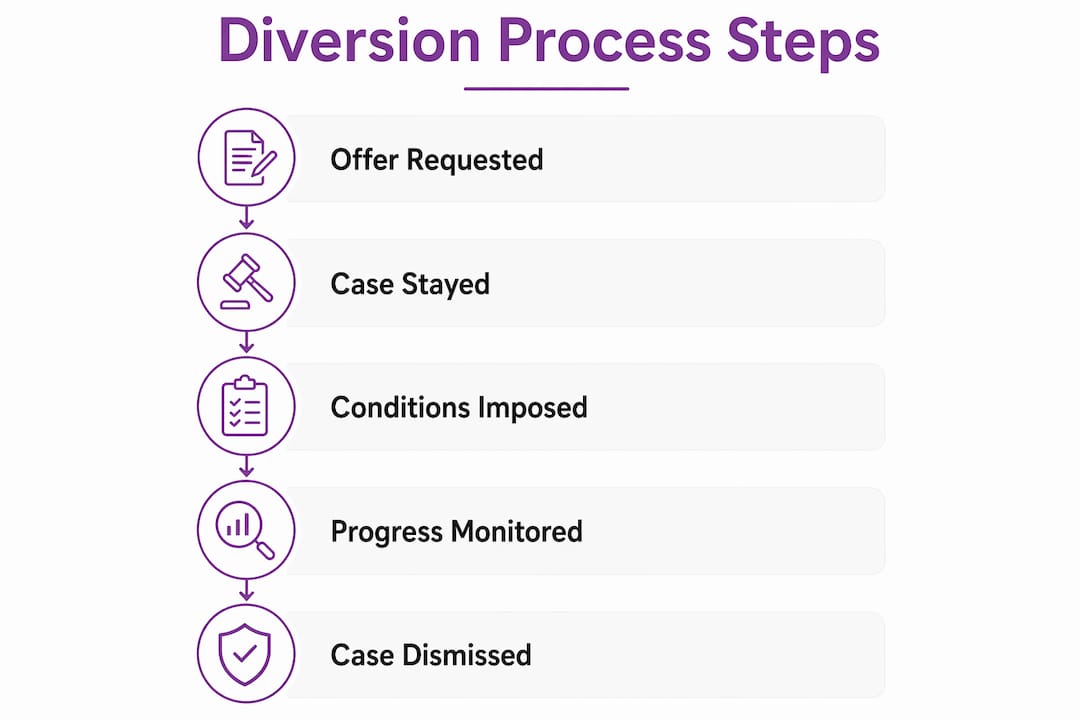
3. The court imposes conditions. These are individualized. Common conditions include counseling or therapy, community service, anger management classes, drug or alcohol education, restitution payments, and stay-away orders. The court tailors conditions to the offense and your circumstances.
4. Progress reviews and reporting. The judge may schedule review hearings or require written proof of compliance. Your attorney attends these with you and addresses any issues before they become problems.
5. Completion or reinstatement. Finish all conditions and the judge must dismiss the case. The arrest is then sealed under PC §851.91, and you can truthfully state you were not convicted. If you fail to comply, the court holds a hearing, and the prosecution can resume as if diversion never happened.
Pre-plea diversion under §1001.95 is meaningfully different from probation or deferred entry of judgment. Probation follows a conviction. Deferred entry of judgment typically requires a guilty plea first. Under §1001.95, no plea is ever entered, which keeps your record clean from the start.
What judges consider, and how to ask the court for diversion
Judges weigh several factors when deciding whether diversion serves the interests of justice. Knowing these factors in advance lets you build a stronger case.
Courts commonly look at:
- Your background, employment, and community ties
- The facts and circumstances of the charged offense
- Your risk of reoffending
- Whether you've made or offered restitution
- Your willingness to participate in rehabilitative programming
- Any public-safety objections raised by the prosecutor and whether the mitigation addresses them
The motion itself should be filed as early as possible, ideally before the arraignment or at the first pretrial hearing. Your attorney submits a written motion supported by a mitigation packet. The prosecutor may object, but the judge can grant diversion anyway. That's the statute's most powerful feature: the court, not the DA's office, has the final word.
A strong mitigation packet typically includes:
- Proof of employment or school enrollment
- Character letters from employers, teachers, or community members
- Treatment enrollment confirmation or completion certificates
- Evidence of restitution payment or a signed payment plan
- A personal statement showing insight and accountability
- Any prior certificates from programs or community service
Pro Tip: When prosecutors object on public-safety grounds, your most effective counter is data-driven mitigation. Concrete treatment enrollment, a restitution receipt, and a community supervision plan that directly addresses the prosecutor's stated concern will carry far more weight than a general statement about wanting to change.

Benefits of completing diversion, and the limits you need to know
The advantages of successful diversion are real and significant.
What you gain:
- No conviction on your record
- No guilty plea, no admission of wrongdoing
- Dismissal of the charges upon completion
- Statutory sealing: the arrest is treated as if it never occurred in most contexts
- The ability to truthfully answer "no" to most questions about prior convictions
Where the limits are:
Immigration consequences are the most critical caveat. Diversion is not a guaranteed fix for non-citizens. Certain immigration proceedings look at the underlying conduct, not just whether a conviction was entered. If you're not a U.S. citizen, consult an immigration attorney before agreeing to any diversion terms.
Professional licensing boards and some employers may still access or consider diverted arrests in narrow circumstances. The Staff Memorandum 2026–01 from California's Committee on Revision of the Penal Code notes that sealing and record-relief processes are not uniform across diversion types, and additional steps may be needed to maximize record relief.
Diversion dismissal and sealing are also distinct from a traditional expungement under PC §1203.4. Expungement applies after a conviction and probation. Diversion dismissal is cleaner because no conviction was ever entered. That said, sealing after diversion is not always automatic. Depending on the diversion pathway, you may need to file an additional motion or provide notice to the DOJ to remove the incident from public background checks.
| Factor | Detail |
|---|---|
| Maximum diversion period | Up to 24 months under PC §1001.95 |
| Plea required? | No — pre-plea diversion |
| Outcome on completion | Mandatory dismissal and arrest sealing |
| Immigration impact | Not automatically resolved; consult immigration counsel |
| Sealing automatic? | Not always — additional motions may be required |
How Rubin Law, P.C. helps you pursue misdemeanor diversion
Diversion is judge-driven, but that doesn't mean the outcome is random. What an experienced criminal defense attorney does is shift the odds by controlling what the judge sees and when.
Here's what that looks like in practice:
- Reviewing the charged offense against the exclusion list and confirming eligibility
- Drafting and filing the motion for diversion with supporting legal argument
- Assembling the mitigation packet: treatment enrollment, character letters, restitution documentation, and a personal statement
- Coordinating with treatment providers to confirm enrollment before the hearing
- Attending all status hearings and addressing compliance issues in real time
- Handling post-dismissal record relief, including sealing motions under PC §851.91
Rubin Law, P.C. is a Los Angeles criminal defense firm with deep familiarity with local judges and prosecutorial strategies. The firm's approach to diversion cases centers on mitigation-driven advocacy: building the strongest possible factual record before the hearing so the judge has concrete reasons to grant diversion, even over a prosecutor's objection. The firm also handles mental-health diversion under PC §1001.36 for clients who may qualify under that statute's additional protections.
Pro Tip: When hiring counsel for a diversion case, prioritize attorneys who appear regularly in the specific courthouse where your case is filed. Familiarity with individual judges' preferences on mitigation presentations is a practical advantage that doesn't show up on a firm's website.
Counsel improves your odds considerably, but it does not guarantee diversion. The judge retains full discretion. What an attorney does is make sure the judge has every reason to say yes.
Key Takeaways
PC §1001.95 gives California judges broad authority to divert most misdemeanor cases without a guilty plea and dismiss charges on completion. Sealing of the arrest record is available, but full sealing may require further steps after diversion depending on the specific statute used.
| Point | Details |
|---|---|
| Broad eligibility | Most misdemeanors qualify regardless of prior record; no mental-health diagnosis required. |
| Key exclusions | DUI, domestic violence (PC §273.5, §243(e)(1)), stalking, sex-registration offenses, and certain firearm charges are excluded. |
| Judge has final say | The court can grant diversion even over prosecutor objection if it serves the interests of justice. |
| Sealing is not automatic | Additional motions or DOJ notice may be required after dismissal to fully clear background checks. |
| Rubin Law, P.C. | The firm handles motion drafting, mitigation assembly, and court advocacy for diversion cases in Los Angeles. |
Why diversion is often the right call, not just the easy one
Most commentary on PC §1001.95 focuses on the mechanics. What gets less attention is the strategic reality: diversion is not a consolation prize. For many misdemeanor defendants, it's the best possible outcome, better than a negotiated plea to a lesser charge, better than probation, and far better than a conviction that follows you into job applications and licensing renewals for years.
The statute's most underappreciated feature is the judge's authority to grant diversion over prosecutorial objection. In practice, this means a well-prepared mitigation presentation can overcome a DA's resistance. Prosecutors object for reasons that are often formulaic. Judges respond to specifics: a treatment program already started, a restitution check already written, a letter from an employer who will lose a good employee if the case proceeds. That's not sentiment. That's the kind of concrete record that changes outcomes.
What I'd caution against is treating diversion as a guaranteed path just because the statute is broad. Immigration consequences, licensing board disclosures, and the gap between dismissal and full record sealing are real complications that catch people off guard. The statute gives you a powerful tool. Using it well requires knowing exactly where its limits are.
Rubin Law, P.C. can help you pursue diversion in Los Angeles
Facing a misdemeanor charge in Los Angeles and wondering whether diversion is within reach? Rubin Law, P.C. handles exactly this: reviewing your charge against the PC §1001.95 exclusion list, building the mitigation packet, filing the motion, and advocating in court so the judge has every reason to grant diversion.
The firm's services for diversion cases include motion drafting, mitigation assembly, treatment provider coordination, status hearing appearances, and post-dismissal record relief. For clients who may qualify under the mental-health diversion statute, the firm's mental health defense practice covers that pathway as well.
Call Rubin Law, P.C. or submit a case review request online. The earlier in the case you act, the more options remain open.
Authoritative sources and when to get legal help
Primary sources:
- California Penal Code §1001.95 — the full statute text, including exclusions under §1001.95(e)
- Staff Memorandum 2026–01 (CRPC) — policy analysis on diversion expansion, sealing inconsistencies, and record relief
- California Courts Self-Help: Record Cleaning — Misdemeanors — plain-language guide to dismissal and expungement procedures
- Sacramento Superior Court: Expungement/Dismissal — county-level procedural guidance on filing dismissal petitions
- Rubin Law, P.C. — PC §1001.95 Resource Page — firm's statutory summary and procedural overview
When to get legal help immediately:
- You are not a U.S. citizen — immigration consequences require specialized analysis before you accept any diversion terms.
- Your profession is licensed by a state board — some boards treat diverted arrests differently than the general public.
- The charged offense involves an alleged victim, restitution disputes, or a restraining order.
- You are unsure whether your charge falls within the exclusion list under PC §1001.95(e).
This article is general legal information, not legal advice. For guidance specific to your case, consult a qualified California criminal defense attorney.