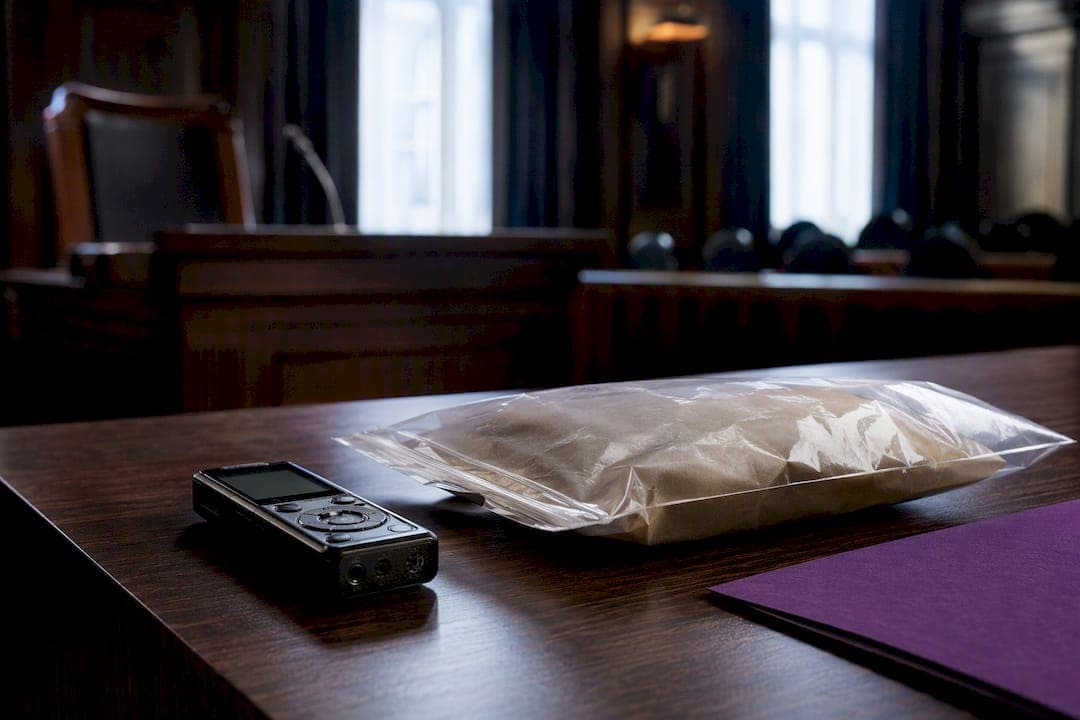
Entrapment is a real, usable defense in California, but only when police conduct, not your own willingness, drove the crime. You must prove it by a preponderance of the evidence under CALCRIM No. 3408, meaning "more likely than not." If you think an officer or informant pushed you into committing an offense, stop talking to law enforcement, save every text and call record you have, and contact a California criminal defense attorney before you say anything else.
TL;DR:
- Police conduct must be the primary cause of the crime for entrapment to be valid, with repeated pressure or inducement ideally documented by recordings or witnesses.
- The defendant must prove entrapment by a preponderance of the evidence, meaning it is more likely than not that police induced the crime, not that they simply created an opportunity.
- Evidence such as texts, recordings, witness statements, and official logs are crucial to corroborate claims of police overreach and support an entrapment defense.
- Courts focus on police behavior rather than the defendant’s prior predisposition, making documented patterns of inducement and specific conduct key to success.
- Building a strong case requires immediate action following arrest, including preserving digital evidence and writing detailed timelines before evidence is lost.
Table of Contents
- What Counts as an Entrapment Defense in California?
- How Much Do You Have to Prove Under CALCRIM No. 3408?
- What Evidence Do You Need to Prove Entrapment?
- What California Case Law Says About Entrapment
- How Rubin Law Investigates and Litigates Entrapment Claims
- Why Entrapment Defenses Fail (and What Legal Stings Look Like)
- What to Do Right Now If You Believe You Were Entrapped
- Entrapment Doctrine Exists for a Reason Beyond the Courtroom
- How Rubin Law, P.C. Approaches Entrapment Cases in Los Angeles
- Sources
- FAQ
What Counts as an Entrapment Defense in California?
California doesn't ask whether you were the type of person who'd commit a crime. It asks whether the officer's conduct would have induced a normally law-abiding person to do it. That's the objective test the California Supreme Court laid out in People v. Barraza, and it's the single most important thing to understand before you decide whether an entrapment defense fits your case.
This matters because it's a sharp break from federal law. Federal courts use a subjective test, digging into your background, prior conduct, and whether you were "predisposed" to commit the offense. California courts refuse to go there. The focus stays on the government's behavior, not your criminal history or character. That distinction alone changes what evidence your attorney will chase and what the prosecution is allowed to bring up at trial.
So what does impermissible police conduct actually look like? Courts have identified a recognizable pattern of overreaching that crosses the line from investigation into inducement:
- Badgering or repeatedly pressuring someone who initially refused
- Cajoling, flattery, or appeals to friendship to wear down resistance
- Playing on sympathy, such as a fabricated hardship story to guilt someone into acting
- Offering unusually generous profits or guarantees that no ordinary transaction would include
- Suggesting that the crime is legal, low-risk, or "not a big deal" to lower a person's guard
An undercover officer offering to buy drugs isn't automatically entrapment. An officer who calls someone repeatedly over several days, invokes a fake medical emergency, and promises substantial profits starts looking very different in front of a jury.
How Much Do You Have to Prove Under CALCRIM No. 3408?
You carry the burden here, not the prosecution. Under CALCRIM No. 3408, the defendant must prove entrapment by a preponderance of the evidence. That's a far lower bar than the "beyond a reasonable doubt" standard prosecutors face on the underlying charge, and understanding that gap changes how a defense attorney builds the case.
Preponderance means simply "more likely than not." You don't need certainty. You need the scale to tip, even slightly, in your favor. That's a meaningfully different task than what the prosecution has to do, and it opens the door to defenses that would fail under a stricter standard.
Before a jury even hears an entrapment instruction, there's a threshold question: does the record show substantial evidence supporting the defense? If it does, the judge has a duty to give the instruction, even without a formal request. Courts have found reversible error when a trial judge failed to instruct the jury on entrapment despite substantial supporting evidence in the record, as the California Supreme Court addressed in People v. McIntire.
Substantial evidence, in practice, usually means:
- Recorded or written statements showing pressure, repetition, or unusual inducement
- Testimony from the defendant or a witness describing the officer's specific words and conduct
- A documented pattern, not a single isolated request
The lower burden is exactly why the paper trail matters so much. A defense built on preponderance succeeds or fails on whatever specific, corroborating evidence you can put in front of the jury.
What Evidence Do You Need to Prove Entrapment?
Winning on preponderance requires more than your own account of what happened. You need documentation that corroborates it, because juries weigh corroborated claims far more heavily than uncorroborated testimony, and prosecutors will attack any gap in the record.
Here's the priority order defense counsel typically works through:
- Every communication with the officer or informant. Texts, emails, DMs, voicemails, and call logs, including timestamps showing frequency and escalation.
- Any recordings. Bodycam footage, dashcam video, jail call recordings, and any audio the defendant or a bystander captured.
- Witness identification. Anyone who saw or heard the interaction, including bystanders, coworkers, or people who received similar approaches from the same officer or informant.
- Statements about financial or personal inducements. Specific numbers, promises, or guarantees the officer made, written down as close to verbatim as possible.
- Jail and booking logs. These sometimes contain officer notes or statements made during processing that corroborate the pressure applied earlier.
- A written timeline. Dates, times, and locations of every contact, built while memory is fresh.
Ask your attorney to request discovery early and to subpoena agency records before anything gets purged. Departments don't always retain bodycam footage indefinitely, and metadata preservation requests need to go out fast. Counsel can also file preservation orders that legally freeze evidence before it disappears through routine data cycles.
Pro Tip: Don't try to "explain your side" to the arresting officer or a detective before you have a lawyer. Anything you say gets used against you, and it can also undercut the very inducement narrative your attorney needs to build. Invoking your right to remain silent, sometimes called invoking the Fifth in California, protects the record rather than damaging it.
What California Case Law Says About Entrapment
Three cases from the California Supreme Court shape almost every entrapment argument made in the state today, and each one teaches something different about what wins and what doesn't.
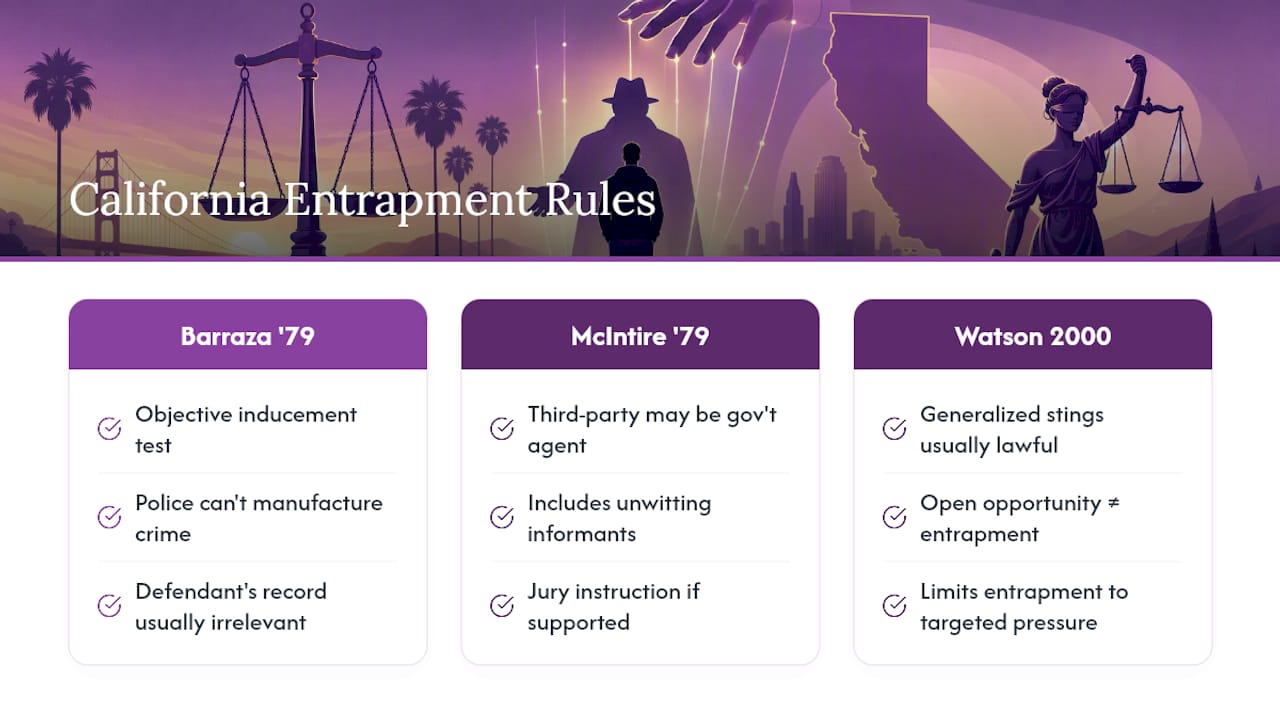
People v. Barraza (1979) is the foundation. The court rejected the old subjective test and adopted the objective standard still used today, holding that courts must ask whether the conduct of police was "likely to induce a normally law-abiding person" to offend. The court framed the rule as a check on law enforcement's role: officers exist to detect crime, not manufacture it.
That framing comes directly from the reasoning in Barraza, and it's why your criminal record almost never comes into play in a properly litigated entrapment defense.
People v. McIntire (1979) extended the doctrine to third parties. The court held that an unwitting informant manipulated by police can still count as a government agent for entrapment purposes, and confirmed the trial court's duty to instruct the jury once substantial evidence supports the defense. If a friend, coworker, or acquaintance was steered by police without fully realizing it, that pressure can still support an entrapment claim.
People v. Watson (2000) drew the outer boundary. The court found that generalized stings, like leaving a car unlocked with keys visible, don't amount to entrapment just because a crime resulted. Merely offering a general public opportunity, without targeted, personal pressure, is usually lawful police work.
Read together, these three cases tell you what evidence matters: proof of specific, repeated, personally directed pressure, not just proof that an opportunity existed.
How Rubin Law Investigates and Litigates Entrapment Claims
Every entrapment case lives or dies on the details, so investigation starts with reconstructing the exact timeline of contact between the defendant and law enforcement. That means pulling phone records, requesting bodycam and dashcam footage before it's overwritten, and preserving metadata that can establish when and how often contact occurred.
A serious defense investigation typically covers:
- Forensic review of recordings and device metadata to establish timing and authenticity
- Interviews with any witnesses to the interaction, including people the same officer or informant approached separately
- Documentation of officer conduct patterns, including prior complaints or similar tactics used in other cases
- Cross-referencing jail logs and booking statements against the claimed timeline
On the motion side, counsel will typically request the entrapment jury instruction where substantial evidence supports it, move to exclude prejudicial predisposition evidence the prosecution might try to sneak in, and file preservation and discovery motions early, before evidence custodians cycle out old footage or files.
At trial, the framing has to stay disciplined. The jury needs to hear about the officer's conduct, not get distracted by arguments about the defendant's character or history. Corroborating evidence, communications, recordings, and witness testimony, carries far more weight than the defendant's word alone.
Pro Tip: If you're under investigation and suspect an informant or undercover contact is pushing you toward a crime you'd never otherwise commit, document it in writing to yourself immediately, dates, quotes, and specifics, even before you have a lawyer. That contemporaneous record can become critical evidence later.
Why Entrapment Defenses Fail (and What Legal Stings Look Like)
Not every unpleasant undercover operation qualifies as entrapment, and it's worth being honest about where these defenses typically collapse. Understanding the limits protects you from putting all your hope in a defense theory the evidence doesn't support.
Lawful police tactics that generally survive scrutiny include:
- Decoy operations, such as an unattended item designed to tempt theft
- Ruses where an undercover officer poses as a buyer or seller without applying personal pressure
- Simply offering an opportunity to commit a crime, without badgering, guarantees, or emotional manipulation
Entrapment claims typically fail when:
- The only evidence is that a general opportunity existed, echoing the outcome in Watson
- There's no recording, message, or witness corroborating claimed pressure
- The defendant approached the officer or informant first, or negotiated terms themselves
- The "inducement" amounts to a single, ordinary request rather than a documented pattern
If your case file shows nothing but a single interaction and no record of repeated contact, discuss the weaknesses candidly with your attorney early. An entrapment defense argued without corroboration rarely persuades a jury, and a failed entrapment argument can sometimes make a defendant look less credible on other issues at trial. That's a real cost worth weighing before committing to the strategy.
What to Do Right Now If You Believe You Were Entrapped
- Preserve everything. Screenshot texts, save call logs, back up voicemails, and write down names of anyone who witnessed the contact.
- Stay silent with police. Don't explain, justify, or "clear things up." Assert your right to remain silent and ask for an attorney immediately.
- Build a timeline before memory fades. Write down dates, approximate times, locations, and exact wording you remember from every interaction.
- Bring documents to your first attorney meeting. Phone records, any recordings, arrest paperwork, and your written timeline all speed up the investigation.
Pro Tip: Bring your phone itself, not just screenshots, to your first meeting with counsel. Attorneys can arrange for forensic preservation of the original device data, which carries more evidentiary weight than a photo of a text thread.
Entrapment Doctrine Exists for a Reason Beyond the Courtroom
Entrapment law isn't a technicality. It's a deliberate check on how far law enforcement can go to manufacture a crime rather than uncover one. That principle from Barraza still does real work in courtrooms across California.
What separates a viable entrapment claim from a losing one almost always comes down to preparation done in the first days after an arrest, not clever arguments made months later. The strongest cases start with someone who preserved a recording, wrote down a timeline, or refused to talk before calling a lawyer. Evidence disappears fast; legal theories don't fix what's already gone.
— Jake
How Rubin Law, P.C. Approaches Entrapment Cases in Los Angeles
If you're facing charges in Los Angeles County and believe police conduct crossed the line into entrapment, the investigation needs to start immediately, not after the case has already moved through arraignment. Experienced criminal defense counsel handles the groundwork that entrapment claims depend on: reconstructing timelines, pursuing preservation orders for bodycam footage and device metadata, and identifying whether predisposition evidence the prosecution wants to introduce should be challenged before trial.
A consultation starts with a review of exactly what contact occurred between you and law enforcement or an informant, what documentation already exists, and what still needs to be preserved before it's lost. From there, the firm builds a strategy around the specific California statute you're charged under, whether that's a drug offense, a domestic violence allegation, or another matter covered across the firm's California criminal laws resource. If you're in the Los Angeles area and need to talk through what happened, schedule a consultation with Rubin Law's Los Angeles County team before evidence windows close.
This article is general information, not a substitute for advice from a qualified lawyer. Consult a qualified legal professional about your own circumstances before acting on anything here.
Sources
- People v. Barraza (1979) — California Supreme Court opinion
- CALCRIM No. 3408. Entrapment — Judicial Council of California Criminal Jury Instructions
FAQ
Can Entrapment Be Claimed as a Valid Defense in California?
Yes. California recognizes entrapment as an affirmative defense, meaning you admit to the conduct but argue police inducement excuses it, and you must prove it by a preponderance of the evidence under CALCRIM No. 3408.
What Test Does California Use for Entrapment?
California applies the objective test from People v. Barraza, asking whether police conduct would likely induce a normally law-abiding person to commit the crime. This differs from the federal subjective test, which examines the defendant's own predisposition.
What Kind of Police Conduct Counts as Entrapment?
Badgering, cajoling, appeals to sympathy or friendship, guarantees of profit, and repeated pressure after an initial refusal can all support an entrapment claim. Simply offering a general opportunity to commit a crime, without targeted pressure, usually does not.
What Legal Protections Exist Against Entrapment in the United States?
Both federal and state law recognize entrapment defenses, though the tests differ: federal courts focus on the defendant's predisposition, while California courts focus solely on the officer's conduct under the Barraza standard. Defendants also retain Fifth Amendment protections against self-incrimination throughout any investigation.
What Happens if an Entrapment Defense Fails at Trial?
If the defense fails, the case proceeds under the original charges, and the underlying conduct you admitted to in raising the defense remains part of the record. That's why attorneys typically pair an entrapment defense with alternate strategies, such as challenging intent or disputing the facts, when the entrapment evidence is thin.