
An arraignment is the court hearing where a judge reads your charges, advises you of your rights, and takes your plea. It is not a trial. In Los Angeles, the single most important move you can make before that hearing is securing a defense attorney or confirming a public defender has been appointed, and never agreeing to waive time without legal advice first.
TL;DR:
- Most felony arraignments in Los Angeles occur in Department 30 at the Clara Shortridge Foltz Criminal Justice Center, while misdemeanors are arraigned at the courthouse nearest the alleged offense.
- A defense attorney should arrive prepared with a signed Humphrey declaration, proof of community ties, and a concrete release plan to improve chances of bail reduction or release conditions.
- Do not waive time extensions without legal advice, as doing so can delay case deadlines and potentially worsen your position unless your attorney carefully reviews the implications.
- The court considers ability to pay under In re Humphrey by reviewing documentation instead of accepting verbal requests for leniency; a well-prepared financial package is more effective.
- You have a constitutional right to an attorney and an interpreter at arraignment; being unrepresented and rushed decisions like waiving time can significantly impact case outcomes.
Table of Contents
- What Happens at an Arraignment in Los Angeles
- Where Arraignments Happen: Foltz/CCB and Local Courthouses
- Bail, PARP, and Humphrey: Fighting for Release
- Your Rights: Counsel, Interpreters, and Protecting Your Timeline
- The Clock Rules That Shape Your Case
- How to Prepare for Arraignment Day
- After Arraignment: What Comes Next
- Why Courtroom Familiarity Changes Outcomes at Arraignment
- Get Arraignment Representation From a Dedicated Criminal Defense Firm
- Sources
- FAQ
What Happens at an Arraignment in Los Angeles
The sequence moves fast, often in under ten minutes once your case is called. The judge (or a commissioner) starts by reading the charges against you and confirming you understand them. Next comes the rights advisement: you're told you have the right to counsel, the right to remain silent, and the right to a certified interpreter at no cost.
Then comes the plea. You'll typically enter one of three:
- Not guilty — preserves every defense option and triggers the standard procedural timeline.
- Guilty — moves the case straight toward sentencing, often the same day for minor misdemeanors.
- No contest — has the same practical effect as a guilty plea in most criminal matters, without a formal admission of the underlying facts.
Most defense attorneys enter a not guilty plea at arraignment even when a plea deal seems likely later. It keeps your options open while your lawyer reviews the evidence. Bail or release also gets addressed during this same calendar. The judge may release you on your own recognizance, set money bail, or hear an argument for reduced conditions right then, depending on what your attorney presents. For felony cases, this happens fast enough that a lawyer who already has your paperwork together at the courthouse door has a real edge over one who is still gathering facts.
Where Arraignments Happen: Foltz/CCB and Local Courthouses
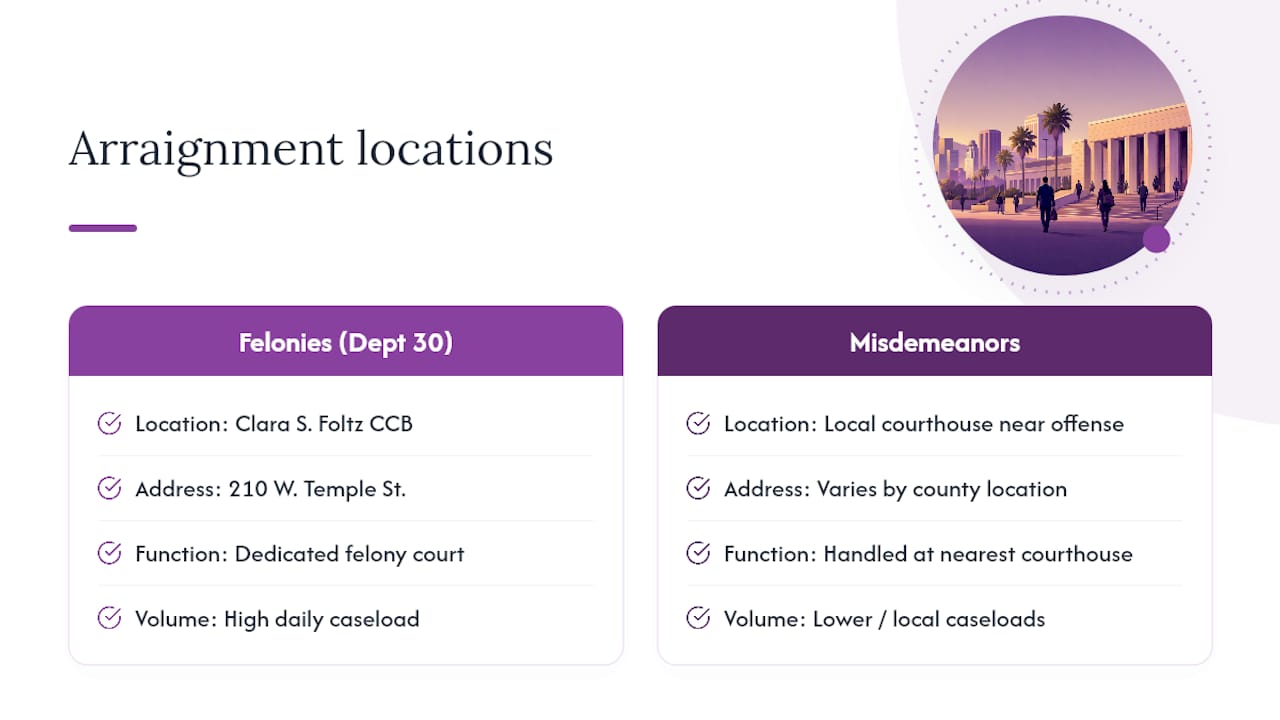
Most felony arraignments for cases filed by the Los Angeles County District Attorney happen in Department 30 of the Clara Shortridge Foltz Criminal Justice Center, known locally as the CCB, at 210 W. Temple Street in downtown Los Angeles. Department 30 functions as the county's dedicated felony arraignment court, processing a high volume of cases daily.
Misdemeanors work differently. Those arraignments generally happen at the courthouse closest to where the alleged offense occurred, not downtown. If you're unsure which courthouse applies to your case, the Central Arraignment location listing confirms address and contact details for the central district. Call ahead or have your attorney verify your department and time. Showing up at the wrong courthouse on arraignment day can create an avoidable failure to appear.
Bail, PARP, and Humphrey: Fighting for Release
Los Angeles doesn't automatically default to the printed bail schedule anymore. The county's Pre-Arraignment Release Protocol assigns most non-serious offenses one of three designations, CR (release with no conditions), BR (release with behavioral conditions), or MR (release with monitoring conditions), rather than a flat dollar amount. Serious and violent felonies are excluded from PARP and still route through a judge.
Even when a judge starts with the printed bail schedule, In re Humphrey requires them to consider your actual ability to pay before setting a financial condition. A judge cannot jail you simply because you can't afford the scheduled amount without first weighing less restrictive alternatives.
To make that argument work, your attorney should walk into Department 30 with:
- A signed declaration detailing your income, assets, and inability to post the scheduled amount.
- Proof of community ties, such as a lease, an employer letter, or family declarations showing you're not a flight risk.
- A concrete, written release plan, including proposed conditions like electronic monitoring, check-ins, or a third-party custodian.
Courts respond far better to a documented package than to a verbal request for leniency. A bare statement of "I can't afford bail" rarely moves a judge; a signed financial declaration paired with a lease and an employer letter does.
Pro Tip: Bring three copies of every document to court, one for the judge, one for the prosecutor, and one for your own attorney. Department 30 moves too fast for anyone to be flipping through a single stapled packet while the case is being called.
Your Rights: Counsel, Interpreters, and Protecting Your Timeline
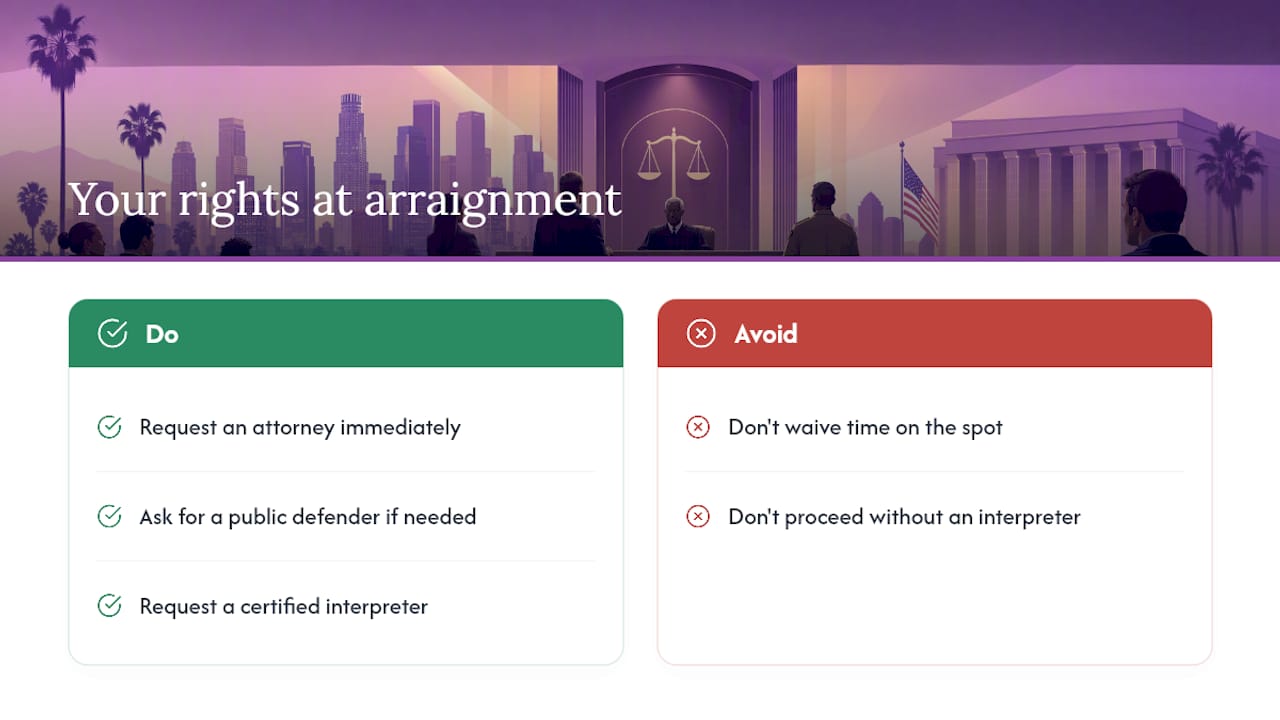
You have a constitutional right to an attorney at arraignment, and if you can't afford one, the court will appoint a public defender on the spot. You also have the right to a certified interpreter at no cost; if one isn't available for your language, courts typically reschedule rather than proceed without one.
The riskiest moment for an unrepresented defendant is being asked to "waive time." Waiving time extends the statutory deadlines that would otherwise force the prosecution to move quickly, and once you agree, it's difficult to walk back. Defense counsel should weigh that decision carefully, because waiving time can push your case weeks or months further out, sometimes to the prosecution's advantage rather than yours. Never agree to waive time on the spot without an attorney explaining what you're giving up.
The Clock Rules That Shape Your Case
California law runs on strict deadlines, and missing one of these can actually work in your favor if the prosecution slips.
- 48 hours to arraignment: Penal Code section 825 requires you to be brought before a judge within 48 hours of arrest, excluding Sundays and judicial holidays. A Friday night arrest often means a Monday arraignment.
- Speedy-trial deadlines: Under Penal Code section 1382, trial must start within 30 days if you're in custody, or 45 days if you're out on release.
- Preliminary hearing timing: For felonies, Penal Code section 959b generally requires the preliminary hearing within 10 court days of arraignment.
Every one of these numbers resets or extends the moment you waive time, which is exactly why that decision belongs to your attorney, not to a rushed choice made standing in a courtroom hallway. For a deeper breakdown of how these deadlines interact, see this guide to California's criminal timeline.
How to Prepare for Arraignment Day
Walking into Department 30 or your local courthouse organized changes how your case opens. Bring these items:
- Government-issued identification and proof of your Los Angeles address or employment.
- A completed Humphrey declaration if bail is likely to be an issue.
- Letters of support from employers, family, or community members.
- A written list of your attorney's contact information, in case you need to reach them from custody.
If you're in custody, ask jail staff how to request that your attorney be notified of your court date. If you need an interpreter, tell the court clerk or your attorney as early as possible, ideally days before, not the morning of.
Pro Tip: Dress like you're going to a job interview, not a court date. Judges and prosecutors form quick impressions, and a defendant who shows up prepared and composed tends to get a more careful hearing on release conditions. For a fuller walkthrough of what to expect, Rubin Law's arraignment guide covers courtroom etiquette in more detail.
After Arraignment: What Comes Next
A not guilty plea sets the case in motion toward a preliminary hearing for felonies, generally within those 10 court days, or a pretrial conference for misdemeanors. Plea negotiations can start immediately, sometimes the same day, and a defense attorney's early read on the evidence often determines whether a deal is realistic or premature.
In the right cases, diversion programs or prefile intervention can redirect the case entirely, avoiding a conviction altogether. Whether that's on the table usually depends on the charge, your record, and how quickly counsel gets involved.
Why Courtroom Familiarity Changes Outcomes at Arraignment
Department 30 and the county's local courthouses run on their own rhythm, and the judges and deputy district attorneys who work those calendars every day notice the difference between a generic filing and a documented, specific release argument. Rubin Law, P.C. builds its arraignment approach around frequent courtroom appearances across Los Angeles County, which means showing up with a Humphrey declaration already signed, community ties already documented, and a concrete release plan ready before the case is even called.
That preparation matters more than it sounds. A judge deciding release in the span of a few minutes responds to specifics, not promises, and an attorney who already knows how a particular bench tends to rule on monitoring conditions can shape the ask accordingly.
— Jake
Get Arraignment Representation From a Dedicated Criminal Defense Firm
For defendants needing representation in Department 30, having a legal professional who prepares thoroughly before the case is called can provide a significant advantage over less personalized approaches.

If you or a family member is facing an arraignment for DUI, drug charges, domestic violence, a felony, or any serious criminal matter in Los Angeles, the time to call is before the hearing, not after. Rubin Law handles bail advocacy, custody appearances, and courtroom representation across the county, and the firm can move quickly to appear on short notice when someone is in custody. Visit the criminal defense practice page to reach the firm directly and get a case reviewed before your next court date.
Sources
For case-specific questions, always confirm details with an attorney rather than relying on general guidance. The rules above draw from the California Courts self-help arraignment overview, the Clara Shortridge Foltz Criminal Justice Center courthouse listing, Penal Code section 825, and the Central Arraignment location page.
This article is general information, not a substitute for advice from a qualified lawyer. Consult a qualified legal professional about your own circumstances before acting on anything here.
- Clara Shortridge Foltz Criminal Justice Center (CCB) courthouse detail — LA Courts
- The arraignment — California Courts self-help
- Los Angeles County Superior Court - Central District - Central Arraignment — LA County locator
- Arraignment — Wex, Legal Information Institute
FAQ
What Is an Arraignment in Los Angeles?
It's the first court appearance after an arrest, where a judge reads the charges, advises you of your rights, and takes your plea. It is not a trial and doesn't involve evidence.
Where Are Felony Arraignments Held in Los Angeles?
Most felony arraignments for District Attorney filings happen in Department 30 of the Clara Shortridge Foltz Criminal Justice Center downtown. Misdemeanors are usually arraigned at the courthouse nearest the alleged offense.
How Long Can Police Hold Me Before Arraignment?
Penal Code section 825 requires you to be brought before a judge within 48 hours of arrest, excluding Sundays and judicial holidays. A weekend arrest often pushes arraignment to the following Monday.
Should I Waive Time at My Arraignment?
Not without talking to an attorney first. Waiving time extends the statutory deadlines under Penal Code section 1382 for a speedy trial, which can work against you depending on the case.
What Does Rubin Law Charge for Arraignment Representation?
Current fees aren't published online and depend on the charge and circumstances of the case. Contact the firm directly through its criminal defense page for a case-specific quote.
Can I Get an Interpreter at My Arraignment?
Yes. You have the right to a certified interpreter at no cost, and if one isn't available, the court will typically reschedule your hearing.