
In California, a "strike" is a prior conviction for a crime listed as a serious felony under Penal Code § 1192.7(c) or a violent felony under Penal Code § 667.5(c). One strike prior doubles your sentence on any new felony conviction. Two strike priors, combined with a new serious or violent felony, can trigger 25-to-life under PC §§ 667(b)–(i) and 1170.12. The California Three Strikes law is one of the most consequential sentencing frameworks in the state, and the crimes that trigger it are more specific than most people realize.
The core rule: A single qualifying prior conviction on either the serious or violent felony list is enough to be alleged as a strike. You do not need both.
The most commonly charged strike offenses include:
- Murder and attempted murder
- Rape and other forcible sex offenses
- Robbery (any degree)
- Residential burglary (first-degree)
- Kidnapping
- Arson of an inhabited structure
- Assault with a deadly weapon or firearm
- Felonies involving personal use of a weapon or infliction of great bodily injury (GBI)
- Certain drug trafficking offenses
If any of these appear in your prior record, or if you are currently charged with one, the strike analysis starts now.
Key Takeaways
California's Three Strikes law doubles sentences for second strikers and imposes 25-to-life for third strikers whose current offense is serious or violent, making early legal intervention on the prior record the most consequential step a defendant can take.
| Point | Details |
|---|---|
| Statutory lists control | Strikes come from Pen. Code §§ 667.5(c) and 1192.7(c); qualifying on either list is sufficient. |
| Second vs. third striker | A second strike doubles the base term; a third strike triggers 25-to-life when the new offense is serious or violent. |
| Romero motions exist but are rare | Courts can strike priors in the interest of justice, but relief is uncommon when the current offense is also serious or violent. |
| Prop 36 narrowed third-strike exposure | Since 2012, 25-to-life applies only when the current felony is itself serious or violent, with specific exceptions. |
| Act on records immediately | Collect certified conviction documents for every prior felony and contact counsel before the prosecution builds its strike case. |
Table of Contents
- What the statutes actually list as serious and violent felonies
- How a strike prior changes your sentence
- Edge cases that complicate strike analysis
- How courts can strike a prior: Romero motions, Prop 36, and Prop 47
- When to contact a criminal defense attorney
- How Rubinlawpc approaches strike-prior cases
- What most people get wrong about California's Three Strikes law
- Sources
What the statutes actually list as serious and violent felonies
The two governing lists sit in different code sections and serve overlapping but distinct purposes. Penal Code § 667.5(c) defines violent felonies. Penal Code § 1192.7(c) defines serious felonies. Both lists feed into the Three Strikes sentencing scheme under PC §§ 667(b)–(i) and 1170.12. A prior conviction that qualifies under either list counts as a strike, as PC 667 explains in detail.
| Category | Representative Offenses | Governing List |
|---|---|---|
| Homicide | Murder, attempted murder, voluntary manslaughter | Both §§ 667.5(c) and 1192.7(c) |
| Sex offenses | Rape, sodomy by force, lewd acts on a child, sexual penetration by force | Both lists |
| Robbery and armed theft | Robbery (all degrees), carjacking | Both lists |
| Residential burglary | First-degree burglary of an inhabited dwelling | § 1192.7(c) serious felony |
| Arson | Arson of an inhabited structure or forest land | § 667.5(c) violent felony |
| Kidnapping | Kidnapping, kidnapping for ransom or extortion | Both lists |
| GBI offenses | Any felony where defendant personally inflicts great bodily injury | § 1192.7(c) |
| Weapon-use offenses | Any felony with personal use of a firearm or deadly weapon | § 1192.7(c) |
| Explosives | Possession or use of a destructive device causing injury | § 667.5(c) |
Statutory note: Qualifying on either list is sufficient. A residential burglary conviction, for example, appears only on the serious felony list under § 1192.7(c), not the violent felony list. It is still a full strike prior.
One critical subtlety: some offenses only qualify as strikes when specific factual findings were made at the time of the original conviction. A felony assault, for instance, becomes a strike if the record shows the defendant personally used a firearm or personally inflicted great bodily injury. Without that finding in the original record, the prior may not count. This is where certified conviction documents become essential, not optional.
Wobbler offenses add another layer. A wobbler is a crime that can be charged as either a felony or a misdemeanor. If a prior wobbler was reduced to a misdemeanor before sentencing or afterward under PC § 17(b), it generally does not count as a strike. The disposition at the time of the prior conviction controls.
How a strike prior changes your sentence
The sentencing math under the California Three Strikes law is straightforward in structure, severe in practice.
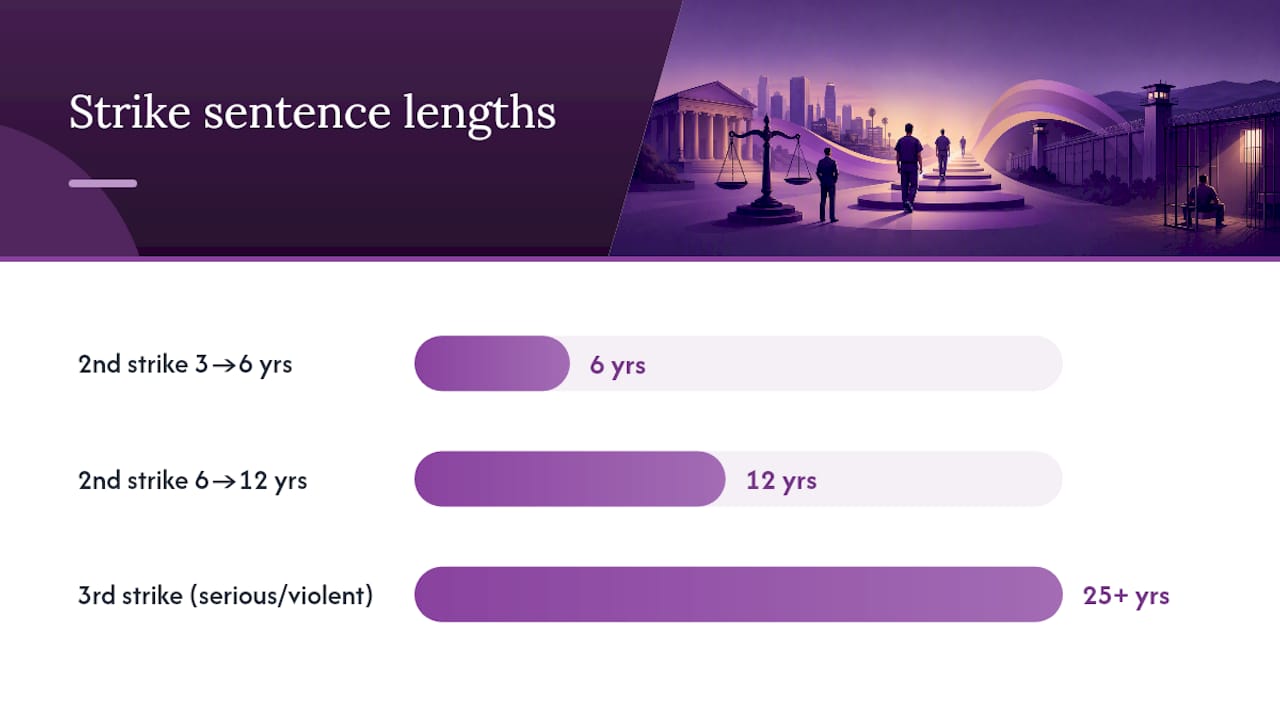
Second striker: If you have one qualifying strike prior and are convicted of any new felony, the base term for the new offense is doubled. A three-year base term becomes six years. A six-year base term becomes twelve. Probation is generally unavailable.
Third striker: If you have two or more qualifying strike priors and your new conviction is itself a serious or violent felony, you face a minimum of 25 years to life. This is the mandatory indeterminate sentence that Proposition 36 (2012) significantly narrowed.
A short example: suppose someone with two prior robbery convictions is charged with a new count of assault with a deadly weapon (a serious felony). Under pre-Prop 36 law, that triggered 25-to-life automatically. After Prop 36, the same scenario still triggers 25-to-life because the new offense is serious or violent. But if the new charge were simple drug possession, Prop 36 changed the outcome: the court would instead impose a doubled determinate term rather than life, unless specific exceptions apply (such as prior sex-offense or homicide strikes, or use of a firearm in the current offense).
Collateral consequences beyond the sentence itself include:
- Parole eligibility is restricted; third strikers serving life terms face the Board of Parole Hearings rather than automatic release
- Immigration consequences are severe: many strike offenses qualify as aggravated felonies under federal law, triggering mandatory deportation for non-citizens
- Probation and diversion programs are generally unavailable when a strike prior is alleged
- Civil rights restoration after release is more complicated and takes longer
The sentencing framework under PC § 1170 governs how base terms are calculated before the strike doubling applies, and understanding that baseline matters when evaluating any plea offer.
Edge cases that complicate strike analysis
Strike analysis rarely stays simple. Several fact patterns come up constantly in practice, and each one can change whether a prior counts.
Wobblers and prior dispositions
A wobbler charged and sentenced as a felony is a strike if the underlying offense appears on either statutory list. But if the court reduced it to a misdemeanor under PC § 17(b) at sentencing or on a later petition, the strike designation disappears with the felony status. Defense counsel will always check the original sentencing minute order and any subsequent reduction orders.
Juvenile adjudications
Juvenile adjudications can qualify as strike priors, but the bar is higher. Under California law, a juvenile adjudication counts as a strike only if the minor was at least 16 years old at the time of the offense, the offense would be a serious or violent felony if committed by an adult, and the juvenile court made a finding that the minor was fit for juvenile court (or the case was transferred). Courts scrutinize juvenile records carefully, and missing findings in the record can defeat the strike allegation entirely.
Out-of-state, federal, and military convictions
An out-of-state or federal conviction can count as a California strike, but only if the elements of the foreign offense match the elements of a California serious or violent felony. This elements-matching analysis is technical and often contested. A Texas robbery conviction, for example, might or might not match California's robbery statute depending on how the Texas offense is defined. Defense counsel will compare the charging document, the plea colloquy, and the jury instructions from the foreign proceeding against the California statute.
Federal convictions present the same challenge. A federal drug trafficking conviction may or may not contain the same elements as a California serious felony. Military court-martial convictions are analyzed the same way.
Weapon-use and GBI findings
This is one of the most litigated areas. A prior felony conviction only counts as a strike based on weapon use or great bodily injury if the record of the prior proceeding shows the defendant personally used the weapon or personally inflicted the injury. A conviction where a co-defendant used the weapon, or where the jury's verdict was ambiguous, may not support the strike allegation. Defense teams audit the original charging document, verdict form, and minute order to find exactly what was found.
What this means in practice: The strike allegation is only as strong as the paper trail behind it. Gaps in the original record are a defense opportunity.
Pro Tip: Request certified copies of the minute orders, abstract of judgment, plea transcript, and original charging document from every prior conviction the prosecution alleges as a strike. These records reveal whether the required factual findings were actually made, and missing findings can defeat the allegation entirely.
How courts can strike a prior: Romero motions, Prop 36, and Prop 47
Three distinct legal pathways exist for challenging or neutralizing a strike prior. None of them is easy, but all of them are worth evaluating.
Romero motions
Under People v. Superior Court (Romero) (1996) 13 Cal.4th 497, a trial court has discretion to strike a prior conviction allegation in the furtherance of justice. The judge must find, on the record, that the defendant falls outside the spirit of the Three Strikes law. Factors courts weigh include:
- How remote the prior conviction is in time
- The defendant's conduct and criminal history since the prior
- The nature and seriousness of the current offense
- Whether the defendant has a history of violence or only property crimes
- Personal circumstances such as substance abuse, mental health, or age at the time of the prior
The honest assessment: Romero relief is uncommon when the current offense is itself serious or violent. Judges who grant it typically do so when the prior is decades old, the defendant has a long gap in criminal activity, and the current charge is at the lower end of the serious-felony spectrum. Expect the prosecution to oppose aggressively.
Proposition 36 resentencing
Proposition 36, passed by California voters in November 2012, changed two things. First, it narrowed the third-strike trigger so that 25-to-life only applies when the current felony is itself serious or violent (with specific exceptions). Second, it created a resentencing petition process for people already serving 25-to-life sentences under the old law whose current offense was not serious or violent.
To petition for resentencing under Prop 36, the person must file in the sentencing court, show that the current conviction was not a serious or violent felony, and demonstrate that resentencing would not pose an unreasonable risk of danger to public safety. The LAO's analysis of Three Strikes' historical scope provides useful context for understanding why Prop 36 was necessary.
Proposition 47 effects
Proposition 47 (2014) reclassified certain felonies as misdemeanors, including simple drug possession and some theft offenses. If a prior conviction that was being used as a strike has since been reclassified as a misdemeanor under Prop 47, it no longer qualifies as a strike prior. Petitioning for Prop 47 reclassification of an old felony can therefore remove a strike from someone's record.
Documents counsel will need to challenge a prior:
- Certified abstract of judgment from the prior conviction
- Plea transcript or reporter's transcript of the plea colloquy
- Original charging document (complaint or information)
- Minute orders from the sentencing hearing
- Jury instructions (if the prior went to trial)
- Any probation reports from the prior case
Pro Tip: There is no washout period for strike priors in California. A conviction from 30 years ago can still be alleged as a strike today. The only way to neutralize it is through a Romero motion, a Prop 47 reclassification, or a direct challenge to the prior's qualifying elements. Do not assume age alone protects you.
When to contact a criminal defense attorney
Contact a criminal defense attorney immediately if any of the following apply:
- The DA's charging document alleges a strike prior
- You have one or more prior convictions for crimes on the serious or violent felony lists
- You are currently charged with a serious or violent felony and have any prior felony convictions
- Immigration consequences are possible (non-citizen status)
- You are already serving a sentence and believe your current conviction was not a serious or violent felony
What to bring to your first meeting: Certified conviction records for every prior felony, plea paperwork, probation reports, any sentence documents, and juvenile records if applicable. The more complete the record, the faster counsel can assess your exposure.
An attorney's first steps in a strike case typically include pulling all prior conviction records, analyzing whether each alleged prior actually meets the statutory elements, filing motions to strike or challenge priors, and evaluating whether a negotiated plea can avoid the strike allegation entirely. Prosecutors sometimes agree to plead a charge to a non-strike offense when the evidence on the strike prior is contestable or when the defendant's overall history supports a different resolution.
The violent crimes defense team at Rubinlawpc handles exactly these cases across Los Angeles County, from the initial records audit through Romero motions and Prop 36 petitions.
How Rubinlawpc approaches strike-prior cases
Rubinlawpc's approach to strike cases starts with the paper trail, not the courtroom. Before any motion is filed, the firm collects and audits every document connected to every alleged prior: charging instruments, plea transcripts, minute orders, and abstracts of judgment. Many strike allegations fail at this stage because the original record is incomplete or the required factual findings were never made.
The firm's position: A strike allegation is a separately provable element. The prosecution must prove it beyond a reasonable doubt, and that proof lives in documents. Attacking the documents is often the most effective defense available.
Rubinlawpc's practical steps in strike cases:
- Immediate records collection: Certified conviction records from every jurisdiction where a prior is alleged
- Elements analysis: Comparing each prior's charging document and plea colloquy against the California statutory definition
- Romero motion practice: Filing and arguing motions to strike priors when the defendant's history and circumstances support it
- Plea negotiation: Structuring plea agreements that resolve the current charge without triggering the strike enhancement, when the evidence and facts allow
- Prop 36 and Prop 47 evaluation: Assessing whether resentencing or reclassification petitions are viable for existing sentences or old priors
The firm's Los Angeles County criminal defense practice covers the full range of serious and violent felony charges that generate strike allegations, including robbery, assault, sex offenses, and homicide-related charges.
If you are facing a strike allegation or believe a prior conviction may affect your current case, contact Rubinlawpc for a direct assessment of your records and options.
What most people get wrong about California's Three Strikes law
The conventional framing of Three Strikes presents it as a law targeting the most dangerous repeat violent offenders. That framing is incomplete, and it leads defendants and their families to underestimate their exposure in ways that cost them.
The Stanford Three Strikes Project documented that before Proposition 36's reforms, a substantial portion of people serving life sentences under Three Strikes had been convicted of nonviolent offenses as their triggering third strike. The law's scope was never limited to violent recidivists. It swept in residential burglary, certain drug offenses, and a range of property crimes that most people would not intuitively classify as "three strikes crimes."
That history matters for defendants today because the serious felony list under § 1192.7(c) is long and includes offenses that do not feel violent in the common-sense meaning of that word. Residential burglary is the clearest example. No one needs to be home. No weapon needs to be used. The offense qualifies as a serious felony, and therefore a strike, based on the structure of the crime alone.
The second thing people consistently underestimate is the permanence of strike priors. There is no washout period. A robbery conviction from 1995 is just as usable as a strike prior today as it was the year after sentencing. Defense attorneys who do not immediately audit the prior record for element-matching problems, missing factual findings, or Prop 47 reclassification eligibility are leaving the most powerful tools unused.
The third gap in conventional advice is the treatment of Romero motions as a realistic fallback. They are not. Romero gives judges discretion; it does not give defendants a right to relief. When the current offense is serious or violent, most judges will not exercise that discretion. The better strategy, in most cases, is attacking the prior's qualification before the Romero question ever becomes relevant.
What should you prioritize? Get the certified records from every prior conviction before you do anything else. The strike allegation is only as strong as the documents behind it, and those documents have gaps more often than prosecutors expect.
This article is general information, not a substitute for advice from a qualified lawyer. Consult a qualified legal professional about your own circumstances before acting on anything here.
Sources
The following statutes, case law, and public resources were used in preparing this article.
Primary statutes:
- Three Strikes Basics - Stanford Law School
- Three Strikes Law - A General Summary
- Penal Code 1170.12: California’s Three Strikes Law - LegalClarity
- A Primer: Three Strikes: The Impact After More Than a Decade
Key case law:
Authoritative explainers and public resources:
Note: Statutes change. Verify current text of Penal Code §§ 667.5(c) and 1192.7(c) through the California Legislative Information portal or with qualified counsel before relying on any list for a specific case.