
Violating a restraining or protective order in California is a crime. Under California Penal Code §273.6, an intentional and knowing breach of a qualifying protective order is a misdemeanor punishable by up to one year in county jail and a fine up to $1,000. When the violation involves physical injury or a credible threat of violence, enhanced penalties and even felony exposure can follow. The law does not require the protected person to be harmed — the act of violating the order's terms is itself the offense.
If you are a victim:
- Call 911 immediately and tell the dispatcher you have an active restraining order.
- Give officers the order number and, if possible, the CLETS entry reference.
If you have been accused:
- Stop all contact with the protected person right now, including through third parties.
- Contact a criminal defense attorney before speaking to police or prosecutors.
Table of Contents
- What does PC §273.6 actually require prosecutors to prove?
- What types of protective orders exist in California?
- How are restraining-order violations enforced in California?
- What are the penalties for violating a restraining order in California?
- What defenses work in a PC §273.6 case?
- Victim and accused checklists: what to do right now
- How experienced defense firms approach PC §273.6 cases
- Key Takeaways
- What Rubin Law, P.C. sees most often in these cases
- Facing a PC §273.6 charge? Here is what Rubin Law, P.C. offers
- Useful sources
What does PC §273.6 actually require prosecutors to prove?
PC §273.6 covers a specific set of court orders: domestic violence restraining orders (DVROs) issued under Family Code §6218, civil harassment orders under Code of Civil Procedure §§527.6, 527.8, and 527.85, and elder or dependent adult abuse orders under Welfare and Institutions Code §15657.03. Criminal protective orders issued in pending criminal cases also fall within the statute's reach.
To secure a conviction, the prosecution must establish three elements:
- A qualifying protective order existed at the time of the alleged violation.
- The defendant had actual notice of the order — through personal service, presence in court when the order was issued, or another documented form of notice.
- The defendant intentionally and knowingly violated a specific term of that order.
The third element is where most cases turn. Accidental or unknowing contact is not a crime under PC §273.6. But courts interpret "knowing" broadly: if you received service, you are presumed to know the order's terms.
Penalty ranges under the statute:
- Subdivision (a): First-offense misdemeanor — up to one year in county jail, a fine up to $1,000, or both.
- Subdivision (b): If the violation results in physical injury, the minimum custody term increases and fines rise.
- Subdivisions (d) and (e): Subsequent convictions within seven years, or within one year when injury is involved, carry elevated penalties.
- Subdivision (g): Firearm possession while subject to a qualifying protective order can trigger separate prosecution under PC §29825.
Under CALCRIM No. 2703, juries are instructed to evaluate whether an act involved violence or a credible threat of violence — a finding that can push a case toward felony treatment and significantly longer sentencing exposure.
Pro Tip: Proof of service is often the single most contested issue in a PC §273.6 case. Defense attorneys routinely demand the proof-of-service declaration, the server's identity, and the method of service. If service was defective — wrong address, wrong person served, or no signed return — that gap can be decisive.
What types of protective orders exist in California?
California issues several distinct types of restraining and protective orders. Each has a different origin, duration, and enforcement pathway, but all of them can support a PC §273.6 prosecution once properly served.

| Order type | Who can request it | Typical duration | How enforced |
|---|---|---|---|
| Domestic Violence Restraining Order (DVRO) | Current or former intimate partners, close family members | renewable for a longer period | Police arrest (PC §273.6), civil contempt |
| Temporary Restraining Order (TRO) | Any qualifying petitioner pending a hearing | Until the full hearing (typically several weeks) | Police arrest, CLETS verification |
| Emergency Protective Order (EPO) | Law enforcement officers, on scene | Up to about a week | Police arrest, immediate CLETS entry |
| Criminal Protective Order (CPO) | Issued by a criminal court in a pending case | Duration of criminal proceedings, sometimes longer | Automatic enforcement through the criminal case |
A few distinctions matter in practice. An EPO is issued by a police officer at the scene and takes effect immediately — no court appearance required. A TRO is granted by a judge, often the same day the petition is filed, without a court fee for domestic violence petitions. The DVRO is the long-term order issued after a full hearing, and it can last up to five years and be renewed indefinitely.
Civil-origin orders (DVROs, civil harassment TROs) become criminally enforceable the moment they are served on the restrained person. That is the point at which PC §273.6 applies.
How are restraining-order violations enforced in California?
Enforcement runs on two parallel tracks: criminal prosecution and civil contempt. Both can be triggered by the same incident.
The criminal track, step by step:
- The victim calls 911 and reports the violation with the order number.
- Officers check the CLETS database to confirm the order is active and its specific terms.
- If probable cause exists, the officer arrests the restrained person on scene.
- The district attorney reviews the arrest report and decides whether to file charges under PC §273.6.
- The defendant is arraigned, bail is set or denied, and the case proceeds through pretrial motions, possible plea negotiations, and, if necessary, trial.
The civil contempt track runs separately through the family or civil court that issued the order. The protected person files a motion, a hearing is scheduled, and the judge can impose fines, jail time, or other sanctions independent of any criminal case.
When reporting a violation, bring:
- A certified copy of the restraining order (not a photocopy).
- Screenshots or printouts of any messages, calls, or social-media contact.
- Names and contact information for any witnesses.
- Photos of injuries or property damage, with timestamps.
Pro Tip: Preserve evidence the moment a violation occurs. Screenshot messages before they can be deleted, note the exact time and location, and write down what happened in your own words while it is fresh. Prosecutors and civil contempt judges rely heavily on contemporaneous documentation — a detailed record made the same day carries far more weight than one reconstructed weeks later.
One thing courts and police enforce to the letter: the specific wording of the order. A "no contact" provision means no contact — not a friendly text, not a message through a mutual friend, not a social-media reaction. Officers act on the order's literal terms, not on the defendant's stated intent.

What are the penalties for violating a restraining order in California?
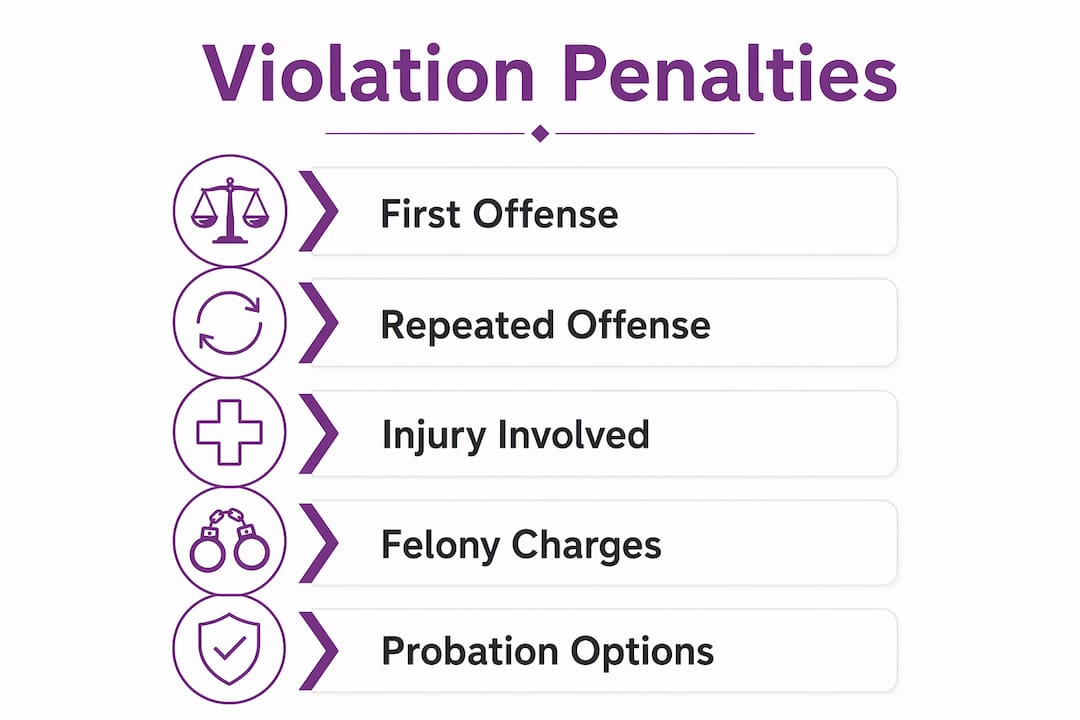
The statutory penalties under PC §273.6 scale with the severity and repetition of the conduct.
| Triggering condition | Charge level | Maximum jail | Maximum fine |
|---|---|---|---|
| First offense, no injury | Misdemeanor | 1 year county jail | $1,000 |
| Violation with physical injury | Misdemeanor (enhanced) | 1 year county jail and increased minimum custody term | Higher fines as specified in statute |
| Second or subsequent conviction within a statutory period | Misdemeanor or felony | Up to 3 years state prison | Higher statutory fines |
| Violation involving violence or credible threat (CALCRIM 2703) | Potential felony | Varies | Varies |
Source: PC §273.6 subdivisions (a), (b), (d), (e) and CALCRIM No. 2703.
Beyond jail and fines, the collateral consequences of a conviction are often what clients feel longest:
- Firearm prohibition: A protective order itself prohibits firearm possession. Violating that prohibition can lead to a separate charge under PC §29825, on top of the PC §273.6 count.
- Custody and visitation: A conviction — or even an arrest — can be used in family court to restrict or eliminate parenting time. Judges take protective-order violations seriously when evaluating the best interests of a child.
- Immigration: Non-citizens face serious risk. A domestic-violence-related conviction can trigger deportation, inadmissibility, or denial of naturalization under federal immigration law.
- Employment and licensing: Many professional licenses (nursing, teaching, law, security) require disclosure of criminal convictions. A PC §273.6 conviction can jeopardize or end a career in licensed fields.
Probation is common in first-offense cases and typically includes mandatory counseling (batterer's intervention programs for domestic violence matters), community service, and compliance with the underlying protective order. Fines may be adjusted based on ability to pay, but the counseling requirement is rarely waived in domestic violence restraining order cases.
What defenses work in a PC §273.6 case?
Defense strategy in a restraining-order violation case almost always starts with two questions: Did the defendant actually know about the order? And did the conduct actually violate its specific terms? Those two lines of attack account for a substantial share of successful defense outcomes.
Common defenses and the evidence that supports them:
- Lack of notice or defective service: If the defendant was never properly served, the "knowing" element fails. Defense counsel will demand the proof-of-service declaration, the server's affidavit, and any return receipts. A wrong address, a substituted service that did not comply with statutory requirements, or service on the wrong person can defeat the charge.
- No intentional violation: Accidental contact — running into the protected person at a grocery store, for example — is not a crime. Location data, surveillance footage, and witness statements can establish that the contact was unplanned.
- Consent or invitation (with a critical caveat): Even if the protected person invited contact or initiated it, that consent is not a legal defense to a PC §273.6 charge. The order remains in effect regardless of what the protected person says or does. Defense counsel can, however, use evidence of the protected person's initiation to challenge the credibility of the complaint or negotiate with the DA.
- Mistaken identity: In cases involving indirect contact through third parties, the defendant may be able to show they did not send or authorize the communication.
- Insufficient evidence: The prosecution bears the burden of proof beyond a reasonable doubt. Challenging the reliability of screenshots, the chain of custody for digital evidence, or the credibility of witnesses can create reasonable doubt without requiring the defendant to prove anything.
Pro Tip: Do not delete any messages, even ones that look bad. Deleting communications after an arrest or investigation can be treated as evidence of consciousness of guilt — and in some cases as obstruction. Preserve everything, then let your attorney decide what is useful and how to present it.
Victim and accused checklists: what to do right now
If you are the protected person
- Call 911 if you feel threatened or the restrained person has made contact.
- Get medical attention for any injuries and ask for documentation from the provider.
- Keep a certified copy of the restraining order with you at all times — give copies to your employer, your children's school, and anyone else who needs to know.
- Photograph injuries and property damage immediately, before anything changes.
- Save every message, voicemail, and social-media interaction. Screenshot and back them up to a secure location.
- Write down the date, time, location, and description of each incident as soon as it happens.
- If you need to modify the order or seek emergency relief, contact your court's self-help center or call the National Domestic Violence Hotline at 1-800-799-7233.
If you have been accused
- Stop all contact with the protected person immediately — including through friends, family, or social media.
- Do not delete any text messages, emails, or call logs.
- Preserve location data (phone GPS history, receipts, surveillance footage) that can establish where you were.
- Gather any evidence showing you were not properly served or did not have notice of the order.
- Follow any temporary court orders already in place, even if you believe they are wrong.
- Contact an experienced criminal defense attorney before your next court date or before speaking to investigators.
Pro Tip: Your phone's metadata — timestamps, GPS coordinates embedded in photos, cell tower records — can be more persuasive than your own account of events. Ask your attorney about preserving this data through a litigation hold before anything is overwritten or lost.
How experienced defense firms approach PC §273.6 cases
A seasoned criminal defense firm treats a PC §273.6 case as a multi-front problem: the criminal charge, the underlying protective order, and any related family or civil proceedings all need attention at the same time.
On the investigative side, defense counsel will:
- Pull the proof-of-service records and CLETS entry to verify proper notice and order validity.
- Subpoena phone records, metadata, and carrier logs to reconstruct the timeline.
- Interview witnesses and, where relevant, the protected person's prior statements for inconsistencies.
- Review body-camera footage from the arresting officers.
On the resolution side, the range of outcomes a firm may pursue includes: outright dismissal for defective service or insufficient evidence, non-prosecution agreements at the pre-filing stage, plea to a lesser non-violent offense, diversion programs (including mental-health diversion under PC §1001.36 where applicable), probation with counseling in lieu of jail, and negotiated sentencing that avoids state prison for repeat-offense cases.
The defense approach differs depending on what kind of violation is alleged. A technical violation — failing to vacate shared housing on schedule, contacting the protected person through a third party, or violating a custody-related condition — often has more room for negotiation than a case involving direct threats or physical contact. Technical violations can be prosecuted with the same statutory severity as contact-based violations, but DAs and judges often respond differently to the underlying facts.
Pro Tip: Ask your attorney specifically about local-court practices and early-intervention opportunities before your arraignment. Rubin Law, P.C.'s experience in Los Angeles courts — including familiarity with how specific prosecutors and judges approach PC §273.6 cases — can shape negotiation strategy from day one.
Key Takeaways
Violating a restraining order in California is a criminal offense under PC §273.6, and the consequences extend well beyond jail time to firearm prohibitions, custody loss, and immigration risk.
| Point | Details |
|---|---|
| PC §273.6 elements | Prosecutors must prove a valid order existed, the defendant had notice, and the violation was intentional and knowing. |
| Base penalties | A first-offense misdemeanor carries up to 1 year in county jail and a fine up to $1,000; injury and repeat offenses can raise minimum custody terms and fines per PC §273.6. |
| CLETS and enforcement | Having the order entered into CLETS enables immediate on-scene enforcement by any responding officer. |
| Collateral consequences | Convictions can trigger firearm prohibition under PC §29825, custody restrictions, immigration consequences, and professional license loss. |
| Rubin Law, P.C. | Rubin Law, P.C. defends PC §273.6 cases in Los Angeles courts, focusing on notice defects, diversion, and pre-filing intervention. |
What Rubin Law, P.C. sees most often in these cases
The detail that surprises most clients is how little the protected person's behavior matters to the prosecution. A defendant who responds to a text from the protected person, shows up at a location the protected person suggested, or passes along a message through a mutual friend can still be arrested and charged — because the order is a court command, not a private agreement between two people. Courts enforce the order's literal terms, full stop.
What that means practically: the defense almost never wins by arguing "she wanted me there" or "he said it was okay." The winning arguments are procedural and evidentiary. Was service proper? Did the defendant actually know the specific term they allegedly violated? Does the prosecution's evidence hold up under scrutiny? Those are the questions that move cases.
The other thing clients consistently underestimate is how fast collateral consequences hit. A custody modification hearing can be filed the same week as an arrest. An immigration hold can be placed before a conviction. A professional licensing board can open an investigation based on an arrest alone. Getting counsel involved early — before arraignment, ideally before charges are even filed — is the only way to address those parallel tracks before they close off options.
Facing a PC §273.6 charge? Here is what Rubin Law, P.C. offers
When a restraining-order violation charge lands, the window for early intervention is narrow. Rubin Law, P.C. provides criminal defense representation for PC §273.6 cases throughout Los Angeles and California state courts, including motion practice to challenge defective service, pre-filing negotiations with the district attorney, plea and diversion advocacy, and trial representation when the case demands it.
The firm's approach is built on courtroom frequency and local knowledge. Rubin Law attorneys appear regularly in Los Angeles courts and understand how individual prosecutors and judges handle protective-order cases — an advantage that shapes strategy from the first phone call. Whether you are facing a first-offense misdemeanor or a repeat-offense case with felony exposure, early legal guidance is the most effective tool available.
For defendants exploring mental-health diversion or alternative sentencing, or for anyone who needs a full case assessment from a Los Angeles criminal defense attorney, contact Rubin Law, P.C. to schedule a consultation before your next court date.
Useful sources
The following primary sources and official materials form the factual foundation of this article. Each is publicly available and free to access.
- California Penal Code §273.6 — FindLaw: Full statutory text of the restraining-order violation statute, including penalty subdivisions (a), (b), (d), (e), and (g) covering firearm prohibitions.
- California Penal Code §273.6 — Justia: Annotated 2024 code text with enhanced-penalty language for injury-based and repeat-offense violations.
- CALCRIM No. 2703 — Justia: The standard jury instruction used in California courts to evaluate whether a protective-order violation involved violence or a credible threat, which affects felony exposure.
- DV-530-INFO: How to Enforce Your Restraining Order — California Courts: Official court guidance on calling police, CLETS verification, civil contempt remedies, and evidence preservation steps for victims.
- Domestic Violence Restraining Orders — California Courts Self-Help: Plain-language overview of how to obtain a DVRO, what it covers, and how to enforce it, including information on filing fees (none for DVRO petitions) and TRO timelines.
- Enforce Your Restraining Order — California Courts Self-Help: Specific guidance on what counts as a violation, how police enforce order terms literally, and why indirect contact still triggers enforcement.
- Restraining Orders Overview — California Courts Self-Help: Index of all California restraining-order types, including DVROs, civil harassment orders, elder abuse orders, and criminal protective orders.
- National Domestic Violence Hotline: 24/7 confidential support line (1-800-799-7233) for victims seeking safety planning, emergency resources, and referrals to local advocacy services.
- Rubin Law, P.C.: Los Angeles criminal defense firm representing clients charged with PC §273.6 violations and related domestic violence offenses throughout California state courts.
This article provides general legal information about California law and is not legal advice for any specific situation. Laws and their application can change, and individual circumstances vary. Consult a qualified California criminal defense attorney for guidance on your own case.