
A charge under Health and Safety Code 11351 is a felony, but a felony charge is not a conviction. Most HS 11351 cases turn on one contested element: whether prosecutors can prove you intended to sell the drugs, not just possess them. That single weak point, combined with search and seizure problems that plague many drug arrests, is why HS 11351 defenses succeed more often than defendants expect. The immediate move is simple: say nothing to police and call a lawyer before you say anything else.
TL;DR:
- Defense strategies often focus on challenging the prosecution's ability to prove actual control, knowledge, and intent to sell the drugs.
- Evidence such as the quantity, packaging, cash, and digital communications are circumstantial and can have innocent explanations if properly challenged.
- Suppression motions are especially powerful if police lacked a warrant or probable cause, potentially dismissing the case before trial.
- Early legal review of the search and evidence significantly increases chances of success, as most defenses are strongest when built promptly.
- Most cases rely on circumstantial indicators of intent, which can be undermined through cross-examination and presentation of alternative explanations.
Table of Contents
- HS 11351 Defenses Start With the Elements Prosecutors Must Prove
- How Prosecutors Try to Prove Intent to Sell
- Common Legal Defenses to HS 11351 Charges
- When Suppression Motions Can End the Case Before Trial
- Penalties and Collateral Consequences of an HS 11351 Conviction
- What to Do Right After an HS 11351 Arrest
- How Rubin Law Approaches HS 11351 Defense
- The Real Verdict on HS 11351 Defenses
- Talk to Rubin Law About Your HS 11351 Case
- Resources for HS 11351 Cases and Support
- Sources
HS 11351 Defenses Start With the Elements Prosecutors Must Prove
Before any defense makes sense, you need to know what the state actually has to establish. HS 11351 covers possession of a controlled substance for the purpose of sale, and prosecutors carry the burden on every piece of it. Miss one element and the case falls apart, which is exactly why defense strategies for HS 11351 focus so heavily on picking apart these specific pieces rather than arguing the case in general terms.
- Possession, either actual (on your person) or constructive (control over the drugs even without physical contact, such as narcotics found in a car you were driving or a room you rented).
- Knowledge that the substance was present and that it was, in fact, a controlled substance. Not "should have known." Actually knew.
- Usable quantity, meaning enough of the drug to be consumed or sold, not mere residue scraped from a pipe or baggie.
- Specific intent to sell, the element that separates this felony from a simple possession charge under HS 11350.
Constructive possession is where a lot of these cases get won or lost. California courts require the prosecution to show actual control or the right to control the drugs, not just proximity. In People v. Williams, courts made clear that being near contraband, or even in a house where it is found, does not automatically establish possession. If you were a passenger in a car with drugs under the seat, or a guest in an apartment where narcotics turned up in someone else's closet, that gap between presence and control is often the entire case.
The usable-quantity requirement trips up prosecutors more than people realize. Crime lab reports sometimes come back showing trace amounts insufficient to meet the legal threshold, and when that happens, the possession element itself can be challenged before intent ever becomes relevant.
How Prosecutors Try to Prove Intent to Sell
Since prosecutors rarely have a confession or a video of a hand-to-hand sale, they build intent through circumstantial evidence stacked piece by piece. Common indicia of intent to sell include:
- Quantity inconsistent with personal use (more than a typical user would keep on hand).
- Packaging materials: small baggies, dime bags, or bindles rather than a single personal-use container.
- Digital scales, especially ones with drug residue.
- Large amounts of cash, particularly in small denominations.
- Ledgers, pay/owe sheets, or handwritten records of transactions.
- Multiple cell phones or coded text messages referencing sales activity.
Digital evidence has become the backbone of many modern cases. Text messages and payment app records showing repeated small transactions can look damning at first glance. But the Supreme Court's decision in Riley v. California requires police to get a warrant before searching the contents of a cell phone in almost every circumstance, and a phone search conducted without one is a frequent target for suppression.
Quick fact: Expert narcotics testimony, where an officer testifies about "typical" dealer behavior based on training and experience, is permitted under California case law, but it is also one of the most successfully challenged pieces of evidence in HS 11351 trials, since People v. Parra confirms this testimony is opinion evidence, not fact, and can be cross-examined and undercut.
Every one of these indicia has an innocent explanation, and defense attorneys build their case around offering it. Cash can come from a paycheck. Baggies get used for jewelry, coins, or vitamins. A second phone might belong to a roommate. The prosecution's stack of circumstantial evidence only wins if the jury never hears a plausible alternative story.
Common Legal Defenses to HS 11351 Charges
Effective HS 11351 legal defenses generally follow a predictable order of attack, starting with the weakest link in the prosecution's chain and working outward. Here's roughly how experienced defense counsel prioritizes them:
- Attack possession and knowledge first. If drugs were found in a shared space, a borrowed car, or a location with multiple occupants, constructive possession becomes hard to prove beyond a reasonable doubt.
- Argue personal use, not sale. Small quantities, no packaging materials, no scale, no cash, and no communications referencing sales all point toward personal consumption rather than distribution. This defense doesn't beat the charge outright, since possession alone is still a crime, but it can knock the case down from a felony HS 11351 to a far less severe HS 11350 charge.
- File a motion to suppress illegally obtained evidence. If police lacked a warrant, consent, or probable cause, everything found in that search can potentially be thrown out.
- Raise momentary or transitory possession. Under People v. Mijares, a defendant who briefly holds a substance only to dispose of it, without any intent to exercise control over it, may have a viable defense. This applies in narrow fact patterns, but it has succeeded in real cases.
- Consider entrapment, prescription, or medical defenses. If law enforcement induced the offense through improper pressure, or if the substance was lawfully prescribed, those facts change the entire analysis.
- Challenge the prosecution's expert. Cross-examining the officer who testified about "dealer behavior" can expose assumptions that don't match the specific facts of your case.
Pro Tip: Never assume a large quantity automatically means a lost case. Courts in People v. Newman and related decisions have recognized that quantity alone, without corroborating indicia like packaging or sales communications, is not always enough to prove intent to sell beyond a reasonable doubt.
When Suppression Motions Can End the Case Before Trial
Illegal search and seizure claims are among the most powerful court defenses for HS 11351 charges, because they attack the evidence itself rather than arguing about what it means. A motion to suppress under Penal Code 1538.5 asks a judge to exclude evidence obtained in violation of the Fourth Amendment, and if the drugs, scale, or cash get thrown out, the prosecution often has nothing left to try.
Grounds for suppression commonly include:
- A search warrant that lacked probable cause or was based on a stale or unreliable informant tip.
- A search conducted without consent and without an exception (such as exigent circumstances) that would justify skipping the warrant requirement.
- A traffic stop extended beyond its original purpose without independent suspicion, a limit set by the Supreme Court in Rodriguez v. United States.
- Warrantless searches of vehicles or containers that exceed the scope allowed under California v. Acevedo.
- Cell phone data pulled without a warrant, which Riley v. California generally prohibits.
Suppression motions typically get filed early, often before the preliminary hearing, and they target the specific piece of evidence the prosecution's whole case rests on. A successful motion doesn't just weaken the case; it frequently forces prosecutors to offer a dramatically reduced plea or dismiss the charge outright, since without the physical evidence there's often nothing left to prosecute.
Penalties and Collateral Consequences of an HS 11351 Conviction
A conviction carries real weight, and that weight is exactly why building a defense early matters. Standard sentencing for HS 11351 runs from two to four years in county jail under California's realignment scheme, with penalties escalating for certain substances and circumstances.
- Sales involving cocaine base (crack) or heroin can carry three, four, or five years depending on the specific facts.
- Enhancements apply for sales within 1,000 feet of a school, sales to a minor, or possession of large, kilo-level quantities.
- A felony conviction can trigger deportation consequences for noncitizens, professional license problems, and loss of eligibility for diversion programs on future charges.
- Reducing the charge to simple possession under HS 11350 changes the entire trajectory, often opening the door to drug diversion under PC 1000 instead of jail time.
What to Do Right After an HS 11351 Arrest
The decisions you make in the first 24 hours shape everything that follows.
- Say nothing to police beyond identifying yourself. Anything said after arrest gets used against you, and there's no upside to explaining yourself before you have counsel.
- Write down everything you remember about the stop, the search, and any statements officers made, while the details are still fresh.
- Leave your phone and messages alone. Deleting texts or apps can look like evidence destruction and create a separate legal problem.
- Call an experienced criminal defense attorney immediately and ask specifically about suppression strategy, since that conversation often determines how the rest of the case unfolds.
How Rubin Law Approaches HS 11351 Defense
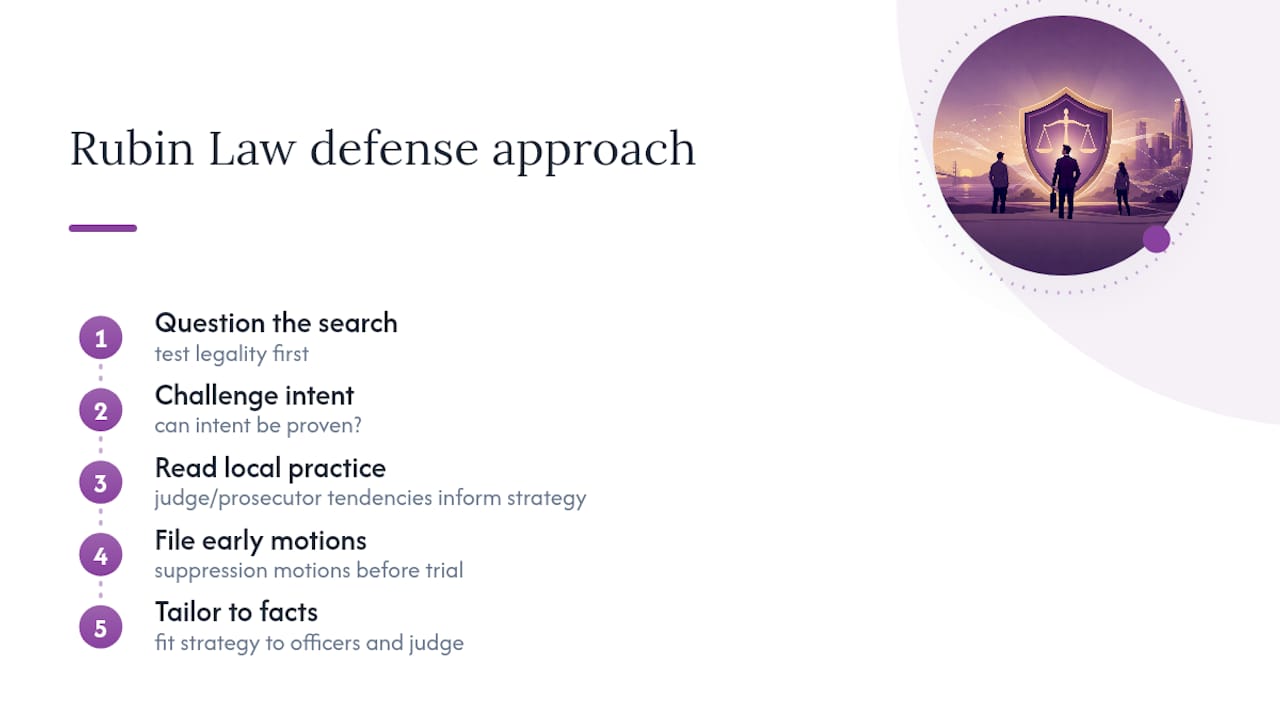
Rubin Law's approach to these cases starts with the same question every defense attorney should ask first: was the search legal, and can intent actually be proven? Frequent courtroom appearances across Los Angeles County give the firm a working understanding of how specific judges and prosecutors handle suppression motions and intent-to-sell arguments, which shapes strategy from the first client meeting.
Early motions and a clear read on local practice often produce better outcomes than waiting until trial to challenge weak evidence. Every case turns on its own facts, its own arresting officers, and its own judge, so no two HS 11351 defenses look identical. What stays consistent is the priority: test the search first, then test the intent.
The Real Verdict on HS 11351 Defenses
Most people facing an HS 11351 charge assume the quantity of drugs found determines their fate. It doesn't. Intent to sell is inferred, argued, and frequently overstated by prosecutors who lean on circumstantial indicia that fall apart under cross-examination. The conventional advice, "hope for a good plea deal," undersells how often a well-timed suppression motion changes the entire negotiation before a plea is even on the table.
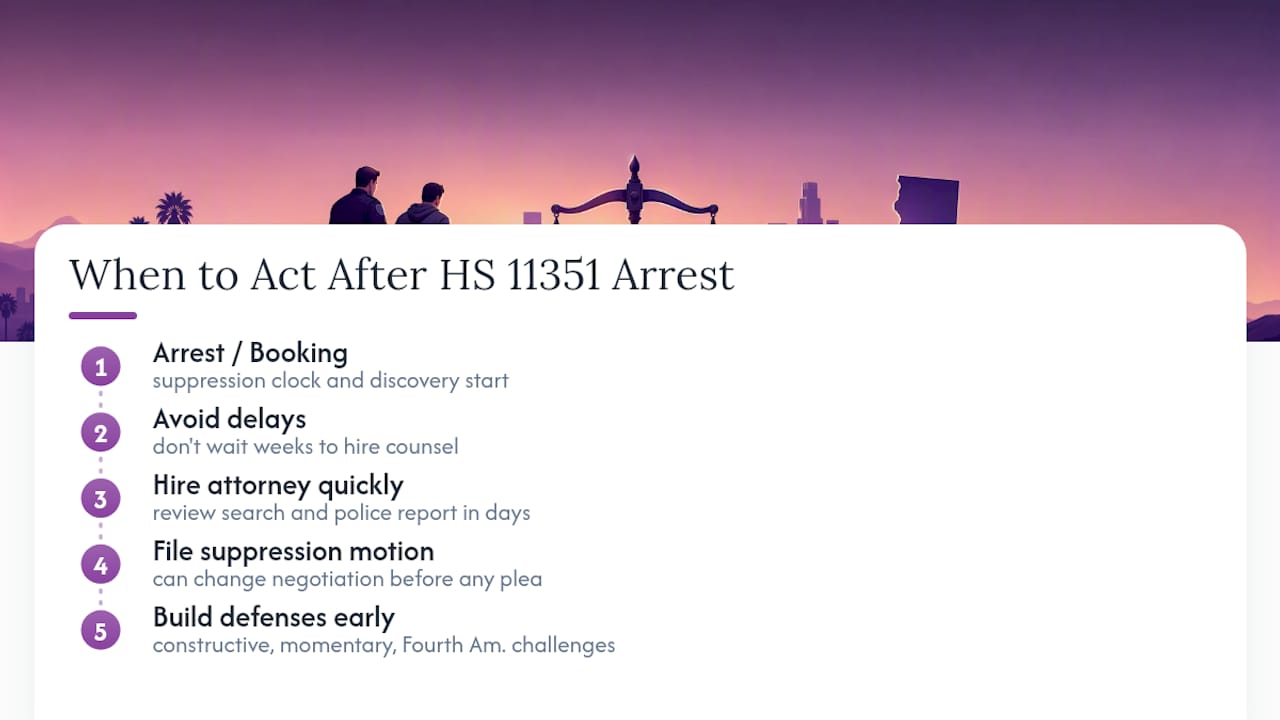
Where most defendants go wrong is waiting. They talk to police hoping to explain their way out of an arrest, or they wait weeks to hire counsel while evidence and witness memories go stale. The suppression clock and the discovery window both start ticking the moment you're booked. If there's one thing worth prioritizing above everything else in this article, it's this: get a defense attorney reviewing the search and the police report within days, not weeks. Common defenses HS 11351 cases raise, whether it's constructive possession, momentary possession, or a Fourth Amendment challenge, are strongest when they're built early, not bolted on right before trial.
— Jake
Talk to Rubin Law About Your HS 11351 Case
For defendants facing HS 11351 charges, choosing a firm with courtroom experience and insight into local judicial and prosecutorial practices can inform real strategy instead of guesswork.
A criminal defense consultation often begins with key questions about the legality of the search and the prosecution's ability to prove intent. Early review of arrest reports, identification of suppression opportunities, and timely collection of witness statements can be crucial to case outcomes. If you're facing an HS 11351 possession for sale charge or any related California drug crime, contact Rubin Law now to schedule a consultation and get a defense strategy built around your specific arrest, not a generic template.
Resources for HS 11351 Cases and Support
- HS 11351 statute page covers the code text and common defense angles.
- Drug diversion under PC 1000 explains eligibility if charges get reduced.
- The SAMHSA National Helpline offers free, confidential treatment referral for substance use concerns.
- SMART Recovery provides peer support meetings that can support mitigation or diversion arguments.
- Abaasy Bail Bonds' guide to California bail costs helps with immediate post-arrest logistics and expected expenses.
This article is general information, not a substitute for advice from a qualified lawyer. Consult a qualified legal professional about your own circumstances before acting on anything here.