
Sealing hides a record from public view; expungement, in a handful of states, actually destroys it. But that one sentence can mislead you, because states don't agree on what "expungement" means. Some states call it expungement and still let police departments pull the file. Others call it sealing and it functions almost like destruction. The label on the form is not the answer. The statute's actual text is.
Here's what that means practically:
- In most job and housing applications, both a properly sealed and a properly expunged record let you legally answer "no" to a conviction question, once the order is final.
- Law enforcement, courts, and certain licensing agencies frequently retain access regardless of which term your state uses.
- Your immediate move: pull up your state's actual expungement or sealing statute, or call a criminal defense attorney, before assuming either process erases anything.
Key Takeaways
The practical difference between expungement and sealing depends entirely on your state's statutory language, not on which word your paperwork uses.
| Point | Details |
|---|---|
| Labels mislead | Only a minority of states treat expungement as true destruction; most restrict access instead. |
| Check eligibility first | Case outcome, offense type, and waiting periods determine whether you qualify at all. |
| Access gaps persist | Law enforcement, licensing boards, and immigration authorities often retain visibility regardless of relief type. |
| Verify the outcome | Pull your RAP sheet or check the court docket after any order to confirm it actually took effect. |
| State law controls | There's no general federal expungement remedy, so your state's statute is the only rule that matters. |
Table of Contents
- Expungement vs Sealing: Why the Terminology Trips People Up
- Who Qualifies, and What Knocks You Out of Eligibility
- How the Petition Process Actually Works
- Who Can Still See a Sealed or Expunged Record
- State Snapshots: Same Words, Different Outcomes
- What Practitioners Actually Watch For
- Editorial Take: What Actually Matters Here
- Frequently Asked Questions
- Sources
Expungement vs Sealing: Why the Terminology Trips People Up
States don't share a dictionary here, and that's the root of most confusion. "Expungement," "sealing," "set-aside," "annulment," and "vacatur" all show up in different state codes, sometimes describing nearly identical outcomes, sometimes describing very different ones.
Two legal effects matter more than the vocabulary:
- Destruction. The record is physically obliterated or purged from the system, as if the case never existed in any retrievable form.
- Restricted access. The record still exists somewhere, usually in law enforcement databases, but the public, employers, and most background-check companies can't see it.
A fifty-state overview from the Post-Conviction Empowerment consortium found that very few states actually mandate destruction under any label including expungement. Most states, no matter what they call the remedy, prohibit public disclosure while quietly preserving the file for internal government use. The National Conference of State Legislatures makes the same point: read the statute's operative language, not its title, because the same word can produce different results from one state line to the next.
Who Qualifies, and What Knocks You Out of Eligibility
Eligibility almost always turns on how your case ended, not just what you were charged with. Courts and legislatures build these rules around outcome, offense category, and time elapsed.
- Non-convictions and diversion (dismissals, acquittals, completed diversion programs) usually qualify fastest and with the fewest hurdles.
- Convictions can often be sealed or expunged too, but typically only after a waiting period and full completion of your sentence, including probation and restitution.
- Common disqualifiers include certain violent felonies, sex offenses requiring registration, and offenses tied to specific regulatory bars, like some driving or firearms convictions.
- Waiting periods vary widely by state and offense level, and outstanding fines or unpaid restitution can pause your clock entirely.
- Juveniles generally face an easier path than adults, with some states sealing juvenile records automatically or through a simplified petition.
Eligibility criteria consistently hinge on outcome, offense severity, and statutory waiting periods, according to FindLaw's expungement eligibility guidance.
Pro Tip: Don't assume a conviction disqualifies you just because it's a felony. Check the specific offense against your state's exclusion list first. Plenty of nonviolent felonies remain eligible even when violent ones are barred.
How the Petition Process Actually Works
Filing looks different in every state, but the skeleton is remarkably consistent.
- Prepare your petition and supporting forms, including certified case records and any required declarations.
- File with the court or the relevant state repository, depending on whether your state routes this through a judge or an administrative agency.
- Notify the prosecutor's office, which usually gets a window to object.
- Attend a hearing, or receive a default order if no one objects within the statutory period.
- Wait for the order to reach state and local agencies, since a signed order isn't the finish line until the databases update.
Timelines swing based on whether the prosecutor contests your petition and whether your state has moved toward automatic "clean slate" sealing for certain offenses. Simple, uncontested petitions can resolve in a few months; contested ones or those requiring a hearing can stretch past a year.
Fees range from nominal court costs to several hundred dollars, and many states offer fee waivers tied to income. Once you have an order, verify it actually took effect:
- Request your RAP sheet from your state's Department of Justice or equivalent bureau.
- Check the court docket directly for the entry reflecting the seal or expungement order.
- Request a certified copy of the order to hand to an employer or licensing board if a question ever comes up.
California's court system, for example, publishes a specific petition form and instructions for sealing arrest records with no filed charges, and pairs it with a DOJ record request process for confirming the seal actually registered.
Who Can Still See a Sealed or Expunged Record
Sealing and expungement close the door to the general public, not to everyone. That gap is where a lot of people get blindsided later.
- Law enforcement and prosecutors typically retain access even after sealing, since they need the history for future investigations or sentencing decisions.
- Licensing boards in fields like law, medicine, education, and childcare can often see records the public cannot, because their enabling statutes carve out an exception.
- Federal immigration authorities generally aren't bound by state sealing or expungement orders at all.
- Sex offender registration requirements frequently survive an otherwise successful expungement, since registration is governed by separate statutes.
- Sentencing enhancement rules can allow a prior conviction to count against you in a future case even after it's sealed.
Even after relief is granted, some licensing boards and specific categories of employer conducting statutory background checks may still pull information the general public cannot access, which is why a tailored petition or clearance letter matters more than a generic form.
State Snapshots: Same Words, Different Outcomes
A quick side-by-side shows why "just Google it" doesn't work for this topic.
| State | What the label actually does |
|---|---|
| Delaware | Expungement statutes there authorize genuine destruction of qualifying records, one of the few states where the word means what it sounds like. |
| Indiana | Expungement still allows law enforcement retrieval in many cases, even though the public sees a closed door. |
| California | Uses both sealing (arrest records with no conviction, under PC 851.8) and PC 1203.4 relief for convictions, plus automatic relief in specific non-conviction scenarios. |
| Colorado | Sealing leaves exceptions open for certain licensing and background-check purposes even after a successful petition. |
| Illinois | Sealing restricts public access but preserves records for law enforcement and specified regulatory bodies. |
There's no general federal counterpart to any of this. Federal law offers no broad expungement authority for most federal convictions, with only narrow exceptions carved out for specific circumstances like human trafficking survivor relief. If your case was prosecuted federally, don't expect a state-style remedy to apply.
For readers weighing California options specifically, Rubin Law's guide on California expungement under PC 1203.4 walks through how that statute actually functions compared with sealing under PC 851.8.
What Practitioners Actually Watch For
Prosecutor cooperation and the assigned judge often decide contested petitions more than the paperwork does. Reaching out to the prosecutor's office before filing, rather than after an objection lands, tends to produce smoother results, according to Rubin Law's own guide on sealing arrest records when no charges were filed.
Documentation carries real weight in front of a judge. Petitions supported by proof of steady employment, completed rehabilitation programs, and character letters get taken more seriously than a bare form.
- Engage counsel early if diversion is on the table; the window to qualify often closes fast.
- Gather employment records, program completion certificates, and personal letters before filing, not after a hearing date is set.
- Expect local practice to vary by courthouse, since some judges and prosecutors handle these petitions far more routinely than others.
Juvenile matters, covered in Rubin Law's guide to sealing juvenile records under WIC 781, tend to move faster and with fewer contested hearings than adult petitions.
If you're facing a pending charge or an old conviction anywhere in Los Angeles County, Rubin Law, P.C. handles criminal defense across drug, DUI, domestic violence, and sex offense cases, and can walk you through whether sealing, expungement, or a pre-file intervention fits your specific record. A short consultation now often saves months of confusion later, especially if your case involves multiple charges or a contested prosecutor.
Editorial Take: What Actually Matters Here
Most articles on this topic treat "expungement vs sealing" like a vocabulary quiz, as if learning the right word solves your problem. It doesn't. The research is clear that the label is close to useless as a predictor of outcome. Delaware's expungement destroys records; Indiana's doesn't. That gap should worry you more than which word your state happens to use.
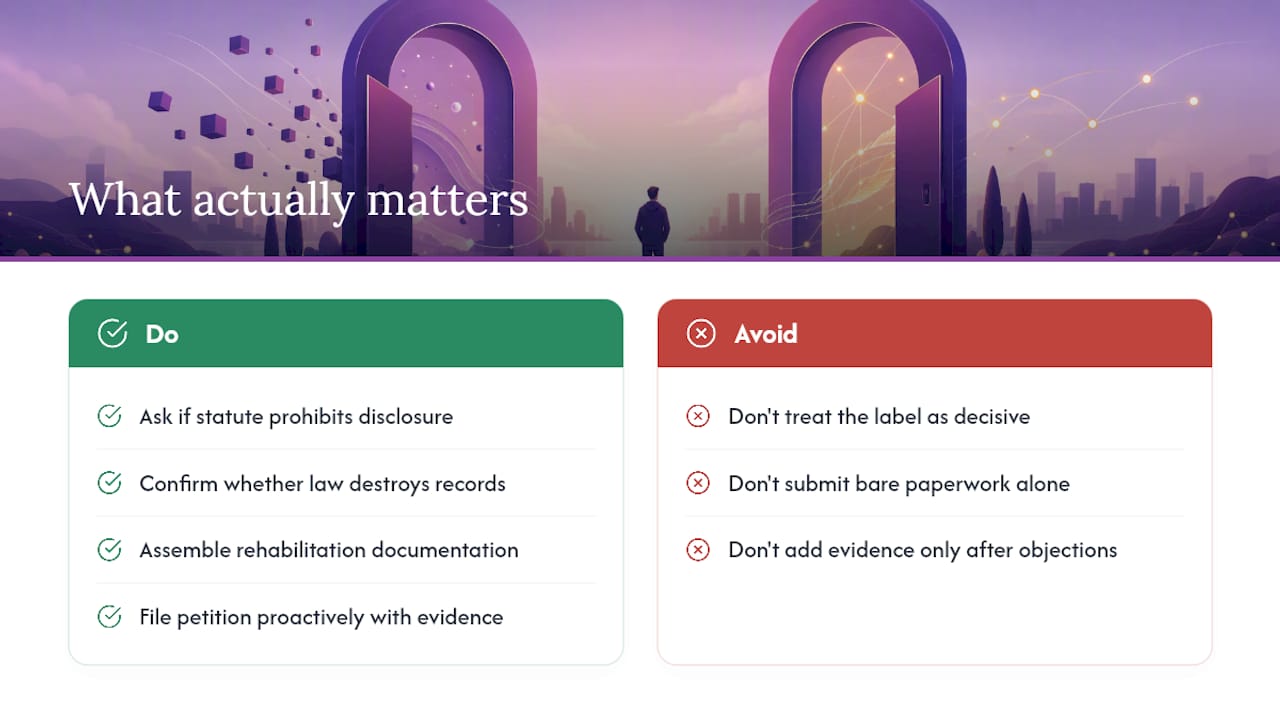
What conventional advice underweights is documentation. People treat filing a petition like paperwork, when the strongest petitions read more like a rehabilitation case file, employment records, program completions, character letters, filed proactively rather than added after a prosecutor objects.
If you take one thing from this: stop asking "is this expungement or sealing?" and start asking "does this statute prohibit disclosure, or does it destroy the record, and who's exempt from either?" That question gets you closer to the truth than any glossary will.
Frequently Asked Questions
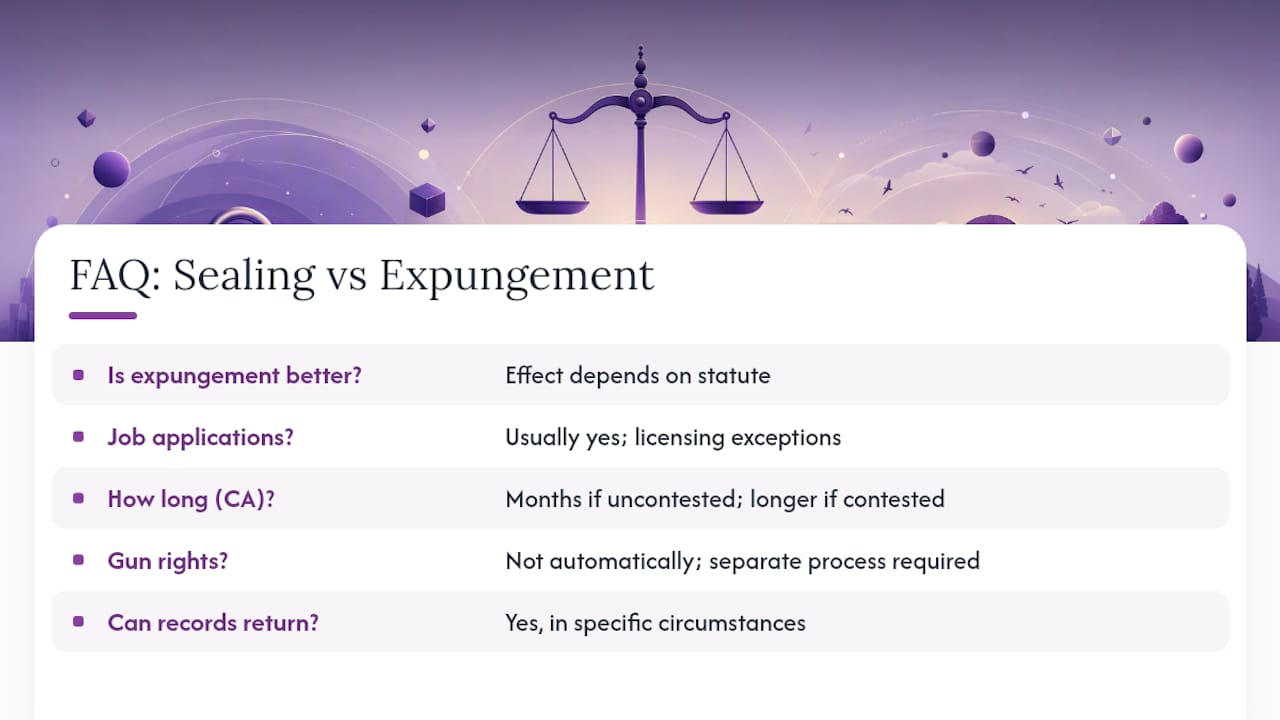
Is expungement always better than sealing? Not necessarily. A well-drafted sealing statute can restrict access nearly as effectively as an expungement statute that still allows law enforcement retrieval. The statute's actual effect matters more than its name.
Can I lawfully deny a sealed or expunged record on a job application? Usually yes, once the order is final, though licensing boards and certain regulated employers may still see it depending on your state and industry.
How long does record sealing or expungement take in California? Uncontested petitions often resolve within a few months; contested cases or those requiring a hearing can take significantly longer, particularly if the prosecutor objects.
Does sealing or expungement restore my gun rights? Not automatically in most states. Firearm restoration frequently requires a separate legal process, even after a record is sealed or expunged.
Can a sealed or expunged record ever come back? Yes, in specific circumstances, such as a subsequent offense triggering unsealing, or agencies with statutory access using the record for sentencing enhancement in a later case.
This article is general information, not a substitute for advice from a qualified lawyer. Consult a qualified legal professional about your own circumstances before acting on anything here.
Sources
Start with the NCSL terminology snapshot for a plain-language rundown of how states differ. The fifty-state PCE survey is the deepest single reference for comparing statutes side by side, and FindLaw's eligibility overview breaks down common qualifying factors state by state.
For step-by-step filing help, Illinois Legal Aid's expungement and sealing guide is a solid model for how state self-help sites present the process, and California's own court self-help petition materials show what a real petition packet looks like. The Lydon Law blog also covers state-level sealing and expungement comparisons worth a look if you're researching outside California. Cross-reference whatever you find against your own state's actual statute before assuming it applies to you.
- Expungement and sealing: 50-state overview (PCE)
- Expungement eligibility overview — FindLaw
- Criminal record clearing: The terminology — NCSL