
An arrest with no charges filed in California does not disappear on its own. The record stays in state criminal justice databases and shows up on background checks until you take action under statutes like Penal Code §851.91. The good news: California's Clean Slate laws now provide automatic sealing in many of these situations, and for cases that don't qualify automatically, the DOJ's BCIA-8270 petition form gives you a clear path to petition for sealing and destruction of the record.
Your first move is to pull your DOJ RAP sheet and confirm exactly what's on file before you do anything else.
Gather these before you file:
- Your DOJ RAP sheet (criminal history record)
- The arrest date and booking number
- Your court case number or docket (if charges were filed and dismissed)
- Any dismissal paperwork, diversion completion certificates, or acquittal orders
- A government-issued photo ID
Pro Tip: Order your RAP sheet through the California DOJ's record review process before filing any petition. Errors on your RAP sheet — wrong disposition codes, missing dismissal entries — can stall or sink a sealing request if you don't catch and correct them first.
Key Takeaways
California arrests with no charges filed can be sealed or destroyed under PC §851.91, with Clean Slate laws providing automatic relief after statutory waiting periods and the BCIA-8270 petition available for cases that require direct action.
| Point | Details |
|---|---|
| Verify your RAP sheet first | Order your DOJ criminal history record and confirm the disposition field is accurate before filing anything. |
| Check Clean Slate automatic eligibility | Misdemeanor no-conviction arrests are often eligible after one year; many felony no-file cases after three years under SB 731. |
| Use BCIA-8270 for petitions | The official DOJ form for sealing adult arrest records with no charges or dismissed charges; file with the superior court in the county of arrest. |
| Sealing limits remain | Sealed records stay accessible to law enforcement, some licensing boards, and federal immigration authorities. |
| Rubin Law, P.C. handles contested cases | Complex petitions, RAP sheet errors, factual innocence motions, and prosecutor objections benefit from attorney representation in Los Angeles County. |
Table of Contents
- What arrests with no charges filed in California qualify for sealing?
- How do you seal an arrest record when no charges were filed?
- How long does sealing take after no charges in California?
- How to get your RAP sheet and fix errors before you petition
- What sealing actually does — and what it does not do
- Special situations: diversion, factual innocence, juvenile records, and dismissals
- When does hiring an attorney make sense for a sealing case?
- What we see in practice at Rubin Law
- Rubin Law, P.C. can review your arrest record and file for sealing
- Sources
What arrests with no charges filed in California qualify for sealing?
California law covers several distinct outcomes under its sealing and Clean Slate statutes. Knowing which category your arrest falls into determines whether you get automatic relief or need to petition.
Covered categories under PC §851.91 and related statutes:
- Arrested but no charges were ever filed
- Charged but the case was dismissed (California case dismissal)
- Completed a diversion program (including PC §1000 drug diversion or Prop 36)
- Deferred Entry of Judgment (DEJ) dismissed
- Acquitted at trial (not guilty verdict)
California's Clean Slate legislation, including SB 731, AB 1076, AB 145, and AB 168, expanded automatic sealing to cover many of these outcomes after statutory waiting periods. Under automatic relief, the DOJ processes eligible records without requiring you to file a petition. The DOJ's automatic record relief guidance explains how Penal Code §851.93 interacts with the automatic process for arrests that did not result in conviction.
Who needs to petition instead of waiting for automatic relief?
Not every eligible arrest gets automatic sealing. If your arrest predates the Clean Slate implementation dates, if the DOJ's records show an incorrect disposition, or if your case involves a more complex outcome (such as a partial dismissal or a charge that was reduced), you will likely need to file a petition.
Statutory exclusions you need to know
Several categories are excluded from sealing relief entirely or face significant restrictions:
- Serious or violent felonies listed under PC §667.5(c) and PC §1192.7(c)
- Sexual offenses requiring registration under PC §290
- Domestic violence offenses in certain circumstances
- Cases where the arrest led to a conviction on a different charge
- Records subject to federal holds or federal background check systems
Even after sealing, certain licensing boards (nursing, teaching, law enforcement) and immigration authorities may still access sealed records in defined circumstances. That access does not disappear with a state seal.
California's Clean Slate Community of Practice implementation guidance notes that automatic sealing covers a broad range of non-conviction outcomes, but the exclusions for serious and sexual offenses are firm statutory limits, not discretionary.
How do you seal an arrest record when no charges were filed?
There are two routes: automatic sealing under Clean Slate, and a petition you file yourself. Most people whose arrests are recent and clearly documented will eventually get automatic relief, but the petition route is faster and more reliable when you need the record cleared now.
Automatic sealing: what triggers it and what you do
Under PC §851.93 and the Clean Slate framework, the DOJ is supposed to identify eligible arrests and seal them automatically after the applicable waiting period. You do not file anything. The DOJ flags the record, processes it, and updates the RAP sheet.
The practical reality: automatic processing depends on the DOJ having accurate disposition data. If your case was dismissed but the court never transmitted that disposition to the DOJ, the automatic system may never trigger. That's why checking your RAP sheet first matters so much.
Petition route: step-by-step
- Order your RAP sheet. Submit a fingerprint-based request through the California DOJ's record review and fingerprinting process. This is the authoritative record of what the state has on file.
- Obtain your court records. Pull the case docket from the superior court where the arrest originated. You can do this online through the court's public portal or in person at the clerk's office.
- Complete the BCIA-8270. The DOJ Petition to Seal and Destroy Adult Arrest Records (BCIA-8270) is the official form for cases where no charges were filed or charges were dismissed. Fill it out completely; incomplete forms are the most common reason for rejection.
- Assemble supporting documents. Attach your dismissal order or proof that no charges were filed (a letter from the DA's office or a court docket showing no complaint was filed), a copy of your RAP sheet, and a government-issued ID.
- Request a fee waiver if eligible. If you cannot afford the filing fee, request a fee waiver using the court's standard fee waiver form (FW-001) when filing with the court, or note financial hardship in your DOJ submission.
- File with the correct agency. Petitions under PC §851.91 go to the superior court in the county where the arrest occurred. The court then notifies the DOJ. Some petitions go directly to the DOJ depending on the specific relief sought.
- Serve the prosecuting agency. You must serve a copy of the petition on the DA's office or city attorney that had jurisdiction. They have the right to object.
- Attend any hearing. If the prosecutor objects, the court schedules a hearing. Bring all documentation and be prepared to show you meet the statutory criteria.
Common forms by name and purpose:
- BCIA-8270: DOJ petition to seal and destroy adult arrest records (no charges or dismissed charges)
- FW-001: Fee waiver application for court filing fees
- RAP sheet request: Fingerprint-based criminal history request through the DOJ
- CIV-110: Request for Dismissal (relevant when a civil settlement accompanies a criminal dismissal)
- Local court sealing petition forms (varies by county — check the superior court's self-help center)
Pro Tip: The California Courts Self-Help pages on record cleaning include county-specific form links. Los Angeles Superior Court, for example, has its own local forms that supplement the DOJ petition. Always check the specific court's self-help center before filing.
How long does sealing take after no charges in California?
Clean Slate automatic sealing and petition processing run on very different clocks. Knowing the difference prevents you from waiting years for relief that requires a petition.
Clean Slate statutory waiting periods
Under SB 731 and related legislation, the general waiting periods before automatic sealing eligibility are:
- Misdemeanor arrests with no conviction: typically one year from the date of arrest
- Felony arrests where no charges were filed or charges were dismissed: typically three years from the date of arrest (where the Clean Slate expansion applies)
These are eligibility thresholds, not processing guarantees. The DOJ must still identify and process the record after the waiting period passes.
Petition processing times
Once you file a BCIA-8270 petition with the court, the timeline depends on the county's caseload and whether the prosecutor objects. Uncontested petitions in most California counties move through in a few months. Contested petitions that require a hearing can take considerably longer.
The DOJ OpenJustice arrest data reflects the volume of arrests processed statewide, which gives context for why DOJ record updates can lag behind court orders. A court may grant your petition, but the DOJ RAP sheet update can take additional weeks.
| Stage | Typical Timeframe |
|---|---|
| RAP sheet order (fingerprint-based) | several weeks |
| Petition preparation and filing | 1–2 weeks (your time) |
| Court processing, uncontested | a few months |
| DOJ RAP sheet update after court order | several additional weeks |
| Automatic Clean Slate processing (after waiting period) | Varies; no guaranteed date |
Statistic context: California DOJ OpenJustice data for 2023 documents hundreds of thousands of adult arrests statewide annually. That volume directly affects how quickly the DOJ processes both automatic relief and petition-driven updates to RAP sheets.
When to follow up: If you have not received confirmation within 120 days of filing, contact the court clerk's office first to confirm the order was entered, then contact the DOJ's Bureau of Criminal Information and Analysis to verify the RAP sheet reflects the change.
How to get your RAP sheet and fix errors before you petition
Your DOJ RAP sheet is the foundation of any sealing effort. Filing a petition against an inaccurate RAP sheet is one of the most avoidable mistakes people make in this process.
How to order your RAP sheet:
- Submit a completed fingerprint card (Live Scan or ink-rolled) to the California DOJ through the record review process
- Pay the applicable processing fee (fee waivers may be available for those who qualify)
- Allow 2–4 weeks for the DOJ to return your criminal history record
What to review once you have it:
- Arrest date and agency: confirm it matches your actual arrest
- Charge codes: verify the listed offense matches what you were actually arrested for
- Disposition field: this is the most critical. It should show "no charges filed," "dismissed," "acquitted," or equivalent. A blank or incorrect disposition is a red flag.
- Booking number and case number: cross-reference these against your court docket
- Subsequent entries: confirm no unrelated arrests are mixed into your record
Errors appear most often in the disposition field. Courts transmit disposition data to the DOJ, but transmission failures happen. If your case was dismissed two years ago and the DOJ RAP sheet still shows "pending" or no disposition, the automatic Clean Slate system will not trigger.
Steps to correct errors:
- Obtain the court's official minute order or abstract of judgment showing the correct disposition
- Submit a written correction request to the DOJ's Bureau of Criminal Information and Analysis with the supporting court document
- Follow up with the originating court to confirm they transmitted the corrected data
- Request an updated RAP sheet after 30–60 days to confirm the fix
A corrected RAP sheet with the accurate disposition attached to your BCIA-8270 petition significantly strengthens the filing. It removes any ambiguity about whether the statutory criteria are met.
What sealing actually does — and what it does not do
Sealing an arrest record under PC §851.91 removes it from public access. That means standard employer background checks, tenant screening services, and most commercial databases will no longer show the arrest. You can legally state in most contexts that you were not arrested for the sealed offense.
But sealing is not erasure.
What remains accessible after sealing:
- Law enforcement agencies retain access for investigative and prosecutorial purposes
- Courts can access sealed records in subsequent criminal proceedings
- Certain licensing boards (medical, nursing, teaching, law enforcement, real estate in some circumstances) may still access sealed records under specific statutory exceptions
- Immigration authorities and federal agencies operate under federal law, which California's sealing statutes do not control
The immigration gap is significant. A California seal does not bind U.S. Citizenship and Immigration Services or immigration courts. If you are not a U.S. citizen, sealing your state record does not eliminate the arrest from federal immigration databases. This is one of the clearest situations where consulting an attorney before filing is worth the cost.
What "destroy" means in practice: When a court orders destruction of arrest records under PC §851.8 (factual innocence), the physical and digital records held by the arresting agency are supposed to be destroyed. In practice, some records persist in legacy systems or third-party databases that were populated before the destruction order. Periodic follow-up with background check companies to dispute residual entries is sometimes necessary.
When sealing is not enough: If your goal is to clear a record for federal employment, a peace officer position, or immigration purposes, a standard sealing petition under PC §851.91 may not accomplish what you need. A factual innocence petition under PC §851.8 carries more weight in some of these contexts but requires meeting a higher legal standard.
Pro Tip: If you are applying for a professional license after sealing, check the specific licensing board's disclosure rules before assuming the sealed record is invisible. The California Board of Registered Nursing and the Commission on Peace Officer Standards and Training, for example, have their own statutory access rights that survive a standard seal.
Special situations: diversion, factual innocence, juvenile records, and dismissals
Not every non-conviction outcome follows the standard BCIA-8270 path. Several special categories have their own procedures.
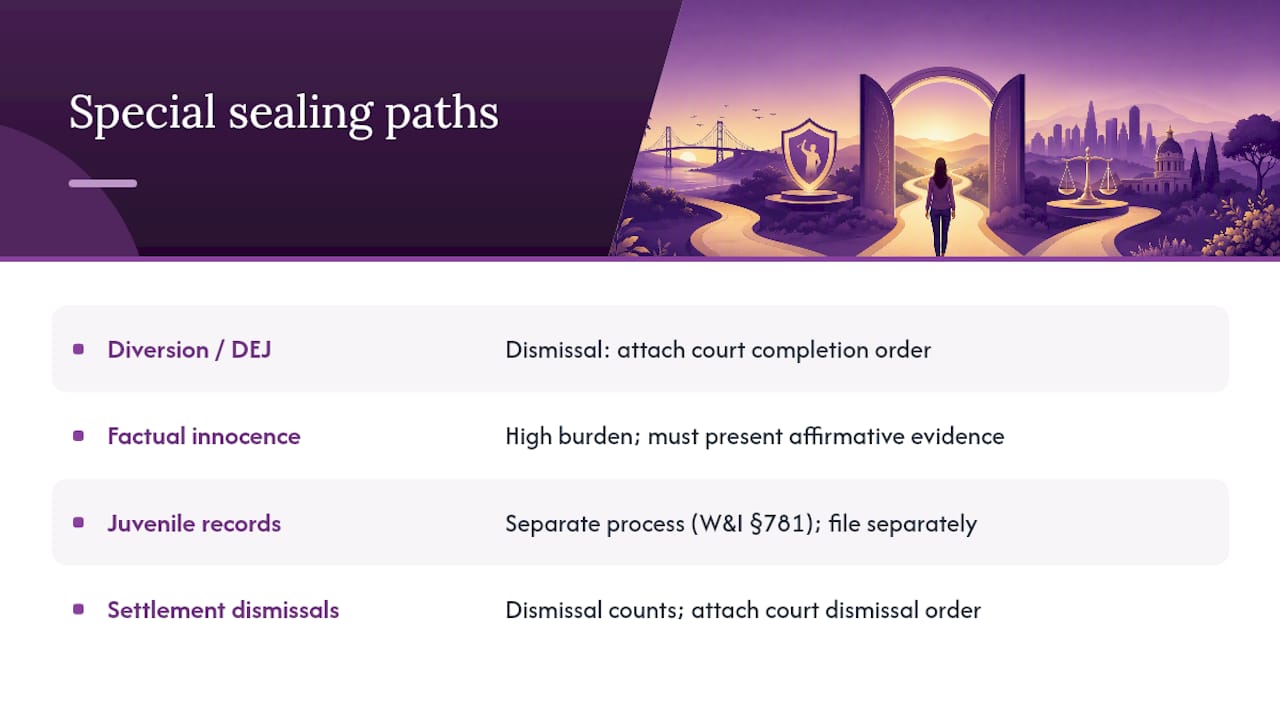
Diversion completions and DEJ dismissals:
When you complete a diversion program under PC §1000 or Prop 36, the charges are dismissed. That dismissal makes you eligible for sealing under the same framework as other dismissed cases. The key document to attach to your petition is the court's order confirming diversion completion and dismissal. For drug diversion cases under PC §1000, the court's completion order is the critical piece of evidence.
Factual innocence petitions (PC §851.8):
A factual innocence petition is a different animal. You are not just asking the court to seal a record because no charges were filed. You are asking a judge to find that there was no reasonable cause to believe you committed the offense. That requires affirmative evidence: witness statements, alibi documentation, forensic evidence, or proof of mistaken identity. The burden is on the petitioner, and the standard is higher than the routine sealing petition. If granted, the court orders the record sealed and destroyed, and you can state you were never arrested. This is the most complete form of relief California offers.
Juvenile records:
Juvenile arrest records follow a separate statutory path under Welfare and Institutions Code §781. The petition process, eligibility rules, and sealing effects differ from adult records. If you have a juvenile record alongside an adult arrest, the two petitions must be filed separately and in the correct courts.
Dismissals after civil settlement:
When a criminal case is dismissed as part of a civil settlement, the dismissal is still a dismissal for sealing purposes. Attach the court's dismissal order (and the CIV-110 or equivalent form if applicable) to your petition. The civil settlement agreement itself is generally not relevant to the criminal sealing petition.
When does hiring an attorney make sense for a sealing case?
The self-help route works for straightforward cases: one arrest, no charges filed, clean RAP sheet, no exclusions. Add any complexity and the calculus shifts quickly.
Situations where legal counsel is worth it:
- Your RAP sheet has errors that the DOJ has not corrected after your own attempts
- The arrest involved a serious or potentially excluded offense and you are unsure whether you qualify
- You are not a U.S. citizen and immigration consequences are a concern
- The prosecutor has objected or is likely to object to your petition
- You need a factual innocence finding, not just a standard seal
- You have multiple arrests across different counties
- A licensing board or employer is already asking about the arrest
What an attorney actually does in these cases:
A criminal defense attorney handles the BCIA-8270 filing and any supporting legal briefs, negotiates with the DA's office when objections arise, prepares factual innocence motions with the evidentiary record those motions require, tracks RAP sheet corrections through the DOJ, and represents you at any hearing. The difference between a contested petition handled by counsel and one handled pro se is often the difference between a granted petition and a denied one.

Timing matters for retention. If you wait until the prosecutor has already filed an objection, your attorney is playing catch-up. Retaining counsel before filing gives them the chance to assess whether the petition is strong enough to survive objection or whether additional evidence needs to be gathered first.
Pro Tip: Preserve all documentation related to your arrest now, even if you are not ready to file. Police reports, booking sheets, DA declination letters, and any correspondence from the court are harder to obtain years later and are exactly what a factual innocence motion or contested petition will need.
What we see in practice at Rubin Law
The cases that stall most often are not the ones with complicated legal questions. They are the ones where the RAP sheet disposition is blank or wrong, and the person filing did not catch it before submitting the petition. The DOJ returns the petition, weeks pass, and the person has to start over.
The second most common problem is misidentifying the correct relief. Someone whose case was dismissed after diversion files under the wrong statute, or someone who genuinely qualifies for a factual innocence finding settles for a standard seal that does not accomplish what they actually need. California's self-help guidance is clear that legal help is recommended when the process gets complex, and that recommendation is not just a disclaimer.
Early action consistently produces better outcomes. Waiting periods run from the arrest date, not from when you decide to act. The sooner you verify your RAP sheet and confirm your eligibility category, the sooner the clock is confirmed to be running in your favor.
Rubin Law, P.C. can review your arrest record and file for sealing
Clearing an arrest record in California is procedurally specific. The wrong form, a missed exclusion, or an unresolved RAP sheet error can set the process back by months. Rubin Law, P.C. handles the full scope of this work for clients in Los Angeles County: RAP sheet review, BCIA-8270 preparation and filing, factual innocence petitions, DOJ correction requests, and court representation when prosecutors object.
The firm's criminal defense practice covers the full range of California criminal laws, and the same attorneys who handle pre-file intervention and diversion programs handle sealing petitions. That continuity matters when your case history is part of what needs to be addressed. Bring your RAP sheet, your arrest date, and any paperwork you have from the case. If you do not have those yet, the intake process starts with helping you get them.
Schedule a consultation with Rubin Law, P.C. in Los Angeles County to get a direct assessment of your eligibility and a clear plan for what to file and when.
Sources
These are the primary documents and pages to use at each stage of the process.
- Record cleaning: Arrest with no conviction | California Courts | Self Help Guide
- Clean your record | California Courts | Self Help Guide
- BCIA-8270 Petition to Seal and Destroy Adult Arrest Records — California DOJ (form PDF)
- SB 731 bill text — California Legislature
- Arrest mandated stats 2023 — OpenJustice (California DOJ)
This article is general information, not a substitute for advice from a qualified lawyer. Consult a qualified legal professional about your own circumstances before acting on anything here.